Claude Code: Preview, Review & Merge Without Tool-Switching

Claude Code: Preview, Review & Merge Without Tool-Switching
Claude

20 feb 2026

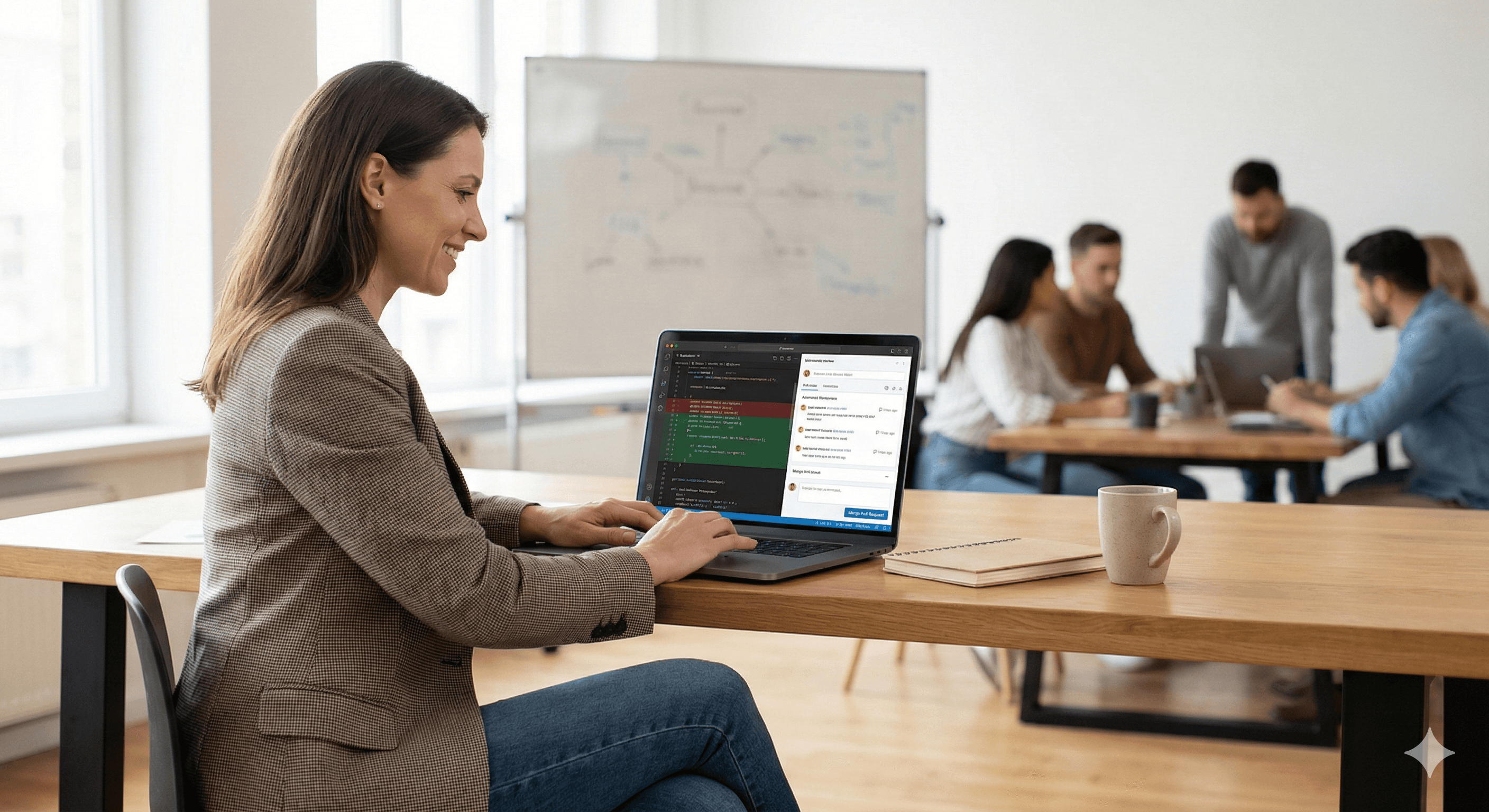
A woman in a gray blazer uses a laptop displaying a code preview interface, seated at a wooden table with a notebook and coffee cup, while four colleagues collaborate in the background.

¿No sabes por dónde empezar con la IA?
Evalúa preparación, riesgos y prioridades en menos de una hora.

¿No sabes por dónde empezar con la IA?
Evalúa preparación, riesgos y prioridades en menos de una hora.

➔ Descarga nuestro paquete gratuito de preparación para IA

Claude Code’s desktop app now supports an end-to-end workflow from coding to merging: preview your running app, review changes in a visual diff, generate automated review notes, and monitor GitHub pull requests and CI checks in one place. For teams, it reduces tool-switching and speeds up review cycles—while keeping merge decisions auditable.

Most teams don’t lose time because they can’t write code. They lose time in the gaps: switching between editor, terminal, preview, PR, CI checks, review comments, and merge approvals.

Anthropic’s latest update to Claude Code on desktop aims to close that loop. You can now preview, review, and merge without bouncing between tools—using a single desktop workflow that brings together live previews, diff review, automated review notes, and PR monitoring.

This article explains what’s new, how the workflow fits modern GitHub-based teams, and how to roll it out safely.

What’s new in Claude Code: preview, review and merge in one place

According to Anthropic’s release notes and documentation, Claude Code desktop now supports:

1) Live app preview

Run your application and preview it directly from the desktop workflow—useful when you want quick feedback without jumping to separate browser windows or complex local setups.

2) Visual diff review

When Claude makes changes across your repo, you can review them file-by-file in a dedicated diff view (with line additions/removals and inline commenting). This makes it easier to sanity-check multi-file edits before you open a pull request.

3) Automated review of diffs

Claude can produce review notes against a changeset: likely issues, risky patterns, missing tests, and style concerns—so you get an early quality pass before a teammate even sees the PR.

4) GitHub pull request monitoring (plus auto-merge)

From the desktop app, you can monitor PR status and checks. With auto-merge enabled, Claude can merge once required checks pass (and in some workflows, attempt to resolve failing checks when you’ve explicitly enabled auto-fix).

The point isn’t to remove human judgement. The point is to remove needless friction.

Why this matters: the fastest way to speed up engineering is to speed up review

For many teams, the slowest step is no longer coding—it’s the review cycle:

  • slow feedback on whether a change works

  • noisy diffs that hide the important decisions

  • PR checks that fail after a reviewer has already spent time

  • context switching between tools and threads

A preview → diff → review → PR → CI → merge loop in one place helps because it:

  • reduces handoffs and waiting

  • improves the signal-to-noise ratio in changes

  • catches basic issues earlier (before the PR becomes a bottleneck)

Practical steps: how to adopt Claude Code safely

Step 1: Decide where Claude can help (and where it can’t)

Start with a clear policy:

  • Good candidates: refactors, small features, bug fixes, documentation, test scaffolding, CI triage

  • Handle carefully: auth flows, payments, encryption, permission models, safety-critical logic

Step 2: Standardise the review prompts

Treat automated review as a repeatable checklist. Example prompts:

  • “Review this diff for security issues, permission mistakes, and secrets.”

  • “Flag breaking changes and missing migrations.”

  • “List test gaps and suggest specific test cases.”

  • “Summarise risk: what could go wrong in production?”

Step 3: Make diffs smaller by default

Claude is most useful when PRs are reviewable. Encourage:

  • one PR per change

  • clear commit messages

  • PR templates that capture risk and tests

Step 4: Keep auto-merge behind guardrails

Auto-merge can be brilliant—but only when your engineering system is healthy.

Guardrails to consider:

  • branch protection rules

  • required reviews for high-risk paths

  • required CI checks and test coverage thresholds

  • ownership rules (CODEOWNERS)

Step 5: Use preview as your fast feedback loop

Preview early for UX/UI changes and app behaviour. If it doesn’t look right in preview, don’t burn reviewer time.

Day-to-day examples

Example A: Fix a bug without a context-switch marathon

  1. Ask Claude to reproduce and propose a fix

  2. Review the multi-file diff in the desktop diff view

  3. Generate an automated review note focused on edge cases

  4. Open the PR and monitor CI

  5. Merge once checks pass (or fix failing checks before it hits a teammate)

Example B: Reduce review load on the team

  1. Ask Claude to suggest tests based on the diff

  2. Run the tests and preview the change

  3. Post Claude’s review summary as a PR comment

  4. Let reviewers focus on architecture and product intent

Where Generation Digital helps

If you’re rolling AI assistants into engineering workflows, the key question isn’t “can it write code?”—it’s “can we use it with control?”

Generation Digital supports teams with:

  • governance and safe-by-default workflows for AI-assisted development

  • review/merge guardrails that still keep velocity high

  • enablement so teams get consistent outcomes (not prompt lottery)

Summary

Claude Code’s new desktop workflow brings preview, diff review, automated review notes, PR monitoring, and auto-merge into one place. Used well, it reduces tool-switching, improves review quality, and shortens the cycle from “code written” to “code shipped”.

Next steps

  1. Pilot with one repo and a well-defined change type (bug fixes or refactors).

  2. Define your review prompt templates and merge guardrails.

  3. Measure impact: lead time to merge, CI failure rate, review time, defect rate.

  4. If you want help designing a safe rollout, contact Generation Digital.

FAQs

Q1: How does Claude Code improve coding efficiency?
A: By bringing preview, diff review, automated review notes, PR monitoring and merging into one workflow, it reduces context switching and shortens the path from change to deployment.

Q2: Is Claude Code only available on desktop?
A: Claude Code is available in multiple surfaces, including terminal and IDE. The preview/review/merge workflow described here is specifically part of the desktop experience.

Q3: What makes Claude Code different from other coding tools?
A: It’s designed as an agentic workflow: it can read and modify your codebase, show a visual diff for review, and integrate with PR workflows so teams can move from coding to merge with fewer tool handoffs.

Q4: Is auto-merge safe to use?
A: It can be safe if your repo has strong branch protections, required checks, and clear ownership rules. Treat it as an automation layer, not a substitute for engineering judgement.

Q5: What should we review manually even with automated reviews?
A: Architecture decisions, security-sensitive changes (auth, payments, permissions), and anything affecting customer-facing behaviour or compliance should still get human review.

Claude Code’s desktop app now supports an end-to-end workflow from coding to merging: preview your running app, review changes in a visual diff, generate automated review notes, and monitor GitHub pull requests and CI checks in one place. For teams, it reduces tool-switching and speeds up review cycles—while keeping merge decisions auditable.

Most teams don’t lose time because they can’t write code. They lose time in the gaps: switching between editor, terminal, preview, PR, CI checks, review comments, and merge approvals.

Anthropic’s latest update to Claude Code on desktop aims to close that loop. You can now preview, review, and merge without bouncing between tools—using a single desktop workflow that brings together live previews, diff review, automated review notes, and PR monitoring.

This article explains what’s new, how the workflow fits modern GitHub-based teams, and how to roll it out safely.

What’s new in Claude Code: preview, review and merge in one place

According to Anthropic’s release notes and documentation, Claude Code desktop now supports:

1) Live app preview

Run your application and preview it directly from the desktop workflow—useful when you want quick feedback without jumping to separate browser windows or complex local setups.

2) Visual diff review

When Claude makes changes across your repo, you can review them file-by-file in a dedicated diff view (with line additions/removals and inline commenting). This makes it easier to sanity-check multi-file edits before you open a pull request.

3) Automated review of diffs

Claude can produce review notes against a changeset: likely issues, risky patterns, missing tests, and style concerns—so you get an early quality pass before a teammate even sees the PR.

4) GitHub pull request monitoring (plus auto-merge)

From the desktop app, you can monitor PR status and checks. With auto-merge enabled, Claude can merge once required checks pass (and in some workflows, attempt to resolve failing checks when you’ve explicitly enabled auto-fix).

The point isn’t to remove human judgement. The point is to remove needless friction.

Why this matters: the fastest way to speed up engineering is to speed up review

For many teams, the slowest step is no longer coding—it’s the review cycle:

  • slow feedback on whether a change works

  • noisy diffs that hide the important decisions

  • PR checks that fail after a reviewer has already spent time

  • context switching between tools and threads

A preview → diff → review → PR → CI → merge loop in one place helps because it:

  • reduces handoffs and waiting

  • improves the signal-to-noise ratio in changes

  • catches basic issues earlier (before the PR becomes a bottleneck)

Practical steps: how to adopt Claude Code safely

Step 1: Decide where Claude can help (and where it can’t)

Start with a clear policy:

  • Good candidates: refactors, small features, bug fixes, documentation, test scaffolding, CI triage

  • Handle carefully: auth flows, payments, encryption, permission models, safety-critical logic

Step 2: Standardise the review prompts

Treat automated review as a repeatable checklist. Example prompts:

  • “Review this diff for security issues, permission mistakes, and secrets.”

  • “Flag breaking changes and missing migrations.”

  • “List test gaps and suggest specific test cases.”

  • “Summarise risk: what could go wrong in production?”

Step 3: Make diffs smaller by default

Claude is most useful when PRs are reviewable. Encourage:

  • one PR per change

  • clear commit messages

  • PR templates that capture risk and tests

Step 4: Keep auto-merge behind guardrails

Auto-merge can be brilliant—but only when your engineering system is healthy.

Guardrails to consider:

  • branch protection rules

  • required reviews for high-risk paths

  • required CI checks and test coverage thresholds

  • ownership rules (CODEOWNERS)

Step 5: Use preview as your fast feedback loop

Preview early for UX/UI changes and app behaviour. If it doesn’t look right in preview, don’t burn reviewer time.

Day-to-day examples

Example A: Fix a bug without a context-switch marathon

  1. Ask Claude to reproduce and propose a fix

  2. Review the multi-file diff in the desktop diff view

  3. Generate an automated review note focused on edge cases

  4. Open the PR and monitor CI

  5. Merge once checks pass (or fix failing checks before it hits a teammate)

Example B: Reduce review load on the team

  1. Ask Claude to suggest tests based on the diff

  2. Run the tests and preview the change

  3. Post Claude’s review summary as a PR comment

  4. Let reviewers focus on architecture and product intent

Where Generation Digital helps

If you’re rolling AI assistants into engineering workflows, the key question isn’t “can it write code?”—it’s “can we use it with control?”

Generation Digital supports teams with:

  • governance and safe-by-default workflows for AI-assisted development

  • review/merge guardrails that still keep velocity high

  • enablement so teams get consistent outcomes (not prompt lottery)

Summary

Claude Code’s new desktop workflow brings preview, diff review, automated review notes, PR monitoring, and auto-merge into one place. Used well, it reduces tool-switching, improves review quality, and shortens the cycle from “code written” to “code shipped”.

Next steps

  1. Pilot with one repo and a well-defined change type (bug fixes or refactors).

  2. Define your review prompt templates and merge guardrails.

  3. Measure impact: lead time to merge, CI failure rate, review time, defect rate.

  4. If you want help designing a safe rollout, contact Generation Digital.

FAQs

Q1: How does Claude Code improve coding efficiency?
A: By bringing preview, diff review, automated review notes, PR monitoring and merging into one workflow, it reduces context switching and shortens the path from change to deployment.

Q2: Is Claude Code only available on desktop?
A: Claude Code is available in multiple surfaces, including terminal and IDE. The preview/review/merge workflow described here is specifically part of the desktop experience.

Q3: What makes Claude Code different from other coding tools?
A: It’s designed as an agentic workflow: it can read and modify your codebase, show a visual diff for review, and integrate with PR workflows so teams can move from coding to merge with fewer tool handoffs.

Q4: Is auto-merge safe to use?
A: It can be safe if your repo has strong branch protections, required checks, and clear ownership rules. Treat it as an automation layer, not a substitute for engineering judgement.

Q5: What should we review manually even with automated reviews?
A: Architecture decisions, security-sensitive changes (auth, payments, permissions), and anything affecting customer-facing behaviour or compliance should still get human review.

Recibe noticias y consejos sobre IA cada semana en tu bandeja de entrada

Al suscribirte, das tu consentimiento para que Generation Digital almacene y procese tus datos de acuerdo con nuestra política de privacidad. Puedes leer la política completa en gend.co/privacy.


Próximos talleres y seminarios web

A diverse group of professionals collaborating around a table in a bright, modern office setting.

Claridad Operacional a Gran Escala - Asana

Webinar Virtual
Miércoles 25 de febrero de 2026
En línea

A diverse group of professionals collaborating around a table in a bright, modern office setting.

Trabaja con compañeros de equipo de IA - Asana

Taller Presencial
Jueves 26 de febrero de 2026
Londres, Reino Unido

A diverse group of professionals collaborating around a table in a bright, modern office setting.

De Idea a Prototipo: IA en Miro

Seminario Web Virtual
Miércoles 18 de febrero de 2026
En línea

Generación
Digital

Oficina en Reino Unido

Generation Digital Ltd
33 Queen St,
Londres
EC4R 1AP
Reino Unido

Oficina en Canadá

Generation Digital Americas Inc
181 Bay St., Suite 1800
Toronto, ON, M5J 2T9
Canadá

Oficina en EE. UU.

Generation Digital Américas Inc
77 Sands St,
Brooklyn, NY 11201,
Estados Unidos

Oficina de la UE

Software Generación Digital
Edificio Elgee
Dundalk
A91 X2R3
Irlanda

Oficina en Medio Oriente

6994 Alsharq 3890,
An Narjis,
Riad 13343,
Arabia Saudita
UK Fast Growth Index UBS Logo
Financial Times FT 1000 Logo
Febe Growth 100 Logo (Background Removed)

Número de la empresa: 256 9431 77 | Derechos de autor 2026 | Términos y Condiciones | Política de Privacidad

Generación
Digital

Oficina en Reino Unido

Generation Digital Ltd
33 Queen St,
Londres
EC4R 1AP
Reino Unido

Oficina en Canadá

Generation Digital Americas Inc
181 Bay St., Suite 1800
Toronto, ON, M5J 2T9
Canadá

Oficina en EE. UU.

Generation Digital Américas Inc
77 Sands St,
Brooklyn, NY 11201,
Estados Unidos

Oficina de la UE

Software Generación Digital
Edificio Elgee
Dundalk
A91 X2R3
Irlanda

Oficina en Medio Oriente

6994 Alsharq 3890,
An Narjis,
Riad 13343,
Arabia Saudita
UK Fast Growth Index UBS Logo
Financial Times FT 1000 Logo
Febe Growth 100 Logo (Background Removed)


Número de Empresa: 256 9431 77
Términos y Condiciones
Política de Privacidad
Derechos de Autor 2026