Ericsson + Mistral AI: Practical AI for Telecom Networks

Ericsson + Mistral AI: Practical AI for Telecom Networks

Mistral
23 feb 2026

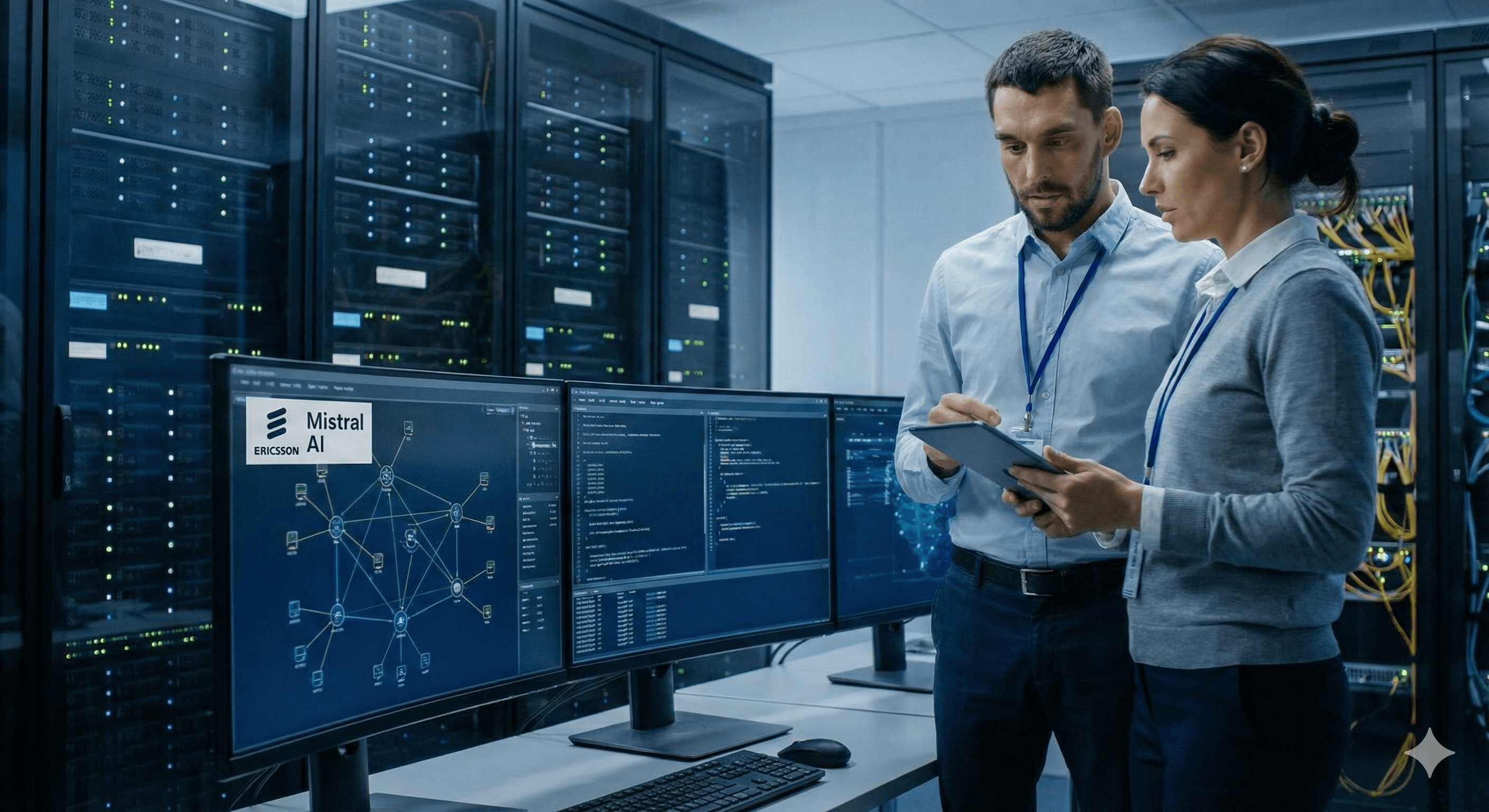
In a modern server room, two professionals examine data on a tablet while multiple monitors display network analytics under the banner "Ericsson + Mistral AI," highlighting the integration of advanced AI technologies in telecom networks.

¿No sabes por dónde empezar con la IA?
Evalúa preparación, riesgos y prioridades en menos de una hora.

¿No sabes por dónde empezar con la IA?
Evalúa preparación, riesgos y prioridades en menos de una hora.

➔ Descarga nuestro paquete gratuito de preparación para IA

In February 2026, Ericsson and Mistral AI announced a partnership to apply customised AI models to telecom challenges, with Ericsson acting as a design partner. The collaboration targets high-impact use cases including automation of legacy code translation, AI-assisted development for 6G research, and custom AI agents for complex workflows in Ericsson’s Networks organisation—aiming for secure, resilient, carrier‑grade outcomes.

Telecom has always been an engineering-first industry — and it has always been constrained by complexity.

Networks are distributed, reliability targets are unforgiving, and modernisation often means working around decades of legacy systems. That’s why the most valuable AI in telecom won’t be “generic AI”. It will be domain‑tuned, carrier‑grade AI that understands the realities of networks, operations, and software lifecycle.

That’s the premise behind the new Mistral AI and Ericsson partnership, announced in February 2026. The two companies say they will co‑develop AI models and agents tailored to Ericsson’s data and engineering environment, with the stated goal of making networks smarter, more efficient, and more trusted.

What’s been announced (and who is doing what)

Ericsson and Mistral AI describe the partnership as a blend of complementary strengths:

  • Mistral AI: model customisation capabilities and foundation model tooling

  • Ericsson: telecom R&D and deep network expertise, validated at global scale

A notable detail in the announcement is that Ericsson acts as a design partner — signalling this is intended to be applied work against real engineering and network challenges, not a loose “innovation lab” arrangement.

The target use cases: where AI delivers measurable value

The release names three concrete areas — and they’re revealing, because they map to the biggest bottlenecks telecom faces.

1) Automating legacy code translation

Telecom software stacks often include long-lived code in older languages and frameworks.

AI-assisted translation and refactoring can:

  • speed modernisation

  • reduce manual rework

  • support consistent testing and documentation

Done well, this shortens the time between “we need to migrate” and “we’ve shipped safely”.

2) AI-assisted development for 6G research

R&D timelines are long, and research teams juggle simulations, model experimentation, and complex documentation.

AI support here is less about writing code from scratch and more about:

  • accelerating exploration

  • summarising and testing hypotheses

  • improving iteration speed across research artefacts

3) Custom AI agents for complex network workflows

The announcement describes joint work on AI agents tailored to Ericsson’s Networks organisation.

In practice, carrier-grade agent use cases typically include:

  • troubleshooting and incident response support

  • change planning and impact analysis

  • documentation and knowledge retrieval

  • workflow orchestration across tools (with strict guardrails)

The important caveat: telecom agents must be designed with reliability and safety controls from day one.

Why “carrier-grade AI” needs a different approach

Telecom differs from many enterprise AI contexts:

  • Reliability targets are strict (downtime is expensive and reputationally damaging)

  • Security is non‑negotiable (networks are critical infrastructure)

  • Data is sensitive and fragmented (customer, network, and operational data often sit in separate domains)

  • Automation risk is real (a single bad change can cascade)

That’s why the announcement emphasises a goal of “secure, high‑performing, and resilient telecom infrastructure” — a reminder that AI isn’t a bolt‑on. It becomes part of the system.

Practical steps: how telecom teams can adopt AI safely

If you’re an operator, vendor, or systems integrator, here’s a practical way to approach the same problem space.

Step 1: Choose the right first use cases

Prioritise areas with high labour cost and clear success metrics:

  • legacy code migration assistance

  • ticket/incident triage support

  • documentation and knowledge retrieval

  • test generation and regression support

Step 2: Bring your data closer to AI (with governance)

The release highlights “bringing data closer to AI.” In practice that means:

  • data classification (what’s sensitive?)

  • access controls and least privilege

  • audit logs for prompts, tool use, and outputs

  • evaluation datasets grounded in your environment

Step 3: Build an evaluation harness

Benchmarking for telco should include:

  • correctness and completeness

  • failure-mode behaviour (does it know when it’s unsure?)

  • security and privacy behaviour

  • latency and availability requirements

Step 4: Add guardrails before autonomy

For agentic workflows:

  • require confirmations for high-impact actions

  • restrict tool permissions by role

  • separate untrusted inputs (like tickets or logs) from instruction channels

  • test prompt-injection style attacks on the workflow

Where Generation Digital helps

Telecom AI succeeds when capability, governance and operations move together.

Generation Digital supports organisations with:

  • AI strategy and operating models for complex environments

  • governance and security guardrails for agentic workflows

  • evaluation frameworks that connect reliability, cost and customer outcomes

Summary

Ericsson and Mistral AI’s February 2026 partnership focuses on applying customised AI to practical telecom challenges: legacy code translation, AI-assisted development for 6G research, and carrier-grade AI agents for complex workflows. The stated ambition is not AI in isolation, but AI that improves network performance, resilience and trust — with telecom-grade security and reliability requirements.

Next steps

  1. Identify two high-value workflows (one software, one operations) to pilot.

  2. Define success metrics and evaluation tests before rollout.

  3. Implement governance guardrails and least-privilege access early.

  4. If you want support designing a carrier-grade AI operating model, contact Generation Digital.

FAQs

Q1: What is the Mistral AI and Ericsson partnership about?
A: It’s a collaboration to apply customised AI models and agents to telecom challenges, combining Mistral AI’s model tooling with Ericsson’s network R&D and carrier-grade expertise.

Q2: Which use cases are they targeting first?
A: The announcement highlights automation of legacy code translation, AI-assisted development for 6G research, and custom AI agents for complex workflows within Ericsson’s Networks organisation.

Q3: Why do telecom AI deployments need extra security and reliability?
A: Telecom networks are critical infrastructure with strict availability and security requirements. AI tools must be evaluated, governed and constrained to avoid unsafe automation.

Q4: What should telcos pilot first?
A: Start with bounded workflows like code modernisation assistance, test generation, knowledge retrieval, and incident triage support — where success metrics and guardrails are clear.

Q5: How do you measure whether AI is helping?
A: Track time-to-resolution, defect and regression rates, release cycle time, reliability metrics, and the model’s safety behaviour under uncertainty.

In February 2026, Ericsson and Mistral AI announced a partnership to apply customised AI models to telecom challenges, with Ericsson acting as a design partner. The collaboration targets high-impact use cases including automation of legacy code translation, AI-assisted development for 6G research, and custom AI agents for complex workflows in Ericsson’s Networks organisation—aiming for secure, resilient, carrier‑grade outcomes.

Telecom has always been an engineering-first industry — and it has always been constrained by complexity.

Networks are distributed, reliability targets are unforgiving, and modernisation often means working around decades of legacy systems. That’s why the most valuable AI in telecom won’t be “generic AI”. It will be domain‑tuned, carrier‑grade AI that understands the realities of networks, operations, and software lifecycle.

That’s the premise behind the new Mistral AI and Ericsson partnership, announced in February 2026. The two companies say they will co‑develop AI models and agents tailored to Ericsson’s data and engineering environment, with the stated goal of making networks smarter, more efficient, and more trusted.

What’s been announced (and who is doing what)

Ericsson and Mistral AI describe the partnership as a blend of complementary strengths:

  • Mistral AI: model customisation capabilities and foundation model tooling

  • Ericsson: telecom R&D and deep network expertise, validated at global scale

A notable detail in the announcement is that Ericsson acts as a design partner — signalling this is intended to be applied work against real engineering and network challenges, not a loose “innovation lab” arrangement.

The target use cases: where AI delivers measurable value

The release names three concrete areas — and they’re revealing, because they map to the biggest bottlenecks telecom faces.

1) Automating legacy code translation

Telecom software stacks often include long-lived code in older languages and frameworks.

AI-assisted translation and refactoring can:

  • speed modernisation

  • reduce manual rework

  • support consistent testing and documentation

Done well, this shortens the time between “we need to migrate” and “we’ve shipped safely”.

2) AI-assisted development for 6G research

R&D timelines are long, and research teams juggle simulations, model experimentation, and complex documentation.

AI support here is less about writing code from scratch and more about:

  • accelerating exploration

  • summarising and testing hypotheses

  • improving iteration speed across research artefacts

3) Custom AI agents for complex network workflows

The announcement describes joint work on AI agents tailored to Ericsson’s Networks organisation.

In practice, carrier-grade agent use cases typically include:

  • troubleshooting and incident response support

  • change planning and impact analysis

  • documentation and knowledge retrieval

  • workflow orchestration across tools (with strict guardrails)

The important caveat: telecom agents must be designed with reliability and safety controls from day one.

Why “carrier-grade AI” needs a different approach

Telecom differs from many enterprise AI contexts:

  • Reliability targets are strict (downtime is expensive and reputationally damaging)

  • Security is non‑negotiable (networks are critical infrastructure)

  • Data is sensitive and fragmented (customer, network, and operational data often sit in separate domains)

  • Automation risk is real (a single bad change can cascade)

That’s why the announcement emphasises a goal of “secure, high‑performing, and resilient telecom infrastructure” — a reminder that AI isn’t a bolt‑on. It becomes part of the system.

Practical steps: how telecom teams can adopt AI safely

If you’re an operator, vendor, or systems integrator, here’s a practical way to approach the same problem space.

Step 1: Choose the right first use cases

Prioritise areas with high labour cost and clear success metrics:

  • legacy code migration assistance

  • ticket/incident triage support

  • documentation and knowledge retrieval

  • test generation and regression support

Step 2: Bring your data closer to AI (with governance)

The release highlights “bringing data closer to AI.” In practice that means:

  • data classification (what’s sensitive?)

  • access controls and least privilege

  • audit logs for prompts, tool use, and outputs

  • evaluation datasets grounded in your environment

Step 3: Build an evaluation harness

Benchmarking for telco should include:

  • correctness and completeness

  • failure-mode behaviour (does it know when it’s unsure?)

  • security and privacy behaviour

  • latency and availability requirements

Step 4: Add guardrails before autonomy

For agentic workflows:

  • require confirmations for high-impact actions

  • restrict tool permissions by role

  • separate untrusted inputs (like tickets or logs) from instruction channels

  • test prompt-injection style attacks on the workflow

Where Generation Digital helps

Telecom AI succeeds when capability, governance and operations move together.

Generation Digital supports organisations with:

  • AI strategy and operating models for complex environments

  • governance and security guardrails for agentic workflows

  • evaluation frameworks that connect reliability, cost and customer outcomes

Summary

Ericsson and Mistral AI’s February 2026 partnership focuses on applying customised AI to practical telecom challenges: legacy code translation, AI-assisted development for 6G research, and carrier-grade AI agents for complex workflows. The stated ambition is not AI in isolation, but AI that improves network performance, resilience and trust — with telecom-grade security and reliability requirements.

Next steps

  1. Identify two high-value workflows (one software, one operations) to pilot.

  2. Define success metrics and evaluation tests before rollout.

  3. Implement governance guardrails and least-privilege access early.

  4. If you want support designing a carrier-grade AI operating model, contact Generation Digital.

FAQs

Q1: What is the Mistral AI and Ericsson partnership about?
A: It’s a collaboration to apply customised AI models and agents to telecom challenges, combining Mistral AI’s model tooling with Ericsson’s network R&D and carrier-grade expertise.

Q2: Which use cases are they targeting first?
A: The announcement highlights automation of legacy code translation, AI-assisted development for 6G research, and custom AI agents for complex workflows within Ericsson’s Networks organisation.

Q3: Why do telecom AI deployments need extra security and reliability?
A: Telecom networks are critical infrastructure with strict availability and security requirements. AI tools must be evaluated, governed and constrained to avoid unsafe automation.

Q4: What should telcos pilot first?
A: Start with bounded workflows like code modernisation assistance, test generation, knowledge retrieval, and incident triage support — where success metrics and guardrails are clear.

Q5: How do you measure whether AI is helping?
A: Track time-to-resolution, defect and regression rates, release cycle time, reliability metrics, and the model’s safety behaviour under uncertainty.

Recibe noticias y consejos sobre IA cada semana en tu bandeja de entrada

Al suscribirte, das tu consentimiento para que Generation Digital almacene y procese tus datos de acuerdo con nuestra política de privacidad. Puedes leer la política completa en gend.co/privacy.


Próximos talleres y seminarios web

A diverse group of professionals collaborating around a table in a bright, modern office setting.

Claridad Operacional a Gran Escala - Asana

Webinar Virtual
Miércoles 25 de febrero de 2026
En línea

A diverse group of professionals collaborating around a table in a bright, modern office setting.

Trabaja con compañeros de equipo de IA - Asana

Taller Presencial
Jueves 26 de febrero de 2026
Londres, Reino Unido

A diverse group of professionals collaborating around a table in a bright, modern office setting.

De Idea a Prototipo: IA en Miro

Seminario Web Virtual
Miércoles 18 de febrero de 2026
En línea

Generación
Digital

Oficina en Reino Unido

Generation Digital Ltd
33 Queen St,
Londres
EC4R 1AP
Reino Unido

Oficina en Canadá

Generation Digital Americas Inc
181 Bay St., Suite 1800
Toronto, ON, M5J 2T9
Canadá

Oficina en EE. UU.

Generation Digital Américas Inc
77 Sands St,
Brooklyn, NY 11201,
Estados Unidos

Oficina de la UE

Software Generación Digital
Edificio Elgee
Dundalk
A91 X2R3
Irlanda

Oficina en Medio Oriente

6994 Alsharq 3890,
An Narjis,
Riad 13343,
Arabia Saudita

UK Fast Growth Index UBS Logo
Financial Times FT 1000 Logo
Febe Growth 100 Logo (Background Removed)

Número de la empresa: 256 9431 77 | Derechos de autor 2026 | Términos y Condiciones | Política de Privacidad

Generación
Digital

Oficina en Reino Unido

Generation Digital Ltd
33 Queen St,
Londres
EC4R 1AP
Reino Unido

Oficina en Canadá

Generation Digital Americas Inc
181 Bay St., Suite 1800
Toronto, ON, M5J 2T9
Canadá

Oficina en EE. UU.

Generation Digital Américas Inc
77 Sands St,
Brooklyn, NY 11201,
Estados Unidos

Oficina de la UE

Software Generación Digital
Edificio Elgee
Dundalk
A91 X2R3
Irlanda

Oficina en Medio Oriente

6994 Alsharq 3890,
An Narjis,
Riad 13343,
Arabia Saudita

UK Fast Growth Index UBS Logo
Financial Times FT 1000 Logo
Febe Growth 100 Logo (Background Removed)


Número de Empresa: 256 9431 77
Términos y Condiciones
Política de Privacidad
Derechos de Autor 2026





