GPT‑5 y Ginkgo: 40% de reducción en costos CFPS con IA autónoma
OpenAI
¿No sabes por dónde empezar con la IA?Evalúa preparación, riesgos y prioridades en menos de una hora.
➔ Descarga nuestro paquete gratuito de preparación para IA
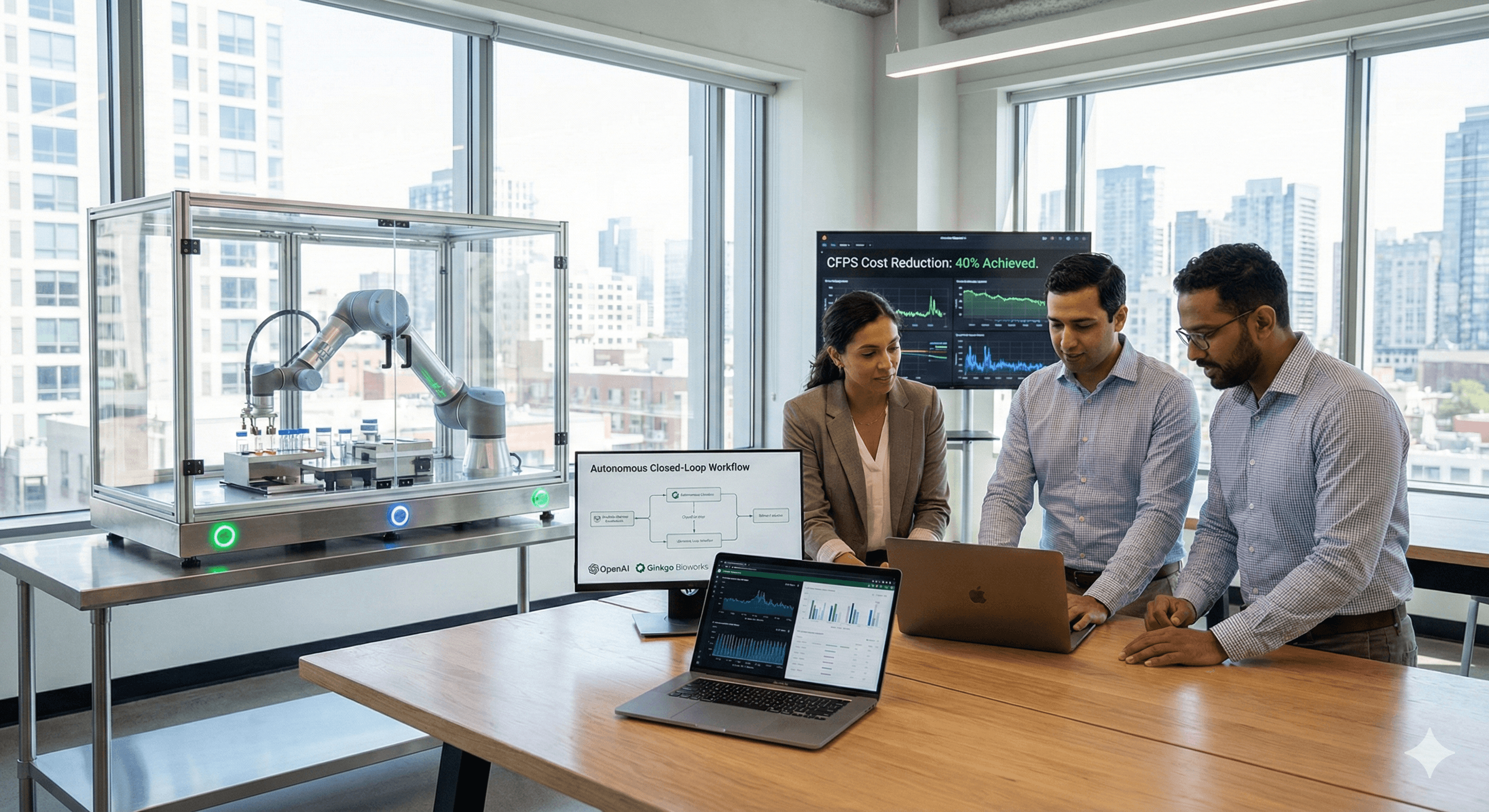
OpenAI y Ginkgo Bioworks utilizaron GPT-5 para llevar a cabo experimentos autónomos de ciclo cerrado que redujeron los costos de componentes de reacción en síntesis de proteínas sin células (CFPS) en un 40%. Al diseñar, ejecutar, analizar y perfeccionar repetidamente los experimentos mediante un flujo de trabajo de laboratorio en la nube, el sistema mejoró la eficiencia de costos con mínima intervención humana.
La síntesis de proteínas sin células (CFPS) es una forma poderosa de producir proteínas sin depender de células vivas, pero optimizarla puede ser costoso y complicado. Por eso, vale la pena prestar atención a la reciente colaboración entre OpenAI y Ginkgo Bioworks.
En un entorno de ciclo cerrado impulsado por GPT-5, el equipo reporta una reducción del 40% en los costos de componentes de reacción de CFPS frente a un estándar de referencia de última generación, logrado a través de experimentación autónoma a gran escala significativa.
Por qué esto importa ahora
Los equipos de biotecnología y ciencias de la vida a menudo enfrentan un cuello de botella similar: pueden generar hipótesis rápidamente, pero la experimentación es lenta y costosa. Los laboratorios autónomos de ciclo cerrado están diseñados para cambiar eso conectando tres elementos:
Un sistema de razonamiento que propone experimentos
Una capa de automatización de laboratorio que los ejecuta
Un ciclo de retroalimentación que convierte los resultados en el siguiente conjunto de experimentos (mejorados)
Si puedes hacer esto de manera confiable, puedes reducir semanas de iteración a días y eliminar gran parte del ensayo y error manual.
Qué hay de nuevo: experimentación de ciclo cerrado con GPT-5 + un laboratorio en la nube
Este trabajo integra GPT-5 en el flujo de trabajo experimental como la "capa cognitiva" que:
Diseña experimentos (seleccionando condiciones, composiciones y estrategia de exploración)
Interpreta resultados (identificando qué cambió y por qué funcionó)
Refina el plan (proponiendo la siguiente ronda de experimentos)
La infraestructura de laboratorio en la nube de Ginkgo proporciona la capa de ejecución física, operando las placas experimentales, recolectando mediciones y devolviendo datos para la próxima iteración.
El resultado principal (y su significado)
El resultado reportado es una reducción del 40% en los costos de componentes de reacción de CFPS, logrado al descubrir composiciones de reacción mejoradas que se adaptan mejor a las condiciones de laboratorio autónomo.
Para los equipos empresariales, la lección práctica se centra menos en una receta de proteína y más en el patrón:
Definir un estándar claro
Realizar iteraciones rápidas y automatizadas
Optimizarlas contra un objetivo medible (aquí: costo)
Permitir que el sistema aprenda de datos reales en ciclos
Ejemplos prácticos
Ejemplo 1: Pruebas automatizadas de optimización
Un equipo define un objetivo (rendimiento, estabilidad, costo o pureza). El modelo propone condiciones, el laboratorio las ejecuta y el siguiente ciclo se guía por los resultados.
Ejemplo 2: Ajustes de eficiencia en tiempo real
Cuando se reciben los resultados, el sistema cambia su estrategia de exploración enfocándose en regiones prometedoras del espacio de parámetros o comprobando la robustez bajo diferentes condiciones de laboratorio.
Lo que esto no significa (importante salvaguardia)
Esto no es "la IA reemplaza a los científicos". En la práctica, el trabajo autónomo de ciclo cerrado aún requiere:
Objetivos y restricciones bien definidos
Supervisión humana para seguridad, calidad e interpretación
Diseño experimental adecuado y validación
Gobernanza sobre lo que el sistema puede ejecutar y cuándo
Qué hacer si quieres explorar experimentación autónoma
Si estás considerando este enfoque, comienza con un problema acotado:
Elige una tarea de optimización de alto costo o alto fricción
Establece un estándar y métricas de éxito
Construye un pequeño piloto de ciclo cerrado con límites claros
Mide el impacto (costo, tiempo para el resultado, reproducibilidad)
Escala solo una vez que puedas auditar decisiones y resultados
Resumen y próximos pasos
Una reducción del 40% en los costos de componentes de reacción de CFPS es una demostración convincente de lo que IA agentica + automatización + ciclos de retroalimentación pueden ofrecer en las ciencias físicas. La historia más grande es el modelo de operación: optimización repetible, guiada por datos, a escala.
Próximo paso: Si deseas ayuda para delimitar un piloto de ciclo cerrado, construir gobernanza o identificar el flujo de trabajo adecuado de automatización + IA, habla con Generation Digital.
Preguntas frecuentes
P1: ¿Qué es la síntesis de proteínas sin células?
La síntesis de proteínas sin células (CFPS) es un método para producir proteínas fuera de células vivas, utilizando una mezcla de reacción bioquímica. Se utiliza comúnmente en investigación y flujos de trabajo industriales donde la rapidez y controlabilidad son importantes.
P2: ¿Cómo contribuye GPT-5 a la reducción de costos?
GPT-5 puede proponer y perfeccionar diseños de experimentos en ciclos, aprendiendo de los resultados y enfocando pruebas en las condiciones más prometedoras. En un entorno de ciclo cerrado, esto reduce el ensayo y error manual y acelera la optimización.
P3: ¿Qué papel desempeña Ginkgo Bioworks?
Ginkgo proporciona el laboratorio en la nube y la infraestructura de automatización que ejecuta experimentos a escala, captura mediciones y devuelve datos para que el sistema pueda iterar.
P4: ¿El 40% se refiere al costo total o a los reactivos?
La mejora destacada reportada es una reducción del 40% en los costos de componentes de reacción bajo las condiciones de referencia. El trabajo también informa una mejora mayor en ciertos métricas de costo de reactivos.
Recibe noticias y consejos sobre IA cada semana en tu bandeja de entrada
Al suscribirte, das tu consentimiento para que Generation Digital almacene y procese tus datos de acuerdo con nuestra política de privacidad. Puedes leer la política completa en gend.co/privacy.



Generación
Digital

Oficina en Reino Unido
Generation Digital Ltd
33 Queen St,
Londres
EC4R 1AP
Reino Unido
Oficina en Canadá
Generation Digital Americas Inc
181 Bay St., Suite 1800
Toronto, ON, M5J 2T9
Canadá
Oficina en EE. UU.
Generation Digital Américas Inc
77 Sands St,
Brooklyn, NY 11201,
Estados Unidos
Oficina de la UE
Software Generación Digital
Edificio Elgee
Dundalk
A91 X2R3
Irlanda
Oficina en Medio Oriente
6994 Alsharq 3890,
An Narjis,
Riad 13343,
Arabia Saudita






Número de la empresa: 256 9431 77 | Derechos de autor 2026 | Términos y Condiciones | Política de Privacidad