Staying Ahead in the Age of AI: 5 Leadership Moves (2026)

Staying Ahead in the Age of AI: 5 Leadership Moves (2026)

OpenAI
24 feb 2026

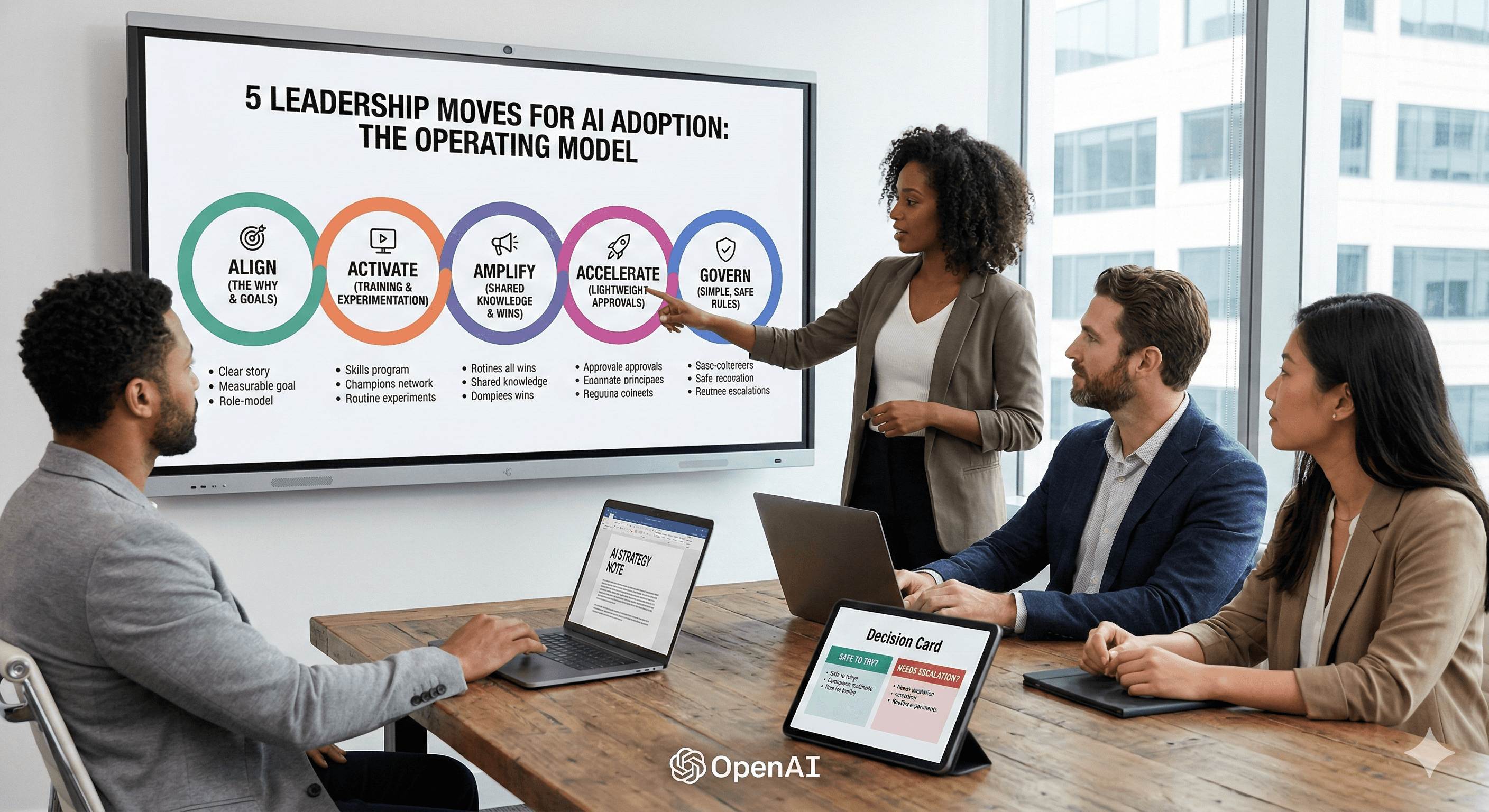
A diverse group of four professionals in a modern office setting are engaged in a meeting, focusing on a presentation titled "5 Leadership Moves for AI Adoption: The Operating Model," with laptops displaying related content, illustrating collaboration and strategic planning.

¿No sabes por dónde empezar con la IA?
Evalúa preparación, riesgos y prioridades en menos de una hora.

¿No sabes por dónde empezar con la IA?
Evalúa preparación, riesgos y prioridades en menos de una hora.

➔ Descarga nuestro paquete gratuito de preparación para IA

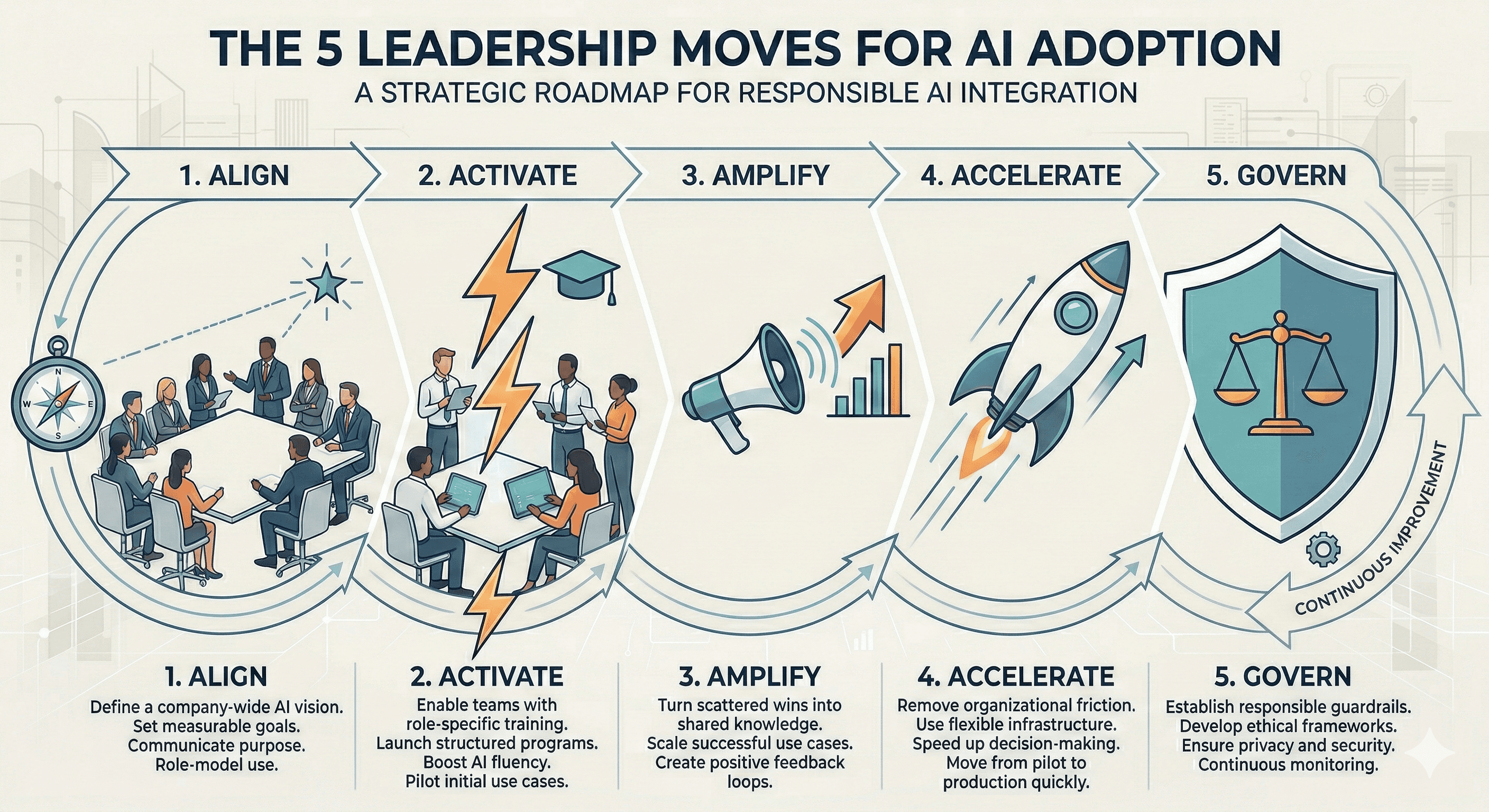
To stay ahead in the age of AI, leaders need an operating model—not just tools. OpenAI’s playbook recommends five moves: Align teams on the “why”, Activate with training and experimentation, Amplify wins through shared knowledge, Accelerate pilots to production with lightweight approvals, and Govern with simple, practical rules that keep innovation safe.

AI progress is moving quickly and unevenly. Some organisations feel constant whiplash; others turn the pace into an advantage.

OpenAI’s leadership guide makes the case that the companies that thrive treat AI as a new way of working, not a side project. It also offers a simple five-part operating model—Align, Activate, Amplify, Accelerate, Govern—to help leaders move faster without losing control. (cdn.openai.com)

This post turns that model into a practical playbook you can run in the next 30 days.

Why this matters now (a few signals of the pace)

The PDF opens with three indicators of why AI feels different:

  • 5.6× growth since 2022 in frontier-scale model releases

  • 280× cheaper to run GPT‑3.5‑class models in ~18 months

  • 4× faster adoption than the desktop internet

It also notes that early adopters are growing revenue 1.5× faster than peers.

You don’t need to accept every statistic at face value to act on the underlying message: AI is becoming part of normal work, quickly.
The five leadership moves (and what to do this quarter)

1) Align: make the “why” obvious

People adopt change faster when they understand how AI improves their work and supports the organisation’s advantage. The guide recommends leaders:

  • tell a clear story about why AI matters now

  • set a measurable AI adoption goal

  • role-model real AI use as a leadership team

Example from the guide: Moderna’s CEO set an expectation that employees should be using ChatGPT 20 times a day.

What to do next:

  • Write a one-page “AI strategy note” for the company: why now, what we’re aiming for, what we will not do.

  • Choose one adoption metric (weekly active users, number of validated use cases, or % of staff trained).

2) Activate: train people and create safe experimentation

The guide states that nearly half of employees say they lack training and support to adopt generative AI confidently, and that training is ranked as the most important factor for successful adoption.

Its recommended tactics are straightforward:

  • launch a structured, role-specific AI skills programme

  • build an AI champions network

  • make experimentation routine (time-boxed and supported)

Example from the guide: the San Antonio Spurs increased AI fluency from 14% to 85% by embedding training into daily work.

What to do next:

  • Start with three prompt patterns per team (e.g., “summarise”, “draft”, “analyse”), then add advanced patterns.

  • Create “safe-to-try” examples and publish them in your knowledge hub.

3) Amplify: stop solving the same problems in silos

Scaling AI isn’t about one brilliant team. It’s about turning wins into shared assets.

The guide suggests:

  • launching a central AI knowledge hub

  • regularly sharing success stories and reusable prompts

  • building internal communities for peer-to-peer learning

What to do next:

  • Create a single “AI Hub” space (in Notion/SharePoint/Confluence) that houses: policies, prompts, templates, training, and approved tools.

  • Share three “wins” a month: one large, two small-and-repeatable.

4) Accelerate: make it easy to go from pilot to production

Most organisations don’t fail at ideation—they fail at decision speed.

The guide’s focus here is removing friction:

  • unblock access to tools and data

  • create an intake and prioritisation process

  • keep approvals lightweight so good ideas move quickly

What to do next:

  • Set up a simple AI intake form with a weekly triage meeting.

  • Create a standard pilot template: use case, data, risk, human review, success metric, owner.

5) Govern: keep speed and control

Governance shouldn’t be a brake. The guide argues it should enable rapid action inside clear safeguards.

It recommends:

  • a simple responsible AI playbook focused on “safe to try” vs “needs escalation”

  • regular reviews/audits so guidelines stay practical as the tech changes

It also suggests creating a custom GPT trained on your responsible AI playbook so employees can ask policy questions in plain English.

What to do next:

  • Publish a one-page policy: allowed tools, data rules, review requirements, and escalation paths.

  • Review quarterly: what changed, what broke, what needs tightening.

A lightweight operating checklist for leaders

If you want to run this without turning it into a programme office:

  • Align: publish the “why” + one adoption goal; leaders share their own AI use monthly.

  • Activate: train by role; create champions; protect time for experimentation.

  • Amplify: central hub + monthly wins + reusable prompt library.

  • Accelerate: intake + fast approvals + measured pilots.

  • Govern: one-page rules + quarterly review.

That’s the playbook.

Next steps

Pick one team and one workflow where the value is obvious—then prove it.

A practical starting point:

  1. Choose a workflow (weekly reporting, customer support triage, meeting notes → actions, or research briefs).

  2. Define success metrics (time saved, quality, fewer errors, faster turnaround).

  3. Run a two-week pilot with human review.

  4. Publish the prompt, the template, and the outcome in your AI hub.

  5. Repeat with the next workflow.

FAQs

What are the five steps in OpenAI’s leadership guide?

OpenAI summarises five practical steps: Align, Activate, Amplify, Accelerate, and Govern—designed to help organisations move quickly and confidently as AI advances. (cdn.openai.com)

What’s the fastest way to increase adoption?

Role-specific training plus protected experimentation time tends to move the needle quickly, especially when leaders role-model usage and teams can reuse proven prompts. (cdn.openai.com)

How do we avoid AI chaos and shadow usage?

Publish simple “safe-to-try” rules, clarify what data is allowed, and give people a trusted set of tools and prompts so they don’t invent their own approach in isolation. (cdn.openai.com)

Does governance slow teams down?

It shouldn’t. The guide argues governance should support rapid action through clear guidelines, not create new roadblocks. (cdn.openai.com)

What should leaders measure?

Adoption (active users), training participation, number of validated use cases, and how many pilots move from prototype to production are all practical signals the guide recommends tracking. (cdn.openai.com)

To stay ahead in the age of AI, leaders need an operating model—not just tools. OpenAI’s playbook recommends five moves: Align teams on the “why”, Activate with training and experimentation, Amplify wins through shared knowledge, Accelerate pilots to production with lightweight approvals, and Govern with simple, practical rules that keep innovation safe.

AI progress is moving quickly and unevenly. Some organisations feel constant whiplash; others turn the pace into an advantage.

OpenAI’s leadership guide makes the case that the companies that thrive treat AI as a new way of working, not a side project. It also offers a simple five-part operating model—Align, Activate, Amplify, Accelerate, Govern—to help leaders move faster without losing control. (cdn.openai.com)

This post turns that model into a practical playbook you can run in the next 30 days.

Why this matters now (a few signals of the pace)

The PDF opens with three indicators of why AI feels different:

  • 5.6× growth since 2022 in frontier-scale model releases

  • 280× cheaper to run GPT‑3.5‑class models in ~18 months

  • 4× faster adoption than the desktop internet

It also notes that early adopters are growing revenue 1.5× faster than peers.

You don’t need to accept every statistic at face value to act on the underlying message: AI is becoming part of normal work, quickly.

The five leadership moves (and what to do this quarter)

1) Align: make the “why” obvious

People adopt change faster when they understand how AI improves their work and supports the organisation’s advantage. The guide recommends leaders:

  • tell a clear story about why AI matters now

  • set a measurable AI adoption goal

  • role-model real AI use as a leadership team

Example from the guide: Moderna’s CEO set an expectation that employees should be using ChatGPT 20 times a day.

What to do next:

  • Write a one-page “AI strategy note” for the company: why now, what we’re aiming for, what we will not do.

  • Choose one adoption metric (weekly active users, number of validated use cases, or % of staff trained).

2) Activate: train people and create safe experimentation

The guide states that nearly half of employees say they lack training and support to adopt generative AI confidently, and that training is ranked as the most important factor for successful adoption.

Its recommended tactics are straightforward:

  • launch a structured, role-specific AI skills programme

  • build an AI champions network

  • make experimentation routine (time-boxed and supported)

Example from the guide: the San Antonio Spurs increased AI fluency from 14% to 85% by embedding training into daily work.

What to do next:

  • Start with three prompt patterns per team (e.g., “summarise”, “draft”, “analyse”), then add advanced patterns.

  • Create “safe-to-try” examples and publish them in your knowledge hub.

3) Amplify: stop solving the same problems in silos

Scaling AI isn’t about one brilliant team. It’s about turning wins into shared assets.

The guide suggests:

  • launching a central AI knowledge hub

  • regularly sharing success stories and reusable prompts

  • building internal communities for peer-to-peer learning

What to do next:

  • Create a single “AI Hub” space (in Notion/SharePoint/Confluence) that houses: policies, prompts, templates, training, and approved tools.

  • Share three “wins” a month: one large, two small-and-repeatable.

4) Accelerate: make it easy to go from pilot to production

Most organisations don’t fail at ideation—they fail at decision speed.

The guide’s focus here is removing friction:

  • unblock access to tools and data

  • create an intake and prioritisation process

  • keep approvals lightweight so good ideas move quickly

What to do next:

  • Set up a simple AI intake form with a weekly triage meeting.

  • Create a standard pilot template: use case, data, risk, human review, success metric, owner.

5) Govern: keep speed and control

Governance shouldn’t be a brake. The guide argues it should enable rapid action inside clear safeguards.

It recommends:

  • a simple responsible AI playbook focused on “safe to try” vs “needs escalation”

  • regular reviews/audits so guidelines stay practical as the tech changes

It also suggests creating a custom GPT trained on your responsible AI playbook so employees can ask policy questions in plain English.

What to do next:

  • Publish a one-page policy: allowed tools, data rules, review requirements, and escalation paths.

  • Review quarterly: what changed, what broke, what needs tightening.

A lightweight operating checklist for leaders

If you want to run this without turning it into a programme office:

  • Align: publish the “why” + one adoption goal; leaders share their own AI use monthly.

  • Activate: train by role; create champions; protect time for experimentation.

  • Amplify: central hub + monthly wins + reusable prompt library.

  • Accelerate: intake + fast approvals + measured pilots.

  • Govern: one-page rules + quarterly review.

That’s the playbook.

Next steps

Pick one team and one workflow where the value is obvious—then prove it.

A practical starting point:

  1. Choose a workflow (weekly reporting, customer support triage, meeting notes → actions, or research briefs).

  2. Define success metrics (time saved, quality, fewer errors, faster turnaround).

  3. Run a two-week pilot with human review.

  4. Publish the prompt, the template, and the outcome in your AI hub.

  5. Repeat with the next workflow.

FAQs

What are the five steps in OpenAI’s leadership guide?

OpenAI summarises five practical steps: Align, Activate, Amplify, Accelerate, and Govern—designed to help organisations move quickly and confidently as AI advances. (cdn.openai.com)

What’s the fastest way to increase adoption?

Role-specific training plus protected experimentation time tends to move the needle quickly, especially when leaders role-model usage and teams can reuse proven prompts. (cdn.openai.com)

How do we avoid AI chaos and shadow usage?

Publish simple “safe-to-try” rules, clarify what data is allowed, and give people a trusted set of tools and prompts so they don’t invent their own approach in isolation. (cdn.openai.com)

Does governance slow teams down?

It shouldn’t. The guide argues governance should support rapid action through clear guidelines, not create new roadblocks. (cdn.openai.com)

What should leaders measure?

Adoption (active users), training participation, number of validated use cases, and how many pilots move from prototype to production are all practical signals the guide recommends tracking. (cdn.openai.com)

Recibe noticias y consejos sobre IA cada semana en tu bandeja de entrada

Al suscribirte, das tu consentimiento para que Generation Digital almacene y procese tus datos de acuerdo con nuestra política de privacidad. Puedes leer la política completa en gend.co/privacy.


Próximos talleres y seminarios web

A diverse group of professionals collaborating around a table in a bright, modern office setting.

Claridad Operacional a Gran Escala - Asana

Webinar Virtual
Miércoles 25 de febrero de 2026
En línea

A diverse group of professionals collaborating around a table in a bright, modern office setting.

Trabaja con compañeros de equipo de IA - Asana

Taller Presencial
Jueves 26 de febrero de 2026
Londres, Reino Unido

A diverse group of professionals collaborating around a table in a bright, modern office setting.

De Idea a Prototipo: IA en Miro

Seminario Web Virtual
Miércoles 18 de febrero de 2026
En línea

Generación
Digital

Oficina en Reino Unido

Generation Digital Ltd
33 Queen St,
Londres
EC4R 1AP
Reino Unido

Oficina en Canadá

Generation Digital Americas Inc
181 Bay St., Suite 1800
Toronto, ON, M5J 2T9
Canadá

Oficina en EE. UU.

Generation Digital Américas Inc
77 Sands St,
Brooklyn, NY 11201,
Estados Unidos

Oficina de la UE

Software Generación Digital
Edificio Elgee
Dundalk
A91 X2R3
Irlanda

Oficina en Medio Oriente

6994 Alsharq 3890,
An Narjis,
Riad 13343,
Arabia Saudita

UK Fast Growth Index UBS Logo
Financial Times FT 1000 Logo
Febe Growth 100 Logo (Background Removed)

Número de la empresa: 256 9431 77 | Derechos de autor 2026 | Términos y Condiciones | Política de Privacidad

Generación
Digital

Oficina en Reino Unido

Generation Digital Ltd
33 Queen St,
Londres
EC4R 1AP
Reino Unido

Oficina en Canadá

Generation Digital Americas Inc
181 Bay St., Suite 1800
Toronto, ON, M5J 2T9
Canadá

Oficina en EE. UU.

Generation Digital Américas Inc
77 Sands St,
Brooklyn, NY 11201,
Estados Unidos

Oficina de la UE

Software Generación Digital
Edificio Elgee
Dundalk
A91 X2R3
Irlanda

Oficina en Medio Oriente

6994 Alsharq 3890,
An Narjis,
Riad 13343,
Arabia Saudita

UK Fast Growth Index UBS Logo
Financial Times FT 1000 Logo
Febe Growth 100 Logo (Background Removed)


Número de Empresa: 256 9431 77
Términos y Condiciones
Política de Privacidad
Derechos de Autor 2026





