AI Autonomous Labs: What OpenAI + Ginkgo Proved
OpenAI
¿No sabes por dónde empezar con la IA?Evalúa preparación, riesgos y prioridades en menos de una hora.
➔ Descarga nuestro paquete gratuito de preparación para IA
An AI autonomous lab is a closed‑loop system where an AI model designs experiments, a robotic laboratory executes them at scale, results are returned as data, and the model proposes the next iteration. In early 2026, OpenAI and Ginkgo used this approach to run 36,000+ reactions and reduce cell‑free protein synthesis costs by about 40%.
Generative AI used to be easy to dismiss in science: it could summarise papers, draft hypotheses, and suggest next steps—but it couldn’t touch the physical world. That constraint is now breaking.
In early 2026, OpenAI connected GPT‑5 to Ginkgo Bioworks’ autonomous “cloud lab” and let the model run a real optimisation programme in biology. The result wasn’t a clever paragraph or a synthetic chart; it was a measurable reduction in experiment cost achieved through closed‑loop experimentation—AI designs, robots run, data returns, AI iterates.
This article explains what actually happened, why the benchmark matters, and how to think about AI‑in‑the‑lab as an operating model rather than a novelty.
What happened (and why people noticed)
OpenAI and Ginkgo set out to test a blunt question: can a frontier model behave like an experimental scientist—designing experiments, interpreting results, and iterating—when it’s paired with a robotic lab capable of high-throughput execution?
They chose a hard but measurable target: cell‑free protein synthesis (CFPS), a way to produce proteins without growing living cells. Instead of engineering cells and waiting for them to grow, CFPS runs the cell’s protein‑making machinery in a controlled mixture—ideal for rapid iteration when you can measure output quickly.
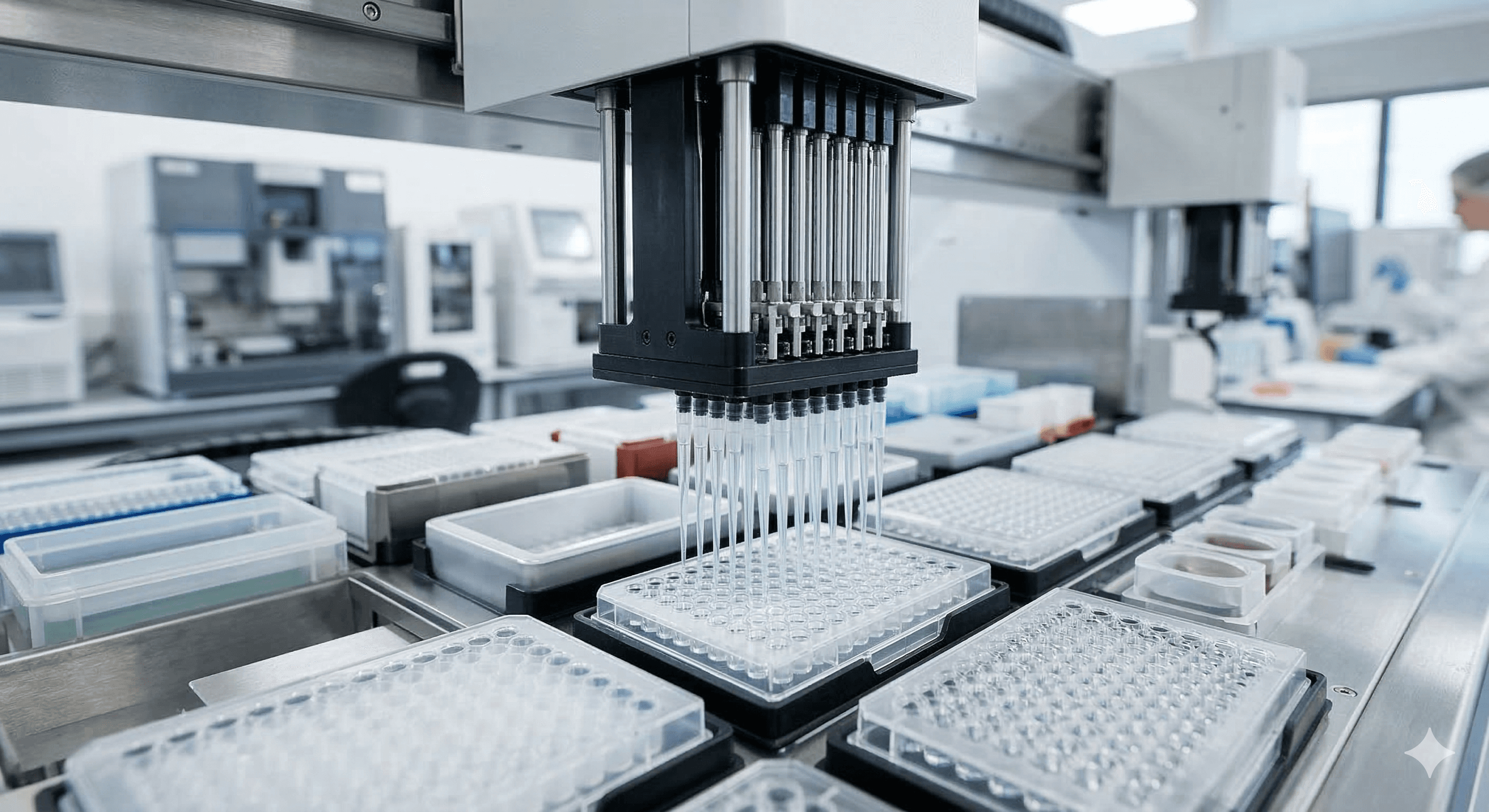
Using superfolder green fluorescent protein (sfGFP) as a benchmark (it glows, so results are unambiguous), the system ran 36,000+ unique reaction compositions across hundreds of automated plates. Each loop took roughly an hour per cycle from data return to the next proposed set of experiments.
Within roughly two months, the collaboration reported about a 40% reduction in protein production cost versus a prior baseline benchmark.
Why CFPS is a good “stress test” for autonomous science
CFPS is not a simple knob‑turn. It’s a multi‑ingredient system with interacting components—DNA template, lysate, energy sources, salts, and more. Small changes can help or harm, and intuition doesn’t scale well when the search space explodes.
That makes CFPS perfect for an autonomous loop:
Fast feedback: you can measure output on the same day (fluorescence for sfGFP).
Huge combination space: robots can explore mixes humans wouldn’t have time to try.
Cost sensitivity at scale: when labs run thousands of reactions, reagent costs become the real bottleneck.
In other words: the question wasn’t “can the model write a plausible protocol?” It was “can the model keep improving performance under real constraints—time, reagent availability, plate layouts, volume limits—while learning from noisy biological data?”
How the closed-loop system actually worked
The key idea is lab‑in‑the‑loop. GPT‑5 wasn’t just asked for suggestions; it sat inside a workflow:
Objective defined: optimise CFPS for lower cost while maintaining useful protein output.
Experiment batch designed: GPT‑5 proposed a set of reaction compositions and controls.
Validation gate: programmatic checks ensured experiments were physically executable (critical to prevent “paper experiments”).
Robotic execution: Ginkgo’s automation ran the plates, measured outputs, and captured metadata.
Data returned to the model: GPT‑5 analysed results and planned the next round.
Repeat: multiple closed‑loop rounds until reaching a new cost benchmark.
One detail matters for anyone building serious AI systems: guardrails were part of the science. In the SciAm reporting, the model even proposed an impossible negative water volume at one point; the lab team adjusted the run. That’s not a gimmick—it’s exactly the kind of failure mode you should expect when models begin to operate in physical systems.
What’s genuinely new here (beyond “AI helps scientists”)
We’ve had machine learning in biology for years. What’s different is the combination of:
Frontier model reasoning (generate hypotheses + explore trade‑offs)
High-throughput automation (execute thousands of tests quickly)
Closed-loop learning (each round improves the next)
Put simply: the bottleneck shifts from “human time at the bench” to “how fast you can generate data”. When iteration becomes cheap, more ideas get tested—so the frontier of “what’s possible per pound spent” moves.
Practical implications for R&D leaders
1) Expect more ‘remote experimentation’ models
Ginkgo’s cloud lab approach is a sign of where this is going: experiments as a service, executed on standardised automation platforms, with results delivered as structured data. That changes how teams plan R&D: less time waiting for bench capacity; more time designing objectives, evaluation criteria, and data pipelines.
2) Validation and governance become part of the workflow
In autonomous experimentation, the equivalent of “prompting” is experimental specification. If the system can waste reagents quickly, you need:
hard constraints (volumes, plate geometry, control sets)
audit trails (why an experiment was proposed)
reproducibility checks (can it repeat under drift?)
clear accountability (who signs off at each stage?)
If you’re scaling AI into operations, you’ll recognise this pattern. The control plane matters as much as the model.
3) Competitive advantage shifts to iteration speed
Autonomous labs don’t magically invent drugs. But they can compress cycles of optimisation—especially in workflows where the output signal is clear and the combinatorial space is large (formulations, reactions, assay conditions, and manufacturing parameters).
What to do next (for organisations exploring AI + lab automation)
If you’re leading digital, data, or R&D transformation, the immediate opportunity is to treat autonomous experimentation like any other enterprise AI programme: define where it fits, how you govern it, and how you measure value.
Start by assessing whether your organisation is ready to scale AI safely: Generation Digital’s AI Readiness & Execution Pack is designed to surface gaps in strategy, skills, data foundations, and governance.
(https://www.gend.co/ai-readiness-execution-pack)If you’re moving from pilots to delivery, build a clear operating model for AI: ownership, evaluation, and change management.
(https://www.gend.co/ai-services)For leadership teams needing clarity, set oversight early: risk appetite, controls, supplier choices, and reporting.
(https://www.gend.co/blog/ai-governance-evolving-board-strategies)
Summary
The OpenAI–Ginkgo work is a clear signal that generative AI is moving into physical, measurable iteration loops. By pairing a frontier model with autonomous lab automation, they explored a huge experimental space quickly and reported a meaningful cost reduction in a widely used protein synthesis method.
For organisations, the lesson is less “robots will do science” and more: iteration speed is becoming a strategic asset—but only if you build the governance, validation, and data foundations that keep autonomous systems grounded.
FAQs
Q1. What is an AI autonomous lab?
An AI autonomous lab is a closed‑loop setup where an AI model proposes experiments, robots execute them, and results feed back to the model so it can iterate and improve.
Q2. Why did OpenAI and Ginkgo use cell-free protein synthesis (CFPS)?
CFPS is fast to measure, expensive to run at scale, and hard to optimise by intuition—making it an ideal benchmark for high‑throughput, closed‑loop experimentation.
Q3. Does this mean AI can replace scientists?
No. Humans still define objectives, constraints, safety checks, and interpret broader meaning. The value is in accelerating iteration, not removing accountability.
Q4. What’s the biggest risk in autonomous experimentation?
Running the wrong experiments quickly. That’s why validation gates, audit trails, and controls are essential—especially when costs and lab capacity scale.
Q5. How should enterprises prepare for lab‑in‑the‑loop AI?
Treat it like any enterprise AI scale‑up: set governance early, standardise data and evaluation, and build a repeatable operating model for safe experimentation.
Recibe noticias y consejos sobre IA cada semana en tu bandeja de entrada
Al suscribirte, das tu consentimiento para que Generation Digital almacene y procese tus datos de acuerdo con nuestra política de privacidad. Puedes leer la política completa en gend.co/privacy.



Generación
Digital

Oficina en Reino Unido
Generation Digital Ltd
33 Queen St,
Londres
EC4R 1AP
Reino Unido
Oficina en Canadá
Generation Digital Americas Inc
181 Bay St., Suite 1800
Toronto, ON, M5J 2T9
Canadá
Oficina en EE. UU.
Generation Digital Américas Inc
77 Sands St,
Brooklyn, NY 11201,
Estados Unidos
Oficina de la UE
Software Generación Digital
Edificio Elgee
Dundalk
A91 X2R3
Irlanda
Oficina en Medio Oriente
6994 Alsharq 3890,
An Narjis,
Riad 13343,
Arabia Saudita







Número de la empresa: 256 9431 77 | Derechos de autor 2026 | Términos y Condiciones | Política de Privacidad