Proliferación de IA: Soluciona el Caos de Herramientas con Miro AI
Miro
¿No sabes por dónde empezar con la IA?Evalúa preparación, riesgos y prioridades en menos de una hora.
➔ Descarga nuestro paquete gratuito de preparación para IA
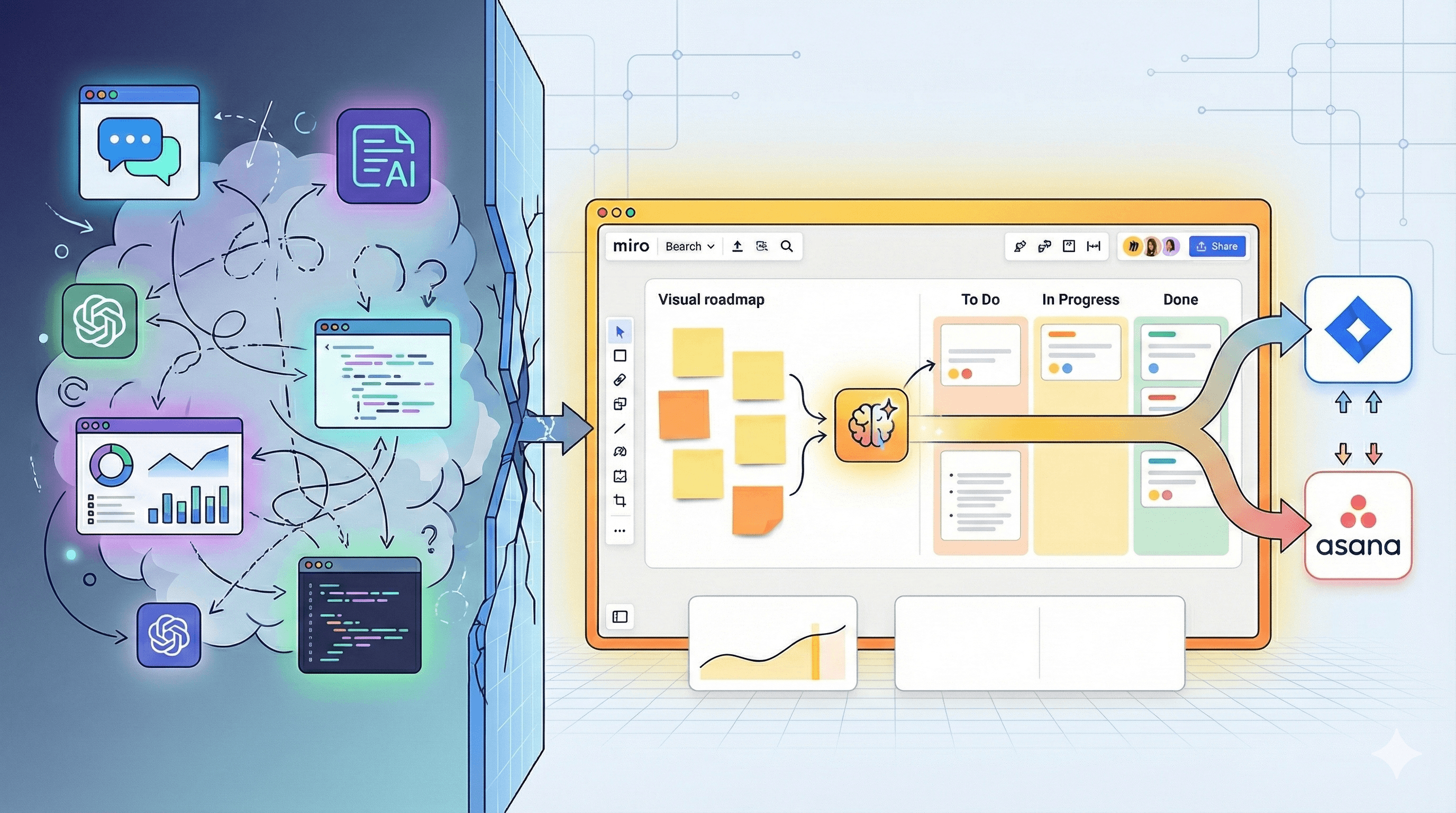
La proliferación de inteligencia artificial (IA) es la expansión descontrolada de herramientas de IA desconectadas a lo largo de una infraestructura tecnológica fragmentada. Esto genera cambios de contexto, datos duplicados y brechas de gobernanza, por lo que las inversiones no se traducen en resultados. La solución es la consolidación: colocar la IA donde sucede el trabajo y conectar la planificación con la ejecución mediante integraciones bidireccionales.
Proliferación de IA: El Impuesto Invisible en tu Transformación Digital
Estás invirtiendo en IA para aumentar la productividad, pero los resultados parecen decepcionantes. El culpable suele ser la proliferación de IA: un cúmulo creciente de aplicaciones de IA desconectadas sumadas a un conjunto de herramientas ya fragmentado. Los líderes informan que el cambiar entre herramientas de trabajo principales y herramientas de IA separadas introduce fricción e interrumpe el flujo, el opuesto a lo que prometía la IA. Cuando la IA está en un lugar y el trabajo en otro, automatizas el caos en lugar de crear claridad.
Por qué sucede la proliferación de IA (y por qué está empeorando)
La mayoría de las organizaciones adoptaron la IA de manera táctica —un chatbot aquí, un resumidor allá— sin solucionar primero la proliferación de aplicaciones. Cada nueva herramienta agrega otro contexto, otro inicio de sesión y otro silo de datos. Los equipos pasan de un espacio de planificación a herramientas de ejecución y asistentes de IA aislados. La gobernanza y la seguridad se vuelven más difíciles, mientras el conocimiento se fragmenta entre sistemas. ¿El resultado? Más esfuerzo en gestionar la infraestructura que en avanzar con el trabajo.
Plan de consolidación: IA donde sucede el trabajo
Las empresas de alto rendimiento están consolidando bases antes de que la complejidad de la IA agrave el problema. El principio es simple: llevar la IA al lugar del trabajo, no al revés.
Presentamos a Miro — el espacio de innovación diseñado para domar la proliferación de herramientas al integrar IA en un lienzo visual. En un espacio compartido, los equipos pasan de la ideación no estructurada a la ejecución estructurada, manteniendo conectados planificación y entrega. En lugar de flujos de trabajo rígidos y de talla única, Miro se adapta a la forma en que los equipos multifuncionales realmente trabajan.
De ideas a resultados: Herramientas de Miro para estructura y velocidad
Plantillas y tableros acelerados por IA. Olvídate de las páginas en blanco. Usa plantillas inteligentes y IA en el lienzo para convertir indicaciones, notas adhesivas e ideas iniciales en tableros estructurados, informes y hojas de ruta. El lienzo se convierte en contexto para la IA, por lo que el resultado refleja el lenguaje y los artefactos de tu equipo.
Kanban para la planificación visual de proyectos. Crea tableros Kanban rápidamente, asigna responsables y fechas de entrega, y visualiza el flujo. Usa tarjetas para capturar detalles y enlazar con sistemas de entrega. Los indicadores de progreso visual ayudan a todos a ver el estado de un vistazo.
Sincronización bidireccional con herramientas de entrega. Mantén la planificación en Miro conectada a la ejecución en tu sistema de registro. Sincroniza las tarjetas Kanban con Jira y —ahora en beta— Asana para que las actualizaciones fluyan en ambas direcciones. Diseñadores, PMs e ingeniería trabajan en el mismo estado actual sin actualizaciones duplicadas.
IA que entiende el contexto. Dado que la IA de Miro opera donde reside tu trabajo, puede transformar notas adhesivas en tablas, diagramas en documentos y redactar contenido in situ. Pasas menos tiempo exportando, reformateando y explicando el contexto a un asistente separado, y más tiempo produciendo.
Prueba de que la consolidación da frutos
Los clientes reportan resultados tangibles cuando consolidan la planificación y la colaboración en Miro:
Alineación: El 80% afirma que Miro mejora la alineación entre equipos, facilitando que se unan en torno a objetivos compartidos y decisiones.
Velocidad: Los equipos observan una reducción del ~19% en el tiempo para completar proyectos después de la consolidación, gracias a menos transferencias y duplicaciones.
Productividad: Los usuarios informan de ganancias medibles cuando la IA y la colaboración coexisten en un solo lienzo.
Juntos, estos resultados forman un círculo virtuoso: una mejor alineación eleva la calidad, una retroalimentación más rápida acelera la entrega y una menor huella de aplicaciones reduce costos y riesgos.
Cómo se ve esto en la práctica
Planifica visualmente, luego sincroniza. Facilita el descubrimiento y la planificación en Miro (talleres, mapeo de historias, planificación PI). Convierte los resultados en un tablero Kanban y sincroniza las tarjetas del tablero con Jira o Asana.
Mantén una única fuente de verdad. Deja que la ingeniería trabaje en Jira mientras el producto/diseño iteran en Miro. La sincronización bidireccional asegura que ambos enfoques reflejen la realidad.
Automatiza lo rutinario. Usa IA en el tablero para generar borradores de tareas, convertir grupos de notas en épicas, resumir retroalimentaciones o traducir contenido para las partes interesadas.
Mide el impacto. Rastrea el tiempo de ciclo y el tiempo de entrega antes/después de la consolidación. Comparte el progreso visible con los ejecutivos mediante tableros ligeros en el tablero.
Gobernanza sin complicaciones
La consolidación también fortalece las directrices. Con menos aplicaciones superpuestas, TI puede estandarizar la autenticación, los permisos y la retención de datos. Los controles empresariales de Miro, su auditabilidad y su ecosistema de socios te ayudan a integrarte de manera segura mientras reduces las herramientas en la sombra y los flujos de datos no gestionados.
Acción: Mapea tu infraestructura hoy
La consolidación estratégica es un prerrequisito para el éxito de la IA. Nuestro equipo ayuda a los líderes de TI a abordar la racionalización de aplicaciones como una estrategia proactiva, no como una medida de reducción de costos. Comienza mapeando tu conjunto de herramientas actual e identificando oportunidades de consolidación que se alineen con tus objetivos empresariales y modelo de entrega.
Contacta con Generation Digital para explorar cómo podemos construir una base lista para la empresa con Miro, integrando IA donde realmente ocurre el trabajo y transformando cómo se realiza.
Preguntas Frecuentes
¿Qué es la proliferación de IA? La expansión descontrolada de herramientas de IA desconectadas en una infraestructura fragmentada, causando cambios de contexto, silos de datos y riesgos de gobernanza.
¿Por qué la proliferación de IA reduce el ROI? Porque la IA opera fuera del flujo de trabajo. La fragmentación añade fricción, duplicación y reprocesamiento, por lo que las mejoras no se traducen en resultados.
¿Cómo ayuda Miro? Consolida la planificación y la colaboración en un solo lienzo, integra IA en contexto y se conecta a Jira/Asana con sincronización bidireccional para una ejecución estructurada.
¿Está disponible la sincronización bidireccional para Jira y Asana? La sincronización bidireccional de Jira está disponible; la de Asana está en fase beta y en desarrollo. Ambas mantienen la planificación y la ejecución alineadas.
¿Qué resultados debemos esperar? Las organizaciones comúnmente reportan una mayor alineación y una finalización de proyectos más rápido después de consolidarse en Miro, junto con una mejor gobernanza.
Recibe noticias y consejos sobre IA cada semana en tu bandeja de entrada
Al suscribirte, das tu consentimiento para que Generation Digital almacene y procese tus datos de acuerdo con nuestra política de privacidad. Puedes leer la política completa en gend.co/privacy.



Generación
Digital

Oficina en Reino Unido
Generation Digital Ltd
33 Queen St,
Londres
EC4R 1AP
Reino Unido
Oficina en Canadá
Generation Digital Americas Inc
181 Bay St., Suite 1800
Toronto, ON, M5J 2T9
Canadá
Oficina en EE. UU.
Generation Digital Américas Inc
77 Sands St,
Brooklyn, NY 11201,
Estados Unidos
Oficina de la UE
Software Generación Digital
Edificio Elgee
Dundalk
A91 X2R3
Irlanda
Oficina en Medio Oriente
6994 Alsharq 3890,
An Narjis,
Riad 13343,
Arabia Saudita







Número de la empresa: 256 9431 77 | Derechos de autor 2026 | Términos y Condiciones | Política de Privacidad