Asana vs Miro y cómo funcionan juntos
Asana
Miro
¿No sabes por dónde empezar con la IA?Evalúa preparación, riesgos y prioridades en menos de una hora.
➔ Descarga nuestro paquete gratuito de preparación para IA
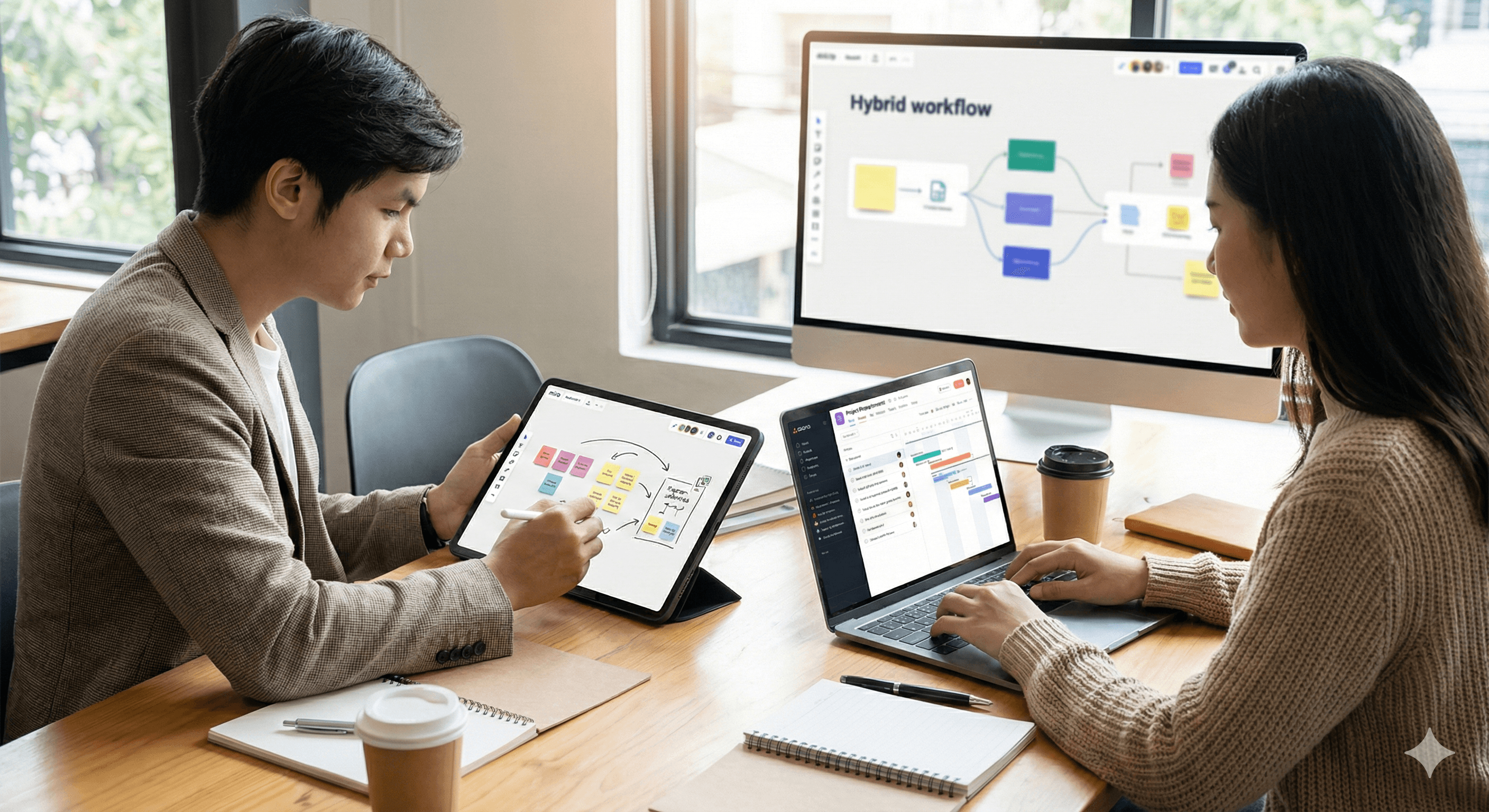
Asana es tu sistema de registro para el trabajo: propietarios, fechas, dependencias, estado. Miro es tu sistema de comprensión: descubrimiento, mapeo, decisiones. Se superponen en la planificación, pero son más fuertes juntos. Usa Miro para crear claridad compartida, luego transfiere el trabajo priorizado a Asana para ejecución, gobernanza, informes y escalabilidad.
Para quién es esta guía
Líderes que eligen herramientas para la entrega multifuncional (Producto, PMO, Operaciones, Ingeniería, Marketing). Somos socios de ambas plataformas; esta es una perspectiva sincera sobre cuándo cada una brilla, dónde se ven desafiadas y cómo operarlas como un único sistema operativo.
Resumen: Si solo recuerdas un diagrama
Pensar: Miro = lienzo infinito para ideas, estructura y decisiones.
Hacer: Asana = tareas rastreadas, propietarios, dependencias y resultados.
Puentear: Las integraciones mantienen la evidencia ↔ ejecución en sincronía (los marcos de Miro vinculan a epics/historias en Asana; las actualizaciones de Asana se muestran de nuevo en el tablero).
Fortalezas principales (lado a lado)
Área | Fortalezas de Asana | Fortalezas de Miro |
|---|---|---|
Trabajo principal | Orquestación de trabajo, portafolios, aprobaciones, dependencias, SLAs, registros de auditoría | Pensamiento colaborativo: descubrimiento, definición de alcance, mapeo, talleres |
Valor de IA | Borradores de actualizaciones, resúmenes de estado, arreglos, asistentes de IA para seguimientos rutinarios | Concentración de insights, resumen de marcos, borradores de alcance, revisión de diagramas |
Planificación | Hojas de ruta, capacidad, dependencias, hitos | Lluvia de ideas → temas → alcance; cronogramas visuales y mapas de dependencias |
Ejecución | Epics/historias, flujos de trabajo, reglas, formularios, tableros | Espacio de co-creación para diseños, investigación y rituales en vivo |
Gobernanza | Permisos, aprobaciones, historial de cambios, informes | Registros de decisiones, trazabilidad visual a la evidencia |
Dónde se rompe | El exceso de plantillas causa ruido; el uso de pizarras blancas en Asana es engorroso | Intentar ejecutar en el tablero crea caos y estados obsoletos |
Perspectiva sincera: Puedes planificar en Asana y puedes capturar acciones en Miro, pero forzar a cualquiera a hacer el trabajo de la otra crea fricción y señales débiles.
Cuándo elegir cuál (guía de decisión)
Elige Miro cuando necesitas: explorar problemas, alinear partes interesadas visualmente, agrupar investigación, mapear dependencias, realizar talleres, registrar decisiones con contexto.
Elige Asana cuando necesitas: asignar propietarios, establecer fechas, modelar dependencias, automatizar flujos de trabajo, reportar estado y escalar la ejecución a través de equipos.
Momento de transferencia: Una vez que el alcance/decisiones se estabilizan en Miro, convierte flujos de trabajo → a epics/historias en Asana con enlaces a marcos. A partir de ese punto, trata a Miro como contexto y a Asana como verdad para la entrega.
La integración que importa (flujo mínimo viable)
Alcance en Miro: Descubrimiento → Insights → Flujos de trabajo (enlaces a marcos + registro de decisiones).
Empujar a Asana: Crea epics/historias con criterios de aceptación y enlaces de vuelta a marcos de Miro.
Espejar estado: Un script/regla ligero publica actualizaciones semanales de Asana en un marco de "Estado" en el tablero de Miro.
Cierra el ciclo: Durante las presentaciones, salta de tareas en Asana a marcos relevantes en Miro para obtener evidencia; actualiza decisiones si cambia el alcance.
Consejo de gobernanza: Publica las reglas de contribución en el tablero ("Miro para ideas y decisiones; Asana para estado y fechas").
Manual de referencia que puedes ejecutar mañana
1) Lluvia de ideas → plan ejecutable en 90 minutos
Captura notas adhesivas, agrúpalas con la IA de Miro, redacta el alcance y los criterios de aceptación.
Convierte flujos de trabajo en epics de Asana con subtareas; asigna propietarios y fechas.
Añade un registro de ‘Decisión’ que enlace ambos lados.
2) Planificación trimestral: un tablero, muchos equipos
Importa listas de tareas del equipo (enlaces).
Mapea dependencias inter-equipos en Miro; etiqueta el camino crítico.
Crea/ajusta hojas de ruta y vistas de portafolio de Asana a partir de flujos de trabajo acordados.
3) Retroalimentación beta → actualizaciones de la hoja de ruta
El tablero público de Miro reúne retroalimentación; resume semanalmente con IA.
Convierte ítems priorizados en tareas de Asana; vincúlalos a los objetivos de la hoja de ruta.
Muestra el progreso vinculando las tareas entregadas de nuevo al marco público.
Patrones negativos (sé brutalmente honesto)
Corriendo ejecución en Miro: los tableros se deterioran; los propietarios/fechas se desvían; los informes mueren. Muévete a Asana una vez que el alcance esté estable.
Haciendo descubrimiento en Asana: la ideación en forma de lista oculta matices; no hay razonamiento espacial; alineación débil. Comienza en Miro.
Fuentes duales de verdad: si el estado vive en ambos, nadie confía en ninguno. Elige Asana para el estado.
Sin registro de decisiones: volverás a debatir. Mantén un marco de Decisiones en Miro que enlace a los ítems afectados en Asana.
Roles y RACI para la pila
Producto/PM: Facilita el descubrimiento en Miro; posee el registro de decisiones; crea epics en Asana.
Ingeniería/Entrega: Desglosa epics en historias/tareas; actualiza el estado en Asana.
Diseño/Investigación: Cura evidencia en Miro; vincula artefactos a las tareas de Asana.
PMO/Liderazgo: Revisa marcos resumen de Miro; consume tableros de portafolio de Asana.
Métricas que importan
Tiempo de avance de descubrimiento→alcance
% de tareas con enlaces a la evidencia en Miro
Retrabajo después de la aprobación
Latencia de decisiones
Frescura del estado en Asana
Desencadenamiento relacionado con dependencias
Estrategia de asientos y control de costos
Miro: otorga asientos de creador a facilitadores/diseño/PM; espectadores/comentarios para interesados; considera tableros públicos para retroalimentación con moderación.
Asana: asientos completos para propietarios/asignados; invitados para colaboradores externos; automatiza administración recurrente a través de reglas en lugar de tiempo humano adicional.
Seguridad y cumplimiento
Conserva la información de identificación personal y contratos en tu sistema de documentos; enlaza, no pegues.
Usa el menor privilegio en ambas plataformas; separa los ambientes de desarrollo/prueba para integraciones.
Trata los marcos de Miro como evidencia, Asana como el registro de cambios auditable.
Preguntas frecuentes
¿Podemos reemplazar Miro con pizarras blancas de Asana?
Perderás profundidad para el descubrimiento y alineación. Usa pizarras blancas de Asana para bocetos ligeros, pero mantén el descubrimiento serio en Miro.
¿Podemos gestionar proyectos solo en Miro?
No a gran escala. Usa Miro para decidir y Asana para entregar.
¿Dónde deberíamos almacenar especificaciones?
Donde sea que tu equipo escriba en formato largo (Confluence/Docs/Notion). Enlaza desde ambos Miro y Asana.
¿Cómo mantenemos los enlaces frescos?
Usa un solo camino de integración: marco de Miro ↔ epic/historia en Asana; nunca enlaces a áreas aleatorias del tablero.
SEO Metadata (borrador)
Título (57 caracteres): Asana vs Miro en 2026 — y por qué necesitas ambos
Descripción Meta (156 caracteres):
Slug: asana-miro
Recomendaciones de esquema
FAQPage para preguntas comunes.
HowTo para el flujo de integración (Miro → Asana transferencia).
Llamado a la acción
¿Quieres una revisión conjunta de la pila?
Auditaremos tus tableros de Miro y proyectos de Asana, diseñaremos la transferencia, conectaremos la integración y entregaremos un plan de 90 días con métricas y gobernanza.
Recibe noticias y consejos sobre IA cada semana en tu bandeja de entrada
Al suscribirte, das tu consentimiento para que Generation Digital almacene y procese tus datos de acuerdo con nuestra política de privacidad. Puedes leer la política completa en gend.co/privacy.



Generación
Digital

Oficina en Reino Unido
Generation Digital Ltd
33 Queen St,
Londres
EC4R 1AP
Reino Unido
Oficina en Canadá
Generation Digital Americas Inc
181 Bay St., Suite 1800
Toronto, ON, M5J 2T9
Canadá
Oficina en EE. UU.
Generation Digital Américas Inc
77 Sands St,
Brooklyn, NY 11201,
Estados Unidos
Oficina de la UE
Software Generación Digital
Edificio Elgee
Dundalk
A91 X2R3
Irlanda
Oficina en Medio Oriente
6994 Alsharq 3890,
An Narjis,
Riad 13343,
Arabia Saudita







Número de la empresa: 256 9431 77 | Derechos de autor 2026 | Términos y Condiciones | Política de Privacidad