DraftNEPABench: AI Can Speed Up NEPA Drafting by 15%
Inteligencia Artificial
¿No sabes por dónde empezar con la IA?Evalúa preparación, riesgos y prioridades en menos de una hora.
➔ Descarga nuestro paquete gratuito de preparación para IA
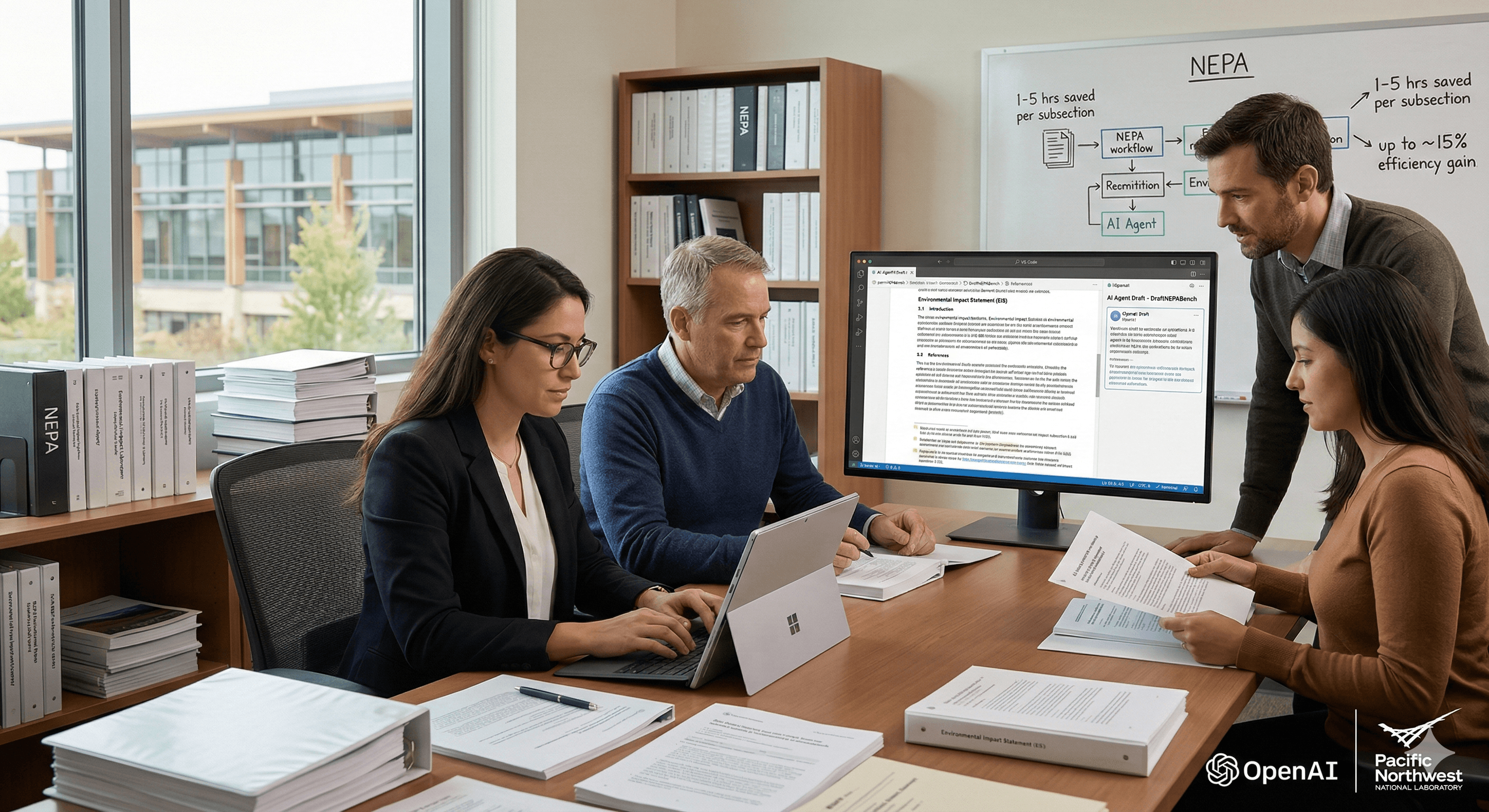
DraftNEPABench is a benchmark from OpenAI and Pacific Northwest National Laboratory that tests whether AI agents can accelerate NEPA permitting workflows. Across representative drafting tasks spanning 18 federal agencies, experts found coding agents could save 1–5 hours per subsection—up to roughly a 15% reduction in drafting time—while keeping human reviewers in control.
Permitting is one of the biggest bottlenecks in delivering infrastructure—whether that’s energy projects, transport upgrades, water systems, or new manufacturing capacity. Much of the delay is not a lack of ambition. It’s the sheer volume of technical and regulatory drafting required for environmental review.
On 26 February 2026, OpenAI and the U.S. Department of Energy’s Pacific Northwest National Laboratory (PNNL) announced DraftNEPABench: a benchmark designed to evaluate whether AI agents can meaningfully speed up NEPA drafting tasks, without compromising the accuracy and reference standards those documents require.
Early findings are promising. Across a representative set of tasks spanning NEPA document sections from 18 federal agencies, subject-matter experts found generalised coding agents could reduce drafting time by up to roughly 15%—equating to 1–5 hours saved per subsection.
What is DraftNEPABench?
DraftNEPABench is a structured benchmark for assessing how well AI models perform on document-heavy NEPA drafting tasks, such as sections of environmental impact statements.
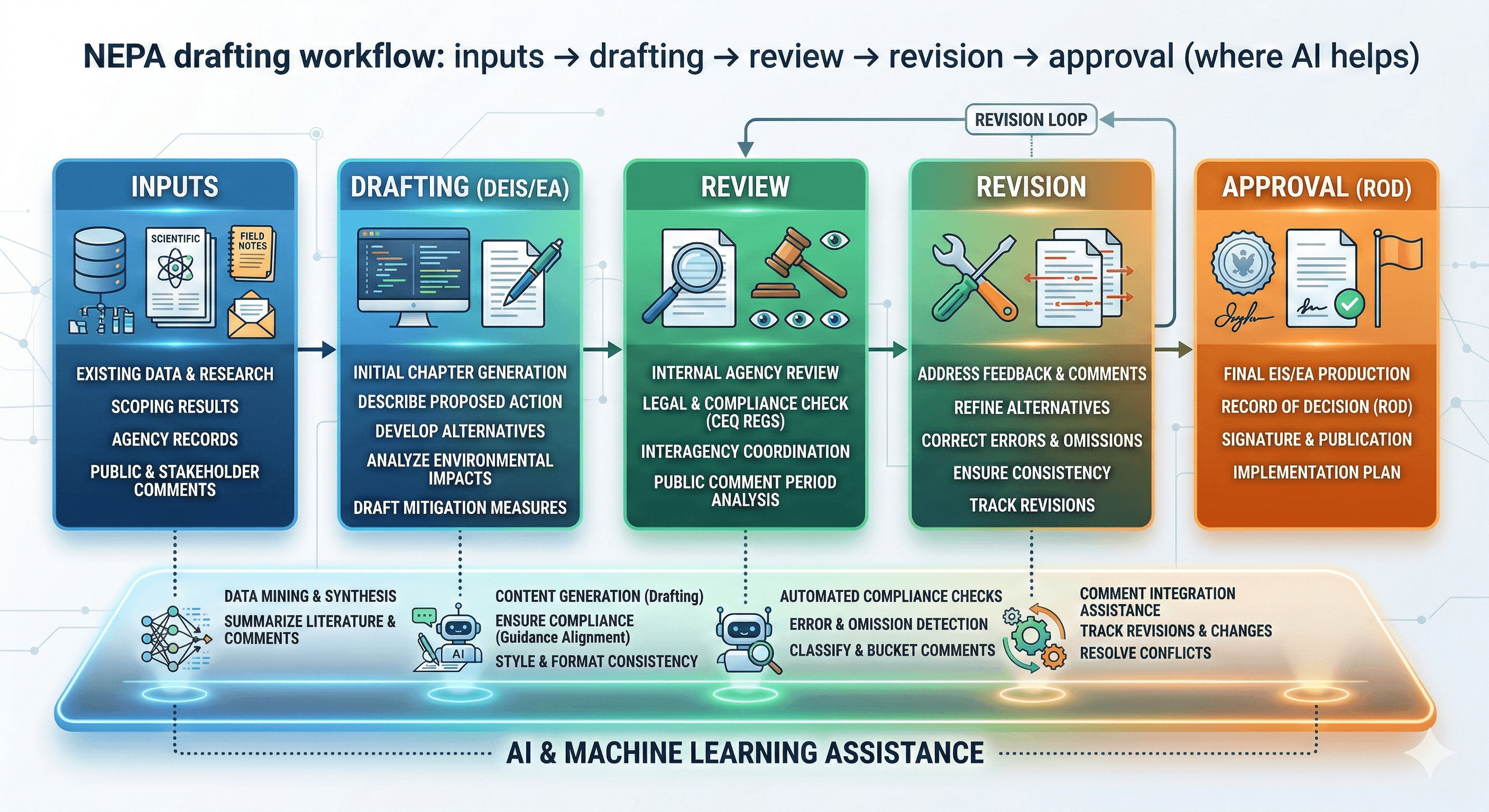
It is built to reflect real-world requirements where drafting isn’t just writing—it involves:
reading and synthesising hundreds of pages of technical material
verifying facts across environmental, engineering and regulatory sources
producing structured outputs that meet detailed legal and technical criteria
citing the right references clearly
Why this matters now
1) Permitting speed affects national delivery capacity
When reviews take years, costs rise, projects stall, and communities wait longer for benefits.
DraftNEPABench is framed as an attempt to modernise the drafting portion of the workflow—so experts can focus more on judgement, oversight, and decision quality.
2) AI is moving into “physical world” decision chains
As AI systems influence planning and delivery in the physical world, the bar for accuracy and reference integrity rises. DraftNEPABench is designed to make those capabilities measurable.
How DraftNEPABench tests AI performance
OpenAI and PNNL’s PermitAI™ team built the benchmark with 19 subject matter experts familiar with NEPA review. Rather than testing vague “writing ability”, the benchmark focuses on well-specified drafting work where relevant context is provided.
A key implementation detail is the use of generalised coding agents (tested using Codex CLI) to unlock strong performance on research, analysis and drafting tasks that involve a file system—similar to how permitting teams work with documents and sources.
DraftNEPABench also uses a scoring approach that evaluates drafts against criteria like:
structure
clarity
accuracy
use of references
What the “15% time saving” actually means
The headline statistic can be easy to misread.
The benchmark does not claim AI completes full permitting decisions. It suggests that for drafting tasks with available context, agents can reduce the drafting workload by:
1–5 hours per subsection
up to roughly 15% reduction in drafting time
In practice, that points to an assistant model where AI handles the time-consuming first draft and evidence formatting—while humans remain accountable for judgement and final sign-off.
Practical steps for organisations exploring AI in permitting workflows
If you work with regulated, document-heavy review processes (government or industry), DraftNEPABench is useful as a reference model.
Step 1: Identify the drafting bottlenecks
Start with the parts of the workflow that are repetitive but high-effort:
summarising technical reports
cross-checking citations and references
drafting standardised sections and templates
Step 2: Establish governance before scaling
For sensitive workflows, guardrails are non-negotiable:
define which source systems are authorised
require references for factual claims
implement audit logs and version control
keep human review and sign-off mandatory
Step 3: Design the workflow for review, not autopilot
AI is most useful when it produces outputs that are easy for experts to validate.
Aim for:
structured drafts with clear headings
reference lists and traceability
clear “unknowns” or gaps flagged for humans
Step 4: Operationalise delivery with the right tools
If you want AI-enabled drafting to reduce timelines in practice, you need a clear operating rhythm:
Track tasks, owners and approvals in Asana
Maintain policy and decision logs in Notion
Use Miro for cross-functional review workshops and review maps
Improve retrieval of approved sources using Glean (where appropriate)
Limitations to keep in mind
OpenAI notes that DraftNEPABench evaluates model capability on well-specified tasks where relevant context is available. Real-world deployments involve more ambiguity, discretion, and iterative expert feedback.
The benchmark also surfaced a common issue: if references are incomplete or out of date, models may not reliably identify those discrepancies unless explicitly instructed.
How Generation Digital can help
Even if your organisation doesn’t work in US federal permitting, DraftNEPABench offers a clear blueprint for introducing AI into complex document workflows safely.
Generation Digital can help you:
evaluate AI use cases and time-saving potential
set governance and approval workflows
design “review-first” drafting systems
train teams on AI-safe writing and verification practices
Summary
DraftNEPABench is a benchmark from OpenAI and PNNL designed to test whether AI agents can accelerate NEPA drafting workflows. Early results show potential time savings of 1–5 hours per subsection—up to roughly 15%—while keeping human experts responsible for review and approval.
Next steps: If you want to apply the same principles to your own regulated documentation processes, speak to Generation Digital about workflow design, governance, and rollout.
FAQs
Q1: How does AI reduce permitting time?
AI can generate structured first drafts, synthesise long technical sources, and format references quickly—reducing manual effort for repetitive drafting steps while leaving judgement and final approval to experts.
Q2: What is NEPA?
NEPA stands for the National Environmental Policy Act, a US law requiring federal agencies to assess the environmental effects of proposed actions before making decisions.
Q3: Who developed DraftNEPABench?
DraftNEPABench was developed by OpenAI in partnership with the U.S. Department of Energy’s Pacific Northwest National Laboratory (PNNL) and its PermitAI™ team.
Q4: Does DraftNEPABench replace human reviewers?
No. The benchmark is designed to measure drafting support. The model still requires expert oversight, validation, and sign-off—especially where decisions have legal, environmental, or public impact.
Q5: What’s the key risk to manage?
Source quality. If inputs are incomplete or out of date, AI may produce confident drafts that require careful verification. Controls like reference requirements and audit logs help manage this.
Recibe noticias y consejos sobre IA cada semana en tu bandeja de entrada
Al suscribirte, das tu consentimiento para que Generation Digital almacene y procese tus datos de acuerdo con nuestra política de privacidad. Puedes leer la política completa en gend.co/privacy.



Generación
Digital

Oficina en Reino Unido
Generation Digital Ltd
33 Queen St,
Londres
EC4R 1AP
Reino Unido
Oficina en Canadá
Generation Digital Americas Inc
181 Bay St., Suite 1800
Toronto, ON, M5J 2T9
Canadá
Oficina en EE. UU.
Generation Digital Américas Inc
77 Sands St,
Brooklyn, NY 11201,
Estados Unidos
Oficina de la UE
Software Generación Digital
Edificio Elgee
Dundalk
A91 X2R3
Irlanda
Oficina en Medio Oriente
6994 Alsharq 3890,
An Narjis,
Riad 13343,
Arabia Saudita






Número de la empresa: 256 9431 77 | Derechos de autor 2026 | Términos y Condiciones | Política de Privacidad