Unlock Enterprise AI Potential with OpenAI on ServiceNow

Unlock Enterprise AI Potential with OpenAI on ServiceNow

OpenAI

20 ene 2026

Four people are working together in a modern office with laptops and a tablet on the table, illustrating collaboration and technology integration, highlighting the potential of AI solutions in enterprise settings.

¿No sabes por dónde empezar con la IA?
Evalúa preparación, riesgos y prioridades en menos de una hora.

¿No sabes por dónde empezar con la IA?
Evalúa preparación, riesgos y prioridades en menos de una hora.

➔ Descarga nuestro paquete gratuito de preparación para IA

ServiceNow and OpenAI have signed a multi‑year agreement to expand enterprise access to OpenAI frontier models inside the ServiceNow platform. The partnership enhances AI-driven workflows across summarisation, search and voice—helping teams resolve issues faster, find answers more reliably, and interact with workflows using natural language in secure, governed environments.

Enterprise AI only creates value when it’s embedded in work—not bolted on as a side tool.

That’s why the latest ServiceNow + OpenAI collaboration matters. ServiceNow has announced a multi‑year agreement with OpenAI to expand customer access to frontier models across the ServiceNow platform, improving how organisations summarise, search and interact with workflows through voice.

For enterprises already running critical IT, HR and customer service operations on ServiceNow, this is a direct path from AI experimentation to measurable outcomes.

What’s been announced?

ServiceNow and OpenAI have expanded their collaboration through a multi‑year agreement that increases customer access to OpenAI models within ServiceNow. The focus is practical: improved summarisation, search, and voice experiences built into workflows.

In plain terms: instead of copying data into external tools, teams can use OpenAI-powered assistance where the work already happens.
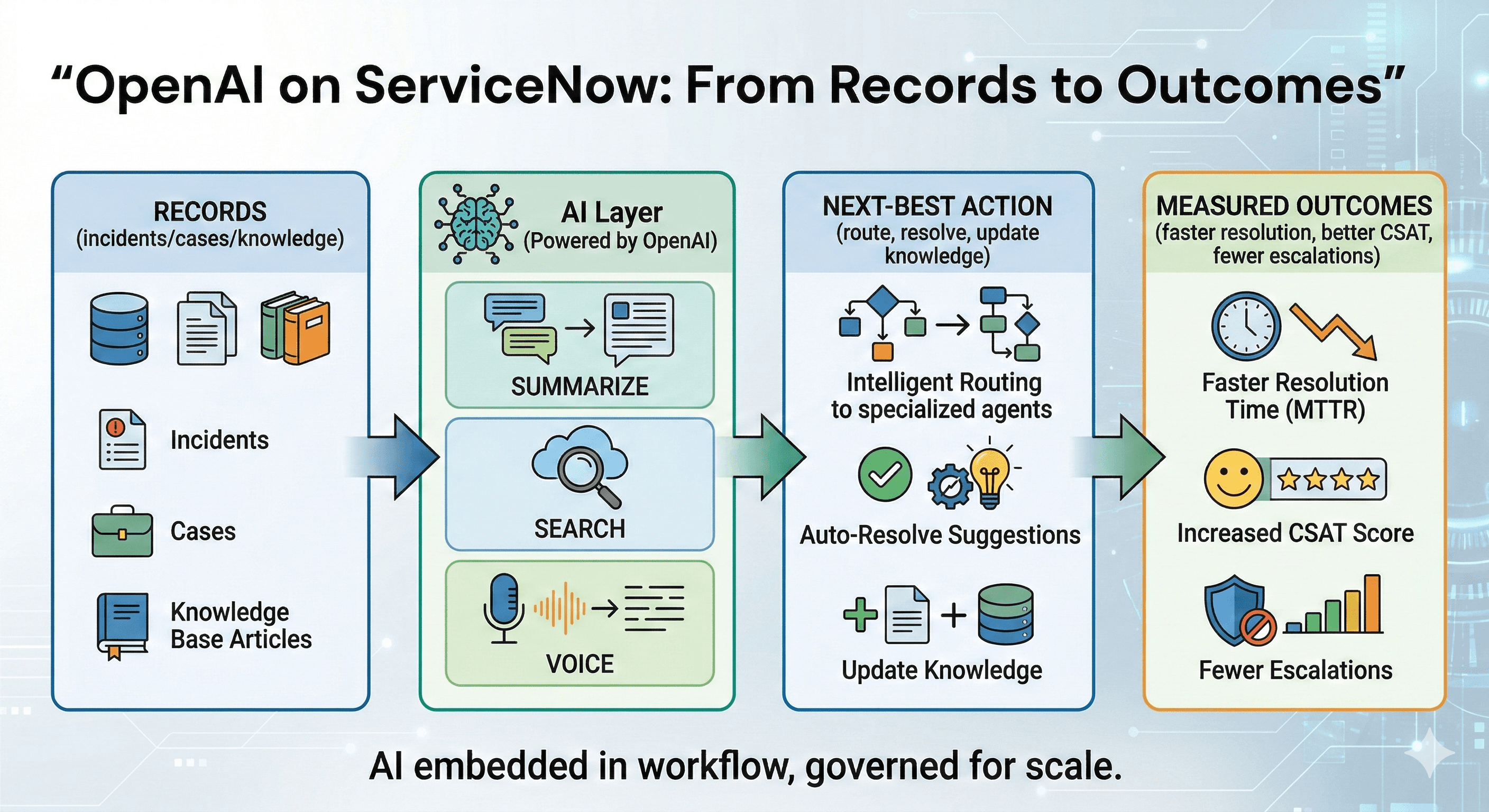
Why this matters for enterprise workflows

The highest ROI AI use cases in large organisations tend to be:

  • high-volume,

  • repeatable,

  • and deeply tied to systems of record.

ServiceNow is exactly that kind of environment.

By embedding OpenAI models into workflows, teams can reduce friction in three common bottlenecks:

1) Summarisation that speeds resolution

Incidents, cases and knowledge articles are information-dense. Better summarisation reduces time-to-triage and improves handoffs—especially across shifts and distributed teams.

2) Search that returns actionable answers

Enterprise search fails when it returns ten links and no guidance. AI-driven answers and summaries can help employees get to “what to do next” faster.

3) Voice as an interface to work

Voice isn’t a gimmick when it’s used to help employees ask questions in natural language and trigger the next step in a workflow—particularly in service and operational contexts.

How it works (without the hype)

The partnership expands access to OpenAI models as an intelligence capability inside ServiceNow.

What this typically enables in practice:

  • natural-language interaction with workflows,

  • AI summarisation and content generation for key record types,

  • improved retrieval and “answer-first” search experiences,

  • and voice interactions that reduce typing and speed decisions.

The value isn’t that the AI is “smarter” in the abstract—it’s that it is deployed in a governed platform with the right context and controls.

Practical use cases to start with

If you want quick wins, begin with workflows that are easy to measure.

IT Service Management (ITSM)

  • Incident summaries and next-step suggestions

  • Faster knowledge article generation and updates

  • Improved search for known errors and resolutions

Customer Service Management (CSM)

  • Case summaries for faster handoff

  • Drafting customer replies with consistent tone

  • Knowledge search for agents during live interactions

HR Service Delivery (HRSD)

  • Policy Q&A grounded in approved documents

  • Draft responses for common requests

  • Faster triage and routing

A rollout playbook for ServiceNow customers

Step 1: Choose 3 workflows with clear metrics

Examples of measurable outcomes:

  • time-to-triage,

  • time-to-resolution,

  • first-contact resolution,

  • reduced backlog,

  • improved employee satisfaction.

Step 2: Define governance before scaling

A workable baseline includes:

  • which use cases are approved,

  • what data is in scope,

  • what requires human review,

  • logging/monitoring expectations,

  • and named owners for each capability.

Step 3: Build repeatable templates

Standardise what “good” looks like:

  • summary formats,

  • response templates,

  • escalation rules,

  • and verification checklists.

Step 4: Train teams in safe, consistent use

Short, role-based training is usually more effective than broad “AI awareness” sessions.

Step 5: Scale what works

Once you can demonstrate impact in three workflows, expand to additional departments and record types.

Where your collaboration stack fits

Scaling AI is a change programme.

  • Use Asana to track rollout ownership, dependencies and success measures.

  • Use Miro to map workflows, handoffs and governance patterns.

  • Use Notion to publish playbooks, templates and “known-good” examples.

  • Use Glean to surface trusted knowledge so AI outputs can be grounded in approved sources.

Summary

ServiceNow’s expanded collaboration with OpenAI is a pragmatic step towards enterprise AI that actually delivers: frontier model capabilities embedded in workflows, improving summarisation, search and voice so teams can resolve work faster and more consistently.

If you want help prioritising use cases, setting governance, and rolling out adoption with measurable outcomes, Generation Digital can support you end-to-end.

Next steps

  • Identify 3 workflows to optimise.

  • Define approved data and review steps.

  • Standardise templates and success metrics.

  • Pilot, measure, then scale.

FAQ

Q1: What benefits does the integration provide?
It expands access to OpenAI models inside ServiceNow to improve summarisation, search and voice interactions, helping teams work faster and more consistently.

Q2: How does this affect existing ServiceNow users?
Existing users can access enhanced AI capabilities within their existing workflows, typically without needing major process changes—though governance and training are essential for safe scale.

Q3: What are the potential use cases?
Common starting points include incident and case summarisation, AI-assisted enterprise search, and natural-language/voice interactions that help employees take the next step in a workflow.

Q4: Is this just for IT?
No. While ITSM is a natural entry point, similar patterns apply to HR service delivery, customer service, procurement and other high-volume workflows.

Q5: How do we make sure the rollout is safe?
Start with low-risk workflows, define data boundaries and human review points, use logging/monitoring, and scale only once you can prove consistent quality and measurable outcomes.

ServiceNow and OpenAI have signed a multi‑year agreement to expand enterprise access to OpenAI frontier models inside the ServiceNow platform. The partnership enhances AI-driven workflows across summarisation, search and voice—helping teams resolve issues faster, find answers more reliably, and interact with workflows using natural language in secure, governed environments.

Enterprise AI only creates value when it’s embedded in work—not bolted on as a side tool.

That’s why the latest ServiceNow + OpenAI collaboration matters. ServiceNow has announced a multi‑year agreement with OpenAI to expand customer access to frontier models across the ServiceNow platform, improving how organisations summarise, search and interact with workflows through voice.

For enterprises already running critical IT, HR and customer service operations on ServiceNow, this is a direct path from AI experimentation to measurable outcomes.

What’s been announced?

ServiceNow and OpenAI have expanded their collaboration through a multi‑year agreement that increases customer access to OpenAI models within ServiceNow. The focus is practical: improved summarisation, search, and voice experiences built into workflows.

In plain terms: instead of copying data into external tools, teams can use OpenAI-powered assistance where the work already happens.

Why this matters for enterprise workflows

The highest ROI AI use cases in large organisations tend to be:

  • high-volume,

  • repeatable,

  • and deeply tied to systems of record.

ServiceNow is exactly that kind of environment.

By embedding OpenAI models into workflows, teams can reduce friction in three common bottlenecks:

1) Summarisation that speeds resolution

Incidents, cases and knowledge articles are information-dense. Better summarisation reduces time-to-triage and improves handoffs—especially across shifts and distributed teams.

2) Search that returns actionable answers

Enterprise search fails when it returns ten links and no guidance. AI-driven answers and summaries can help employees get to “what to do next” faster.

3) Voice as an interface to work

Voice isn’t a gimmick when it’s used to help employees ask questions in natural language and trigger the next step in a workflow—particularly in service and operational contexts.

How it works (without the hype)

The partnership expands access to OpenAI models as an intelligence capability inside ServiceNow.

What this typically enables in practice:

  • natural-language interaction with workflows,

  • AI summarisation and content generation for key record types,

  • improved retrieval and “answer-first” search experiences,

  • and voice interactions that reduce typing and speed decisions.

The value isn’t that the AI is “smarter” in the abstract—it’s that it is deployed in a governed platform with the right context and controls.

Practical use cases to start with

If you want quick wins, begin with workflows that are easy to measure.

IT Service Management (ITSM)

  • Incident summaries and next-step suggestions

  • Faster knowledge article generation and updates

  • Improved search for known errors and resolutions

Customer Service Management (CSM)

  • Case summaries for faster handoff

  • Drafting customer replies with consistent tone

  • Knowledge search for agents during live interactions

HR Service Delivery (HRSD)

  • Policy Q&A grounded in approved documents

  • Draft responses for common requests

  • Faster triage and routing

A rollout playbook for ServiceNow customers

Step 1: Choose 3 workflows with clear metrics

Examples of measurable outcomes:

  • time-to-triage,

  • time-to-resolution,

  • first-contact resolution,

  • reduced backlog,

  • improved employee satisfaction.

Step 2: Define governance before scaling

A workable baseline includes:

  • which use cases are approved,

  • what data is in scope,

  • what requires human review,

  • logging/monitoring expectations,

  • and named owners for each capability.

Step 3: Build repeatable templates

Standardise what “good” looks like:

  • summary formats,

  • response templates,

  • escalation rules,

  • and verification checklists.

Step 4: Train teams in safe, consistent use

Short, role-based training is usually more effective than broad “AI awareness” sessions.

Step 5: Scale what works

Once you can demonstrate impact in three workflows, expand to additional departments and record types.

Where your collaboration stack fits

Scaling AI is a change programme.

  • Use Asana to track rollout ownership, dependencies and success measures.

  • Use Miro to map workflows, handoffs and governance patterns.

  • Use Notion to publish playbooks, templates and “known-good” examples.

  • Use Glean to surface trusted knowledge so AI outputs can be grounded in approved sources.

Summary

ServiceNow’s expanded collaboration with OpenAI is a pragmatic step towards enterprise AI that actually delivers: frontier model capabilities embedded in workflows, improving summarisation, search and voice so teams can resolve work faster and more consistently.

If you want help prioritising use cases, setting governance, and rolling out adoption with measurable outcomes, Generation Digital can support you end-to-end.

Next steps

  • Identify 3 workflows to optimise.

  • Define approved data and review steps.

  • Standardise templates and success metrics.

  • Pilot, measure, then scale.

FAQ

Q1: What benefits does the integration provide?
It expands access to OpenAI models inside ServiceNow to improve summarisation, search and voice interactions, helping teams work faster and more consistently.

Q2: How does this affect existing ServiceNow users?
Existing users can access enhanced AI capabilities within their existing workflows, typically without needing major process changes—though governance and training are essential for safe scale.

Q3: What are the potential use cases?
Common starting points include incident and case summarisation, AI-assisted enterprise search, and natural-language/voice interactions that help employees take the next step in a workflow.

Q4: Is this just for IT?
No. While ITSM is a natural entry point, similar patterns apply to HR service delivery, customer service, procurement and other high-volume workflows.

Q5: How do we make sure the rollout is safe?
Start with low-risk workflows, define data boundaries and human review points, use logging/monitoring, and scale only once you can prove consistent quality and measurable outcomes.

Recibe noticias y consejos sobre IA cada semana en tu bandeja de entrada

Al suscribirte, das tu consentimiento para que Generation Digital almacene y procese tus datos de acuerdo con nuestra política de privacidad. Puedes leer la política completa en gend.co/privacy.


Próximos talleres y seminarios web

A diverse group of professionals collaborating around a table in a bright, modern office setting.

Claridad Operacional a Gran Escala - Asana

Webinar Virtual
Miércoles 25 de febrero de 2026
En línea

A diverse group of professionals collaborating around a table in a bright, modern office setting.

Trabaja con compañeros de equipo de IA - Asana

Taller Presencial
Jueves 26 de febrero de 2026
Londres, Reino Unido

A diverse group of professionals collaborating around a table in a bright, modern office setting.

De Idea a Prototipo: IA en Miro

Seminario Web Virtual
Miércoles 18 de febrero de 2026
En línea

Generación
Digital

Oficina en Reino Unido

Generation Digital Ltd
33 Queen St,
Londres
EC4R 1AP
Reino Unido

Oficina en Canadá

Generation Digital Americas Inc
181 Bay St., Suite 1800
Toronto, ON, M5J 2T9
Canadá

Oficina en EE. UU.

Generation Digital Américas Inc
77 Sands St,
Brooklyn, NY 11201,
Estados Unidos

Oficina de la UE

Software Generación Digital
Edificio Elgee
Dundalk
A91 X2R3
Irlanda

Oficina en Medio Oriente

6994 Alsharq 3890,
An Narjis,
Riad 13343,
Arabia Saudita

UK Fast Growth Index UBS Logo
Financial Times FT 1000 Logo
Febe Growth 100 Logo (Background Removed)

Número de la empresa: 256 9431 77 | Derechos de autor 2026 | Términos y Condiciones | Política de Privacidad

Generación
Digital

Oficina en Reino Unido

Generation Digital Ltd
33 Queen St,
Londres
EC4R 1AP
Reino Unido

Oficina en Canadá

Generation Digital Americas Inc
181 Bay St., Suite 1800
Toronto, ON, M5J 2T9
Canadá

Oficina en EE. UU.

Generation Digital Américas Inc
77 Sands St,
Brooklyn, NY 11201,
Estados Unidos

Oficina de la UE

Software Generación Digital
Edificio Elgee
Dundalk
A91 X2R3
Irlanda

Oficina en Medio Oriente

6994 Alsharq 3890,
An Narjis,
Riad 13343,
Arabia Saudita

UK Fast Growth Index UBS Logo
Financial Times FT 1000 Logo
Febe Growth 100 Logo (Background Removed)


Número de Empresa: 256 9431 77
Términos y Condiciones
Política de Privacidad
Derechos de Autor 2026




