New Miroverse Templates (2026): Flows, Sidekicks & Wins
Miro
¿No sabes por dónde empezar con la IA?Evalúa preparación, riesgos y prioridades en menos de una hora.
➔ Descarga nuestro paquete gratuito de preparación para IA
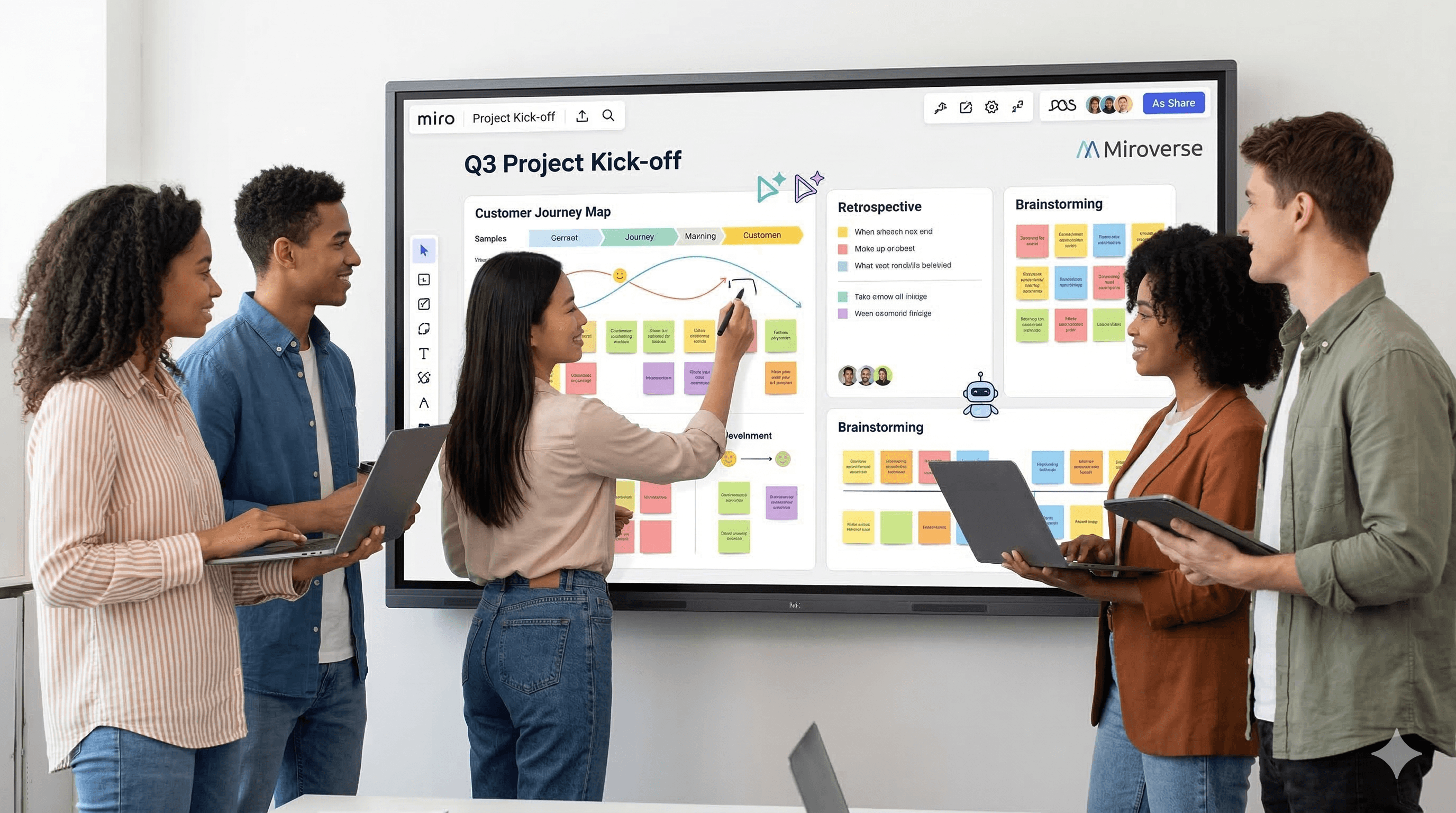
Miroverse is Miro’s template gallery, where teams can start faster with proven boards for planning, workshops and delivery. The latest templates increasingly include Flows (multi‑step workflows that do the busy work) and Sidekicks (AI agents that help teams think, summarise and create). Together, they turn templates into repeatable systems.
Templates aren’t just about saving five minutes at the start of a workshop. In 2026, they’re becoming a way to standardise how teams plan, decide and deliver — with AI doing more of the repetitive work.
That’s the promise behind the latest wave of Miroverse templates. Beyond fresh boards for planning and collaboration, many of the newest templates now build in Flows and Sidekicks — so you can move from “blank canvas” to “repeatable workflow” far more quickly.
What is Miroverse?
Miroverse is Miro’s template gallery where you can browse and reuse thousands of ready‑made boards. Instead of inventing a format every time, you can start with a proven structure — and customise it for your team.
The big shift is that templates are no longer purely static. Increasingly, they include interactive or AI‑accelerated elements that help you produce consistent outputs with less manual effort.
What’s new: Flows and Sidekicks (and why they matter)
Flows: multi-step workflows that keep work moving
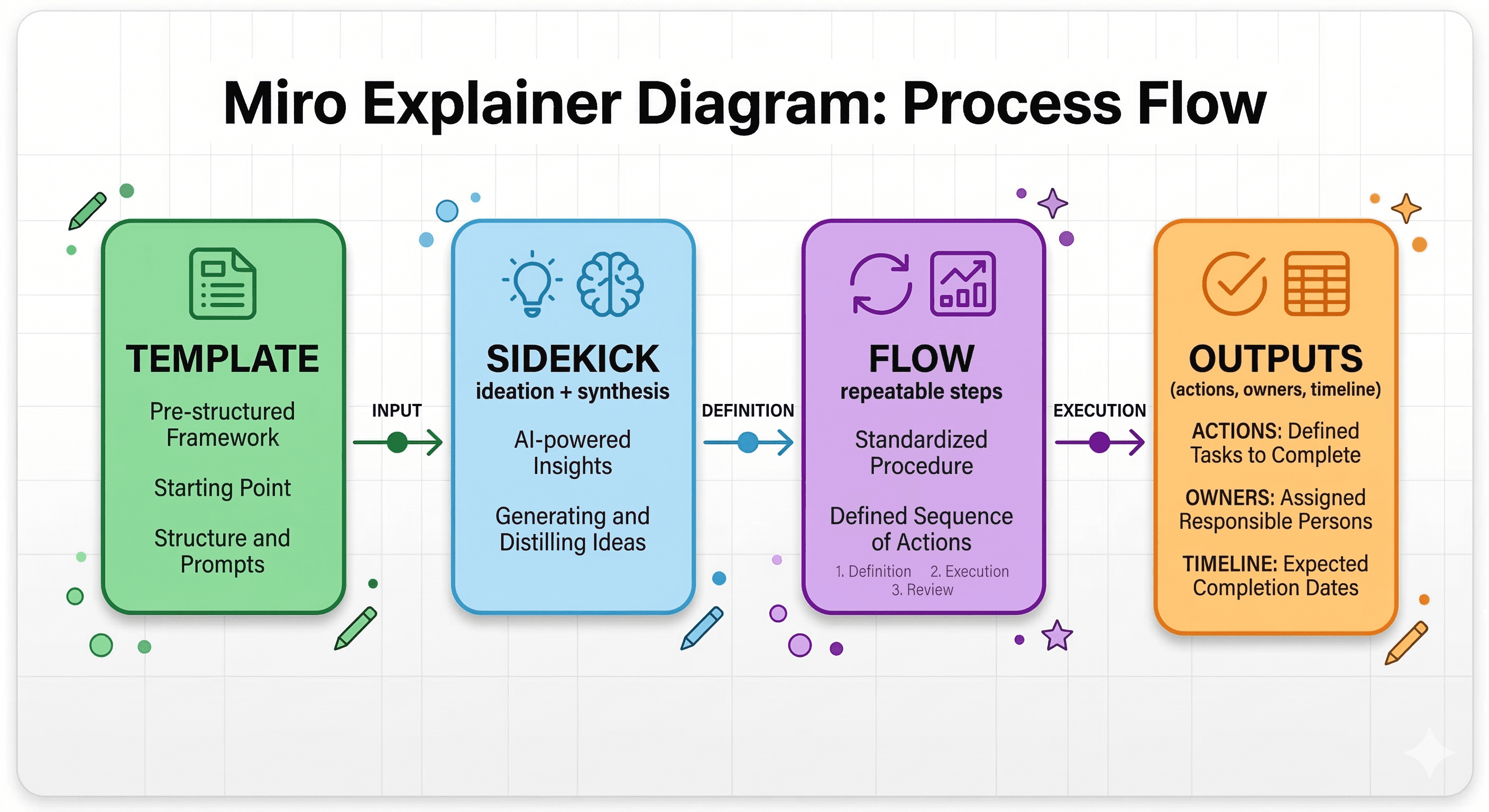
Flows turn a template into a guided process. Rather than asking a team to remember each step (“cluster themes, write insights, translate into actions”), a Flow can run those steps on the canvas and pass structured output forward.
That makes Flows especially useful for:
Workshop synthesis (notes → themes → insights → actions)
Planning cycles (objectives → initiatives → milestones → owners)
Repeatable analysis (customer feedback → patterns → opportunities)
Sidekicks: AI agents that collaborate on the canvas
Sidekicks are AI helpers that work alongside your team on the board. They can support exploratory thinking and “first draft” creation: summarising content, challenging assumptions, drafting a plan, or helping you turn rough ideas into structured artefacts.
In practice, Sidekicks are most valuable when:
You want fast synthesis without losing context
You need a second opinion (“what am I missing?”)
You’re creating a repeatable facilitation rhythm across teams
Why “new templates” can improve real workflows
Most workflow friction isn’t caused by a lack of ideas — it’s caused by inconsistency.
One team runs a brilliant retrospective. Another runs a messy one. A third skips it entirely because they don’t know where to start.
Templates fix that by providing a shared starting point. Flows and Sidekicks take it further by:
Reducing the facilitator burden
Turning best practice into repeatable steps
Producing more consistent outputs (not just nicer boards)
How to use the latest Miroverse templates (step by step)
1) Start with the work you repeat most
Pick one recurring workflow that has a clear output:
Sprint planning
Quarterly OKR planning
Project kick-off
Weekly prioritisation
Discovery synthesis
2) Choose a template that already matches your format
In Miroverse, search by outcome (e.g. “roadmap”, “retro”, “OKRs”), not by department. You’re looking for a structure that fits your decision-making style.
3) Look for AI-accelerated templates first
If your team is already using Miro AI, choose templates that include:
A Flow that runs the repeatable steps
Sidekicks that help with synthesis, drafting, or review
This helps you avoid building automation from scratch.
4) Customise once, then standardise
The best approach is:
Adapt the template for your terminology and governance
Save it as your organisation’s “default” version
Reuse it consistently for 4–6 cycles before you change anything
5) Add light governance (so it scales)
To keep quality high:
Define who can run Flows in production boards
Set naming conventions for outputs (actions, decisions, owners)
Add a quick review step for anything that’s published externally
Practical examples you can try this week
Example 1: Turn workshop notes into an action plan
Use a template that supports synthesis. Run a Flow (or ask a Sidekick) to:
Cluster notes into themes
Draft 3–5 insights with evidence
Convert insights into actions with owners and dates
Example 2: Make quarterly planning less chaotic
Start with a planning or OKR template. Use Sidekicks to draft first‑pass objectives, then use a Flow to structure:
Initiatives
Milestones
Risks and dependencies
Example 3: Standardise project kick-offs
Pick one kick-off board and make it your default.
Sidekicks can create an initial brief, while Flows can ensure every kick‑off captures the essentials: scope, success metrics, stakeholders, and next actions.
Common pitfalls (and how to avoid them)
Trying to adopt 20 templates at once
Pick one workflow. Make it excellent. Then expand.
Letting AI outputs become “the truth”
Use Sidekicks and Flows to accelerate creation — but keep human review for decisions, commitments and anything customer-facing.
Forgetting to measure impact
Track one simple metric for 4–6 weeks:
Less time spent in workshops
Faster time to action
Fewer rework cycles
Better stakeholder clarity
Summary
The newest Miroverse templates aren’t just more boards — they’re a move towards repeatable, AI‑accelerated workflows. By combining proven formats with Flows (multi‑step processes) and Sidekicks (on‑canvas AI agents), teams can plan and deliver faster with more consistent outputs.
Next steps (Generation Digital): If you want help choosing templates, building a rollout plan, or designing safe usage patterns for Flows and Sidekicks, Generation Digital can support adoption, enablement and governance.
FAQs
1) What are Flows and Sidekicks in Miroverse?
Flows are multi-step workflows that guide repeatable tasks on the canvas (for example, turning notes into insights and actions). Sidekicks are AI agents that collaborate with teams on the board, helping with synthesis, drafting and structured thinking.
2) How can I access the new Miroverse templates?
Open Miroverse from Miro’s templates gallery, then browse by category or search by outcome (roadmaps, planning, retrospectives, research synthesis). Choose a template and apply it to a new or existing board.
3) Who creates Miroverse templates?
Templates come from a mix of Miro and the Miro community (creators and experts). That variety is useful — it means you can adopt templates that reflect real facilitation styles across different teams and industries.
4) Do Flows and Sidekicks work for Enterprise teams?
Yes — but treat them like any enterprise capability: start with a pilot workflow, apply light governance, and standardise patterns before scaling across departments.
5) What’s the best first template to adopt?
Choose the workflow you repeat most (planning, kick-offs, retros) and pick a template that produces a clear output. Standardise that one template first, then expand.
Recibe noticias y consejos sobre IA cada semana en tu bandeja de entrada
Al suscribirte, das tu consentimiento para que Generation Digital almacene y procese tus datos de acuerdo con nuestra política de privacidad. Puedes leer la política completa en gend.co/privacy.



Generación
Digital

Oficina en Reino Unido
Generation Digital Ltd
33 Queen St,
Londres
EC4R 1AP
Reino Unido
Oficina en Canadá
Generation Digital Americas Inc
181 Bay St., Suite 1800
Toronto, ON, M5J 2T9
Canadá
Oficina en EE. UU.
Generation Digital Américas Inc
77 Sands St,
Brooklyn, NY 11201,
Estados Unidos
Oficina de la UE
Software Generación Digital
Edificio Elgee
Dundalk
A91 X2R3
Irlanda
Oficina en Medio Oriente
6994 Alsharq 3890,
An Narjis,
Riad 13343,
Arabia Saudita







Número de la empresa: 256 9431 77 | Derechos de autor 2026 | Términos y Condiciones | Política de Privacidad