Accenture + Mistral AI: What the Deal Means for AI

Accenture + Mistral AI: What the Deal Means for AI

Mistral

4 mars 2026

Two business professionals analyze strategic documents and a European map in a modern office, reflecting on Accenture and Mistral AI's potential impact in the AI industry.

Pas sûr de quoi faire ensuite avec l'IA?Évaluez la préparation, les risques et les priorités en moins d'une heure.

Pas sûr de quoi faire ensuite avec l'IA?Évaluez la préparation, les risques et les priorités en moins d'une heure.

➔ Téléchargez notre kit de préparation à l'IA gratuit

Accenture and Mistral AI have announced a multi-year collaboration to help organisations scale advanced AI securely, with deployments aligned to regional requirements and designed to support “strategic autonomy”. For buyers, it’s a signal that sovereign AI is moving from policy talk to delivery — but success still depends on governance, architecture, and clear use cases. (newsroom.accenture.com)

Accenture and Mistral AI have announced a multi-year strategic collaboration aimed at helping organisations scale advanced AI securely and at enterprise scale — with deployments aligned to regional requirements and framed around “strategic autonomy”.

This is more than a press-release partnership. It’s a marker of where the enterprise market is heading in 2026:

  • AI is moving from pilots to production

  • Regulators are tightening expectations around data, controls and transparency

  • And European organisations increasingly want options that reduce dependence on a single technology geography

If you’re a CIO, CDO or Head of Transformation, the important question isn’t “is Mistral good?” It’s “what does this deal make easier — and what do we still have to solve ourselves?”

What was announced?

According to Accenture’s newsroom announcement, the companies will work together to help customers rapidly move to secure, large-scale AI deployments aligned with regional requirements. The collaboration is described as multi-year and strategic, with an explicit emphasis on delivering strategic autonomy for customers. (newsroom.accenture.com)

Independent reporting adds two useful clarifications:

  • The deal’s financial terms and exact duration were not disclosed.

  • Accenture will also become a Mistral customer and roll out Mistral technology internally for its own employees. (techcrunch.com)

Those details matter because they signal commitment beyond co-marketing: Accenture is putting Mistral models into real internal usage and client delivery.

Why this matters: “sovereign AI” is becoming operational
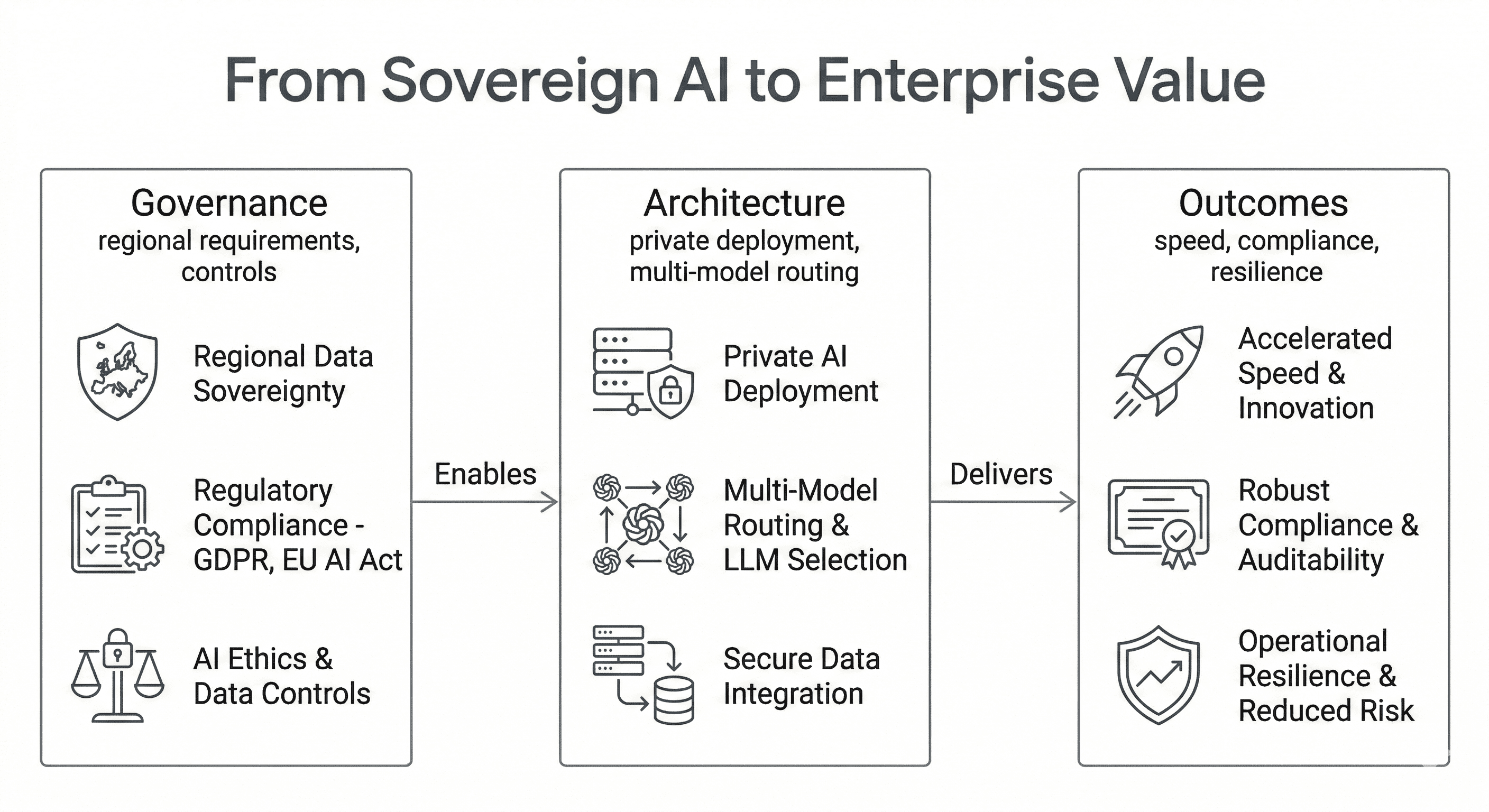
For the last 18 months, sovereign AI has often been discussed as a political or policy concept. This partnership positions it as a practical delivery agenda.

The shift is driven by three realities:

1) Data and compliance constraints don’t disappear in production

Teams can run pilots on almost any model. Scaling in a regulated environment (finance, healthcare, public sector, defence-adjacent) is where requirements bite: logging, permissions, data residency, retention, audit trails, and third-party risk.

A partnership that explicitly references “secure” and “aligned with regional requirements” is aimed straight at that pain. (newsroom.accenture.com)

2) Multi-model is normal — sovereignty is about choice, not purity

Enterprises increasingly run multiple models for different tasks (coding, summarisation, research, classification, customer service). The question becomes: can you route work to a model that fits the data, region, and risk profile?

In that context, Mistral isn’t a replacement for every model. It’s a strategic option that expands the portfolio — especially for workloads where self-hosting, regional control, or supplier diversity matters.

3) Partners matter because adoption is the hardest part

Mistral can build strong models. Accenture can operationalise them: architecture, security, change management, training, evaluation and measurement. That’s what makes “enterprise AI solutions” real rather than aspirational.

What does “strategic autonomy” mean for buyers?

In plain terms: reducing dependency risk.

Strategic autonomy in AI usually includes:

  • Deployment control: options for private / dedicated infrastructure and stronger control over where data flows

  • Supplier diversity: avoiding single-vendor lock-in for core workloads

  • Policy alignment: being able to meet regional governance expectations without bending your operating model

Accenture is leaning into this language because it reflects buyer reality — especially in Europe — where boards are increasingly asking whether AI capability is strategically resilient.

If you want the wider context, we’ve covered how sovereign AI is shaping enterprise decisions and why it’s not just a government topic anymore. (Internal link: Sovereign AI on gend.co.)

Practical implications: what this partnership makes easier

Based on the announcement, buyers can reasonably expect three things to become easier:

Faster path from pilot to production

A structured delivery partnership typically accelerates:

  • Reference architectures

  • Security patterns (identity, permissions, logging)

  • Model evaluation and governance templates

  • Industry-specific solution patterns

Enterprise-grade implementation support

This is where many AI programmes fail: not on model quality, but on everything around it — data readiness, integration, and adoption.

A stronger “European option” for regulated deployments

For organisations that want credible alternatives within a European ecosystem, this partnership gives them a large systems integrator plus a European model provider.

What still needs to be solved (and where teams get caught out)

Even with a strong partner ecosystem, you still need internal clarity.

Here are the common gaps:

1) Use-case prioritisation

“AI everywhere” is not a strategy. Pick workflows where:

  • the data is accessible and governable

  • the task repeats frequently

  • outcomes can be measured

2) Governance that works across vendors

If you adopt Mistral for sovereignty but your governance only works for one vendor’s tooling, you’ve created a new kind of lock-in. Set policy at the operating model level:

  • data classes and handling rules

  • approval paths for high-risk use

  • evaluation and monitoring

  • incident response and human oversight

3) Portability of prompts, profiles and evaluation sets

The organisations doing this well maintain a portable “AI profile” and prompt library, plus a small set of standard evaluation tasks. That’s what lets you compare models and switch without chaos.

(Internal link: AI as a utility / multi-model strategy on gend.co.)

How to evaluate whether sovereign AI is relevant to you

A simple test:

  • Do you handle regulated or sensitive data at scale?

  • Do you need regional control for legal, customer, or reputational reasons?

  • Would a forced vendor change in 30–90 days materially disrupt operations?

If you answered yes to any of those, sovereign AI isn’t just a nice-to-have — it’s a risk and resilience topic.

Next steps

If this partnership has prompted questions internally, a sensible approach is:

  1. Identify 3–5 candidate use cases (one quick win, one operational, one strategic)

  2. Define your minimum governance baseline (data, logging, permissions)

  3. Run a short model evaluation with measurable tasks

  4. Choose an architecture path (hosted vs private, single vs multi-model)

Generation Digital can help you translate sovereign AI from a headline into a delivery plan — including governance, evaluation, and adoption.

FAQs

What did Accenture and Mistral AI announce?
They announced a multi-year strategic collaboration to help organisations scale advanced AI securely, aligned with regional requirements, and positioned around strategic autonomy. (newsroom.accenture.com)

Will Accenture use Mistral internally?
Reporting indicates Accenture will become a Mistral customer and roll out Mistral technology for its employees; deal terms and duration were not disclosed. (techcrunch.com)

Is this mainly about sovereign AI in Europe?
The announcement emphasises regional requirements and autonomy, which strongly aligns with sovereign AI demand — particularly in Europe — but it’s also framed as supporting global enterprise scaling. (newsroom.accenture.com)

Does sovereign AI mean we can’t use US models?
No. Most enterprises run multi-model strategies. Sovereign AI is about having viable options and control paths for sensitive workloads.

How should enterprises evaluate a new model partner?
Use measurable tasks, standard evaluation sets, and a governance baseline that applies across vendors (data handling, logging, permissions, human oversight).

Accenture and Mistral AI have announced a multi-year collaboration to help organisations scale advanced AI securely, with deployments aligned to regional requirements and designed to support “strategic autonomy”. For buyers, it’s a signal that sovereign AI is moving from policy talk to delivery — but success still depends on governance, architecture, and clear use cases. (newsroom.accenture.com)

Accenture and Mistral AI have announced a multi-year strategic collaboration aimed at helping organisations scale advanced AI securely and at enterprise scale — with deployments aligned to regional requirements and framed around “strategic autonomy”.

This is more than a press-release partnership. It’s a marker of where the enterprise market is heading in 2026:

  • AI is moving from pilots to production

  • Regulators are tightening expectations around data, controls and transparency

  • And European organisations increasingly want options that reduce dependence on a single technology geography

If you’re a CIO, CDO or Head of Transformation, the important question isn’t “is Mistral good?” It’s “what does this deal make easier — and what do we still have to solve ourselves?”

What was announced?

According to Accenture’s newsroom announcement, the companies will work together to help customers rapidly move to secure, large-scale AI deployments aligned with regional requirements. The collaboration is described as multi-year and strategic, with an explicit emphasis on delivering strategic autonomy for customers. (newsroom.accenture.com)

Independent reporting adds two useful clarifications:

  • The deal’s financial terms and exact duration were not disclosed.

  • Accenture will also become a Mistral customer and roll out Mistral technology internally for its own employees. (techcrunch.com)

Those details matter because they signal commitment beyond co-marketing: Accenture is putting Mistral models into real internal usage and client delivery.

Why this matters: “sovereign AI” is becoming operational

For the last 18 months, sovereign AI has often been discussed as a political or policy concept. This partnership positions it as a practical delivery agenda.

The shift is driven by three realities:

1) Data and compliance constraints don’t disappear in production

Teams can run pilots on almost any model. Scaling in a regulated environment (finance, healthcare, public sector, defence-adjacent) is where requirements bite: logging, permissions, data residency, retention, audit trails, and third-party risk.

A partnership that explicitly references “secure” and “aligned with regional requirements” is aimed straight at that pain. (newsroom.accenture.com)

2) Multi-model is normal — sovereignty is about choice, not purity

Enterprises increasingly run multiple models for different tasks (coding, summarisation, research, classification, customer service). The question becomes: can you route work to a model that fits the data, region, and risk profile?

In that context, Mistral isn’t a replacement for every model. It’s a strategic option that expands the portfolio — especially for workloads where self-hosting, regional control, or supplier diversity matters.

3) Partners matter because adoption is the hardest part

Mistral can build strong models. Accenture can operationalise them: architecture, security, change management, training, evaluation and measurement. That’s what makes “enterprise AI solutions” real rather than aspirational.

What does “strategic autonomy” mean for buyers?

In plain terms: reducing dependency risk.

Strategic autonomy in AI usually includes:

  • Deployment control: options for private / dedicated infrastructure and stronger control over where data flows

  • Supplier diversity: avoiding single-vendor lock-in for core workloads

  • Policy alignment: being able to meet regional governance expectations without bending your operating model

Accenture is leaning into this language because it reflects buyer reality — especially in Europe — where boards are increasingly asking whether AI capability is strategically resilient.

If you want the wider context, we’ve covered how sovereign AI is shaping enterprise decisions and why it’s not just a government topic anymore. (Internal link: Sovereign AI on gend.co.)

Practical implications: what this partnership makes easier

Based on the announcement, buyers can reasonably expect three things to become easier:

Faster path from pilot to production

A structured delivery partnership typically accelerates:

  • Reference architectures

  • Security patterns (identity, permissions, logging)

  • Model evaluation and governance templates

  • Industry-specific solution patterns

Enterprise-grade implementation support

This is where many AI programmes fail: not on model quality, but on everything around it — data readiness, integration, and adoption.

A stronger “European option” for regulated deployments

For organisations that want credible alternatives within a European ecosystem, this partnership gives them a large systems integrator plus a European model provider.

What still needs to be solved (and where teams get caught out)

Even with a strong partner ecosystem, you still need internal clarity.

Here are the common gaps:

1) Use-case prioritisation

“AI everywhere” is not a strategy. Pick workflows where:

  • the data is accessible and governable

  • the task repeats frequently

  • outcomes can be measured

2) Governance that works across vendors

If you adopt Mistral for sovereignty but your governance only works for one vendor’s tooling, you’ve created a new kind of lock-in. Set policy at the operating model level:

  • data classes and handling rules

  • approval paths for high-risk use

  • evaluation and monitoring

  • incident response and human oversight

3) Portability of prompts, profiles and evaluation sets

The organisations doing this well maintain a portable “AI profile” and prompt library, plus a small set of standard evaluation tasks. That’s what lets you compare models and switch without chaos.

(Internal link: AI as a utility / multi-model strategy on gend.co.)

How to evaluate whether sovereign AI is relevant to you

A simple test:

  • Do you handle regulated or sensitive data at scale?

  • Do you need regional control for legal, customer, or reputational reasons?

  • Would a forced vendor change in 30–90 days materially disrupt operations?

If you answered yes to any of those, sovereign AI isn’t just a nice-to-have — it’s a risk and resilience topic.

Next steps

If this partnership has prompted questions internally, a sensible approach is:

  1. Identify 3–5 candidate use cases (one quick win, one operational, one strategic)

  2. Define your minimum governance baseline (data, logging, permissions)

  3. Run a short model evaluation with measurable tasks

  4. Choose an architecture path (hosted vs private, single vs multi-model)

Generation Digital can help you translate sovereign AI from a headline into a delivery plan — including governance, evaluation, and adoption.

FAQs

What did Accenture and Mistral AI announce?
They announced a multi-year strategic collaboration to help organisations scale advanced AI securely, aligned with regional requirements, and positioned around strategic autonomy. (newsroom.accenture.com)

Will Accenture use Mistral internally?
Reporting indicates Accenture will become a Mistral customer and roll out Mistral technology for its employees; deal terms and duration were not disclosed. (techcrunch.com)

Is this mainly about sovereign AI in Europe?
The announcement emphasises regional requirements and autonomy, which strongly aligns with sovereign AI demand — particularly in Europe — but it’s also framed as supporting global enterprise scaling. (newsroom.accenture.com)

Does sovereign AI mean we can’t use US models?
No. Most enterprises run multi-model strategies. Sovereign AI is about having viable options and control paths for sensitive workloads.

How should enterprises evaluate a new model partner?
Use measurable tasks, standard evaluation sets, and a governance baseline that applies across vendors (data handling, logging, permissions, human oversight).

Recevez chaque semaine des nouvelles et des conseils sur l'IA directement dans votre boîte de réception

En vous abonnant, vous consentez à ce que Génération Numérique stocke et traite vos informations conformément à notre politique de confidentialité. Vous pouvez lire la politique complète sur gend.co/privacy.


Génération
Numérique

Bureau du Royaume-Uni

Génération Numérique Ltée
33 rue Queen,
Londres
EC4R 1AP
Royaume-Uni

Bureau au Canada

Génération Numérique Amériques Inc
181 rue Bay, Suite 1800
Toronto, ON, M5J 2T9
Canada

Bureau aux États-Unis

Generation Digital Americas Inc
77 Sands St,
Brooklyn, NY 11201,
États-Unis

Bureau de l'UE

Génération de logiciels numériques
Bâtiment Elgee
Dundalk
A91 X2R3
Irlande

Bureau du Moyen-Orient

6994 Alsharq 3890,
An Narjis,
Riyad 13343,
Arabie Saoudite

UK Fast Growth Index UBS Logo
Financial Times FT 1000 Logo
Febe Growth 100 Logo (Background Removed)

Numéro d'entreprise : 256 9431 77 | Droits d'auteur 2026 | Conditions générales | Politique de confidentialité

Génération
Numérique

Bureau du Royaume-Uni

Génération Numérique Ltée
33 rue Queen,
Londres
EC4R 1AP
Royaume-Uni

Bureau au Canada

Génération Numérique Amériques Inc
181 rue Bay, Suite 1800
Toronto, ON, M5J 2T9
Canada

Bureau aux États-Unis

Generation Digital Americas Inc
77 Sands St,
Brooklyn, NY 11201,
États-Unis

Bureau de l'UE

Génération de logiciels numériques
Bâtiment Elgee
Dundalk
A91 X2R3
Irlande

Bureau du Moyen-Orient

6994 Alsharq 3890,
An Narjis,
Riyad 13343,
Arabie Saoudite

UK Fast Growth Index UBS Logo
Financial Times FT 1000 Logo
Febe Growth 100 Logo (Background Removed)


Numéro d'entreprise : 256 9431 77
Conditions générales
Politique de confidentialité
Droit d'auteur 2026



