L'IA Agentique dans le commerce automobile - Au-delà du chatbot (Guide 2026)
IA
Pas sûr de quoi faire ensuite avec l'IA?Évaluez la préparation, les risques et les priorités en moins d'une heure.
➔ Téléchargez notre kit de préparation à l'IA gratuit
Les gros titres ce matin de Motor Trader confirment ce que beaucoup d'entre nous dans le domaine de la transformation numérique suivent depuis des mois : 2026 est l'année où l'industrie automobile dépasse l'IA "bavarde" d'hier et adopte l'IA agentique.
Depuis les deux dernières années, les concessionnaires et les OEM ont accéléré l'implémentation de l'IA générative (GenAI) pour rédiger des textes marketing ou alimenter des bots de service client de base. Mais à mesure que nous nous installons en 2026, la nouveauté d'une IA capable de parler s'estompe. L'avantage compétitif appartient désormais à l'IA qui peut agir.
Le Changement : De "Génératif" à "Agentique"
Pour comprendre l'ampleur de ce changement, nous devons clarifier la terminologie qui domine actuellement les discussions de la salle de conseil.
IA générative (La norme de 2024 à 2025) : Considérez cela comme un assistant créatif brillant. Vous lui demandez de rédiger une description de véhicule ou de résumer un appel de vente, et il produit du texte. Il est réactif - il attend votre sollicitation.
IA agentique (La réalité de 2026) : Considérez cela comme un employé qualifié. Il a du pouvoir d'agir. Vous lui donnez un objectif - "Vendez cet excédent de stock de VUS électriques" - et il planifie les étapes, exécute des actions de marketing, gère les demandes des clients, négocie selon vos règles de marge et organise le transfert.
Comme le souligne Motor Trader, cette capacité à fonctionner avec une supervision limitée est ce qui définira la prochaine ère d'achat automobile. Il ne s'agit pas seulement de répondre aux questions ; il s'agit de supprimer complètement les frictions de la transaction.
À quoi ressemble l'achat de voiture agentique
Pour le consommateur, la friction de l'achat d'une voiture - les interminables échanges d'e-mails, les options de financement déroutantes, la réservation des essais de conduite - a toujours été le point de douleur. L'IA agentique résout cela en agissant comme un "concierge numérique".
Imaginez une cliente, Sarah, disant à son agent IA personnel : "Trouve-moi un VUS rouge sous 35k$ avec peu de kilométrage, et organise un essai pour mardi."
Au lieu de passer des heures sur Auto Trader, son agent communique directement avec l'agent d'inventaire d'un concessionnaire. L'agent du concessionnaire vérifie le stock, confirme la marge, offre une estimation de financement provisoire basée sur le profil de crédit de Sarah, et réserve le créneau dans le calendrier du showroom. Cette négociation se déroule machine à machine, en quelques secondes.
Principales capacités des agents automobiles :
Négociation autonome : Les agents peuvent conclure des offres dans des marges de profit préétablies sans avoir besoin d'une approbation du manager pour chaque rabais de 50$.
Gestion intelligente de l'inventaire : Au lieu d'attendre qu'un humain remarque une tendance, les agents analysent la demande du marché et ajustent automatiquement les prix ou commandent du stock pour correspondre à l'intérêt local.
Service après-vente : Après la vente, les agents de service programme proactivement la maintenance, prédictif des besoins en pièces avant même que la voiture n'entre dans l'atelier.
Le défi de l'infrastructure : vous ne pouvez pas simplement le "brancher"
C'est là que l'excitation rencontre la réalité. Bien que la vision de l'IA agentique soit captivante, l'exécution nécessite une "plomberie numérique" robuste. Un agent autonome est uniquement efficace selon les données qu'il peut accéder et les limites qui lui sont données.
Si vos données client sont isolées, ou si votre système d'inventaire ne communique pas avec votre CRM, un agent IA commettra simplement des erreurs plus rapidement qu'un humain ne pourrait jamais le faire.
1. Le besoin d'orchestration
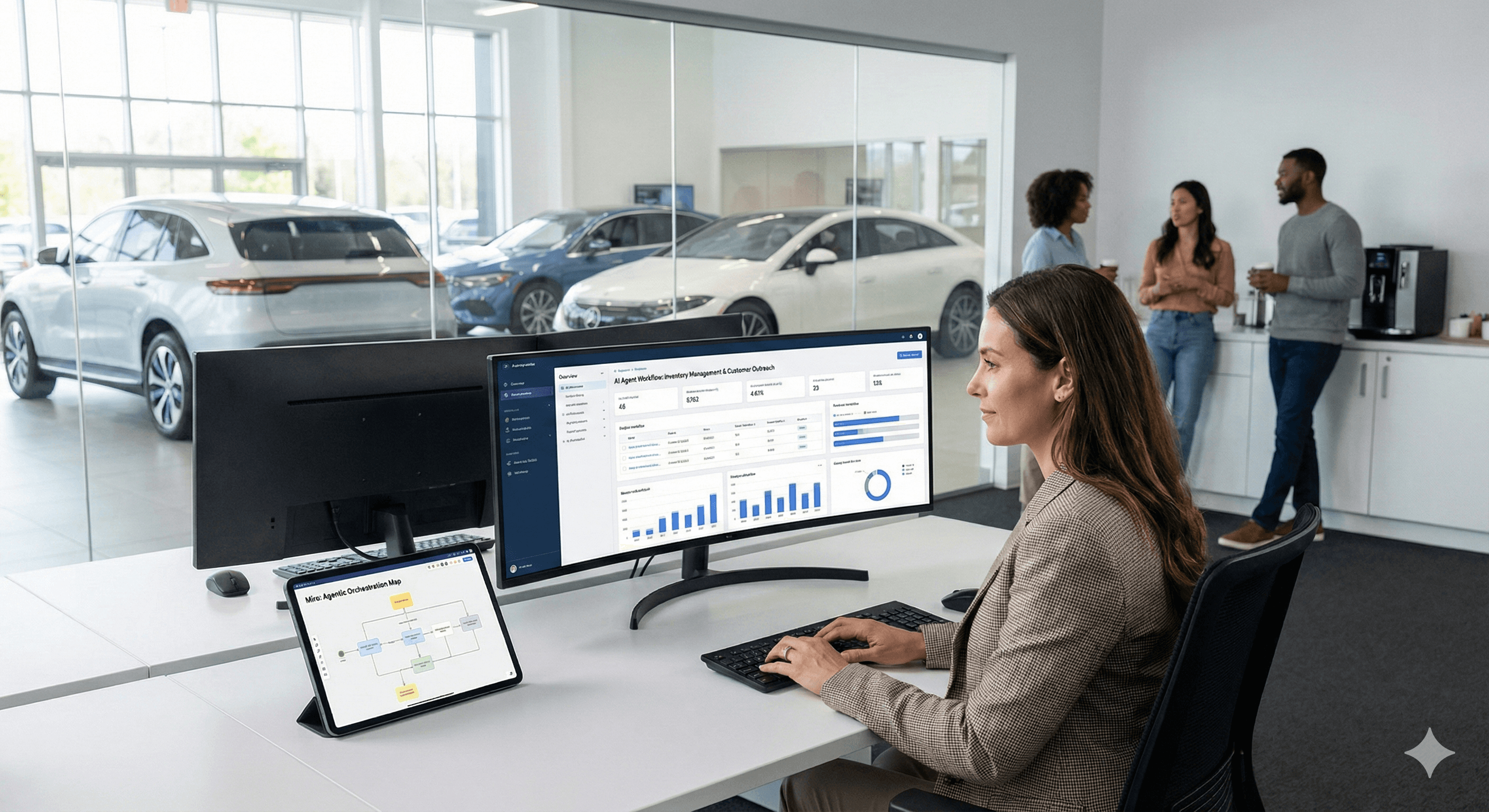
Vous ne pouvez pas laisser des agents autonomes diriger votre entreprise. Vous avez besoin d'une couche d'orchestration centrale - une manière de cartographier exactement ce que ces agents sont autorisés à faire. Des outils comme Miro deviennent essentiels pour cartographier ces workflows agentiques visuellement avant qu'ils soient codés, assurant que chaque partie prenante comprend les "règles d'engagement".
2. Gouvernance et sécurité des données
Hier seulement, l'ICO a publié un rapport sur les risques de confidentialité de l'IA agentique, soulignant le besoin d'un "contrôle" strict. Parce que les agents agissent spontanément, les concessionnaires ont besoin de gouvernance rigoureuse. Qui est responsable si un agent promet un rabais qu'il ne devrait pas ? Des plateformes comme Glean sont cruciales ici, assurant que vos agents IA peuvent uniquement accéder aux connaissances de l'entreprise qu'ils devraient voir, tout en maintenant conformité et sécurité.
Résumé : la route à venir
L'article de Motor Trader est un signal d'alarme. Le processus d'achat de voiture devient fluide, rapide et sans friction.
Pour les dirigeants automobiles, la tâche n'est plus simplement d'"acheter des outils d'IA". Il s'agit de construire l'architecture agentique - les workflows, la gouvernance des données, et l'orchestration - qui permet à ces employés numériques de prospérer en toute sécurité.
À Generation Digital, nous aidons les organisations à construire cette fondation. Que ce soit pour cartographier le parcours dans Miro, gérer le workflow dans Asana, ou sécuriser les connaissances dans Glean, nous nous assurons que votre entreprise est prête pour l'âge agentique.
FAQ
Question : Quelle est la différence entre l'IA générative et l'IA agentique ?
Réponse : L'IA générative crée du contenu (texte, images) basé sur une sollicitation. L'IA agentique agit de manière autonome pour atteindre un objectif (par exemple, "réserver un rendez-vous") en planifiant et exécutant plusieurs étapes sans intervention humaine constante.
Question : L'IA agentique est-elle sûre pour les données clients ?
Réponse : Elle introduit de nouveaux risques car les agents agissent spontanément. Toutefois, avec des cadres de gouvernance robustes et en conformité avec les récents directives de l'ICO (janvier 2026), elle peut être déployée en toute sécurité.
Question : Les agents IA remplaceront-ils les vendeurs de voitures ?
Réponse : Peu probable. Ils remplaceront l'administration des ventes - la paperasse, la planification et la qualification initiale - libérant ainsi les experts humains pour se concentrer sur les aspects émotionnels et de conseil de l'achat.
Recevez chaque semaine des nouvelles et des conseils sur l'IA directement dans votre boîte de réception
En vous abonnant, vous consentez à ce que Génération Numérique stocke et traite vos informations conformément à notre politique de confidentialité. Vous pouvez lire la politique complète sur gend.co/privacy.



Génération
Numérique

Bureau du Royaume-Uni
Génération Numérique Ltée
33 rue Queen,
Londres
EC4R 1AP
Royaume-Uni
Bureau au Canada
Génération Numérique Amériques Inc
181 rue Bay, Suite 1800
Toronto, ON, M5J 2T9
Canada
Bureau aux États-Unis
Generation Digital Americas Inc
77 Sands St,
Brooklyn, NY 11201,
États-Unis
Bureau de l'UE
Génération de logiciels numériques
Bâtiment Elgee
Dundalk
A91 X2R3
Irlande
Bureau du Moyen-Orient
6994 Alsharq 3890,
An Narjis,
Riyad 13343,
Arabie Saoudite







Numéro d'entreprise : 256 9431 77 | Droits d'auteur 2026 | Conditions générales | Politique de confidentialité