L'IA dans le Film & TV : 3 résultats futurs (et que faire maintenant)
IA
Pas sûr de quoi faire ensuite avec l'IA?Évaluez la préparation, les risques et les priorités en moins d'une heure.
➔ Téléchargez notre kit de préparation à l'IA gratuit
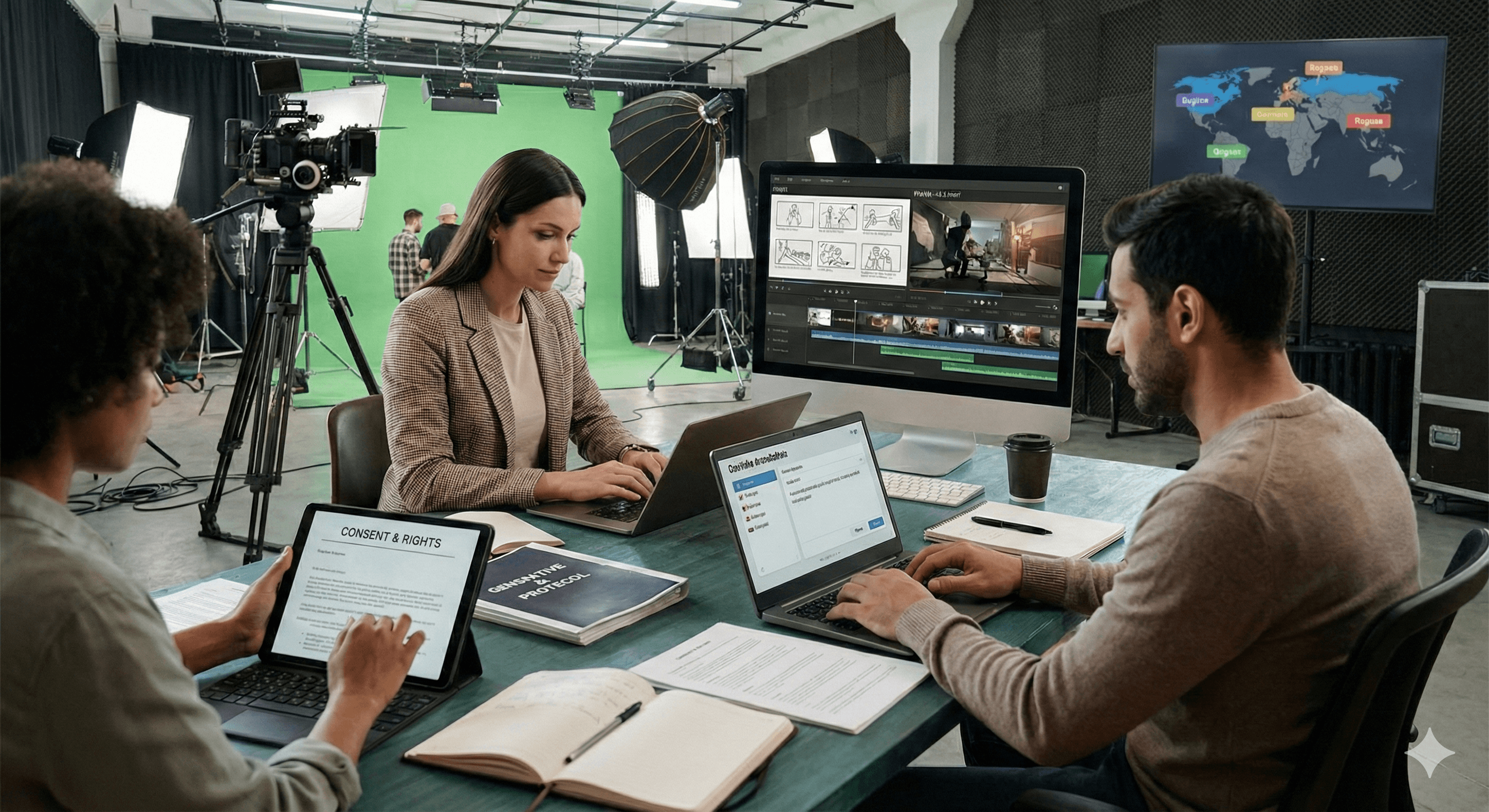
L'IA transformera le cinéma et la télévision au-delà des économies de coûts de trois manières : accélération créative (du prévisualisation au post grâce à la vidéo générative), localisation hyper-personnalisée à grande échelle, et flux de travail axés sur les droits guidés par de nouvelles règles syndicales et la Loi de l'UE sur l'IA. Les gagnants associent une expérimentation rapide à des contrôles robustes de consentement, de crédit et de conformité.
Pourquoi cela importe-t-il maintenant ?
L'IA se déplace de l'expérimentation à l'artisanat quotidien. Les organismes britanniques publient des directives (BFI), la BBC a mis en place un protocole d'IA générative, et la réglementation est en cours avec la Loi de l'UE sur l'IA — modifiant comment nous concevons les pipelines, gérons les projets et clarifions les droits.
Trois résultats (au-delà de la perturbation de la chaîne d'approvisionnement)
1) Accélération créative : de l'idée à l'image en quelques heures
Les moteurs de texte-à-vidéo et en temps réel rapprochent la prévisualisation, le développement visuel et le post. Les cinéastes présentent déjà des séquences créées avec Sora; la production virtuelle et le rotoscope assisté par IA, le nettoyage et le travail de foule accélèrent les itérations tout en gardant les réalisateurs plus proches de l'image.
Ce qu'il faut faire maintenant
Mettez en place une voie R&D pour les tests de vidéo générative (conception des prises de vue, mood reels, prises alternatives).
Créez une bibliothèque d'instructions et de références à côté des storyboards.
Ajoutez des portes de révision pour que les sorties de l'IA ne contournent jamais la supervision éditoriale ou VFX.
2) Sorties hyper-localisées et axées sur les données
Le doublage, le sous-titrage et le contrôle qualité assistés par l'IA permettent d'offrir plus de langues, plus rapidement. Les plateformes élargissent les options linguistiques sur les applications TV, et les équipes de localisation peuvent tester des variantes de tonalité par marché pour augmenter le taux de complétion et le ROI du catalogue.
Ce qu'il faut faire maintenant
Élaborez un manuel de localisation (guides de style vocal, vérifications culturelles, spécifications des légendes).
Effectuez des tests A/B sur des doublages/sous-titres alternatifs et mesurez la rétention par territoire.
Enregistrez chaque modèle, jeu de données et décision pour la traçabilité.
3) Flux de travail axés sur les droits, conçus pour la conformité
Les accords syndicaux codifient maintenant le consentement/la compensation pour les répliques numériques et limitent l'utilisation de l'IA dans l'écriture ; la Loi de l'UE sur l'IA ajoute des obligations de provenance et de transparence. Traitez le juridique comme des exigences produit, non comme une paperasse à la clôture.
Ce qu'il faut faire maintenant
Capturez le consentement explicite et les fenêtres d'utilisation pour les scans/répliques; stockez les contrats à côté des actifs.
Ajoutez un filigrane ou étiquetez les médias synthétiques là où requis; conservez des cartes de modèle avec chaque livrable.
Ajoutez une révision de l'IA aux listes de contrôle de feu vert et de livraison.
Comment ça fonctionne (la chaîne d'outils d'aujourd'hui, simplement)
Développement & prévisualisation : vidéo générative pour les planches de ton, blocage approximatif ; outils de scénario pour les cartes de battement (jamais en tant qu'auteurs uniques).
Production : VP assistée par l'IA, planification, continuité ; contrôles de sécurité (détection de chutes, validation de plans de tournage).
Post-production : assemblage de montage accéléré, nettoyage des dialogues, réduction du bruit, corrections de fond; le processus créatif final reste dirigé par l'humain.
Distribution : localisation rapide, passages d'accessibilité, variantes de bandes-annonces avec balises spécifiques à chaque territoire.
Contexte britannique : politique et pratique
Le rapport 2025 de la BFI décrit les opportunités et les risques dans le secteur audiovisuel, pressant pour une intégration éthique et un investissement dans les compétences; le protocole de la BBC interdit l'utilisation de l'IA générative pour la recherche factuelle/les nouvelles; la Loi de l'UE sur l'IA introduit progressivement des obligations entre 2025 et 2026. Planifiez pour la formation, la provenance et la transparence pour le public.
Étapes pratiques (vous pouvez commencer ce trimestre)
Gouvernance : Créez une politique d'utilisation de l'IA (consentement, divulgation, provenance), alignez-vous avec les obligations de la Loi de l'UE sur l'IA et les termes syndicaux.
Pilotes de flux de travail : Choisissez 2 à 3 cas d'utilisation (rouleaux de prévisualisation, nettoyage, localisation) et réalisez des sprints de quatre semaines avec des indicateurs clés de performance mesurables.
Données & droits : Cataloguez tous les matériaux de formation et références; enregistrez les licences et permissions des performeurs à côté des actifs.
Personnel : Accélérez la formation des monteurs, des VFX et des équipes de production avec des modules courts ; définissez de nouveaux rôles (gestionnaire d'IA, responsable de la provenance).
Outils : Standardisez sur un ensemble restreint de modèles et gardez des journaux de modèle/version dans votre bible de show (Notion), avec des tâches Asana et des tableaux Miro pour les chemins de validation.
FAQs
Quels sont les avantages de l'IA dans la production cinématographique ?
Des prévisualisations et post-productions plus rapides, une localisation moins coûteuse et des cycles créatifs plus itératifs—lorsque les sorties sont supervisées et que les droits sont dégagés.
Comment l'IA affecte-t-elle le contenu télévisuel ?
Attendez-vous à plus de langues, à des fenêtres de sortie plus rapides et à des promotions ciblées, avec un étiquetage transparent et le consentement pour tout élément synthétique.
L'adoption est-elle généralisée ?
L'adoption se développe dans les studios et les diffuseurs, avec des directives britanniques du BFI/BBC et des règles contractuelles de la WGA/SAG-AFTRA façonnant une utilisation responsable.
Prochaines étapes
Voulez-vous un pipeline IA axé sur les droits qui livre réellement ? Contactez Generation Digital pour une évaluation rapide, un plan pilote et une formation d'équipe.
Recevez chaque semaine des nouvelles et des conseils sur l'IA directement dans votre boîte de réception
En vous abonnant, vous consentez à ce que Génération Numérique stocke et traite vos informations conformément à notre politique de confidentialité. Vous pouvez lire la politique complète sur gend.co/privacy.



Génération
Numérique

Bureau du Royaume-Uni
Génération Numérique Ltée
33 rue Queen,
Londres
EC4R 1AP
Royaume-Uni
Bureau au Canada
Génération Numérique Amériques Inc
181 rue Bay, Suite 1800
Toronto, ON, M5J 2T9
Canada
Bureau aux États-Unis
Generation Digital Americas Inc
77 Sands St,
Brooklyn, NY 11201,
États-Unis
Bureau de l'UE
Génération de logiciels numériques
Bâtiment Elgee
Dundalk
A91 X2R3
Irlande
Bureau du Moyen-Orient
6994 Alsharq 3890,
An Narjis,
Riyad 13343,
Arabie Saoudite







Numéro d'entreprise : 256 9431 77 | Droits d'auteur 2026 | Conditions générales | Politique de confidentialité