AI in QSRs: Streamline Operations and Cut Costs (2026)
IA
Pas sûr de quoi faire ensuite avec l'IA?Évaluez la préparation, les risques et les priorités en moins d'une heure.
➔ Téléchargez notre kit de préparation à l'IA gratuit
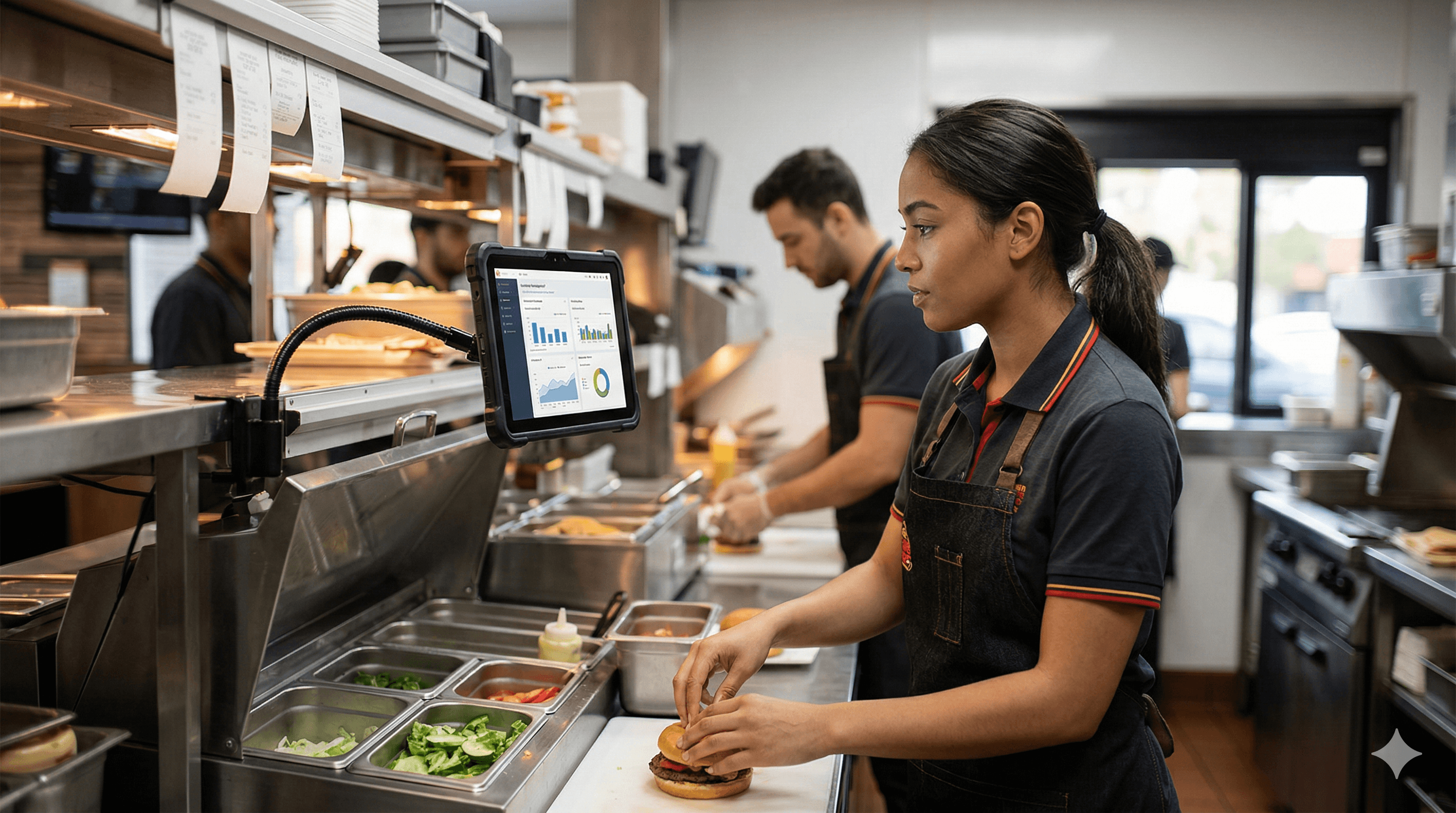
AI is transforming QSR operations by automating high-volume tasks and optimising resources across ordering, kitchens, inventory, and staffing. With tools like voice ordering, demand forecasting, and waste tracking, restaurants can serve customers faster, reduce errors and food waste, and run leaner shifts—cutting costs while protecting the guest experience.
QSR margins live and die on three things: speed, accuracy, and labour efficiency.
AI is becoming a practical lever for all three—especially as restaurants face volatile demand, rising costs, and persistent staffing pressure. What’s changed in the last 18–24 months is that AI is less “future innovation” and more operational infrastructure.
Where AI is creating value in QSRs right now
AI in QSRs falls into five high-impact categories. The best programmes don’t chase everything at once—they pick one and scale it properly.
1) Faster, more consistent ordering
Voice AI in the drive‑thru and AI-assisted ordering are being deployed to:
reduce order-taking load during peaks
improve consistency of upsell prompts
shorten queue times when staffing is tight
Reality check: voice AI is improving, but it still needs fallback patterns (staff takeover, confirmation steps) to protect accuracy.
2) Order accuracy and error prevention
Even small error rates become expensive at QSR scale.
AI can help by:
flagging missing items (e.g., weight/accuracy checks)
detecting repeat remakes and likely root causes
highlighting menu items that drive confusion (naming, modifiers)
The impact is lower refunds, fewer remakes, and better customer sentiment.
3) Demand forecasting and inventory optimisation
This is one of the most reliable cost levers.
Machine learning models can forecast demand by blending:
historical sales
local events and weather
promotions and seasonality
time-of-day patterns
The result: better prep, tighter inventory, and fewer stockouts.
4) Food waste tracking and reduction
Food waste is a hidden margin killer.
Computer vision and automated waste tracking can:
identify what’s being wasted, when, and why
link waste patterns to shifts, items, and process steps
feed forecasting and ordering improvements
Waste reduction programmes work best when they’re paired with simple operational changes (prep thresholds, batch size tweaks, training).
5) Workforce scheduling and labour planning
Labour is often the biggest controllable cost.
AI-driven scheduling can:
match labour to forecast demand
reduce overstaffing on quiet periods
protect service speed during peaks
The highest ROI comes when scheduling also accounts for skill mix, not just headcount.
Practical AI use cases by QSR team
AI adoption sticks when it’s mapped to clear team outcomes.
Operations and store leadership
automated daily briefs: staffing, issues, and priorities
exception alerts: unusual refunds, long ticket times, equipment anomalies
coaching cues: which stations or items need support
Supply chain and inventory
demand forecasts to guide ordering and prep
intelligent safety stock recommendations
supplier performance insights (fill rate, lead times)
Customer service and digital experience
chatbots for order status and FAQs
personalised offers based on loyalty behaviour
proactive issue resolution (e.g., delayed delivery)
HR, training, and frontline enablement
AI-guided onboarding by role
instant access to policies, recipes, and SOPs
micro‑learning prompts based on common errors
Finance and analytics
margin drivers by item, shift, and store
promo effectiveness and cannibalisation modelling
root-cause analysis for waste and refunds
How to implement AI in a QSR without breaking operations
A sensible rollout looks like this.
Step 1: Pick one measurable problem
Examples:
reduce drive‑thru time by X seconds
cut refunds/remakes by X%
reduce food waste by X%
improve forecast accuracy by X%
Avoid “improve efficiency” as a goal. Make it measurable.
Step 2: Start with data readiness
Before AI, validate:
clean POS data (items, modifiers, cancellations)
consistent store-level operational data
clear definitions (e.g., what counts as ‘waste’)
Step 3: Design the human fallback
For customer-facing AI (voice ordering, chatbots):
confirmation steps for modifiers and allergens
staff takeover paths
escalation rules for complaints and refunds
Step 4: Pilot in a representative store set
Choose stores that reflect real variance:
high vs low volume
different demographics and accents
different layouts and staffing patterns
Step 5: Measure and iterate before scaling
Track:
speed of service
order accuracy
labour hours vs sales
waste and stockouts
customer satisfaction and complaints
Then scale with training and operational playbooks.
Where enterprise AI platforms fit (and why it matters)
QSRs often run dozens of tools: POS, labour scheduling, inventory, delivery platforms, HR systems, and knowledge bases.
This is where enterprise AI platforms can help:
unify knowledge across systems so operators can find answers fast
reduce time wasted searching for SOPs, policy updates, and training materials
provide role-based answers and guidance with governance controls
If your frontline teams can’t access the right knowledge in the moment, even the best forecasting model won’t fix the real bottleneck.
FAQs
How does AI improve customer service in QSRs?
AI improves customer service by speeding up ordering and issue resolution, personalising offers, and reducing errors through smarter confirmations and accuracy checks.
What cost benefits do QSRs gain from AI?
AI reduces operational costs by improving forecast accuracy, cutting food waste, reducing remakes and refunds, and optimising labour scheduling.
Can AI predict demand in QSRs?
Yes. AI can forecast demand using historical sales and external signals (promotions, events, seasonality, and sometimes weather), helping QSRs plan staffing and inventory more precisely.
Is voice AI ready for drive‑thru ordering?
It’s increasingly viable, especially with human fallback and confirmation design. The best deployments treat it as an assistant that reduces load, not a full replacement for staff.
Next steps
If you’re exploring AI in your QSR operation, start with a single use case that touches margin: forecasting, labour planning, waste, or order accuracy.
Generation Digital can help you:
select the right use cases and vendors
design safe customer-facing AI patterns
build governance for data, privacy, and measurement
Contact Generation Digital to map a pilot and scale plan.
Recevez chaque semaine des nouvelles et des conseils sur l'IA directement dans votre boîte de réception
En vous abonnant, vous consentez à ce que Génération Numérique stocke et traite vos informations conformément à notre politique de confidentialité. Vous pouvez lire la politique complète sur gend.co/privacy.



Génération
Numérique

Bureau du Royaume-Uni
Génération Numérique Ltée
33 rue Queen,
Londres
EC4R 1AP
Royaume-Uni
Bureau au Canada
Génération Numérique Amériques Inc
181 rue Bay, Suite 1800
Toronto, ON, M5J 2T9
Canada
Bureau aux États-Unis
Generation Digital Americas Inc
77 Sands St,
Brooklyn, NY 11201,
États-Unis
Bureau de l'UE
Génération de logiciels numériques
Bâtiment Elgee
Dundalk
A91 X2R3
Irlande
Bureau du Moyen-Orient
6994 Alsharq 3890,
An Narjis,
Riyad 13343,
Arabie Saoudite






Numéro d'entreprise : 256 9431 77 | Droits d'auteur 2026 | Conditions générales | Politique de confidentialité