Benzinga x Perplexity et l'avenir de la recherche financière propulsée par l'IA
Pérplexité
Pas sûr de quoi faire ensuite avec l'IA?Évaluez la préparation, les risques et les priorités en moins d'une heure.
➔ Téléchargez notre kit de préparation à l'IA gratuit
Benzinga x Perplexity : ce que signifie le partenariat de données pour les investisseurs
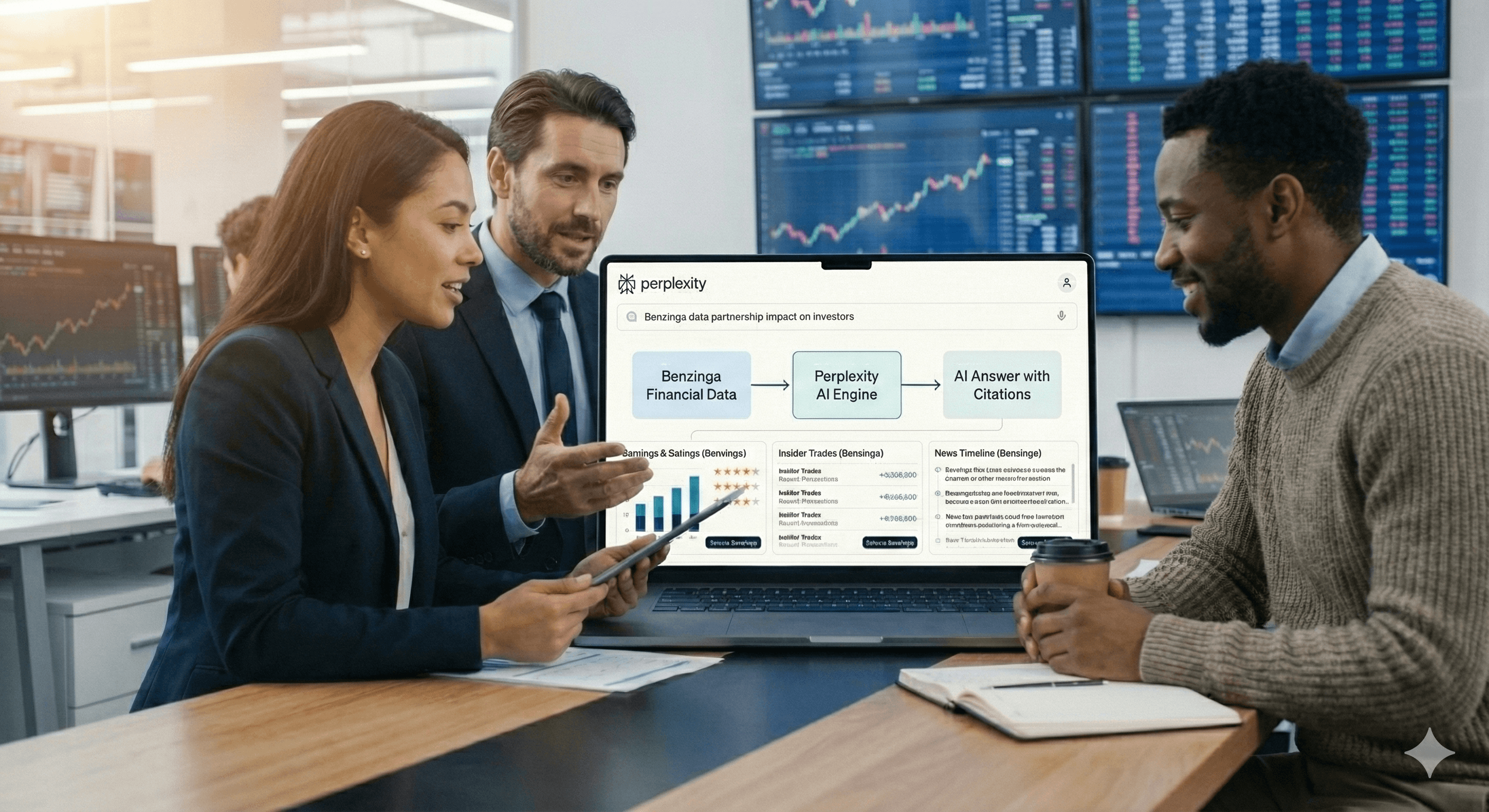
Benzinga et Perplexity ont conclu un partenariat stratégique pour rendre les données de Benzinga, susceptibles de faire bouger le marché, disponibles dans le moteur de réponse IA de Perplexity. Pour les investisseurs et les chefs de produit, c'est un autre signe que les outils de recherche en IA passent du chat à usage général à des réponses riches en données et ancrées dans les sources.
Ce qui arrive dans Perplexity
Nouvelles de marché en temps réel et mouvements de prix
Perspectives sur les bénéfices (faits saillants des résultats, surprises, mentions des orientations)
Évaluations d'analystes et modifications des cibles
Transactions des initiés (événements basés sur des formulaires)
Panneaux contextuels reliant les éléments ci-dessus aux titres, aux secteurs et aux fenêtres temporelles
Note de mise en œuvre : Attendez-vous à un flux soutenu par API et à une interface utilisateur qui fait apparaître des citations et des liens sources pour vérification.
Pourquoi c'est important
Rapidité à la clarté : Condense les flux épars en vues orientées vers la réponse.
Transparence : Les citations permettent aux utilisateurs de vérifier les affirmations, ce qui est crucial en période de marchés volatils.
Attrait pour le commerce de détail et les pros : Le commerce de détail obtient une simplification ; les pros peuvent accélérer la recherche de première passe et le triage.
Exemples d'invites que les investisseurs essaieront
« Qu'est-ce qui a fait bouger NVDA après les bénéfices du dernier trimestre ? Incluez les changements d'évaluation d'analystes et l'activité des initiés. »
« Résumez les gros titres et les mouvements de prix des banques britanniques de ce matin ; montrez les changements de notation du consensus. »
« Les initiés de TSLA ont-ils acheté ou vendu au cours des 90 derniers jours ? Lien vers les dossiers sous-jacents. »
Liste de contrôle de gouvernance et conformité (finance)
Attribution et licences : Assurez-vous que Benzinga est affiché comme source des données ; maintenez les clics vers les originaux.
Indicateurs de rapidité : Marquez les réponses avec le moment de la dernière mise à jour ; alertez en cas de données obsolètes.
Conflits et pertinence : Évitez les sorties qui se lisent comme des conseils en investissement ; incluez des mentions légales ; laissez les utilisateurs exporter des citations.
Tenue de dossiers : Consignez les invites/réponses utilisées dans les flux de travail de recherche ; enregistrez les modèles/versions et les horodatages des données.
PII et abus de marché : Empêchez l'entrée de MNPI ; instaurez une surveillance pour détecter les invites suspectes.
Recommandations produit/UX
Panneaux de sources : un bloc à droite listant les éléments de nouvelles, les dépôts et les notes d'évaluation avec horodatages.
Conscience des titres : détectez automatiquement les titres et permettez un pivot rapide vers les titres/ETF voisins.
Expliquez comment nous savons : une section de « provenance » rétractable avec le fournisseur de données, la cadence de rafraîchissement et les mises en garde.
Exportation : copie en un clic des citations pour des notes ou des tickets CRM.
Plan de pilote pour les bureaux et les plateformes (90 jours)
Semaines 1–2 : Fondations
Activez l'accès sécurisé ; configurez SSO/RBAC ; rédigez une politique d'utilisation acceptable pour la recherche.
Semaines 3–6 : Tranches fines
Lancez trois modèles : Résumé des bénéfices, Évaluations et changements PT, Digest d'activité des initiés.
Mesurez la latence, la couverture des citations, les scores de confiance des utilisateurs.
Semaines 7–12 : Expansion
Ajoutez des briefings matinaux sectoriels ; intégrez aux prises de notes/CRM ; suivez le temps de cycle du concept à la commande (le cas échéant).
Effectuez un examen de conformité ; établissez un archivage/exportation pour les audits.
Contexte concurrentiel
Cela s'inscrit dans un cadre plus large : les assistants IA licencient des flux premium (nouvelles, imagerie, données de référence) plutôt que de les gratter. Pour la finance, le différenciateur est la fraîcheur + provenance—des réponses rapides avec des sources vérifiables.
Résumé
L'association Benzinga–Perplexity signale une avancée vers une recherche IA fondée sur des données fiables. Les équipes qui associent ces capacités à une gouvernance claire peuvent accélérer la couverture tout en respectant les normes de conformité.
Prochaines étapes : Vous souhaitez un programme pilote de recherche IA conforme pour votre bureau ? Generation Digital aide à connecter des données sous licence à des moteurs de réponse avec une gouvernance et des métriques prêtes pour l'audit.
FAQ
Q1. Quels sont les données apportées par Benzinga dans Perplexity ?
R. Nouvelles de marché en temps réel et mouvements de prix, perspectives sur les bénéfices, évaluations d'analystes, et transactions des initiés, exposées dans les réponses Perplexity avec des citations.
Q2. Est-ce un conseil en investissement ?
R. Non. Traitez les résultats en tant qu'outils de recherche. Maintenez les mentions légales et la révision humaine pour les décisions.
Q3. Quelle est la fraîcheur des données ?
R. Attendez-vous à des mises à jour quasi-réelles ; affichez les horodatages et la cadence de rafraîchissement dans l'interface utilisateur.
Q4. Les entreprises peuvent-elles l'intégrer en interne ?
R. Oui—initiez un pilote avec SSO/RBAC, journalisation, et exportation de citations ; connectez-vous aux notes de recherche ou au CRM.
Q5. Que doit vérifier la conformité en premier ?
R. Attribution, horodatages de rapidité, politique d'utilisation acceptable, protections MNPI et pistes d'audit pour les invites/outputs.
Recevez chaque semaine des nouvelles et des conseils sur l'IA directement dans votre boîte de réception
En vous abonnant, vous consentez à ce que Génération Numérique stocke et traite vos informations conformément à notre politique de confidentialité. Vous pouvez lire la politique complète sur gend.co/privacy.



Génération
Numérique

Bureau du Royaume-Uni
Génération Numérique Ltée
33 rue Queen,
Londres
EC4R 1AP
Royaume-Uni
Bureau au Canada
Génération Numérique Amériques Inc
181 rue Bay, Suite 1800
Toronto, ON, M5J 2T9
Canada
Bureau aux États-Unis
Generation Digital Americas Inc
77 Sands St,
Brooklyn, NY 11201,
États-Unis
Bureau de l'UE
Génération de logiciels numériques
Bâtiment Elgee
Dundalk
A91 X2R3
Irlande
Bureau du Moyen-Orient
6994 Alsharq 3890,
An Narjis,
Riyad 13343,
Arabie Saoudite







Numéro d'entreprise : 256 9431 77 | Droits d'auteur 2026 | Conditions générales | Politique de confidentialité