Asana + Claude - Améliorer l'IA « dépourvue de contexte » dans l'entreprise
Asana
Claude
Pas sûr de quoi faire ensuite avec l'IA?Évaluez la préparation, les risques et les priorités en moins d'une heure.
➔ Téléchargez notre kit de préparation à l'IA gratuit
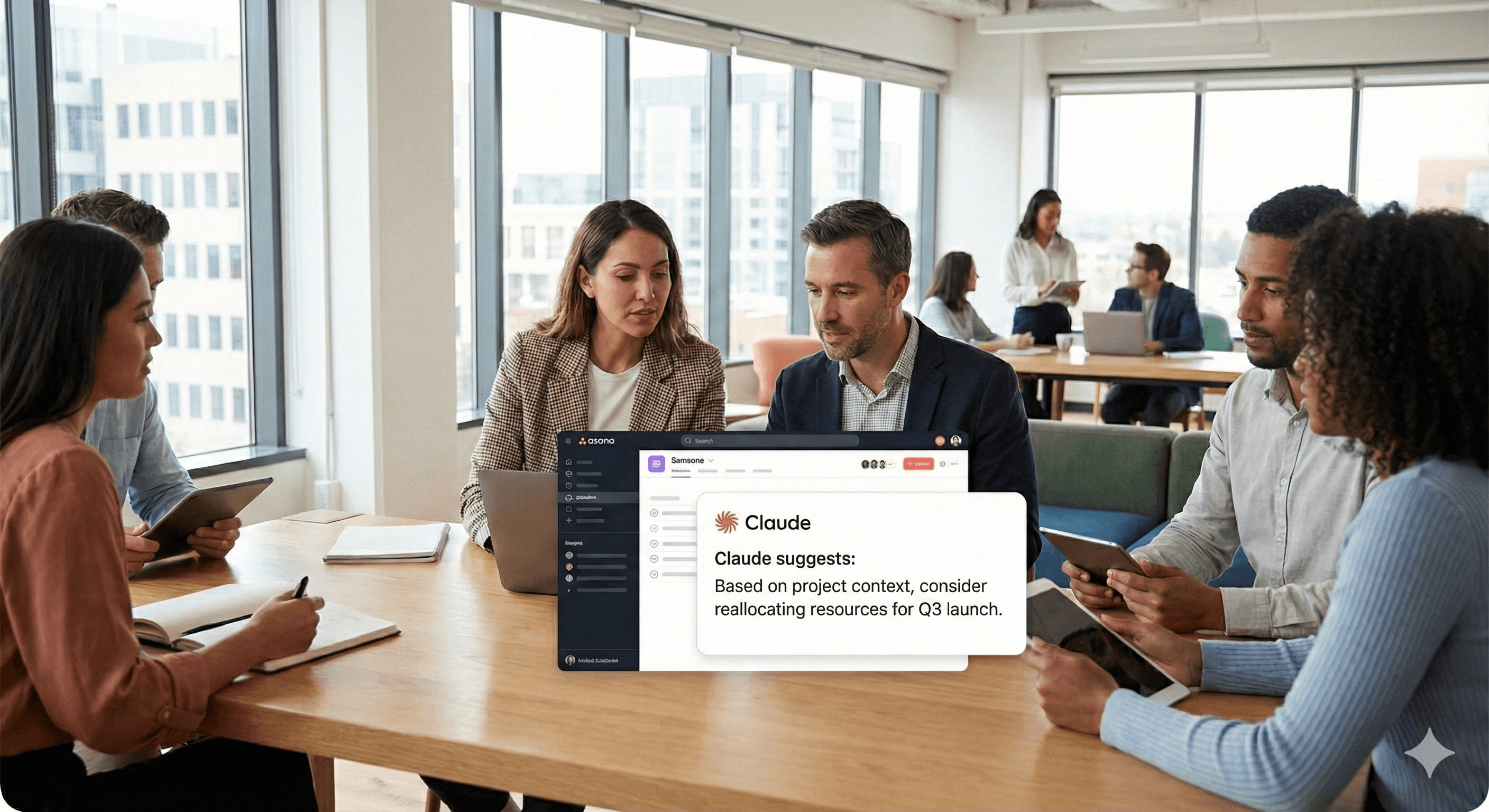
Asana vient de lancer une application Claude interactive et a clairement établi un argument : les LLM sans contexte d'entreprise sont "affamés de contexte." Le pari d'Asana est que le Work Graph—la carte vivante de qui fait quoi, quand, et pourquoi—fournit ce contexte pour que les modèles externes (Anthropic aujourd'hui ; OpenAI/Google demain) accomplissent réellement un travail utile.
Dans l'interview de VentureBeat, le CPO d'Asana l'expose de manière directe : la puissance brute du modèle compte moins que le contexte commercial, et Asana vise à être l'interface pour les agents de tout fournisseur, et non un fournisseur de modèles en soi.
Ce qui a été lancé (et pourquoi c'est important)
Claude dans votre flux Asana : Connectez-vous via OAuth, puis créez des projets, des tâches et des structures complètes par conversation ; posez des questions de statut et obtenez des réponses basées sur vos projets. L'approbation humaine est requise avant que Claude ne fasse des changements.
Disponible maintenant : Le guide d'Asana confirme le processus d'installation via le répertoire d'applications de Claude ; une fois connecté, mentionnez Asana dans le chat pour transformer les idées en action.
Stratégie indépendante du modèle : Asana approfondit également les connecteurs ChatGPT et Gemini et s'aligne sur les normes MCP et agent-à-agent—prévenant le verrouillage par un fournisseur.
Perspective plus vaste : Les nouvelles applications interactives d'Anthropic (Asana, Slack, Figma, etc.) transforment Claude en une vraie surface de travail plutôt qu'un onglet séparé.
Pourquoi c'est important : C'est le passage de "discuter du travail" à "changer le travail"—mais seulement si l'IA est ancrée dans les objectifs, les approbations et les relations de votre organisation (c'est-à-dire le Work Graph).
Le modèle opérationnel : rendre l'IA utile, sûre et mesurable
Basé sur le Work Graph (ou équivalent)
Assurez-vous que les agents voient les projets, les propriétaires, les dépendances et les objectifs—pas seulement du texte. Cela réduit les hallucinations et favorise des actions pertinentes.Intervention humaine par conception
Gardez les approbations obligatoires pour les modifications/créations ; suivez le modèle d'Asana : examen, confirmation, puis exécution. (Cela réduit le risque organisationnel tout en construisant la confiance.)Pluralisme du modèle plutôt que verrouillage
Traitez Claude, ChatGPT et Gemini comme des moteurs de raisonnement interchangeables derrière une couche d'orchestration unique. La feuille de route d'Asana soutient explicitement cette position.Rôles d'agent, pas de chat générique
Utilisez les modèles AI Teammates/agents liés aux objectifs et aux workflows (mise en évidence des risques, vérification des dépendances, orchestration des suivis). C'est là que le contexte du Work Graph se démarque.Gouvernance & audit
Accès délimité par OAuth, actions respectueuses des permissions, visibilité pour les administrateurs, et journaux des modifications. Publiez "Ce que cet agent peut et ne peut pas faire."
Guide de déploiement (vous pouvez commencer maintenant)
Phase 1 — Connecter et contraindre (2–3 semaines)
Activez l'application Asana dans Claude; délimitez l'accès par espace de travail/projet.
Définissez les actions approuvées (créer des tâches, rédiger des plans) vs. lecture seule.
Configurez une porte d'approbation pour toute action d'écriture.
Phase 2 — Concevoir des workflows agentiques (3–6 semaines)
Créez des commandes par barre oblique/prompts conversationnels pour :
« Rédiger un plan de projet à partir de ce PRD » → examiner → approuver → publier sur Asana.
« Qu'est-ce qui est en retard pour le lancement X ? » → statut, risques, responsables, et mitigations suggérées.
Expérimentez des routines de style AI Teammate qui surveillent les dépendances et proposent des suivis.
Phase 3 — Mesurer et étendre (en cours)
Suivez le temps de cycle jusqu'à la création de projet, % des tâches créées via l'IA (avec approbation humaine), temps de résolution des dépendances, et satisfaction des utilisateurs.
Ajoutez des connecteurs pour Slack (mises à jour), Figma (liens de révision), Miro (ateliers) dans les applications interactives de Claude pour moins de basculements de contexte.
Risques & mitigations
Anxiété de sur-automatisation : Maintenez la validation humaine obligatoire ; publiez une matrice des capacités des agents.
Évolution du périmètre des données : Appliquez le principe du moindre privilège avec OAuth et accès basé sur les rôles ; auditez l'utilisation via les panneaux d'administration.
Volatilité des fournisseurs : Utilisez la position indépendante du modèle d'Asana et des normes comme MCP pour rester portable.
Où s'intègre Generation Digital (ce que nous faisons vs ne faisons pas)
Ce que nous faisons : Logiciels d'orchestration, gouvernance de politiques/prompts, portes d'approbation, tableaux de bord métriques, programmes de développement, et intégrations (Asana, Slack, Notion, Miro, Glean).
Ce que nous ne faisons pas : Construire des modèles de fondation ou remplacer votre pile PM—nous faisons fonctionner réellement votre configuration multi-modèles, human-in-loop.
FAQs
Comment fonctionne l'intégration d'Asana avec Claude ?
Authentifiez-vous via OAuth, puis utilisez Claude pour créer/modifier des projets et obtenir des statuts—avec approbation humaine explicite avant que les modifications ne soient mises en ligne.
Pourquoi l'AI "affamée de contexte" est-elle un problème ?
Les modèles peuvent écrire, mais ils ne connaissent pas vos objectifs, responsables, ou approbations. Le Work Graph fournit ce contexte organisationnel pour que les actions soient pertinentes.
Sommes-nous verrouillés avec Anthropic ?
Non. Asana est indépendant du modèle et approfondit ses connecteurs pour ChatGPT et Gemini, ainsi que les normes industrielles comme MCP.
Quels garde-fous sont en place ?
Les permissions des utilisateurs sont respectées ; les administrateurs ont de la visibilité ; et l'approbation human-in-loop est requise avant que Claude n'écrive sur Asana.
Quelle est la façon la plus rapide de tester ?
Choisissez un workflow à fort impact (e.g., « nouveau projet à partir du PRD »), mettez en œuvre avec des approbations, suivez le temps jusqu'au projet et la satisfaction, puis étendez.
Prochaines étapes
Prêt à apporter du contexte à votre IA ?
Nous mettrons en place Asana + Claude avec des garde-fous, approbations, et métriques—et vous garderons portable à travers les modèles.
→ Réservez une session de découverte avec Generation Digital pour un test en semaines, pas en mois.
Recevez chaque semaine des nouvelles et des conseils sur l'IA directement dans votre boîte de réception
En vous abonnant, vous consentez à ce que Génération Numérique stocke et traite vos informations conformément à notre politique de confidentialité. Vous pouvez lire la politique complète sur gend.co/privacy.



Génération
Numérique

Bureau du Royaume-Uni
Génération Numérique Ltée
33 rue Queen,
Londres
EC4R 1AP
Royaume-Uni
Bureau au Canada
Génération Numérique Amériques Inc
181 rue Bay, Suite 1800
Toronto, ON, M5J 2T9
Canada
Bureau aux États-Unis
Generation Digital Americas Inc
77 Sands St,
Brooklyn, NY 11201,
États-Unis
Bureau de l'UE
Génération de logiciels numériques
Bâtiment Elgee
Dundalk
A91 X2R3
Irlande
Bureau du Moyen-Orient
6994 Alsharq 3890,
An Narjis,
Riyad 13343,
Arabie Saoudite







Numéro d'entreprise : 256 9431 77 | Droits d'auteur 2026 | Conditions générales | Politique de confidentialité