Codex Security Enhances AI Vulnerability Detection
OpenAI

Pas sûr de quoi faire ensuite avec l'IA?Évaluez la préparation, les risques et les priorités en moins d'une heure.
➔ Téléchargez notre kit de préparation à l'IA gratuit
Codex Security is an AI-powered application security agent by OpenAI designed to detect, validate, and patch software vulnerabilities. By analysing your repository to build a custom threat model, it pressure-tests findings in a sandboxed environment to eliminate false positives, and proposes context-aware code patches that developers can easily review.
The application security landscape has a persistent problem: noise. Traditional security scanners are notorious for overwhelming engineering teams with false positives and low-impact alerts, turning crucial security reviews into a bottleneck. Enter Codex Security—OpenAI’s newly released AI application security agent, now available in research preview.
Evolving from its highly successful private beta (formerly known as Aardvark), Codex Security aims to behave less like a static code scanner and more like a pragmatic, experienced security researcher. It builds deep context around your specific project to find vulnerabilities, validate them, and actually propose the code to fix them.
Why Context is the Missing Link in AppSec
Most AI security tools fail because they lack an understanding of system intent. They flag potential issues without knowing if a specific service is intentionally exposed or securely isolated. Codex Security bridges this gap by combining the agentic reasoning of OpenAI’s frontier models with automated validation.
This means it doesn't just find a vulnerability; it checks whether that vulnerability matters in the context of your architecture.
How Codex Security Works: The Three-Step Workflow
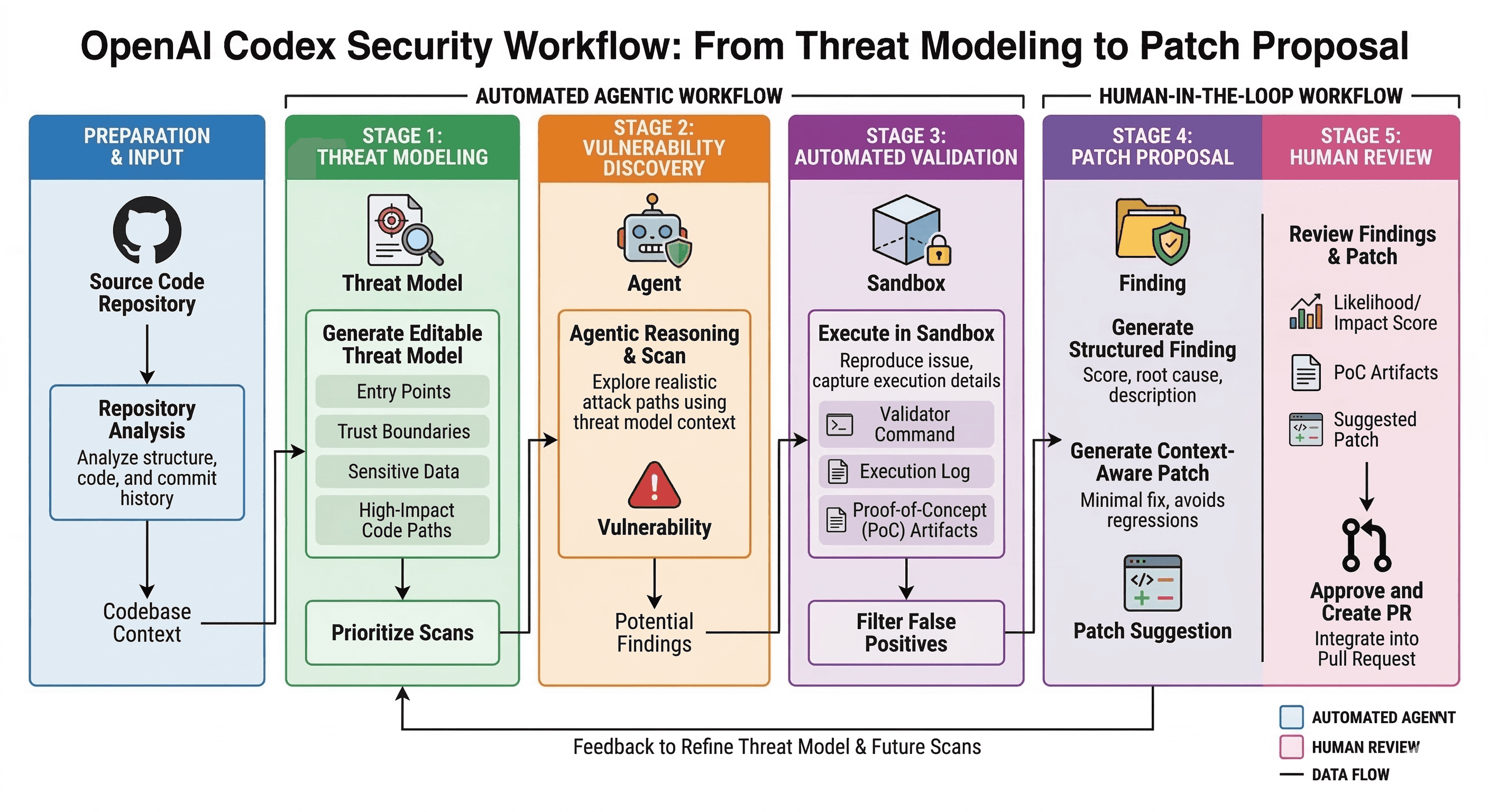
To eliminate "scanner fatigue," Codex Security follows a structured, logical loop that mirrors human security analysis:
1. Building System Context and Threat Modelling When you connect a GitHub repository, Codex Security scans the codebase to understand trust boundaries, exposed surfaces, and overall system behaviour. It then generates an editable threat model. Security teams can refine this model to perfectly align the agent with their actual risk posture.
2. Prioritising and Validating Findings Using the custom threat model, the agent searches for vulnerabilities and categorises them by real-world impact. Crucially, it pressure-tests these findings in an isolated, sandboxed validation environment. By proving the exploitability of a bug, it drastically cuts down on false positives.
3. Proposing Context-Aware Patches Finding a vulnerability is only half the battle. Codex Security proposes high-confidence patches that align with the surrounding code’s intent. The goal is to provide developers with small, reviewable pull requests that improve security without causing unexpected regressions.
Real-World Impact: The 1.2 Million Commit Beta
Codex Security is built to operate at an enterprise scale. During its recent 30-day beta testing phase, the agent scanned over 1.2 million commits across external repositories. The results highlight a massive leap forward in signal-to-noise ratio:
Critical Discoveries: Identified 792 critical findings and over 10,500 high-severity issues in major open-source projects like Chromium and OpenSSH.
Reduced Noise: Dropped the rate of over-reported severity by 90% and reduced overall false positives by more than 50%.
These metrics prove that the system can successfully identify security-impacting issues in large volumes of code while sparing reviewers from the noise of insignificant bugs.
Getting Started: Who Has Access?
Currently rolling out in research preview, Codex Security is available via the Codex web interface. Access is automatically granted to ChatGPT Pro, Enterprise, Business, and Edu customers, with free usage offered for the first month of the preview.
Summary
Codex Security is not just another scanner; it is a context-driven layer that complements your existing security stack (like SAST and DAST). By validating issues and writing functional patches, it allows your engineers to focus on higher-order logic rather than drowning in triage.
Ready to integrate intelligent security into your development pipeline? Contact Generation Digital to discover how we can help you implement AI-driven AppSec frameworks seamlessly into your organisation.
FAQ Section
Question: What is Codex Security?
Answer: Codex Security is an AI-based application security agent developed by OpenAI. It connects to repositories to detect, validate, and patch software vulnerabilities using deep system context.
Question: How does Codex Security reduce false positives?
Answer: It reduces noise by generating a custom threat model for your project and pressure-testing potential vulnerabilities in a sandboxed validation environment before alerting your team.
Question: Who can use the Codex Security research preview?
Answer: The research preview is currently rolling out to ChatGPT Pro, Enterprise, Business, and Edu customers via the Codex web interface.
Recevez chaque semaine des nouvelles et des conseils sur l'IA directement dans votre boîte de réception
En vous abonnant, vous consentez à ce que Génération Numérique stocke et traite vos informations conformément à notre politique de confidentialité. Vous pouvez lire la politique complète sur gend.co/privacy.



Génération
Numérique

Bureau du Royaume-Uni
Génération Numérique Ltée
33 rue Queen,
Londres
EC4R 1AP
Royaume-Uni
Bureau au Canada
Génération Numérique Amériques Inc
181 rue Bay, Suite 1800
Toronto, ON, M5J 2T9
Canada
Bureau aux États-Unis
Generation Digital Americas Inc
77 Sands St,
Brooklyn, NY 11201,
États-Unis
Bureau de l'UE
Génération de logiciels numériques
Bâtiment Elgee
Dundalk
A91 X2R3
Irlande
Bureau du Moyen-Orient
6994 Alsharq 3890,
An Narjis,
Riyad 13343,
Arabie Saoudite







Numéro d'entreprise : 256 9431 77 | Droits d'auteur 2026 | Conditions générales | Politique de confidentialité