Product Innovation Tools: Miro + reMarkable Workflow (2026)
Miro
Pas sûr de quoi faire ensuite avec l'IA?Évaluez la préparation, les risques et les priorités en moins d'une heure.
➔ Téléchargez notre kit de préparation à l'IA gratuit
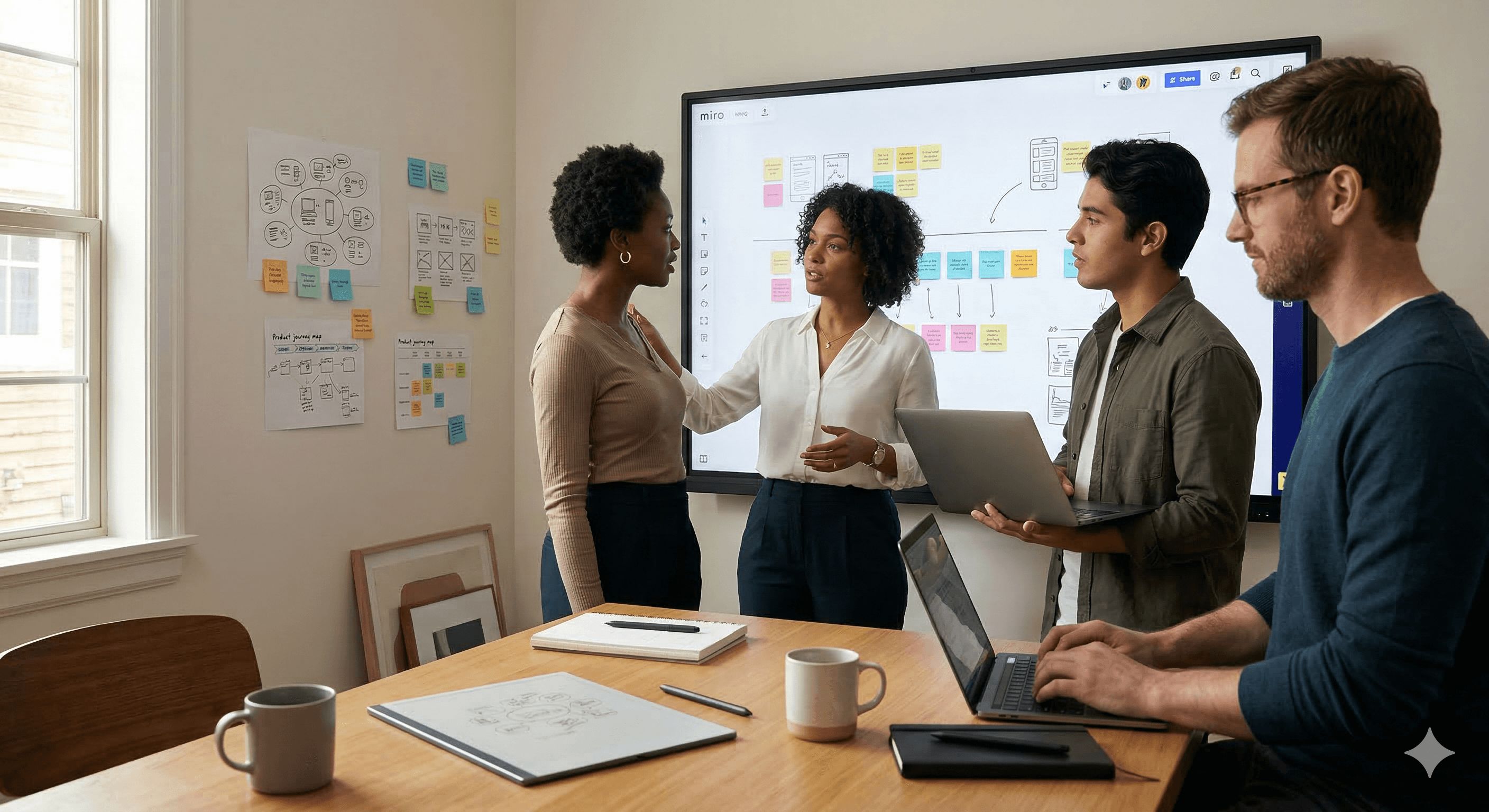
Miro and reMarkable help product teams innovate faster by combining shared visual collaboration with distraction-free individual thinking. Capture early ideas and sketches on reMarkable, then bring them into Miro to cluster insights, prioritise opportunities, and align stakeholders in real time—creating a clear concept that’s ready for prototyping and delivery.
Innovation doesn’t fail because teams lack ideas. It fails because ideas get scattered across meetings, messages, notebooks and slides—then lose context during handoffs.
A simple way to fix that is to pair a personal thinking tool with a shared collaboration space:
reMarkable for quiet, distraction-free capture (sketches, notes, early models).
Miro for turning those raw inputs into aligned decisions, structured concepts and a trackable plan.
Done well, you don’t just “brainstorm”. You build a repeatable system for concepting that teams can run every week.
Why this matters now (and why it’s different in 2026)
Modern product work moves fast, but context still moves slowly. The biggest time sink is the work between the work: summarising meetings, reformatting notes, rebuilding diagrams, and translating a concept into tickets.
Miro’s recent direction is to bring more of that “glue work” onto the canvas with AI workflows (Sidekicks and Flows), reusable Blueprints, and faster handoff to tools like Figma. Meanwhile, reMarkable has doubled down on what it does best: a paper-like writing experience designed to help you focus, now available in an 11.8” colour format on reMarkable Paper Pro.
The core idea: capture privately, align publicly
Most teams do one of two things:
All-in on collaboration tools – great for alignment, but often noisy for deep thinking.
All-in on personal notes – great for creativity, but ideas struggle to travel.
The best concept work uses both.
On reMarkable, individuals can sketch a feature, map a workflow, or outline a customer problem without distractions.
In Miro, the team can turn that raw material into a shared structure: themes, priorities, decisions, and next steps.
Where each tool shines
Miro is best for:
Cross-functional ideation (product, design, engineering, marketing)
Structured workshops and design sprints
Visual organisation (clusters, maps, timelines, system diagrams)
Turning concepts into artefacts stakeholders can review
reMarkable is best for:
Rapid sketching and note capture
One-to-one thinking time before a workshop
Reviewing documents and annotating without distractions
Keeping a personal “thinking archive” you can search and reuse
A practical workflow you can run every week
Below is a lightweight process that works for product discovery, sprint planning, or early concept refinement.
Step 1: Individual capture (reMarkable, 20–40 minutes)
Before the team meets, ask each person to capture:
One customer problem they believe is worth solving
One sketch (flow, UI, system shape, or journey)
One risk (dependency, edge case, constraint)
On reMarkable Paper Pro, you can sketch and annotate in colour, which is useful when separating “user problem”, “solution idea”, and “open questions” visually.
Tip: Use a simple template on the device: Problem / Evidence / Idea / Questions. The goal is speed, not polish.
Step 2: Bring the thinking into Miro (5–10 minutes)
When you start the session, move the raw inputs into a single Miro board.
Good options:
Photograph or export notes from reMarkable and drop them onto the board.
Create a dedicated “Sketch wall” frame with a consistent naming convention.
Once the artefacts are on the canvas, you can keep everything together: research snippets, sketches, decisions, and links.
Step 3: Synthesis and clustering (Miro, 20–30 minutes)
Now do the work that turns “ideas” into “signals”.
Group similar problems.
Identify patterns in customer language.
Merge duplicate ideas.
If your team is using Miro’s AI capabilities, Sidekicks and Flows can help accelerate parts of synthesis by summarising content and turning messy notes into clearer structures.
Step 4: Prioritise with a decision method (Miro, 20–30 minutes)
Make prioritisation easy to repeat. Choose one method and stick to it for a month.
Options that work well in Miro:
Impact / effort matrix
RICE scoring
Opportunity solution tree
If you’re using Miro Tables and templates, you can track candidate ideas with a few consistent fields: problem, hypothesis, audience, impact, effort, owner, next experiment.
Step 5: Turn a concept into a prototype-ready brief (Miro, 30–45 minutes)
A concept that ships is usually a concept that was clarified early.
Create one frame (or doc) that includes:
Problem statement and evidence
Target user and scenario
Proposed solution sketch (include the best reMarkable sketch)
Assumptions + risks
What “success” looks like
First experiment or prototype scope
If you need a quick stakeholder-ready artefact, Miro’s newer presentation format (AI Slides) is designed to help teams convert rough work into a more polished narrative.
Step 6: Handoff without losing context
The handoff usually breaks because teams copy/paste between tools.
Instead:
Keep the board as the “source of truth” for the concept.
Use integrations to sync actions into delivery tools.
Miro supports integrations with tools many product teams rely on (for example Jira, Azure DevOps, Slack and others), reducing context switching and manual rework.
If your engineering team is experimenting with AI coding assistants, Miro’s MCP server (beta) is designed to provide those tools with richer context from your boards—so specifications and diagrams can inform downstream code generation more reliably.
How to make this work in real teams
Build a repeatable board pattern
If every workshop starts from scratch, adoption stalls.
Create a “concept to prototype” board that includes:
A sketch wall
A clustering zone
A prioritisation frame
A concept brief frame
A decision log
Then reuse it. Miro’s Custom Blueprints are designed specifically for reusing proven workflows so you don’t rebuild every time.
Put guardrails around AI
AI is most helpful when it has context—and when humans stay responsible for decisions.
Practical guardrails:
Use AI for summaries, clustering suggestions, and draft wording.
Keep a decision log with owners.
Avoid pasting sensitive data unless your governance and licensing supports it.
Use reMarkable as your “pre-work engine”
A quick trick: instead of asking people to “prepare”, give them a very short prompt:
“Sketch the ideal experience in 6 boxes.”
“Write the one sentence we want users to say after using it.”
“List the top 3 risks and how we’ll test them.”
That’s where reMarkable wins: it makes preparation feel simple—and therefore more likely to happen.
Common pitfalls (and how to avoid them)
Pitfall 1: The board becomes a dumping ground
Fix: introduce a weekly “tidy and tag” ritual. Archive old frames. Keep a decision log.
Pitfall 2: Workshops are dominated by the loudest voices
Fix: do silent reMarkable capture first, then bring artefacts into Miro for equal-weight review.
Pitfall 3: Great concepts die in handoff
Fix: link the concept brief to tickets and specs, and keep the board as the shared reference.
Pitfall 4: Tool sprawl
Fix: decide what lives where. Miro is the shared canvas. reMarkable is personal capture. Delivery tools run execution.
Next steps
If you want to turn this into a team habit (not a one-off workshop), Generation Digital can help you:
Design and roll out a repeatable concept-to-prototype workflow in Miro
Train teams on practical AI-assisted collaboration patterns
Connect Miro to the rest of your toolchain for smoother handoffs
Recommended internal links (add within the copy):
Learn how Generation Digital supports teams with Miro: /miro/
Explore Miro updates and AI workflows: /blog/miro-february-2026-updates and /blog/miro-ai-tips-beginners
See how Miro supports product development with AI: /blog/how-miro-transforms-product-development-ai-collaboration-public-boards
Contact Generation Digital: add a CTA to your preferred contact page from the site navigation
FAQ
How does Miro enhance team collaboration during ideation?
Miro keeps everyone on a shared visual canvas, so teams can co-create in real time, organise ideas into structures, and maintain context from discovery through delivery.
What makes reMarkable different from a normal tablet?
reMarkable is designed for focus: a paper-like writing experience with minimal distractions, built for handwriting, sketching and reading—ideal for pre-work and personal thinking time.
Can Miro integrate with project management and delivery tools?
Yes. Miro supports integrations with many common tools (for example Jira and Azure DevOps) to reduce copy/paste and keep actions connected to the original context.
How do we move sketches from reMarkable into Miro?
Export or capture your sketches and drop them into a Miro board as images, then cluster and annotate them with the team during synthesis.
Are Miro’s AI features safe to use in product work?
They can be, when you apply the right governance: limit sensitive inputs, use AI for drafting and synthesis, and keep human owners responsible for final decisions.
Recevez chaque semaine des nouvelles et des conseils sur l'IA directement dans votre boîte de réception
En vous abonnant, vous consentez à ce que Génération Numérique stocke et traite vos informations conformément à notre politique de confidentialité. Vous pouvez lire la politique complète sur gend.co/privacy.



Génération
Numérique

Bureau du Royaume-Uni
Génération Numérique Ltée
33 rue Queen,
Londres
EC4R 1AP
Royaume-Uni
Bureau au Canada
Génération Numérique Amériques Inc
181 rue Bay, Suite 1800
Toronto, ON, M5J 2T9
Canada
Bureau aux États-Unis
Generation Digital Americas Inc
77 Sands St,
Brooklyn, NY 11201,
États-Unis
Bureau de l'UE
Génération de logiciels numériques
Bâtiment Elgee
Dundalk
A91 X2R3
Irlande
Bureau du Moyen-Orient
6994 Alsharq 3890,
An Narjis,
Riyad 13343,
Arabie Saoudite







Numéro d'entreprise : 256 9431 77 | Droits d'auteur 2026 | Conditions générales | Politique de confidentialité