Mistral AI remporte un accord cadre en intelligence artificielle pour la défense en France
Mistral
Pas sûr de quoi faire ensuite avec l'IA?Évaluez la préparation, les risques et les priorités en moins d'une heure.
➔ Téléchargez notre kit de préparation à l'IA gratuit
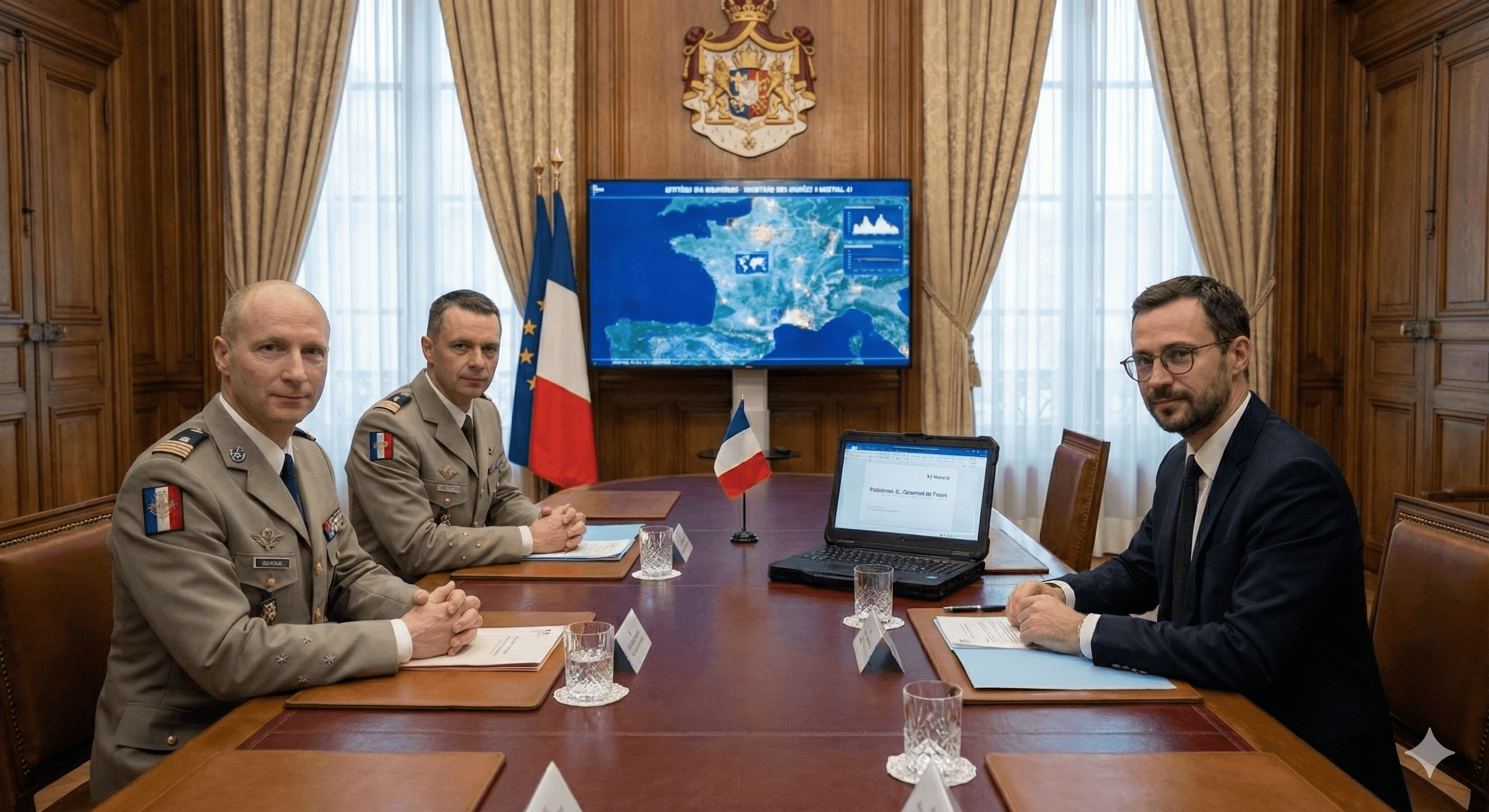
Le ministère des Armées de la France a attribué à Mistral AI un accord-cadre permettant aux branches militaires, aux directions et aux organismes affiliés (par exemple, CEA, ONERA, SHOM) d'accéder à ses modèles d'IA, logiciels et services. Supervisées par AMIAD, les solutions fonctionneront sur l'infrastructure française et s'appuieront sur un accord de coopération 2025, renforçant le contrôle souverain de l'IA.
Ce qui s'est passé et pourquoi c'est important
Le 8 janvier 2026, Reuters a rapporté que le ministère des Armées de France avait attribué à Mistral AI un accord-cadre pour fournir des modèles d'IA générative, logiciels et services à travers l'écosystème de défense. Cette initiative formalise l'accès pour les forces armées et les directions du ministère et s'étend aux principales institutions publiques affiliées, avec la supervision d'AMIAD. L'hébergement est assuré sur l'infrastructure française pour préserver le contrôle national sur les données et technologies sensibles. Cela fait suite à un accord de coopération de mars 2025, marquant une accélération du pilote à l'adoption à grande échelle.
Pourquoi un accord-cadre est crucial
Dans la passation de marchés publics européens, un contrat-cadre établit des termes commerciaux et juridiques prédéfinis pour que plusieurs unités puissent faire appel aux services rapidement, sans renégociation à chaque fois. Pour l'IA de défense, cela se traduit par une rapidité de déploiement: tester, évaluer et déployer des outils basés sur des modèles sans mois de travail contractuel tout en restant dans les limites de la gouvernance.
Portée et bénéficiaires
Qui peut l'utiliser : Les forces armées, directions, services et organismes publics désignés du ministère tels que le CEA (Commissariat à l'énergie atomique), ONERA (études & recherches aérospatiales) et SHOM (hydrographie & océanographie navales).
Ce qui est inclus : Accès aux modèles d’IA de Mistral, logiciels d'entreprise et services professionnels—y compris un éventuel affinage sur les données de défense pour répondre aux besoins opérationnels.
Supervision : L'Agence de l'intelligence artificielle de défense (AMIAD) coordonne les normes de déploiement, les contrôles de risque et l'interopérabilité.
IA souveraine : hébergement et contrôle
Emplacement & contrôle : Mistral indique que les solutions seront hébergées entièrement sur l'infrastructure française, soutenant la résidence des données, l'assurance de la chaîne d'approvisionnement et la continuité sous la politique nationale.
Sécurité opérationnelle : Attendez-vous à des contrôles stricts d'identité et d'accès (SSO, RBAC), une journalisation des invites/résultats et une séparation des pipelines de formation publics—c'est-à-dire, aucune utilisation des invites/données de défense pour entraîner des modèles publics.
Cas d'utilisation probable en défense
Renseignement & analyse – résumés de rapports multi-sources, triage multilingue, génération d'hypothèses avec validation humaine.
Planification opérationnelle – listes de contrôle, recherches de procédures et évaluations de plans; fiches modélisées avec références de source.
Cyber & SecOps – résumés de journaux, brouillons de narration d'incidents et guides de playbook; récupération de haute précision dans des corpus classifiés.
Logistique & maintenance – recherche de manuels techniques, aides au raisonnement d'arbre de défaillance et planification de pièces sous supervision humaine.
Éducation & doctrine – génération de contenu de formation, Q&A sur les politiques et traduction alignée à la terminologie de défense.
Considérations de risque et de gouvernance (contexte de défense)
Gestion des risques des modèles : Enregistrer les modèles, l'utilisation prévue et les contraintes de sécurité; mesurer la dérive des performances et la robustesse face aux attaques.
Frontières de sécurité : Imposer l'inférence sur air-gapped ou hébergée VPC selon les besoins; vérifier l'isolation des chemins de données.
Contrôles d'exportation et classification : Assurer les contrôles pour des contraintes semblables à l'ITAR le cas échéant et la gestion de classification (étiquetage des métadonnées, règles de déclassement).
Auditabilité & provenance : Exiger des résultats fondés sur des sources, une journalisation complète des demandes/réponses et un verrouillage des versions de modèle pour des revues après-action.
Supervision humaine : Humain dans la boucle pour toute décision opérationnelle ou adjacente au ciblage; les résultats de l'IA restent consultatifs.
Comment cela se compare et ce que les acheteurs devraient surveiller
Mécanisme d'accélération : Avec un cadre en place, les unités peuvent piloter et adopter avec moins de friction que les contrats sur-mesure.
Positionnement souverain : L'hébergement en France soutient les objectifs politiques de souveraineté technologique et réduit le risque de dépendance.
Interaction de l'écosystème : La France dispose d’initiatives parallèles (par exemple, programmes soutenus par AMIAD et contrats séparés pour l'intégration de l'IA) indiquant une institutionnalisation plus large de l'IA de défense. Attendez-vous à une demande croissante pour l'interopérabilité avec les systèmes C2/ISR existants et la conformité aux normes de l'OTAN lorsqu'elles sont pertinentes.
Un plan d'évaluation pragmatique de 90 jours pour les agences de défense/sécurisées
Semaines 1–2 : Accueil & garde-fous
Confirmer les limites de classification; établir des environnements isolés; implémenter SSO/RBAC/journalisation; définir les procédures de red-team.
Semaines 3–6 : Piloter des tranches fines
Choisir deux workflows (par exemple, résumé d'intel; récupération de doctrine). Connecter un magasin de connaissances en lecture seule; implémenter RAG; définir des métriques d'évaluation (latence, couverture de citation, satisfaction opérateur).
Semaines 7–12 : Échelle prudemment
Élargir à d'autres unités; exécuter des exercices sur table; formaliser le contrôle de retour arrière/modification; rédiger le cas des bénéfices et le registre des risques.
Pertinence UK/UE pour les acheteurs non français
À retenir : Le modèle—cadre + hébergement souverain + supervision de type AMIAD—influencera d'autres ministères et acheteurs d'infrastructures critiques nationales. En dehors de la France, adapter à la politique nationale (par exemple, orientation UK DSIT/MoD) et aux accréditations de sécurité locales tout en gardant une stratégie de sortie (portabilité du modèle, options de poids ouvert si approprié).
En résumé
Le cadre Mistral AI offre à l'écosystème de défense français un chemin rapide et souverain pour adopter l'IA générative tout en préservant le contrôle national. Pour les acheteurs gouvernementaux et réglementés à travers l'Europe, cela signifie qu'il faut prioriser l'approvisionnement basé sur cadre, la souveraineté d'hébergement, et la gouvernance mesurable lors de l'adoption de l'IA.
Prochaines étapes : Contactez Generation Digital pour un soutien sur les déploiements sécurisés de LLM dans les secteurs gouvernementaux et réglementés, y compris la gouvernance, l'architecture et le suivi des avantages.
FAQ
Q1. Que couvre l'accord-cadre ?
R. Accès aux modèles, logiciels et services de Mistral AI pour les forces armées, directions, services et affiliés du ministère (CEA, ONERA, SHOM), supervisé par AMIAD, avec hébergement sur l'infrastructure française.
Q2. Les données de défense sont-elles utilisées pour entraîner des modèles publics ?
R. Les déploiements d'entreprise/souverains excluent généralement les données client de l'entraînement des modèles publics; confirmez cela contractuellement et dans les contrôles techniques.
Q3. Quelles options d'hébergement s'appliquent ?
R. Infrastructure française (fournisseur ou auto-hébergé/VPC) avec contrôles stricts d'identité, de journalisation et de résidence des données; options air-gapped pour les classifications plus élevées.
Q4. À quelle vitesse les unités peuvent-elles adopter les outils ?
R. Les cadres prédéterminent les termes commerciaux/juridiques, permettant des call-offs plus rapides et des pilotes comparés aux contrats sur-mesure.
Q5. Quels sont les cas d'utilisation à court terme ?
R. Résumés d'intel, triage multilingue, recherche de doctrine, narration d'incidents, récupération de connaissances logistiques et contenu de formation—toujours avec un humain dans la boucle.
Recevez chaque semaine des nouvelles et des conseils sur l'IA directement dans votre boîte de réception
En vous abonnant, vous consentez à ce que Génération Numérique stocke et traite vos informations conformément à notre politique de confidentialité. Vous pouvez lire la politique complète sur gend.co/privacy.



Génération
Numérique

Bureau du Royaume-Uni
Génération Numérique Ltée
33 rue Queen,
Londres
EC4R 1AP
Royaume-Uni
Bureau au Canada
Génération Numérique Amériques Inc
181 rue Bay, Suite 1800
Toronto, ON, M5J 2T9
Canada
Bureau aux États-Unis
Generation Digital Americas Inc
77 Sands St,
Brooklyn, NY 11201,
États-Unis
Bureau de l'UE
Génération de logiciels numériques
Bâtiment Elgee
Dundalk
A91 X2R3
Irlande
Bureau du Moyen-Orient
6994 Alsharq 3890,
An Narjis,
Riyad 13343,
Arabie Saoudite







Numéro d'entreprise : 256 9431 77 | Droits d'auteur 2026 | Conditions générales | Politique de confidentialité