Stargate Community: Community-First AI Infrastructure

Stargate Community: Community-First AI Infrastructure

OpenAI
20 janv. 2026

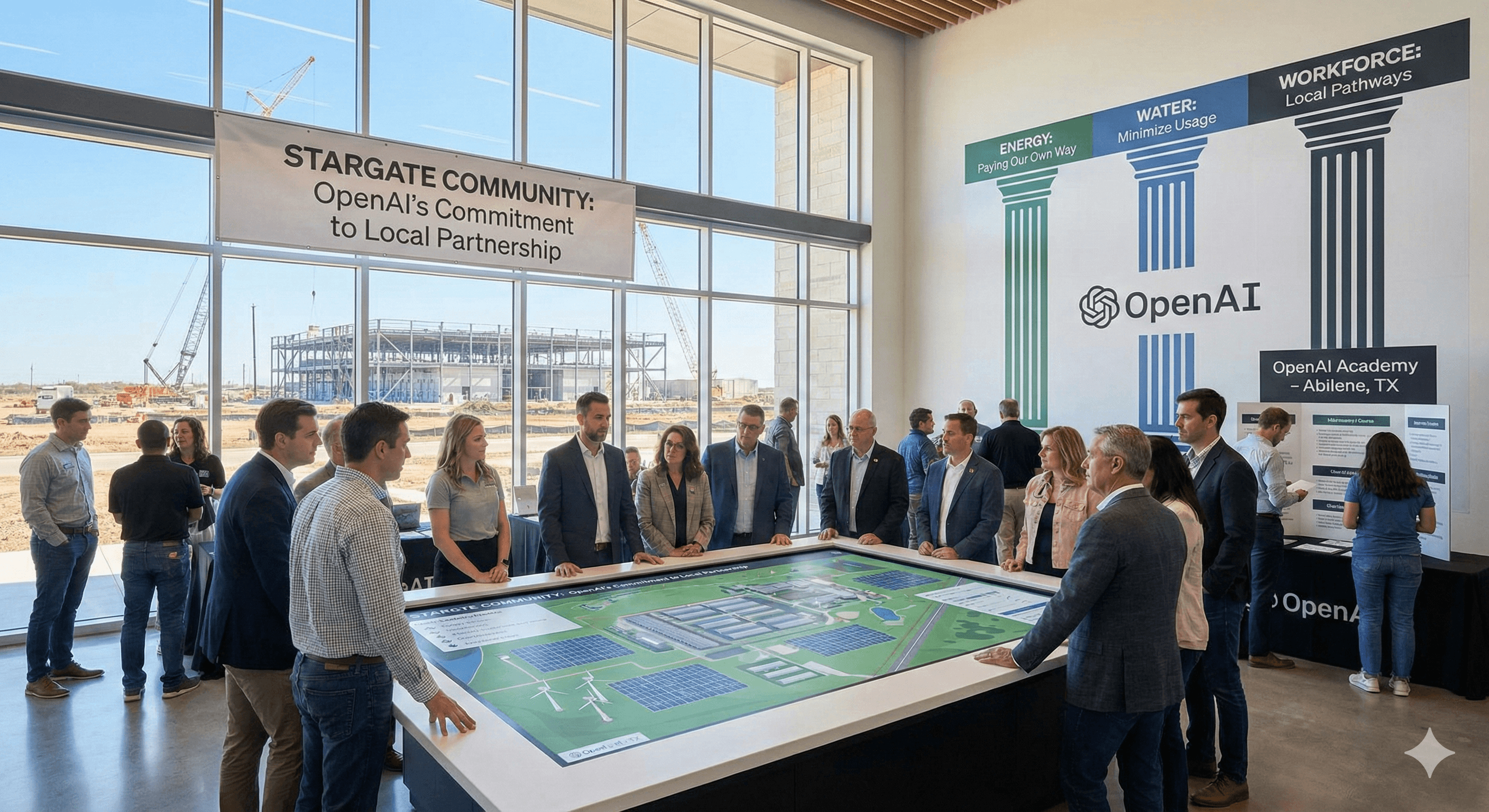
A group of people gather around a large digital display showcasing a detailed map, inside a spacious room with banners promoting "Stargate Community: OpenAI's Commitment to Local Partnership" and "OpenAI Academy - Abilene, TX" visible in the background.

Pas sûr de quoi faire ensuite avec l'IA?
Évaluez la préparation, les risques et les priorités en moins d'une heure.

Pas sûr de quoi faire ensuite avec l'IA?
Évaluez la préparation, les risques et les priorités en moins d'une heure.

➔ Téléchargez notre kit de préparation à l'IA gratuit

Stargate Community is OpenAI’s community-first approach to building large AI infrastructure, with a locally tailored plan for every Stargate site shaped by community input. The programme commits to “paying our own way” on energy so operations don’t raise local electricity prices, alongside lower-water cooling priorities and workforce pathways such as OpenAI Academies.

AI infrastructure is getting bigger, faster.

The downside is that communities increasingly feel the impact first: electricity prices, grid stress, water usage, construction disruption, and housing pressure — long before they see the promised benefits.

That’s the context for Stargate Community, OpenAI’s initiative to put community impact into the design of AI campuses from the start. The headline idea is simple: every Stargate site gets its own local plan, shaped by community input, and grounded in commitments around energy, water, and jobs.

This article explains what the plan says, why it matters, and what “good” looks like if you’re a local authority, utility, employer, or an organisation evaluating AI infrastructure partnerships.

What is Stargate Community?

Stargate Community is OpenAI’s framework for building Stargate AI campuses as long-term community partners — with locally tailored community plans that reflect regional needs and concerns.

In OpenAI’s announcement, the company states that it aims to expand U.S. AI infrastructure to 10GW by 2029, and that it is already “well beyond halfway” in planned capacity, with sites under development across Texas, New Mexico, Wisconsin, and Michigan.

The reason for the initiative is practical: large-scale AI campuses depend on local trust and local capacity. Without a community-first approach, projects can stall under the weight of opposition and regulatory friction.

The three pillars: energy, water, and workforce

1) Energy: “paying our own way”

The central commitment is explicit: OpenAI says its operations should not increase local electricity prices.

Because grid conditions differ by region, the plan describes site-by-site approaches that may include:

  • funding the incremental generation and grid upgrades required by the project

  • planning proactively with utilities, regulators and grid operators

  • operating AI campuses as flexible loads, meaning the campus can reduce or curtail consumption during forecast peak conditions and participate in demand-response and grid stability programmes

OpenAI also points to early examples, including work with local utilities and developer partners in Wisconsin and Michigan, structured to protect other customers from rate increases.

Why it matters: Energy is the single biggest community risk signal. If residents believe their bills will rise, trust collapses.

2) Water: minimise usage and protect ecosystems

OpenAI’s plan states it will prioritise closed-loop or low-water cooling and says facility water use should be a fraction of a community’s overall water usage.

Why it matters: Water is a flashpoint issue for datacentres and AI campuses, particularly in regions experiencing drought or seasonal stress.

3) Workforce: local pathways into high-quality jobs

OpenAI says it will invest early in local jobs and skills by establishing OpenAI Academies as the backbone of regional workforce development in Stargate communities.

The announcement states the first Stargate community OpenAI Academy will launch in Abilene, Texas in spring 2026, delivering credentials and pathways into jobs aligned with local employers.

It also mentions engagement with labour unions and workforce partners to support the skilled trades and technical workforce needed to build and operate AI infrastructure.

Why it matters: Communities tend to be sceptical of “jobs” promises that result in short-term construction roles but limited long-term local employment. Workforce pathways are how you turn investment into durable prosperity.

Why this approach exists now

Large datacentre builds are facing growing local scrutiny — with opposition often driven by three questions:

  1. Will this raise our energy bills or stress the grid?

  2. Will it consume scarce water?

  3. Will it leave us with disruption but few long-term benefits?

Stargate Community is best understood as a response to that reality: a commitment to build trust through transparency, local engagement and concrete mitigations.

Practical steps: what a strong “community-first AI infrastructure plan” should include

Whether you’re a local authority, developer, utility, or major customer, these are the elements that make a community plan credible.

1) Transparent capacity planning

  • publish site-level assumptions (power needs, cooling approach, build schedule)

  • explain how demand will be met and how community impact will be mitigated

2) An energy “no-surprises” commitment

  • who pays for grid upgrades

  • how rate impacts are avoided

  • how the campus will participate in demand response and flexible load programmes

3) Water and environmental safeguards

  • cooling approach (closed loop / low water)

  • monitoring and reporting commitments

  • ecosystem protection measures

4) Workforce outcomes that can be measured

  • number of local trainees and credentials issued

  • apprenticeships and skilled trade pathways

  • targets for long-term local hiring

5) A community feedback loop that continues after launch

  • community advisory groups

  • ongoing reporting and grievance pathways

  • clear contact points and escalation

What this means for businesses and public-sector stakeholders

For businesses investing in AI capability

If your roadmap depends on frontier AI, you will depend on infrastructure. “Community-first” commitments can reduce supply risk by helping projects move through permits and grid upgrades faster — but only if commitments are real and enforceable.

For local authorities and utilities

The opportunity is significant: investment, jobs, and skills — if you negotiate clear terms on energy, water, housing impact, and workforce outcomes.

For education and workforce providers

The demand for technicians, electricians, cooling specialists, network engineers and security staff will grow. Structured academies and credential pathways help ensure local residents benefit.

Where Generation Digital helps

If you’re navigating AI adoption and the infrastructure realities behind it, the hardest part is aligning ambition with governance and operational control.

Generation Digital supports organisations with:

  • AI strategy and governance that boards can trust

  • deployment guardrails and risk management

  • operating models that translate AI investment into measurable outcomes

Summary

Stargate Community sets out a community-first model for AI campuses: local plans driven by community input, a commitment to “pay our own way” on energy so electricity prices don’t rise, strategies like flexible loads to support grid stability, lower-water cooling priorities, and workforce pathways through OpenAI Academies. The measure of success will be whether these commitments translate into verifiable outcomes on the ground.

Next steps

  1. If you’re in a host community: ask for transparent energy, water and workforce commitments and a post-launch feedback mechanism.

  2. If you’re an enterprise buyer: treat community and infrastructure risk as part of your AI risk register.

  3. If you’re building AI capability: ensure governance and operational control keep pace with scale.

  4. To discuss governed AI adoption and operating models, contact Generation Digital.

FAQs

Q1: What is the main goal of Stargate Community?
A: To build large AI infrastructure in partnership with host communities, using locally tailored plans shaped by community input, with commitments around energy costs, environmental impact, and workforce benefits.

Q2: How does Stargate Community incorporate local input?
A: The initiative states that each Stargate site will have its own community plan driven by local concerns, with planning conducted alongside utilities, regulators and other local stakeholders.

Q3: What does “paying our own way on energy” mean?
A: It means funding the incremental generation and grid upgrades required by the project so the facility’s electricity use does not increase prices for other customers, with site-specific structures.

Q4: What are “flexible loads” in this context?
A: Flexible loads are demand-response strategies where a campus can reduce or curtail power consumption during peak conditions or grid stress, helping stabilise the grid.

Q5: How does Stargate Community address local jobs?
A: OpenAI states it will establish OpenAI Academies customised to each site, providing credentials and pathways into local high-quality jobs, beginning with an academy in Abilene, Texas.

Stargate Community is OpenAI’s community-first approach to building large AI infrastructure, with a locally tailored plan for every Stargate site shaped by community input. The programme commits to “paying our own way” on energy so operations don’t raise local electricity prices, alongside lower-water cooling priorities and workforce pathways such as OpenAI Academies.

AI infrastructure is getting bigger, faster.

The downside is that communities increasingly feel the impact first: electricity prices, grid stress, water usage, construction disruption, and housing pressure — long before they see the promised benefits.

That’s the context for Stargate Community, OpenAI’s initiative to put community impact into the design of AI campuses from the start. The headline idea is simple: every Stargate site gets its own local plan, shaped by community input, and grounded in commitments around energy, water, and jobs.

This article explains what the plan says, why it matters, and what “good” looks like if you’re a local authority, utility, employer, or an organisation evaluating AI infrastructure partnerships.

What is Stargate Community?

Stargate Community is OpenAI’s framework for building Stargate AI campuses as long-term community partners — with locally tailored community plans that reflect regional needs and concerns.

In OpenAI’s announcement, the company states that it aims to expand U.S. AI infrastructure to 10GW by 2029, and that it is already “well beyond halfway” in planned capacity, with sites under development across Texas, New Mexico, Wisconsin, and Michigan.

The reason for the initiative is practical: large-scale AI campuses depend on local trust and local capacity. Without a community-first approach, projects can stall under the weight of opposition and regulatory friction.

The three pillars: energy, water, and workforce

1) Energy: “paying our own way”

The central commitment is explicit: OpenAI says its operations should not increase local electricity prices.

Because grid conditions differ by region, the plan describes site-by-site approaches that may include:

  • funding the incremental generation and grid upgrades required by the project

  • planning proactively with utilities, regulators and grid operators

  • operating AI campuses as flexible loads, meaning the campus can reduce or curtail consumption during forecast peak conditions and participate in demand-response and grid stability programmes

OpenAI also points to early examples, including work with local utilities and developer partners in Wisconsin and Michigan, structured to protect other customers from rate increases.

Why it matters: Energy is the single biggest community risk signal. If residents believe their bills will rise, trust collapses.

2) Water: minimise usage and protect ecosystems

OpenAI’s plan states it will prioritise closed-loop or low-water cooling and says facility water use should be a fraction of a community’s overall water usage.

Why it matters: Water is a flashpoint issue for datacentres and AI campuses, particularly in regions experiencing drought or seasonal stress.

3) Workforce: local pathways into high-quality jobs

OpenAI says it will invest early in local jobs and skills by establishing OpenAI Academies as the backbone of regional workforce development in Stargate communities.

The announcement states the first Stargate community OpenAI Academy will launch in Abilene, Texas in spring 2026, delivering credentials and pathways into jobs aligned with local employers.

It also mentions engagement with labour unions and workforce partners to support the skilled trades and technical workforce needed to build and operate AI infrastructure.

Why it matters: Communities tend to be sceptical of “jobs” promises that result in short-term construction roles but limited long-term local employment. Workforce pathways are how you turn investment into durable prosperity.

Why this approach exists now

Large datacentre builds are facing growing local scrutiny — with opposition often driven by three questions:

  1. Will this raise our energy bills or stress the grid?

  2. Will it consume scarce water?

  3. Will it leave us with disruption but few long-term benefits?

Stargate Community is best understood as a response to that reality: a commitment to build trust through transparency, local engagement and concrete mitigations.

Practical steps: what a strong “community-first AI infrastructure plan” should include

Whether you’re a local authority, developer, utility, or major customer, these are the elements that make a community plan credible.

1) Transparent capacity planning

  • publish site-level assumptions (power needs, cooling approach, build schedule)

  • explain how demand will be met and how community impact will be mitigated

2) An energy “no-surprises” commitment

  • who pays for grid upgrades

  • how rate impacts are avoided

  • how the campus will participate in demand response and flexible load programmes

3) Water and environmental safeguards

  • cooling approach (closed loop / low water)

  • monitoring and reporting commitments

  • ecosystem protection measures

4) Workforce outcomes that can be measured

  • number of local trainees and credentials issued

  • apprenticeships and skilled trade pathways

  • targets for long-term local hiring

5) A community feedback loop that continues after launch

  • community advisory groups

  • ongoing reporting and grievance pathways

  • clear contact points and escalation

What this means for businesses and public-sector stakeholders

For businesses investing in AI capability

If your roadmap depends on frontier AI, you will depend on infrastructure. “Community-first” commitments can reduce supply risk by helping projects move through permits and grid upgrades faster — but only if commitments are real and enforceable.

For local authorities and utilities

The opportunity is significant: investment, jobs, and skills — if you negotiate clear terms on energy, water, housing impact, and workforce outcomes.

For education and workforce providers

The demand for technicians, electricians, cooling specialists, network engineers and security staff will grow. Structured academies and credential pathways help ensure local residents benefit.

Where Generation Digital helps

If you’re navigating AI adoption and the infrastructure realities behind it, the hardest part is aligning ambition with governance and operational control.

Generation Digital supports organisations with:

  • AI strategy and governance that boards can trust

  • deployment guardrails and risk management

  • operating models that translate AI investment into measurable outcomes

Summary

Stargate Community sets out a community-first model for AI campuses: local plans driven by community input, a commitment to “pay our own way” on energy so electricity prices don’t rise, strategies like flexible loads to support grid stability, lower-water cooling priorities, and workforce pathways through OpenAI Academies. The measure of success will be whether these commitments translate into verifiable outcomes on the ground.

Next steps

  1. If you’re in a host community: ask for transparent energy, water and workforce commitments and a post-launch feedback mechanism.

  2. If you’re an enterprise buyer: treat community and infrastructure risk as part of your AI risk register.

  3. If you’re building AI capability: ensure governance and operational control keep pace with scale.

  4. To discuss governed AI adoption and operating models, contact Generation Digital.

FAQs

Q1: What is the main goal of Stargate Community?
A: To build large AI infrastructure in partnership with host communities, using locally tailored plans shaped by community input, with commitments around energy costs, environmental impact, and workforce benefits.

Q2: How does Stargate Community incorporate local input?
A: The initiative states that each Stargate site will have its own community plan driven by local concerns, with planning conducted alongside utilities, regulators and other local stakeholders.

Q3: What does “paying our own way on energy” mean?
A: It means funding the incremental generation and grid upgrades required by the project so the facility’s electricity use does not increase prices for other customers, with site-specific structures.

Q4: What are “flexible loads” in this context?
A: Flexible loads are demand-response strategies where a campus can reduce or curtail power consumption during peak conditions or grid stress, helping stabilise the grid.

Q5: How does Stargate Community address local jobs?
A: OpenAI states it will establish OpenAI Academies customised to each site, providing credentials and pathways into local high-quality jobs, beginning with an academy in Abilene, Texas.

Recevez chaque semaine des nouvelles et des conseils sur l'IA directement dans votre boîte de réception

En vous abonnant, vous consentez à ce que Génération Numérique stocke et traite vos informations conformément à notre politique de confidentialité. Vous pouvez lire la politique complète sur gend.co/privacy.


Ateliers et webinaires à venir

A diverse group of professionals collaborating around a table in a bright, modern office setting.

Clarté opérationnelle à grande échelle - Asana

Webinaire Virtuel
Mercredi 25 février 2026
En ligne

A diverse group of professionals collaborating around a table in a bright, modern office setting.

Collaborez avec des coéquipiers IA - Asana

Atelier en personne
Jeudi 26 février 2026
London, UK

A diverse group of professionals collaborating around a table in a bright, modern office setting.

De l'idée au prototype - L'IA dans Miro

Webinaire virtuel
Mercredi 18 février 2026
En ligne

Génération
Numérique

Bureau du Royaume-Uni

Génération Numérique Ltée
33 rue Queen,
Londres
EC4R 1AP
Royaume-Uni

Bureau au Canada

Génération Numérique Amériques Inc
181 rue Bay, Suite 1800
Toronto, ON, M5J 2T9
Canada

Bureau aux États-Unis

Generation Digital Americas Inc
77 Sands St,
Brooklyn, NY 11201,
États-Unis

Bureau de l'UE

Génération de logiciels numériques
Bâtiment Elgee
Dundalk
A91 X2R3
Irlande

Bureau du Moyen-Orient

6994 Alsharq 3890,
An Narjis,
Riyad 13343,
Arabie Saoudite

UK Fast Growth Index UBS Logo
Financial Times FT 1000 Logo
Febe Growth 100 Logo (Background Removed)

Numéro d'entreprise : 256 9431 77 | Droits d'auteur 2026 | Conditions générales | Politique de confidentialité

Génération
Numérique

Bureau du Royaume-Uni

Génération Numérique Ltée
33 rue Queen,
Londres
EC4R 1AP
Royaume-Uni

Bureau au Canada

Génération Numérique Amériques Inc
181 rue Bay, Suite 1800
Toronto, ON, M5J 2T9
Canada

Bureau aux États-Unis

Generation Digital Americas Inc
77 Sands St,
Brooklyn, NY 11201,
États-Unis

Bureau de l'UE

Génération de logiciels numériques
Bâtiment Elgee
Dundalk
A91 X2R3
Irlande

Bureau du Moyen-Orient

6994 Alsharq 3890,
An Narjis,
Riyad 13343,
Arabie Saoudite

UK Fast Growth Index UBS Logo
Financial Times FT 1000 Logo
Febe Growth 100 Logo (Background Removed)


Numéro d'entreprise : 256 9431 77
Conditions générales
Politique de confidentialité
Droit d'auteur 2026





