ChatGPT Deep Research: How It Works and When to Use It

ChatGPT Deep Research: How It Works and When to Use It

ChatGPT

24 feb 2026

A group of professionals engaged in a collaborative office setting, analyzing documents and laptop screens filled with charts and graphs, embodying elements of ChatGPT deep research and its practical applications.

¿No sabes por dónde empezar con la IA?
Evalúa preparación, riesgos y prioridades en menos de una hora.

¿No sabes por dónde empezar con la IA?
Evalúa preparación, riesgos y prioridades en menos de una hora.

➔ Descarga nuestro paquete gratuito de preparación para IA

ChatGPT Deep Research is a research mode that turns complex questions into structured, cited reports. You choose the sources it can use—public web, specific sites, uploaded files, and connected apps—then review a proposed plan before it runs. It’s best for multi-step research, synthesis, and verification-ready outputs you can reuse.

Most people don’t need “more AI answers”. They need research they can trust, with sources they can check.

That’s the promise of Deep Research in ChatGPT: instead of a quick response, it creates a documented report by reading and synthesising multiple sources—while letting you control where the information comes from and how the scope evolves.

This guide explains what Deep Research is, how to use it well, and how to roll it out safely in a business setting.

What is Deep Research in ChatGPT?

Deep Research is a research workflow inside ChatGPT that:

  • proposes a research plan based on your goal

  • reads across multiple sources (websites, specific domains, uploaded files, and connected apps)

  • lets you follow progress and redirect mid-run

  • produces a structured report with citations/source links for verification

It’s designed for multi-step questions where you want more depth and traceability than a normal chat response.
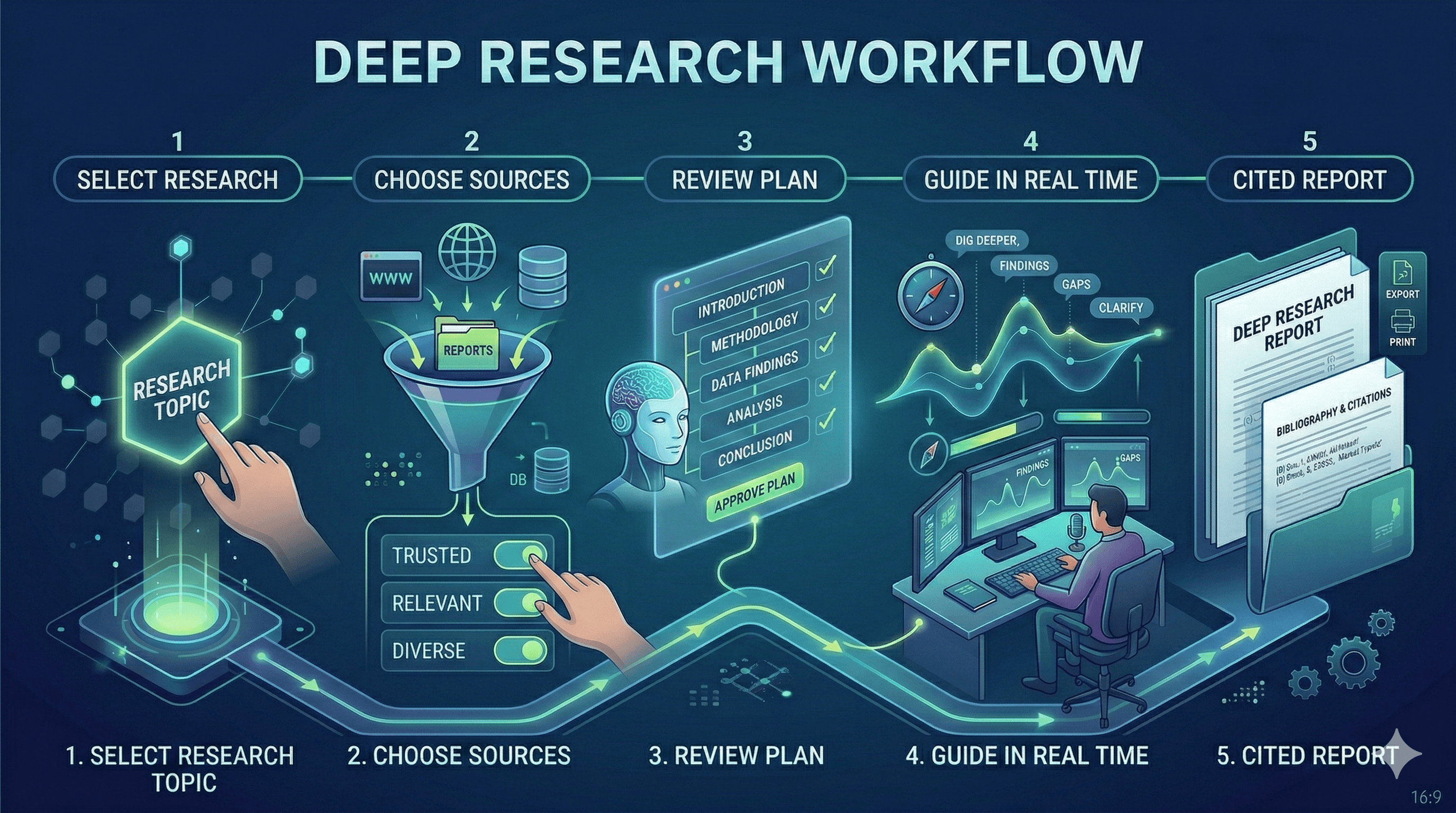
Search vs Deep Research vs Agent mode (simple comparison)

When teams get confused, it’s usually because they’re mixing three different experiences.

Mode

Best for

Output style

Control over sources

Search (web)

Quick facts, recent updates, fast browsing

Short summary + links

Limited (general web)

Deep Research

Multi-step research + synthesis

Structured, cited report

High: sites, files, connected apps

Agent mode

Tasks that combine research + actions (and, in some setups, a visual browser)

Longer workflows and tool use

Varies by configuration

As a rule of thumb:

  • use Search when you just need a quick answer and a few links;

  • use Deep Research when you need a report you can share or build on;

  • use Agent mode when the task includes multiple steps and tool use beyond research.

How Deep Research works (step by step)

1) Select Deep Research

In ChatGPT, open the tools menu (“+”) and choose Deep Research. You can also start it via shortcut commands (depending on your interface and plan).

2) Add your sources

You can let Deep Research use the public web, but the real value is in curated sources:

  • add a set of URLs you trust

  • restrict the task to specific sites/domains

  • attach files (PDFs, docs, spreadsheets)

  • connect apps (e.g., document stores) for authenticated context

Deep Research prioritises the sources you provide over general web results.

3) Review the proposed plan

Before it starts, ChatGPT creates a proposed research plan. Review it like you would a brief:

  • is the scope right?

  • are the constraints clear?

  • is anything missing (markets, competitors, date ranges, definitions)?

4) Guide the work in real time

As it runs, you can:

  • refine the scope

  • add constraints

  • update sources

  • interrupt and redirect the research

5) Review and download the report

Deep Research outputs are designed for reuse:

  • table of contents for navigation

  • sources used for reference checking

  • activity history to see progress

You can export reports in formats like Markdown, Word, and PDF.

What to use Deep Research for (high-value use cases)

Deep Research works best when the output is a work product.

Market and competitor research

  • competitor positioning and feature comparisons

  • market landscape summaries

  • pricing and packaging research (with citations)

Policy and regulatory scanning

  • summary of regulatory requirements by region

  • comparison of guidance across authorities

  • evidence-backed recommendations (with source trail)

Procurement and vendor assessment

  • vendor shortlists based on defined criteria

  • security/compliance documentation review

  • “pros/cons + risks” reports with links to primary sources

Research briefs for product and comms teams

  • write a PRD background section with citations

  • build a structured briefing for leadership

  • assemble “what changed since last quarter” updates

How to write prompts that get better research

A good Deep Research prompt looks more like a brief than a question.

Include:

  • the decision you’re trying to make

  • the audience (exec, technical, customer)

  • scope boundaries (region, timeframe, industry)

  • required format (table, SWOT, narrative, checklist)

  • preferred sources (or sites to exclude)

Example prompt

“Create a cited report comparing three AI note-taking tools for UK professional services teams. Include: pricing, data handling, security certifications, meeting transcription capability, and admin controls. Prioritise vendor documentation and reputable third-party reviews. Summarise recommendations for a CIO and include a decision matrix.”

Governance and safe rollout for teams

Deep Research is most powerful when it becomes repeatable—and that requires a few guardrails.

Source control and traceability

Teach teams to:

  • prioritise primary sources (vendor docs, regulators, standards bodies)

  • restrict research to trusted domains when accuracy matters

  • treat citations as part of the deliverable, not an afterthought

Data privacy basics

Deep Research follows the same data handling settings as standard ChatGPT conversations (including retention and training preferences configured in your data controls). For enterprise environments, admins can control access through role-based controls and can reference activity via admin APIs.

A simple operating model

If you’re rolling out Deep Research across a business:

  1. define approved use cases (and prohibited ones)

  2. publish “trusted source packs” by function (e.g., HR, finance, legal)

  3. standardise prompts and report templates

  4. train people on verification and citation hygiene

  5. set review rules for high-risk outputs

Next steps

If you want to get value quickly:

  1. Pick one workflow where research is already routine (vendor evaluation, market scans, policy reviews).

  2. Build a small set of trusted sources and a standard prompt.

  3. Run five Deep Research tasks, review the outputs, and refine the template.

  4. Scale to the next workflow once quality is consistent.

FAQs

What’s the difference between Search and Deep Research?
Search is for quick lookups and recent updates. Deep Research reads and analyses many sources to produce a structured, documented report you can verify.

Can I choose which websites Deep Research uses?
Yes. You can prioritise specific sites or restrict research to only the domains you specify.

Can Deep Research use my private documents?
Yes. You can upload files, and—depending on your plan—connect apps like document stores so Deep Research can pull from authenticated sources you already have access to.

Can it write back to connected apps?
Deep Research uses read actions from connected apps for research. It does not use app write actions as part of the research workflow.

How do I share results with stakeholders?
Deep Research reports open in a fullscreen view designed for review, and you can export them in formats like Markdown, Word, or PDF.

ChatGPT Deep Research is a research mode that turns complex questions into structured, cited reports. You choose the sources it can use—public web, specific sites, uploaded files, and connected apps—then review a proposed plan before it runs. It’s best for multi-step research, synthesis, and verification-ready outputs you can reuse.

Most people don’t need “more AI answers”. They need research they can trust, with sources they can check.

That’s the promise of Deep Research in ChatGPT: instead of a quick response, it creates a documented report by reading and synthesising multiple sources—while letting you control where the information comes from and how the scope evolves.

This guide explains what Deep Research is, how to use it well, and how to roll it out safely in a business setting.

What is Deep Research in ChatGPT?

Deep Research is a research workflow inside ChatGPT that:

  • proposes a research plan based on your goal

  • reads across multiple sources (websites, specific domains, uploaded files, and connected apps)

  • lets you follow progress and redirect mid-run

  • produces a structured report with citations/source links for verification

It’s designed for multi-step questions where you want more depth and traceability than a normal chat response.

Search vs Deep Research vs Agent mode (simple comparison)

When teams get confused, it’s usually because they’re mixing three different experiences.

Mode

Best for

Output style

Control over sources

Search (web)

Quick facts, recent updates, fast browsing

Short summary + links

Limited (general web)

Deep Research

Multi-step research + synthesis

Structured, cited report

High: sites, files, connected apps

Agent mode

Tasks that combine research + actions (and, in some setups, a visual browser)

Longer workflows and tool use

Varies by configuration

As a rule of thumb:

  • use Search when you just need a quick answer and a few links;

  • use Deep Research when you need a report you can share or build on;

  • use Agent mode when the task includes multiple steps and tool use beyond research.

How Deep Research works (step by step)

1) Select Deep Research

In ChatGPT, open the tools menu (“+”) and choose Deep Research. You can also start it via shortcut commands (depending on your interface and plan).

2) Add your sources

You can let Deep Research use the public web, but the real value is in curated sources:

  • add a set of URLs you trust

  • restrict the task to specific sites/domains

  • attach files (PDFs, docs, spreadsheets)

  • connect apps (e.g., document stores) for authenticated context

Deep Research prioritises the sources you provide over general web results.

3) Review the proposed plan

Before it starts, ChatGPT creates a proposed research plan. Review it like you would a brief:

  • is the scope right?

  • are the constraints clear?

  • is anything missing (markets, competitors, date ranges, definitions)?

4) Guide the work in real time

As it runs, you can:

  • refine the scope

  • add constraints

  • update sources

  • interrupt and redirect the research

5) Review and download the report

Deep Research outputs are designed for reuse:

  • table of contents for navigation

  • sources used for reference checking

  • activity history to see progress

You can export reports in formats like Markdown, Word, and PDF.

What to use Deep Research for (high-value use cases)

Deep Research works best when the output is a work product.

Market and competitor research

  • competitor positioning and feature comparisons

  • market landscape summaries

  • pricing and packaging research (with citations)

Policy and regulatory scanning

  • summary of regulatory requirements by region

  • comparison of guidance across authorities

  • evidence-backed recommendations (with source trail)

Procurement and vendor assessment

  • vendor shortlists based on defined criteria

  • security/compliance documentation review

  • “pros/cons + risks” reports with links to primary sources

Research briefs for product and comms teams

  • write a PRD background section with citations

  • build a structured briefing for leadership

  • assemble “what changed since last quarter” updates

How to write prompts that get better research

A good Deep Research prompt looks more like a brief than a question.

Include:

  • the decision you’re trying to make

  • the audience (exec, technical, customer)

  • scope boundaries (region, timeframe, industry)

  • required format (table, SWOT, narrative, checklist)

  • preferred sources (or sites to exclude)

Example prompt

“Create a cited report comparing three AI note-taking tools for UK professional services teams. Include: pricing, data handling, security certifications, meeting transcription capability, and admin controls. Prioritise vendor documentation and reputable third-party reviews. Summarise recommendations for a CIO and include a decision matrix.”

Governance and safe rollout for teams

Deep Research is most powerful when it becomes repeatable—and that requires a few guardrails.

Source control and traceability

Teach teams to:

  • prioritise primary sources (vendor docs, regulators, standards bodies)

  • restrict research to trusted domains when accuracy matters

  • treat citations as part of the deliverable, not an afterthought

Data privacy basics

Deep Research follows the same data handling settings as standard ChatGPT conversations (including retention and training preferences configured in your data controls). For enterprise environments, admins can control access through role-based controls and can reference activity via admin APIs.

A simple operating model

If you’re rolling out Deep Research across a business:

  1. define approved use cases (and prohibited ones)

  2. publish “trusted source packs” by function (e.g., HR, finance, legal)

  3. standardise prompts and report templates

  4. train people on verification and citation hygiene

  5. set review rules for high-risk outputs

Next steps

If you want to get value quickly:

  1. Pick one workflow where research is already routine (vendor evaluation, market scans, policy reviews).

  2. Build a small set of trusted sources and a standard prompt.

  3. Run five Deep Research tasks, review the outputs, and refine the template.

  4. Scale to the next workflow once quality is consistent.

FAQs

What’s the difference between Search and Deep Research?
Search is for quick lookups and recent updates. Deep Research reads and analyses many sources to produce a structured, documented report you can verify.

Can I choose which websites Deep Research uses?
Yes. You can prioritise specific sites or restrict research to only the domains you specify.

Can Deep Research use my private documents?
Yes. You can upload files, and—depending on your plan—connect apps like document stores so Deep Research can pull from authenticated sources you already have access to.

Can it write back to connected apps?
Deep Research uses read actions from connected apps for research. It does not use app write actions as part of the research workflow.

How do I share results with stakeholders?
Deep Research reports open in a fullscreen view designed for review, and you can export them in formats like Markdown, Word, or PDF.

Recibe noticias y consejos sobre IA cada semana en tu bandeja de entrada

Al suscribirte, das tu consentimiento para que Generation Digital almacene y procese tus datos de acuerdo con nuestra política de privacidad. Puedes leer la política completa en gend.co/privacy.


Próximos talleres y seminarios web

A diverse group of professionals collaborating around a table in a bright, modern office setting.

Claridad Operacional a Gran Escala - Asana

Webinar Virtual
Miércoles 25 de febrero de 2026
En línea

A diverse group of professionals collaborating around a table in a bright, modern office setting.

Trabaja con compañeros de equipo de IA - Asana

Taller Presencial
Jueves 26 de febrero de 2026
Londres, Reino Unido

A diverse group of professionals collaborating around a table in a bright, modern office setting.

De Idea a Prototipo: IA en Miro

Seminario Web Virtual
Miércoles 18 de febrero de 2026
En línea

Generación
Digital

Oficina en Reino Unido

Generation Digital Ltd
33 Queen St,
Londres
EC4R 1AP
Reino Unido

Oficina en Canadá

Generation Digital Americas Inc
181 Bay St., Suite 1800
Toronto, ON, M5J 2T9
Canadá

Oficina en EE. UU.

Generation Digital Américas Inc
77 Sands St,
Brooklyn, NY 11201,
Estados Unidos

Oficina de la UE

Software Generación Digital
Edificio Elgee
Dundalk
A91 X2R3
Irlanda

Oficina en Medio Oriente

6994 Alsharq 3890,
An Narjis,
Riad 13343,
Arabia Saudita

UK Fast Growth Index UBS Logo
Financial Times FT 1000 Logo
Febe Growth 100 Logo (Background Removed)

Número de la empresa: 256 9431 77 | Derechos de autor 2026 | Términos y Condiciones | Política de Privacidad

Generación
Digital

Oficina en Reino Unido

Generation Digital Ltd
33 Queen St,
Londres
EC4R 1AP
Reino Unido

Oficina en Canadá

Generation Digital Americas Inc
181 Bay St., Suite 1800
Toronto, ON, M5J 2T9
Canadá

Oficina en EE. UU.

Generation Digital Américas Inc
77 Sands St,
Brooklyn, NY 11201,
Estados Unidos

Oficina de la UE

Software Generación Digital
Edificio Elgee
Dundalk
A91 X2R3
Irlanda

Oficina en Medio Oriente

6994 Alsharq 3890,
An Narjis,
Riad 13343,
Arabia Saudita

UK Fast Growth Index UBS Logo
Financial Times FT 1000 Logo
Febe Growth 100 Logo (Background Removed)


Número de Empresa: 256 9431 77
Términos y Condiciones
Política de Privacidad
Derechos de Autor 2026





