Agentic AI in Auto Retail: Beyond the Chatbot (2026 Guide)

Agentic AI in Auto Retail: Beyond the Chatbot (2026 Guide)

Artificial Intelligence
Jan 23, 2026

A man is sitting at a desk in a modern office, using dual monitors displaying code and a collaborative platform, illustrating the use of Glean Code Search and Writing Tools.

Not sure what to do next with AI?
Assess readiness, risk, and priorities in under an hour.

Not sure what to do next with AI?
Assess readiness, risk, and priorities in under an hour.

➔ Schedule a Consultation

The headlines this morning from Motor Trader confirm what many of us in the digital transformation space have been tracking for months: 2026 is the year the automotive industry moves beyond the "chatty" AI of yesterday and embraces Agentic AI.

For the last two years, dealerships and OEMs have raced to implement Generative AI (GenAI) to write marketing copy or power basic customer service bots. But as we settle into 2026, the novelty of an AI that can talk is fading. The competitive edge now belongs to AI that can act.

The Shift: From "Generative" to "Agentic"

To understand the magnitude of this shift, we must clarify the terminology that is currently dominating boardroom discussions.

  • Generative AI (The 2024–2025 Standard): Think of this as a brilliant creative assistant. You ask it to write a vehicle description or summarise a sales call, and it produces text. It is reactive—it waits for your prompt.

  • Agentic AI (The 2026 Reality): Think of this as a skilled employee. It has agency. You give it a goal—"Sell this excess stock of EV SUVs"—and it plans the steps, executes marketing actions, handles customer inquiries, negotiates within your margin rules, and schedules the handover.

As Motor Trader highlights, this ability to function with limited supervision is what will define the next era of car buying. It is not just about answering questions; it is about removing friction from the transaction entirely.

What Agentic Car Buying Looks Like

For the consumer, the friction of buying a car—the endless back-and-forth emails, the confusing finance options, the booking of test drives—has always been the pain point. Agentic AI solves this by acting as a "Digital Concierge."

Imagine a customer, Sarah, telling her personal AI agent: "Find me a red SUV under £35k with low mileage, and arrange a test drive for Tuesday."

Instead of Sarah trawling through Auto Trader, her agent talks directly to a dealership's Inventory Agent. The dealership's agent checks stock, verifies the margin, offers a provisional finance quote based on Sarah’s credit profile, and books the slot in the showroom diary. This entire negotiation happens machine-to-machine, in seconds.

Key Capabilities of Automotive Agents:

  • Autonomous Negotiation: Agents can close deals within pre-set profit margins without needing a manager’s sign-off for every £50 discount.

  • Smart Inventory Management: Instead of waiting for a human to notice a trend, agents analyse market demand and automatically adjust pricing or order stock to match local interest.

  • Post-Sale Service: After the sale, service agents proactively schedule maintenance, predicting parts requirements before the car even enters the workshop.

The Infrastructure Challenge: You Can't Just "Plug It In"

This is where the excitement meets reality. While the vision of Agentic AI is compelling, the execution requires robust "digital plumbing." An autonomous agent is only as good as the data it can access and the boundaries it is given.

If your customer data is siloed, or your inventory system doesn't talk to your CRM, an AI agent will simply make mistakes faster than a human ever could.

1. The Need for Orchestration

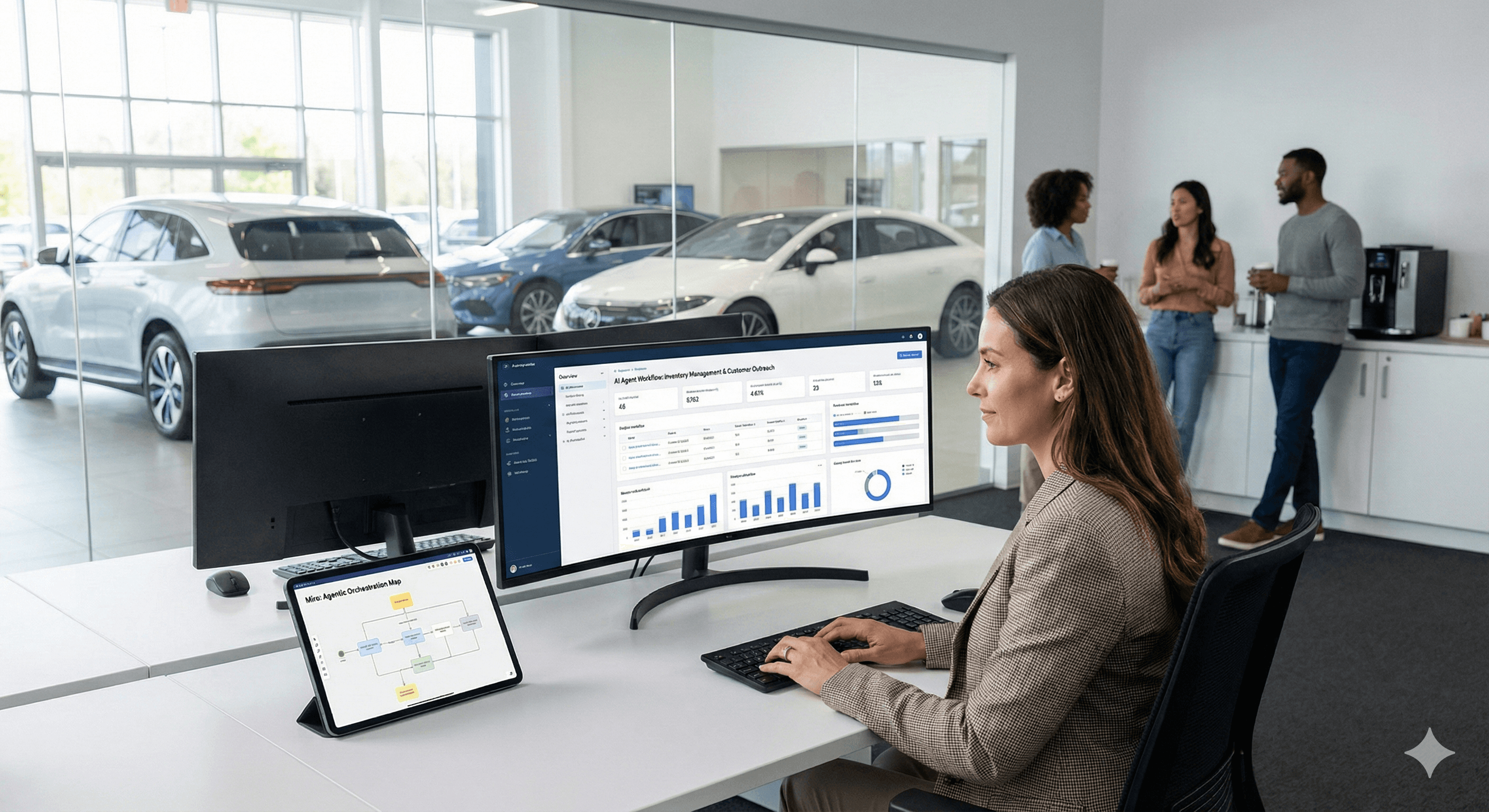
You cannot have rogue agents running your business. You need a central orchestration layer—a way to map out exactly what these agents are allowed to do. Tools like Miro are becoming essential for mapping these agentic workflows visually before they are coded, ensuring every stakeholder understands the "rules of engagement."

2. Data Governance & Security

Just yesterday, the ICO released a report on the privacy risks of Agentic AI, highlighting the need for strict "controllership". Because agents act spontaneously, dealerships need rigourous governance. Who is responsible if an agent promises a discount it shouldn't have? Platforms like Glean are critical here, ensuring that your AI agents can only access the enterprise knowledge they should see, maintaining compliance and security.

Summary: The Road Ahead

The Motor Trader article is a wake-up call. The car buying process is becoming fluid, fast, and frictionless.

For automotive leaders, the task is no longer just "buying AI tools." It is about building the Agentic Architecture—the workflows, the data governance, and the orchestration—that allows these digital employees to thrive safely.

At Generation Digital, we help organisations build this foundation. Whether it is mapping the journey in Miro, managing the workflow in Asana, or securing the knowledge in Glean, we ensure your business is ready for the Agentic age.

FAQ

Question: What is the difference between Generative AI and Agentic AI?
Answer: Generative AI creates content (text, images) based on a prompt. Agentic AI acts autonomously to achieve a goal (e.g., "book an appointment") by planning and executing multiple steps without constant human input.

Question: Is Agentic AI safe for customer data?
Answer: It introduces new risks because agents act spontaneously. However, with robust governance frameworks and compliance with recent ICO guidelines (Jan 2026), it can be deployed securely.

Question: Will AI agents replace car salespeople?
Answer: Unlikely. They will replace the admin of sales—paperwork, scheduling, and initial qualification—freeing up human experts to focus on the emotional and advisory aspects of the purchase.

The headlines this morning from Motor Trader confirm what many of us in the digital transformation space have been tracking for months: 2026 is the year the automotive industry moves beyond the "chatty" AI of yesterday and embraces Agentic AI.

For the last two years, dealerships and OEMs have raced to implement Generative AI (GenAI) to write marketing copy or power basic customer service bots. But as we settle into 2026, the novelty of an AI that can talk is fading. The competitive edge now belongs to AI that can act.

The Shift: From "Generative" to "Agentic"

To understand the magnitude of this shift, we must clarify the terminology that is currently dominating boardroom discussions.

  • Generative AI (The 2024–2025 Standard): Think of this as a brilliant creative assistant. You ask it to write a vehicle description or summarise a sales call, and it produces text. It is reactive—it waits for your prompt.

  • Agentic AI (The 2026 Reality): Think of this as a skilled employee. It has agency. You give it a goal—"Sell this excess stock of EV SUVs"—and it plans the steps, executes marketing actions, handles customer inquiries, negotiates within your margin rules, and schedules the handover.

As Motor Trader highlights, this ability to function with limited supervision is what will define the next era of car buying. It is not just about answering questions; it is about removing friction from the transaction entirely.

What Agentic Car Buying Looks Like

For the consumer, the friction of buying a car—the endless back-and-forth emails, the confusing finance options, the booking of test drives—has always been the pain point. Agentic AI solves this by acting as a "Digital Concierge."

Imagine a customer, Sarah, telling her personal AI agent: "Find me a red SUV under £35k with low mileage, and arrange a test drive for Tuesday."

Instead of Sarah trawling through Auto Trader, her agent talks directly to a dealership's Inventory Agent. The dealership's agent checks stock, verifies the margin, offers a provisional finance quote based on Sarah’s credit profile, and books the slot in the showroom diary. This entire negotiation happens machine-to-machine, in seconds.

Key Capabilities of Automotive Agents:

  • Autonomous Negotiation: Agents can close deals within pre-set profit margins without needing a manager’s sign-off for every £50 discount.

  • Smart Inventory Management: Instead of waiting for a human to notice a trend, agents analyse market demand and automatically adjust pricing or order stock to match local interest.

  • Post-Sale Service: After the sale, service agents proactively schedule maintenance, predicting parts requirements before the car even enters the workshop.

The Infrastructure Challenge: You Can't Just "Plug It In"

This is where the excitement meets reality. While the vision of Agentic AI is compelling, the execution requires robust "digital plumbing." An autonomous agent is only as good as the data it can access and the boundaries it is given.

If your customer data is siloed, or your inventory system doesn't talk to your CRM, an AI agent will simply make mistakes faster than a human ever could.

1. The Need for Orchestration

You cannot have rogue agents running your business. You need a central orchestration layer—a way to map out exactly what these agents are allowed to do. Tools like Miro are becoming essential for mapping these agentic workflows visually before they are coded, ensuring every stakeholder understands the "rules of engagement."

2. Data Governance & Security

Just yesterday, the ICO released a report on the privacy risks of Agentic AI, highlighting the need for strict "controllership". Because agents act spontaneously, dealerships need rigourous governance. Who is responsible if an agent promises a discount it shouldn't have? Platforms like Glean are critical here, ensuring that your AI agents can only access the enterprise knowledge they should see, maintaining compliance and security.

Summary: The Road Ahead

The Motor Trader article is a wake-up call. The car buying process is becoming fluid, fast, and frictionless.

For automotive leaders, the task is no longer just "buying AI tools." It is about building the Agentic Architecture—the workflows, the data governance, and the orchestration—that allows these digital employees to thrive safely.

At Generation Digital, we help organisations build this foundation. Whether it is mapping the journey in Miro, managing the workflow in Asana, or securing the knowledge in Glean, we ensure your business is ready for the Agentic age.

FAQ

Question: What is the difference between Generative AI and Agentic AI?
Answer: Generative AI creates content (text, images) based on a prompt. Agentic AI acts autonomously to achieve a goal (e.g., "book an appointment") by planning and executing multiple steps without constant human input.

Question: Is Agentic AI safe for customer data?
Answer: It introduces new risks because agents act spontaneously. However, with robust governance frameworks and compliance with recent ICO guidelines (Jan 2026), it can be deployed securely.

Question: Will AI agents replace car salespeople?
Answer: Unlikely. They will replace the admin of sales—paperwork, scheduling, and initial qualification—freeing up human experts to focus on the emotional and advisory aspects of the purchase.

Receive practical advice directly in your inbox

By subscribing, you agree to allow Generation Digital to store and process your information according to our privacy policy. You can review the full policy at gend.co/privacy.


Are you ready to get the support your organization needs to successfully leverage AI?

Miro Solutions Partner
Asana Platinum Solutions Partner
Notion Platinum Solutions Partner
Glean Certified Partner

Ready to get the support your organization needs to successfully use AI?

Miro Solutions Partner
Asana Platinum Solutions Partner
Notion Platinum Solutions Partner
Glean Certified Partner

Generation
Digital

Canadian Office
33 Queen St,
Toronto
M5H 2N2
Canada

Canadian Office
1 University Ave,
Toronto,
ON M5J 1T1,
Canada

NAMER Office
77 Sands St,
Brooklyn,
NY 11201,
USA

Head Office
Charlemont St, Saint Kevin's, Dublin,
D02 VN88,
Ireland

Middle East Office
6994 Alsharq 3890,
An Narjis,
Riyadh 13343,
Saudi Arabia

UK Fast Growth Index UBS Logo
Financial Times FT 1000 Logo
Febe Growth 100 Logo (Background Removed)

Business Number: 256 9431 77 | Copyright 2026 | Terms and Conditions | Privacy Policy

Generation
Digital

Canadian Office
33 Queen St,
Toronto
M5H 2N2
Canada

Canadian Office
1 University Ave,
Toronto,
ON M5J 1T1,
Canada

NAMER Office
77 Sands St,
Brooklyn,
NY 11201,
USA

Head Office
Charlemont St, Saint Kevin's, Dublin,
D02 VN88,
Ireland

Middle East Office
6994 Alsharq 3890,
An Narjis,
Riyadh 13343,
Saudi Arabia

UK Fast Growth Index UBS Logo
Financial Times FT 1000 Logo
Febe Growth 100 Logo (Background Removed)


Business No: 256 9431 77
Terms and Conditions
Privacy Policy
© 2026





