AI for Quick-Service Restaurants: Speedier Drive-Thrus, Reduced Costs, Satisfied Guests
Artificial Intelligence
Featured List
Uncertain about how to get started with AI?Evaluate your readiness, potential risks, and key priorities in less than an hour.
➔ Download Our Free AI Preparedness Pack
AI Enhances QSR Operations: Simplify and Cut Costs
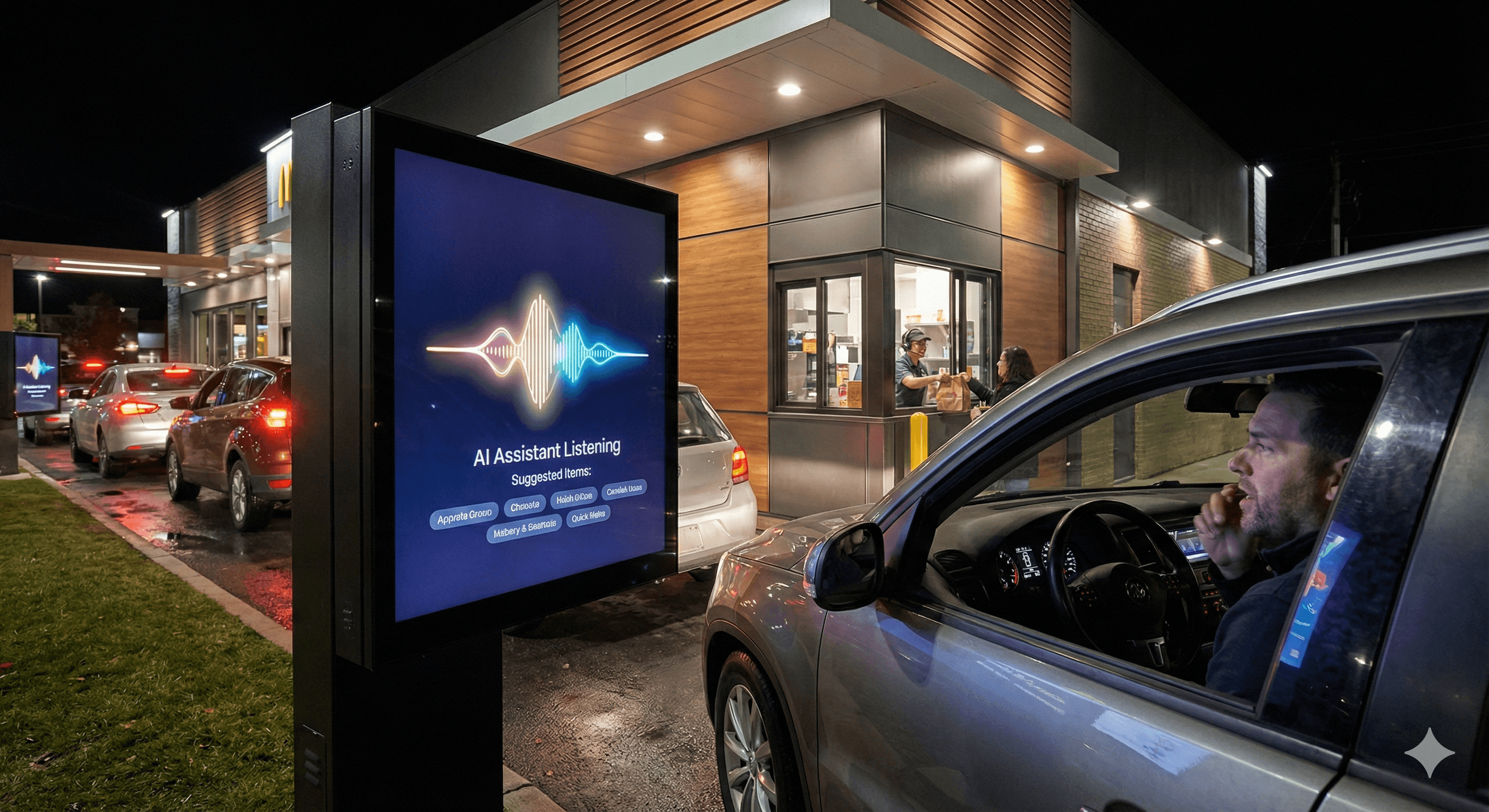
Margins in quick-service restaurants are thin, and customer patience is even thinner. AI is transitioning from a 'trial' phase to mainstream use: drive-thru voice bots, predictive inventory, and labour optimization are delivering noticeable time savings, increased accuracy, and reduced waste for large brands.
What’s New (2026)
Voice AI on a Large Scale. Wendy’s 'FreshAI', developed with Google Cloud, is reporting faster service and improved accuracy; the chain is expanding to hundreds of locations.
Platform Update at McDonald’s. After concluding an IBM drive-thru voice test in 2024, McDonald’s is strengthening its broader partnership with Google Cloud to modernize restaurant technology and AI across thousands of outlets.
Yum!’s Proprietary Stack. Taco Bell, KFC, and Pizza Hut are standardizing on 'Byte by Yum!' and partnering with Nvidia to deploy AI voice ordering and computer vision starting in 2025.
Independent Success Stories. White Castle is expanding SoundHound’s drive-thru AI to over 100 lanes; Jersey Mike’s is using AI to handle phone orders.
How AI Enhances QSR Operations
Voice Ordering (Drive-thru & Phone).
Manages routine orders, consistently upsells, and frees up staff for faster service. Major chains are reporting time savings and improved accuracy as staff concentrate on hand-offs and quality checks.
Deployment varies from third-party solutions (SoundHound, Presto) to cloud and in-house platforms (Google Cloud, Nvidia).
Predictive Inventory & Waste Reduction.
Forecasts demand based on sales history, weather, local events, and time of day; automatically replenishes or alerts managers before stockouts, reducing over-preparation and shrinkage.
Labour and Scheduling Optimization.
Predicts staffing needs by hour and position; automates shift suggestions; assists managers in reallocating staff in real time as demand changes—an approach popularized by Starbucks’ Deep Brew.
Kitchen and Quality Control (Computer Vision).
Monitors production steps, hold times, and hand-off accuracy; flags discrepancies to ensure order quality during peak times. Yum! emphasizes this in its platform development plans.
Menu and Pricing Insights.
Utilizes purchase patterns to suggest bundles and limited-time offers and supports dynamic messaging on digital menu boards.
Practical Steps to Begin (90-Day Playbook)
Phase 1 — Identify High-Impact Use Cases (Weeks 1–3)
Select one business KPI per outlet: time saved at drive-thru, order accuracy, waste percentage, or labour hours per transaction.
Document constraints: accents/noise at your locations, menu complexity, peak times, data availability.
Phase 2 — Foundations (Weeks 2–6)
Data Infrastructure: integrate POS, kitchen displays, inventory, and staffing data; collect audio transcripts for training (with appropriate signage/consent).
Governance: establish boundaries (no payment capture via bots), data retention policies, and escalation procedures involving human oversight.
Vendor Selection: shortlist based on maturity and solution type (platform vs. point solution). Options include white-label voice solutions (SoundHound/Presto) or cloud-based stacks (Google Cloud, Nvidia-accelerated) vs. in-house hybrids.
Phase 3 — Pilot (Weeks 6–10)
Voice AI: launch at 1–3 high-traffic drive-thrus or phone lines; benchmark service speed, order accuracy, upsell attachment rate, agent takeover rate. Use a human staff member as a 'safety net' for exceptions. Wendy’s reported approximately 22 seconds faster service in trials.
Inventory Forecasting: operate AI alongside manager forecasts; implement if it consistently reduces waste and stockouts for at least two consecutive weeks.
Phase 4 — Rollout (Weeks 10–13)
Develop a playbook for site evaluations (acoustic tests), Wi-Fi/edge computing readiness, microphone/speaker hardware, and staff training.
Incorporate KPI dashboards into the General Manager's daily routine; set weekly 'exception reviews' (bot escalation, complaints, refunds) to continually improve models.
Cost Factors & ROI Story
Labour Reallocation: voice bots take over order taking; staff focus on production and guest service during busy times. Yum! indicates AI products are already in 25k+ restaurants with plans for continued expansion, showing operating leverage at scale.
Fewer Redos: improved accuracy from consistent capture and computer vision checks reduces waste and refunds.
Waste Reduction: demand-driven preparation and smarter replenishment minimize shrinkage and emergency purchases.
Common Pitfalls (and How to Avoid Them)
Noisy Environments & Accents → Misinterpretations. Utilize dual-mic arrays, acoustics trained on local accents, and ensure clear fallback to human staff. McDonald’s 2024 phasedown illustrates the importance of gradual rollouts and quick iterations.
Menu Complexity. Begin with simplified language and core product names; add more complex items later.
Change Management. Train teams in 'bot co-pilot' protocols; emphasize time savings rather than threatening job security.
Vendor Lock-in. Ensure transcripts, labels, and prompts are easily transferable; prioritize standards-based APIs.
Tools & Partners to Consider
Voice AI: Solutions based on Google Cloud (e.g., FreshAI at Wendy’s), SoundHound (drive-thru and phone), Presto.
Inventory Forecasting: Built-in modules from POS vendors or a light data science layer using historical sales and weather/events.
Enterprise Search/Knowledge: Glean for policy-aware SOPs, training, and store-level knowledge retrieval.
Next Steps?
Looking for a practical QSR pilot—voice at one lane and predictive inventory in two locations—completed in 90 days? Contact Generation Digital.
FAQs
How does AI enhance QSR operations?
By automating order processing, forecasting inventory, and refining staffing, AI reduces order time and errors while keeping teams focused on production and customer experience. Yahoo Finance
What are the cost benefits?
Labour is shifted from order taking to fulfilment; fewer remakes and enhanced preparation planning cut down on waste and overtime. Larger groups (like Yum!) are scaling platform approaches to capture these efficiencies. MarketWatch
Is voice AI ready for noisy drive-thrus?
Yes—with the right acoustic setup and a human-in-the-loop system. Deploy gradually, monitor hand-off rates, and adjust for local accents. Learn from early test outcomes before scaling. AP News
Can smaller brands use AI without large teams?
Yes—phone bots and forecasting modules can be rolled out store-by-store. Chains like White Castle and Jersey Mike’s demonstrate efficient rollouts. SoundHound AI
Receive weekly AI news and advice straight to your inbox
By subscribing, you agree to allow Generation Digital to store and process your information according to our privacy policy. You can review the full policy at gend.co/privacy.



Generation
Digital

Canadian Office
33 Queen St,
Toronto
M5H 2N2
Canada
Canadian Office
1 University Ave,
Toronto,
ON M5J 1T1,
Canada
NAMER Office
77 Sands St,
Brooklyn,
NY 11201,
USA
Head Office
Charlemont St, Saint Kevin's, Dublin,
D02 VN88,
Ireland
Middle East Office
6994 Alsharq 3890,
An Narjis,
Riyadh 13343,
Saudi Arabia







Business Number: 256 9431 77 | Copyright 2026 | Terms and Conditions | Privacy Policy