How Purpose-Driven Organizations Use Asana to Create Meaningful Impact
Asana

Uncertain about how to get started with AI?Evaluate your readiness, potential risks, and key priorities in less than an hour.
➔ Download Our Free AI Preparedness Pack
Why this matters now
Mission-driven teams in healthcare, education and the public sector face a challenge: crucial work often gets overshadowed by administration, status meetings, and fragmented tools. With tight budgets and high accountability, you need a platform that securely and swiftly links strategy to delivery.
Enter Asana. Built on the Asana Work Graph®, Asana integrates goals, projects, tasks, people, and workflows, ensuring every action leads to outcomes. In 2025, that foundation supports practical AI—like AI teammates and rules—to automate routine tasks and provide actionable insights for leaders.
What is the Asana Work Graph®?
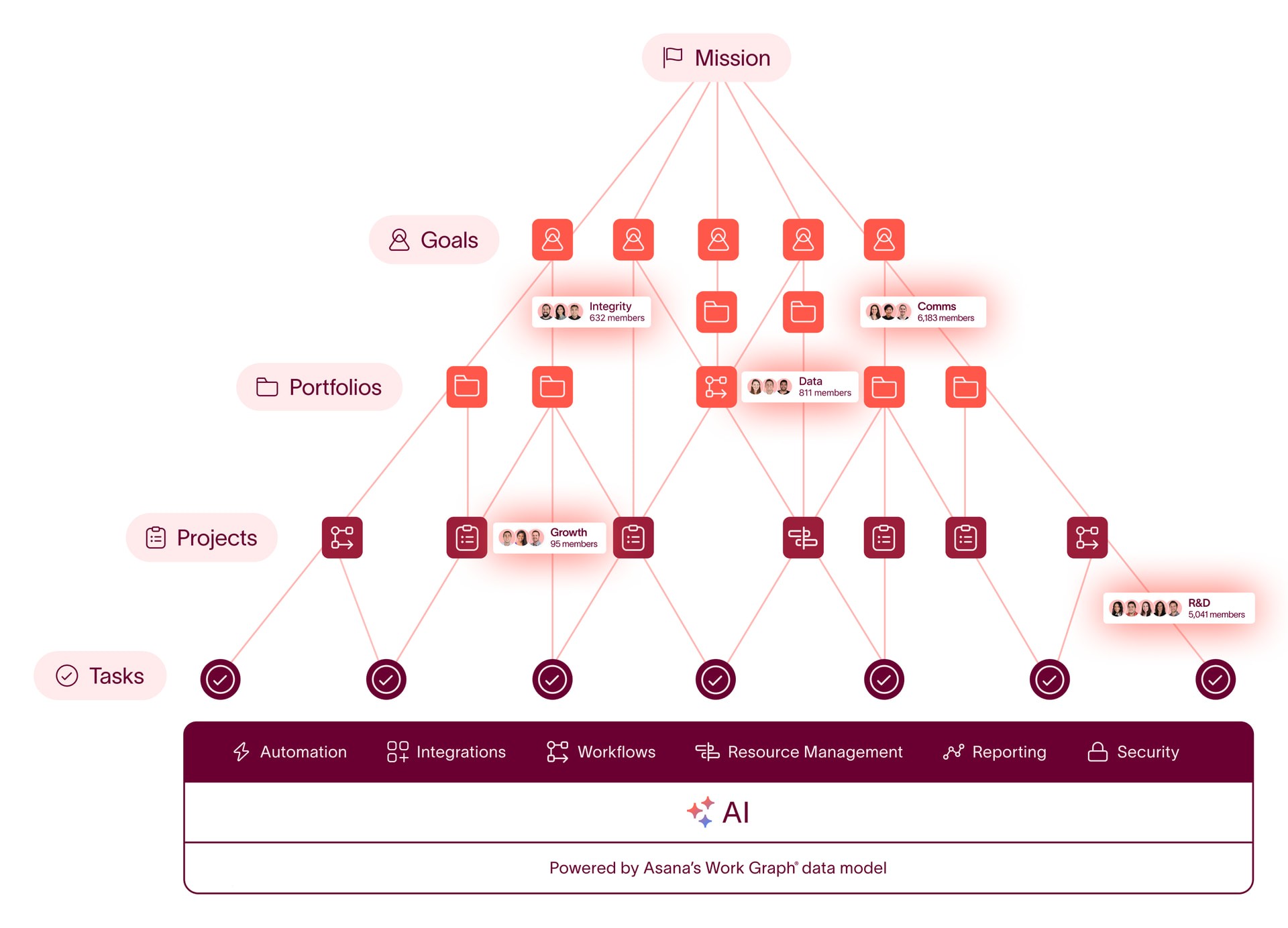
The Asana Work Graph® is a data model that outlines the relationships between goals, projects, tasks, people, and workflows. Together with Asana’s AI, it provides a dynamic and connected view of progress, allowing leaders to see real-time progress, risks, and dependencies, linking daily work to measurable results.
Core capabilities that benefit all three sectors
1) Connect goals & OKRs to real work
Turn OKRs from static documents into an active system. Break goals into key results, connect them to projects and tasks, and monitor progress with dashboards and custom fields. Result: every contributor understands the why, and leaders see real-time progress without constantly requesting updates.
2) Practical AI that augments people
Asana’s AI tools (like AI teammates and AI rules) automate routine processes, enhance delivery standards, and summarize status—even as humans retain accountability. Typical advantages include faster priority setting, timely milestone achievement, and fewer “information-gathering” meetings.
3) Unified visibility without the sprawl
Consolidate scattered spreadsheets and email trails into one platform for project intake, portfolio management, resource planning, and goal tracking. Because views are based on the Work Graph, teams share the same source of truth—eliminating “version wars.”
4) Security, privacy, and governance
Ensure secure collaboration with enterprise controls like SSO/SCIM, role-based access, audit trails, encryption, and administrative guardrails. Pair these platform controls with your information governance (DPIAs, retention, conditional access) for strong assurance.
Sector playbooks
Healthcare (Healthcare networks, ICSs, private providers)
Challenges: Complex, multi-disciplinary programs; stringent information governance; capacity pressures; inspection readiness.
Where Asana helps:
Clinical service improvement & pathway redesign: track pathway changes, dependencies, and benefits realization.
Digital front door & EPR roadmap delivery: coordinate suppliers, milestones, and change impacts.
Accreditation preparation & action plans: centralize evidence, responsibilities, and deadlines; maintain audit trails.
Estates & capital projects: align capital plans with operational impacts and clinical moves.
Outcomes:
Faster decisions with portfolio-level risks and blockers visible.
Clear ownership and hand-offs across clinical/operational teams and suppliers.
Reduced meeting load thanks to automated updates and summaries.
Tip: Start with a pilot in a contained program (e.g., virtual wards or outpatient transformation) to prove value and build momentum.
Education (universities, colleges, educational trusts)
Challenges: Cross-department coordination, research compliance, cyclical peaks (admissions/exams), estate projects, and student-experience initiatives.
Where Asana helps:
Research project portfolios: standardize templates, milestones, risks, and ethics checkpoints.
Student services & case initiatives: triage requests, monitor SLAs, and escalate risks.
Marketing & recruitment cycles: align campaign plans to enrolment objectives; track backlog and creative approvals.
Estates & IT change: manage dependencies across moves, labs, teaching spaces, and infrastructure.
Outcomes:
Real-time visibility for deans, project management offices, and central services.
Less admin for educators and professional services due to AI-assisted updates.
Clearer alignment from institutional KPIs to department tasks.
Tip: Use Forms to organize intake (research, IT, estates) and route work automatically with AI rules.
Public sector (federal government, local authorities, agencies)
Challenges: Policy delivery across departments, funding constraints, procurement cycles, and transparency demands.
Where Asana helps:
Policy & program delivery: track initiatives, statutory milestones, and inter-agency dependencies.
Grant management: intake, assess, award, and monitor with transparent audit trails.
Performance & benefits reporting: link objectives to delivery and automate periodic updates.
Supplier & contract coordination: consolidate timelines, obligations, and change requests.
Outcomes:
Faster cross-team decisions with shared context.
Fewer status meetings; clearer accountability; improved record-keeping.
Portfolio-level insights for senior responsible officers and senior leaders.
Tip: Set up a streamlined governance model early (naming, fields, permissions) to maintain consistency as adoption grows.
Example solutions we implement (cross-sector)
OKR → Delivery: Link organizational goals to projects, tasks, and dashboards.
Project Intake: Use forms with routing, automatic assignment, and SLA tracking.
PMO Toolkit: Templates for business cases, RAID, change control, and stage gates.
Portfolio Health: Executive views showing status, risks, blockers, and upcoming decisions.
Change Enablement: Role-based training, playbooks, and champions for sustainable adoption.
Partner with Generation Digital (Platinum Asana Solutions Partner)
As an acclaimed Platinum Partner, Generation Digital crafts secure, scalable Asana implementations for healthcare, education, and public-sector teams. We customize OKR frameworks, portfolio views, intake forms, permissions, and AI rules to fit your operating model so Asana becomes a strategic asset—not “just another tool.”
What we deliver:
Discovery & Design: governance structure, roles, fields, and workflows
Build: projects, templates, dashboards, and advanced automation/AI
Assurance: admin strengthening, audit trails, SSO/SCIM, and data hygiene
Adoption: Enablement for project management offices and frontline teams; playbooks
Optimization: Quarterly reviews aligned with Asana’s release cycle
Start with a Readiness Workshop for your sector (security, OKRs, portfolio and AI use cases), then initiate a pilot in a low-risk area to demonstrate value and cultivate champions.
Ready to modernize delivery?
Contact Generation Digital for a tailored Asana plan that connects your goals to results—safely, visibly, and more efficiently.
FAQs
1) Can we connect OKRs to projects and tasks in Asana?
Yes. Goals and key results link to projects and tasks, with dashboards and fields to track progress.
2) How does Asana’s AI help regulated teams?
AI teammates and rules automate routine steps (such as triage, updates, and prompts) while summarizing status, enabling faster decision-making—keeping human accountability intact.
3) Will Asana meet our governance and security requirements?
Asana offers enterprise controls such as SSO/SCIM, role-based access, audit trails, and encryption. Combine these with your information governance and conditional access policies.
4) What’s the fastest way to demonstrate value?
Conduct a focused pilot within a single program or department with clear success metrics (e.g., timely milestones, fewer meetings, quicker approvals). Expand using templates and governance.
5) Do you have sector-specific templates?
Yes. We offer healthcare, education, and public-sector templates/playbooks and personalize them to fit your operating model.
Receive weekly AI news and advice straight to your inbox
By subscribing, you agree to allow Generation Digital to store and process your information according to our privacy policy. You can review the full policy at gend.co/privacy.



Generation
Digital

Canadian Office
33 Queen St,
Toronto
M5H 2N2
Canada
Canadian Office
1 University Ave,
Toronto,
ON M5J 1T1,
Canada
NAMER Office
77 Sands St,
Brooklyn,
NY 11201,
USA
Head Office
Charlemont St, Saint Kevin's, Dublin,
D02 VN88,
Ireland
Middle East Office
6994 Alsharq 3890,
An Narjis,
Riyadh 13343,
Saudi Arabia






Business Number: 256 9431 77 | Copyright 2026 | Terms and Conditions | Privacy Policy