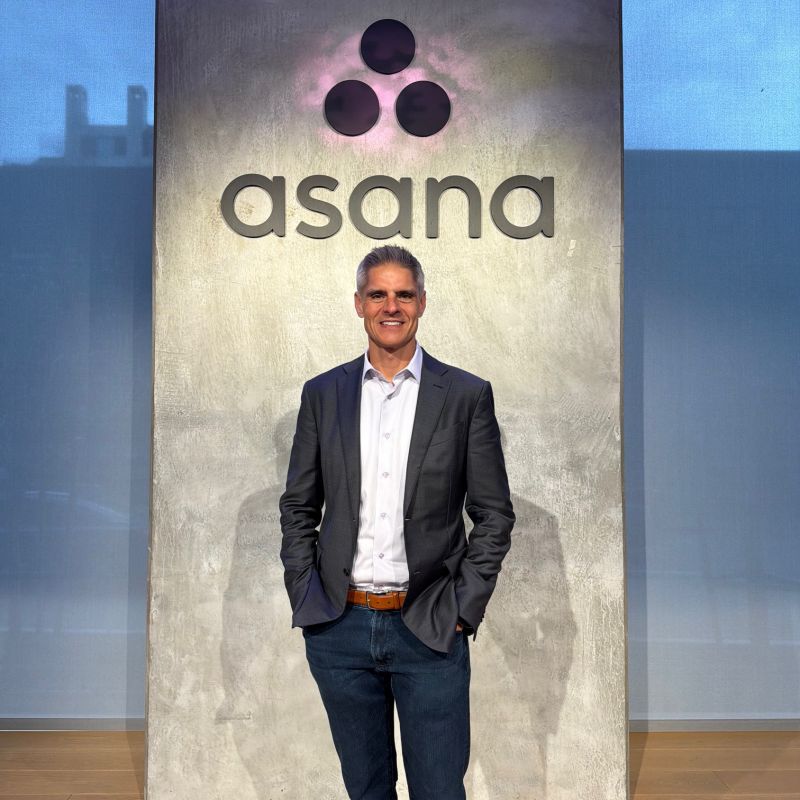
Asana Appoints Kevin Knieriem as CRO to Drive Growth
Asana
Uncertain about how to get started with AI?Evaluate your readiness, potential risks, and key priorities in less than an hour.
➔ Download Our Free AI Preparedness Pack
Kevin Knieriem has joined Asana as Chief Revenue Officer (CRO), responsible for leading the company’s global go-to-market and revenue strategy. The appointment signals a renewed focus on scaling enterprise growth, strengthening commercial execution across sales and customer success, and accelerating Asana’s next phase of expansion.
Asana has appointed Kevin Knieriem as Chief Revenue Officer (CRO), tasking him with leading the company’s global go-to-market strategy and revenue execution as Asana enters its next phase of growth.
Senior revenue appointments aren’t just a line on the org chart. For customers, partners and prospective buyers, they often signal where the product is heading, how enterprise support will evolve, and what “good” looks like for adoption at scale. This is especially true for work management platforms operating at the intersection of enterprise delivery, operational governance and AI-driven productivity.
What Asana has announced — and why it matters
In Asana’s official announcement welcoming Knieriem, the emphasis is clear: he is joining to lead global go-to-market and support Asana’s next phase of growth.
In practical terms, “go-to-market” usually covers:
How Asana segments and serves customers (mid-market vs enterprise, vertical focus, global coverage)
How sales, solutions consulting, customer success and partner channels operate together
How renewals, expansion, adoption, and value realisation are measured and improved
How messaging and packaging aligns to the outcomes customers want (not just feature lists)
A CRO appointment can also be a signal that a business is tightening the link between product value and commercial execution—ensuring that what the platform can do is consistently translated into what customers achieve.
Who is Kevin Knieriem?
Kevin Knieriem is a revenue leader with experience across high-growth SaaS and enterprise organisations. Asana’s announcement highlights his senior go-to-market leadership background, including roles at Oracle and serving as CRO at DataScience.com, where he helped scale the commercial organisation through to acquisition.
He has also held senior leadership roles at Clari, including CRO and later President for Strategic GTM, reflecting a track record in revenue execution and operationalisation—often a key strength for organisations selling to complex enterprise environments.
What Knieriem’s appointment suggests about Asana’s revenue strategy
While Asana hasn’t published a “here’s what changes next” roadmap for the CRO function, we can infer several likely priorities from the remit and from what enterprise SaaS companies typically focus on at this stage of growth.
1) Sharper enterprise execution (not just more pipeline)
Enterprise work management is rarely a single-team purchase. It touches PMOs, transformation leads, IT, security, Ops, and business unit leadership. A CRO often helps ensure:
Value is defined early (time saved, better delivery predictability, clearer ownership)
Implementation is paired with change management
Adoption metrics matter as much as closed-won
For buyers, this tends to translate into clearer onboarding paths, stronger success motion, and better alignment between what was sold and what teams actually use.
2) Stronger global go-to-market coordination
Asana explicitly references global go-to-market leadership in its announcement. That commonly means improving consistency across regions: coverage models, partner strategy, enablement, and how enterprise accounts are supported across time zones and functions.
For multinational organisations, this matters. It’s the difference between “one team loves it” and “the organisation standardises it”.
3) More deliberate partner ecosystem leverage
Asana’s partner ecosystem is a meaningful route to enterprise value—particularly for organisations that need workflow design, governance, training, and adoption programmes.
Generation Digital, for example, is listed in Asana’s partner directory as a Platinum Solutions Partner. As CROs align direct sales and partner channels, it often results in clearer partner-led motions, tighter handoffs, and better outcomes for customers who want a structured rollout rather than a DIY deployment.
4) A practical lens on “AI + work management”
For customers, the key question is not “does it have AI?”, but:
Where does AI remove friction from day-to-day execution?
How is data governed and surfaced responsibly?
How do teams adopt AI features without chaos?
This is where go-to-market leadership matters: helping customers move from curiosity to measurable outcomes, safely.
What customers and prospects should watch for next
If you’re already using Asana—or considering it—these are the practical signals to look out for over the next 1–2 quarters:
Clearer enterprise packaging and positioning: less feature-led messaging, more outcome-led guidance
Stronger enablement for admins and champions: governance, templates, reporting standards
Tighter success metrics: adoption, expansion, value realisation (not just licences)
More structured rollout patterns: phased deployment, use-case prioritisation, measurable pilots
None of this requires a dramatic product shift. Often, it’s the commercial operating system that changes: how Asana is introduced, deployed, expanded, and embedded in how teams actually work.
Where Generation Digital fits
If you’re aligning teams around enterprise delivery, operating rhythm, or AI-enabled productivity, the tools matter—but so does adoption.
Generation Digital helps organisations implement and scale Asana with the right workflow design, governance and training, as an award-winning Asana partner. If you’re evaluating Asana or planning your next phase of rollout, we can help you move quickly without sacrificing clarity or control.
Summary
Kevin Knieriem’s appointment as Asana’s Chief Revenue Officer is a strategic signal: a focus on global go-to-market execution, enterprise scale, and a stronger commercial engine to support the next stage of growth. For customers, the most meaningful outcomes are likely to be clearer enterprise motions, improved adoption support, and more deliberate value realisation.
Next steps: If you want to pressure-test your Asana rollout plan—governance, adoption, AI use cases, or enterprise operating rhythm—speak to Generation Digital.
FAQ
Who is Kevin Knieriem?
Kevin Knieriem is Asana’s newly appointed Chief Revenue Officer. He is an experienced go-to-market and revenue leader with prior senior roles including Oracle and Clari.
What will Kevin Knieriem do at Asana?
He will lead Asana’s revenue organisation and global go-to-market strategy to support the company’s next phase of growth.
Why is this appointment significant?
A CRO appointment often signals a stronger focus on enterprise execution—aligning sales, customer success and partners to improve adoption, expansion and value realisation at scale.
When was the appointment announced?
Asana published an announcement welcoming Kevin Knieriem as CRO.
Does this change Asana’s product direction?
Not directly, but it can influence how Asana is positioned, sold and deployed—especially for enterprise customers—by tightening the link between product value and rollout success.
Receive weekly AI news and advice straight to your inbox
By subscribing, you agree to allow Generation Digital to store and process your information according to our privacy policy. You can review the full policy at gend.co/privacy.



Generation
Digital

Canadian Office
33 Queen St,
Toronto
M5H 2N2
Canada
Canadian Office
1 University Ave,
Toronto,
ON M5J 1T1,
Canada
NAMER Office
77 Sands St,
Brooklyn,
NY 11201,
USA
Head Office
Charlemont St, Saint Kevin's, Dublin,
D02 VN88,
Ireland
Middle East Office
6994 Alsharq 3890,
An Narjis,
Riyadh 13343,
Saudi Arabia







Business Number: 256 9431 77 | Copyright 2026 | Terms and Conditions | Privacy Policy