CES 2026: Is This the End of AI as Just a Tool? Here's What to Do Next

CES 2026: Is This the End of AI as Just a Tool? Here's What to Do Next

Artificial Intelligence
Jan 7, 2026

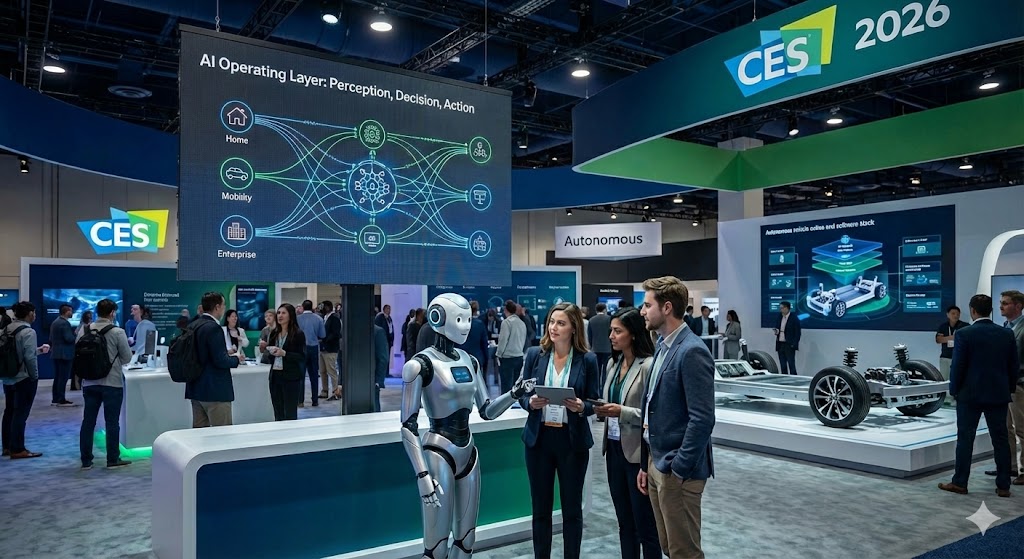
The AI-generated image depicts a lively trade show floor at CES 2026, where a humanoid robot is engaging with visitors next to a digital display reading, "AI Operating Layer: Perception, Decision, Action." Surrounding the scene are booths displaying cutting-edge technology and self-driving vehicles, creating a dynamic environment.

Uncertain about how to get started with AI?
Evaluate your readiness, potential risks, and key priorities in less than an hour.

Uncertain about how to get started with AI?
Evaluate your readiness, potential risks, and key priorities in less than an hour.

➔ Download Our Free AI Preparedness Pack

CES 2026 confirms a change many teams have felt for a year: AI has shed its “tool” label and become an operating layer for products, spaces, and services. This is evident in humanoid and companion robots on the show floor, the shift from flashy EV launches to focusing on autonomy and software, and entertainment panels addressing AI-driven production.

For leaders, this is crucial because your advantage won’t come from simply adding a chatbot or a one-time feature. It will stem from designing systems—how models, data, sensing, safety, and user experience intertwine over time.

From “app you open” to “layer you live in”

In previous technology cycles, AI existed in distinct interfaces: you typed a prompt; it responded. By 2026, AI increasingly perceives, decides, and acts within context: robots co-navigate homes, vehicles integrate AI into driving systems, and content pipelines blend AI with human oversight. The key takeaway at CES isn’t the novelty of AI—it’s the integration.

  • Home & care: Companion robots and social bots focus on presence and interaction, not just automation. They recognize people, converse, and assist with everyday routines—early steps towards ambient assistance.

  • Mobility: Automakers emphasize autonomy platforms and driver-assist roadmaps more than headline EVs, indicating investment in AI software stacks over hardware spectacle.

  • Media & entertainment: Panels and demonstrations explore AI-assisted creation, personalization, and distribution—tempered by rights, attribution, and workforce considerations.

Why “AI systems” outperform “AI features”

“AI as a tool” focuses on features. “AI as a layer” focuses on architecture. Systems thinking wins because it amplifies over time:

  1. Data network effects: The more your system learns from safe, governed data flows, the better the experiences.

  2. Orchestration: Coordinating perception, planning, and action across devices outperforms isolated skills.

  3. Lifecycle: Models drift; regulations evolve. Teams that design for monitoring, evaluation, and updates ship faster and with greater safety.

What to prioritize in 2026

1. Define the roles for autonomous or semi-autonomous agents
Begin with bounded, high-value tasks (e.g., triaging a support queue, preparing a sales proposal, conducting inventory checks) and specify inputs, authority levels, guardrails, and hand-off rules. Aim for measurable improvements in cycle-time and quality, not just novelty.

2. Build a real-time context graph
Integrate signals from apps, devices, and sensors (where appropriate and lawful) into a privacy-respecting context layer. This enables agents to perceive state (“who, what, where, when”) and act responsibly. It’s the connective tissue of ambient AI.

3. Operationalize safety and governance
Treat safety like uptime: define misuse cases, conduct red-team tests, and create an AI change-management path (model updates, prompt changes, policy shifts). Add explainability, consent, and audit logs early—especially where people, vehicles, or content rights are involved. Entertainment and mobility discussions at CES highlight the importance of this.

4. Invest in human-in-the-loop workflows
Balance autonomy with oversight. In robotics and media, skilled human review remains vital for edge cases, brand voice, and rights management. CES sessions emphasize that AI should augment creators and operators, not replace them.

5. Choose platforms for longevity, not hype
If 2025 was about “trying numerous tools,” 2026 is about standardizing on interoperable stacks that withstand multiple model and hardware cycles. Inquire vendors about evaluation discipline, model switching, data portability, and safety certifications. Automotive shifts this year serve as a warning: software plans outlast hardware trends.

Signals from CES 2026 you can act on

  • Robotics is crossing the threshold from novelty to utility. While companion and humanoid robots are still in earlier stages, they showcase how AI will occupy our spaces as a continuous presence, not just apps. Begin trialing agents in physical workflows (inventory, inspections, concierge) where risk can be bounded.

  • Automotive showcases prioritize AI stacks over new EVs. Even brands renowned for concept cars focused on autonomy software, partnerships, and data infrastructure. If you’re in any regulated, safety-critical domain, align your AI roadmap with compliance-by-design and secure telemetry.

  • Entertainment leaders are aligning creativity and controls. From AI-assisted story development to adaptive content, the industry is building rights-aware, creator-centred pipelines. Marketing and product teams should emulate this: standard prompts, approved datasets, brand guardrails.

A simple framework: From tool → layer

  1. Map the journey: Where can ambient, continuous AI reduce friction (set-up, search, hand-offs, personalisation)?

  2. Instrument context: What events and states must the system “sense” to act responsibly?

  3. Assign capability levels: What can be automated now vs. supervised vs. manual?

  4. Design guardrails: Safety, privacy, fairness, and escalation paths.

  5. Measure and iterate: Define key metrics (resolution time, satisfaction, defect rates) and a weekly evaluation process.

What this means for teams

  • Product: Shift roadmaps from “feature releases” to developing capabilities (perception, reasoning, action, recovery).

  • Data: Build governed pipelines and evaluation sets that reflect real-world complexity, not just ideal scenarios.

  • Engineering: Choose platforms with observability, A/B safety testing and model swap-ability.

  • Legal & Risk: Ensure pre-clearance for consent patterns, content rights, and incident responses for AI outcomes.

  • People & Change: Train for agent collaboration—prompting, supervising, and auditing AI outputs in everyday tools.

Bottom line

CES 2026 doesn’t say “AI won.” It proclaims that integration won. The leaders of 2026–27 will be those who create coherent systems across products, data, and governance, so users experience intelligence not as a tool they access, but as a capability that’s seamlessly present.

FAQ

Q1: What does “end of AI as a tool” actually mean?
AI is transitioning from standalone apps to an embedded, always-on layer across devices, vehicles, and media workflows, prioritizing system design over single features. The Verge

Q2: What are the clearest CES 2026 signals of this shift?
Companion/humanoid robots, autonomy-first automotive keynotes, and creator-focused AI pipelines in entertainment—each showcasing AI as an integrated capability. The Verge

Q3: Where should enterprises start?
Define agent-worthy tasks, unify context signals, operationalize safety, maintain human oversight, and standardize on durable platforms with strong evaluation.

Q4: How do we manage risk?
Embed governance: consent and data controls, rights management, red-teaming, incident response, and model/change logs—especially in safety-critical or rights-sensitive domains. AP News

CES 2026 confirms a change many teams have felt for a year: AI has shed its “tool” label and become an operating layer for products, spaces, and services. This is evident in humanoid and companion robots on the show floor, the shift from flashy EV launches to focusing on autonomy and software, and entertainment panels addressing AI-driven production.

For leaders, this is crucial because your advantage won’t come from simply adding a chatbot or a one-time feature. It will stem from designing systems—how models, data, sensing, safety, and user experience intertwine over time.

From “app you open” to “layer you live in”

In previous technology cycles, AI existed in distinct interfaces: you typed a prompt; it responded. By 2026, AI increasingly perceives, decides, and acts within context: robots co-navigate homes, vehicles integrate AI into driving systems, and content pipelines blend AI with human oversight. The key takeaway at CES isn’t the novelty of AI—it’s the integration.

  • Home & care: Companion robots and social bots focus on presence and interaction, not just automation. They recognize people, converse, and assist with everyday routines—early steps towards ambient assistance.

  • Mobility: Automakers emphasize autonomy platforms and driver-assist roadmaps more than headline EVs, indicating investment in AI software stacks over hardware spectacle.

  • Media & entertainment: Panels and demonstrations explore AI-assisted creation, personalization, and distribution—tempered by rights, attribution, and workforce considerations.

Why “AI systems” outperform “AI features”

“AI as a tool” focuses on features. “AI as a layer” focuses on architecture. Systems thinking wins because it amplifies over time:

  1. Data network effects: The more your system learns from safe, governed data flows, the better the experiences.

  2. Orchestration: Coordinating perception, planning, and action across devices outperforms isolated skills.

  3. Lifecycle: Models drift; regulations evolve. Teams that design for monitoring, evaluation, and updates ship faster and with greater safety.

What to prioritize in 2026

1. Define the roles for autonomous or semi-autonomous agents
Begin with bounded, high-value tasks (e.g., triaging a support queue, preparing a sales proposal, conducting inventory checks) and specify inputs, authority levels, guardrails, and hand-off rules. Aim for measurable improvements in cycle-time and quality, not just novelty.

2. Build a real-time context graph
Integrate signals from apps, devices, and sensors (where appropriate and lawful) into a privacy-respecting context layer. This enables agents to perceive state (“who, what, where, when”) and act responsibly. It’s the connective tissue of ambient AI.

3. Operationalize safety and governance
Treat safety like uptime: define misuse cases, conduct red-team tests, and create an AI change-management path (model updates, prompt changes, policy shifts). Add explainability, consent, and audit logs early—especially where people, vehicles, or content rights are involved. Entertainment and mobility discussions at CES highlight the importance of this.

4. Invest in human-in-the-loop workflows
Balance autonomy with oversight. In robotics and media, skilled human review remains vital for edge cases, brand voice, and rights management. CES sessions emphasize that AI should augment creators and operators, not replace them.

5. Choose platforms for longevity, not hype
If 2025 was about “trying numerous tools,” 2026 is about standardizing on interoperable stacks that withstand multiple model and hardware cycles. Inquire vendors about evaluation discipline, model switching, data portability, and safety certifications. Automotive shifts this year serve as a warning: software plans outlast hardware trends.

Signals from CES 2026 you can act on

  • Robotics is crossing the threshold from novelty to utility. While companion and humanoid robots are still in earlier stages, they showcase how AI will occupy our spaces as a continuous presence, not just apps. Begin trialing agents in physical workflows (inventory, inspections, concierge) where risk can be bounded.

  • Automotive showcases prioritize AI stacks over new EVs. Even brands renowned for concept cars focused on autonomy software, partnerships, and data infrastructure. If you’re in any regulated, safety-critical domain, align your AI roadmap with compliance-by-design and secure telemetry.

  • Entertainment leaders are aligning creativity and controls. From AI-assisted story development to adaptive content, the industry is building rights-aware, creator-centred pipelines. Marketing and product teams should emulate this: standard prompts, approved datasets, brand guardrails.

A simple framework: From tool → layer

  1. Map the journey: Where can ambient, continuous AI reduce friction (set-up, search, hand-offs, personalisation)?

  2. Instrument context: What events and states must the system “sense” to act responsibly?

  3. Assign capability levels: What can be automated now vs. supervised vs. manual?

  4. Design guardrails: Safety, privacy, fairness, and escalation paths.

  5. Measure and iterate: Define key metrics (resolution time, satisfaction, defect rates) and a weekly evaluation process.

What this means for teams

  • Product: Shift roadmaps from “feature releases” to developing capabilities (perception, reasoning, action, recovery).

  • Data: Build governed pipelines and evaluation sets that reflect real-world complexity, not just ideal scenarios.

  • Engineering: Choose platforms with observability, A/B safety testing and model swap-ability.

  • Legal & Risk: Ensure pre-clearance for consent patterns, content rights, and incident responses for AI outcomes.

  • People & Change: Train for agent collaboration—prompting, supervising, and auditing AI outputs in everyday tools.

Bottom line

CES 2026 doesn’t say “AI won.” It proclaims that integration won. The leaders of 2026–27 will be those who create coherent systems across products, data, and governance, so users experience intelligence not as a tool they access, but as a capability that’s seamlessly present.

FAQ

Q1: What does “end of AI as a tool” actually mean?
AI is transitioning from standalone apps to an embedded, always-on layer across devices, vehicles, and media workflows, prioritizing system design over single features. The Verge

Q2: What are the clearest CES 2026 signals of this shift?
Companion/humanoid robots, autonomy-first automotive keynotes, and creator-focused AI pipelines in entertainment—each showcasing AI as an integrated capability. The Verge

Q3: Where should enterprises start?
Define agent-worthy tasks, unify context signals, operationalize safety, maintain human oversight, and standardize on durable platforms with strong evaluation.

Q4: How do we manage risk?
Embed governance: consent and data controls, rights management, red-teaming, incident response, and model/change logs—especially in safety-critical or rights-sensitive domains. AP News

Receive weekly AI news and advice straight to your inbox

By subscribing, you agree to allow Generation Digital to store and process your information according to our privacy policy. You can review the full policy at gend.co/privacy.


Upcoming Workshops and Webinars

A diverse group of professionals collaborating around a table in a bright, modern office setting.

Streamlined Operations for Canadian Businesses - Asana

Virtual Webinar
Wednesday, February 25, 2026
Online

A diverse group of professionals collaborating around a table in a bright, modern office setting.

Collaborate with AI Team Members - Asana

In-Person Workshop
Thursday, February 26, 2026
Toronto, Canada

A diverse group of professionals collaborating around a table in a bright, modern office setting.

From Concept to Prototype - AI in Miro

Online Webinar
Wednesday, February 18, 2026
Online

Generation
Digital

Canadian Office
33 Queen St,
Toronto
M5H 2N2
Canada

Canadian Office
1 University Ave,
Toronto,
ON M5J 1T1,
Canada

NAMER Office
77 Sands St,
Brooklyn,
NY 11201,
USA

Head Office
Charlemont St, Saint Kevin's, Dublin,
D02 VN88,
Ireland

Middle East Office
6994 Alsharq 3890,
An Narjis,
Riyadh 13343,
Saudi Arabia

UK Fast Growth Index UBS Logo
Financial Times FT 1000 Logo
Febe Growth 100 Logo (Background Removed)

Business Number: 256 9431 77 | Copyright 2026 | Terms and Conditions | Privacy Policy

Generation
Digital

Canadian Office
33 Queen St,
Toronto
M5H 2N2
Canada

Canadian Office
1 University Ave,
Toronto,
ON M5J 1T1,
Canada

NAMER Office
77 Sands St,
Brooklyn,
NY 11201,
USA

Head Office
Charlemont St, Saint Kevin's, Dublin,
D02 VN88,
Ireland

Middle East Office
6994 Alsharq 3890,
An Narjis,
Riyadh 13343,
Saudi Arabia

UK Fast Growth Index UBS Logo
Financial Times FT 1000 Logo
Febe Growth 100 Logo (Background Removed)


Business No: 256 9431 77
Terms and Conditions
Privacy Policy
© 2026





