Enhance Efficiency: Link Company Expertise to ChatGPT
ChatGPT
Uncertain about how to get started with AI?Evaluate your readiness, potential risks, and key priorities in less than an hour.
➔ Download Our Free AI Preparedness Pack
Work Smarter: Allowing ChatGPT to Access Your Company's Internal Knowledge
Why this matters now
General AI can't answer questions about your policies, projects, or governance. In 2025, ChatGPT incorporated company knowledge and connectors so that teams can base answers on internal context (SharePoint, Google Drive, Outlook, GitHub and more). Executed properly, this reduces the need for context‑switching, minimizes rework, and transforms AI into an expert colleague rather than just a smart guesser.
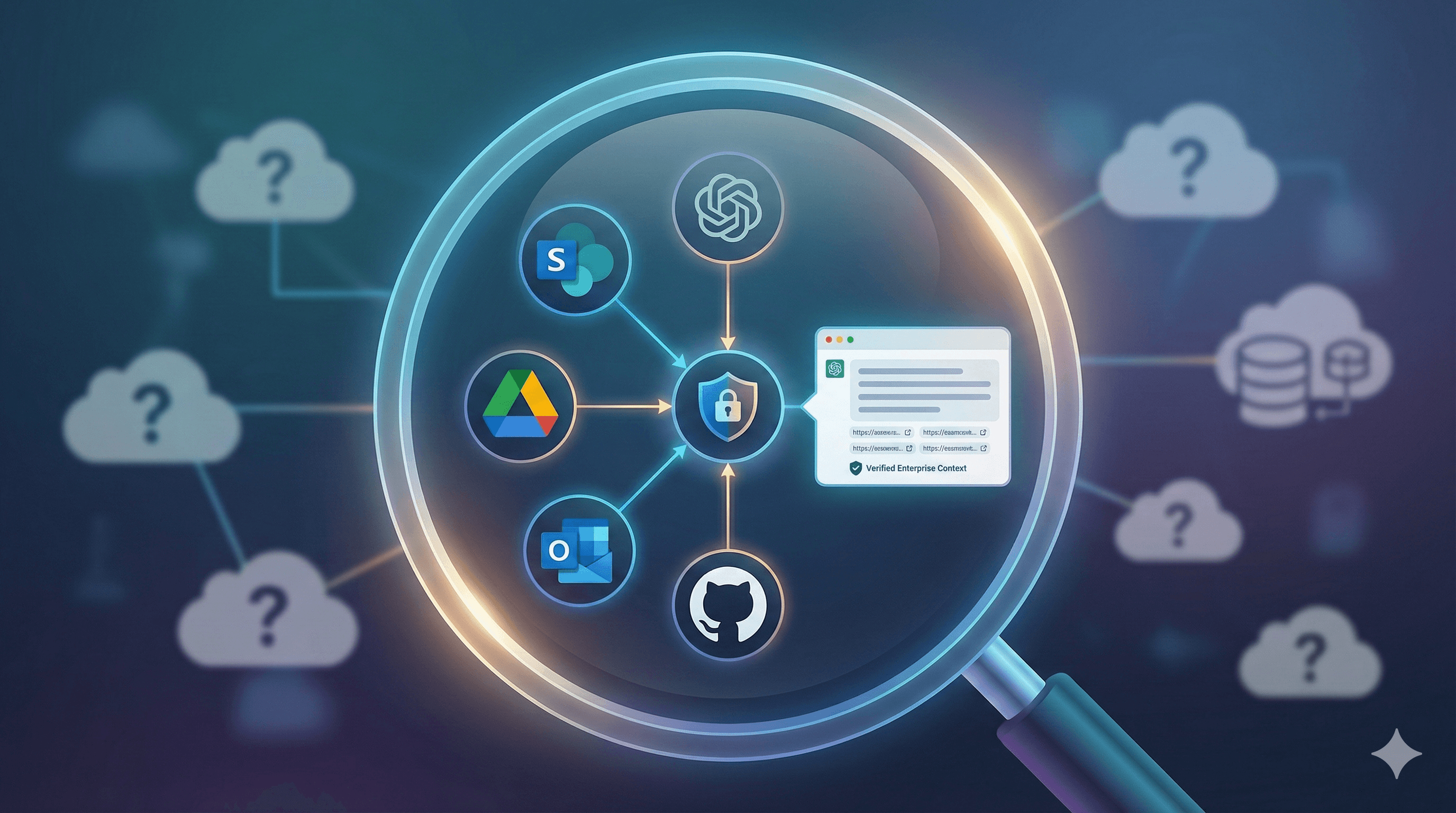
Company knowledge in ChatGPT allows you to securely connect internal sources (e.g., SharePoint, Google Drive, Outlook) so answers reflect your company's files, permissions and vocabulary. With admin controls, SSO, and optional custom connectors, teams receive referenced, contextual responses without needing to copy data between tools.
What “ChatGPT with company knowledge” actually means
Contextual answers: ChatGPT integrates content from your connected apps and files, respecting your existing permissions.
Connectors: Prebuilt links to tools like SharePoint, Google Drive, Outlook Email/Calendar, GitHub, and others for searching and retrieving information within the chat.
Projects & files: Group chats, data, and uploads; Business/Enterprise versions support larger file allowances per project.
SSO & governance: Enterprise sign-in, role-based controls, data retention policies, and admin settings suitable for audits.
Custom connectors (advanced): Extend company knowledge using your own MCP connectors for specific repositories and query types.
Bottom line: You pose a natural question; ChatGPT provides answers with your data, citations, and links back to the source, adhering to the access you already have.
Implementation playbook (fast path)
1) Prepare the workspace
Choose ChatGPT Business or Enterprise (or Edu for schools) and enable SSO with your identity provider.
Define a data governance profile: retention, export, and admin visibility; document what is in scope from day one.
2) Connect priority sources
Start with SharePoint and Google Drive (documents), then add Outlook Email/Calendar (communications) and GitHub (engineering).
Utilize Projects to group files, chats, and tasks for a team, program, or portfolio.
3) Pilot “trusted answers” use cases
Policy Q&A (HR/Legal), project history (PMO), customer context (CS), sprint/PRD discovery (Product/Engineering).
Require source-linked answers and capture feedback within the project to improve coverage.
4) Extend via custom connectors (optional)
Where gaps remain (e.g., legacy DMS, bespoke knowledge bases), introduce custom MCP connectors to enable search/fetch capabilities.
5) Operationalize governance
Activate admin guardrails: specify which connectors are allowed, who can enable them, and set retention defaults.
Add usage dashboards, periodic permission recertification, and a sunset plan for overlapping search tools.
Measurable benefits
Time saved: Fewer steps between systems; answers include citations and links.
Fewer mistakes: Outputs are based on approved documents and up-to-date sources of truth.
Happier teams: Less context switching; clarity takes the place of guesswork.
Reduced tool sprawl: Streamline overlapping search, wiki, and assistant tools.
Security, privacy, and compliance (in brief)
Data control: Your business owns the inputs/outputs; enterprise workspaces have configurable retention settings.
No training on your data by default: Business/Enterprise/Edu data is not used to train OpenAI models by default.
Permissions respected: Company knowledge and connectors maintain existing access controls in your repositories.
Admin controls: Allow/deny specific connectors; configure SSO; monitor usage.
Tip: Document which repositories are included from day one and how highly sensitive data will be handled (e.g., legal holds, restricted sites).
Example prompts your teams can use
“Summarize our Q3 product roadmap from the latest PRD folder in SharePoint and list risks with owners.”
“Search customer ABC email threads this quarter and identify renewal blockers; link to the original messages.”
“Draft a release note from the GitHub PRs merged in the last 7 days; include commit links.”
“Compare our Expense Policy to the draft in /Policies/2025; highlight changes in per-diem rates.”
FAQs
Is ChatGPT safe for regulated data? Enterprise includes admin controls, SSO, and retention settings. You decide the scope and connectors; begin with low-risk repositories and expand gradually.
Does ChatGPT train on our content? Not by default for Business/Enterprise/Edu. You control retention and exports.
What if we need a niche source (legacy DMS)? Use custom MCP connectors to add search/fetch capabilities to company knowledge.
Can we limit who uses which connector? Yes—workspace admins can allow/deny connectors and set defaults per group.
How many files can we attach? Projects accommodate generous file limits on Business/Enterprise; use Projects to keep context intact.
How Generation Digital helps
Discovery & governance design: Scope repositories, risk categories, SSO, and retention.
Connection & pilots: Activate connectors, configure Projects, and conduct real use-case sprints with measurable outcomes.
Enablement: Admin playbooks, prompt patterns, and team training.
Scale & optimize: Add custom connectors, improve retrieval quality, and phase out overlapping tools.
Ready to get reliable, cited answers that truly understand your business? Contact us to plan your company-knowledge rollout.
Receive weekly AI news and advice straight to your inbox
By subscribing, you agree to allow Generation Digital to store and process your information according to our privacy policy. You can review the full policy at gend.co/privacy.



Generation
Digital

Canadian Office
33 Queen St,
Toronto
M5H 2N2
Canada
Canadian Office
1 University Ave,
Toronto,
ON M5J 1T1,
Canada
NAMER Office
77 Sands St,
Brooklyn,
NY 11201,
USA
Head Office
Charlemont St, Saint Kevin's, Dublin,
D02 VN88,
Ireland
Middle East Office
6994 Alsharq 3890,
An Narjis,
Riyadh 13343,
Saudi Arabia






Business Number: 256 9431 77 | Copyright 2026 | Terms and Conditions | Privacy Policy