Asana + Claude: Enhancing AI Context in Canadian Enterprises
Asana
Claude
Uncertain about how to get started with AI?Evaluate your readiness, potential risks, and key priorities in less than an hour.
➔ Download Our Free AI Preparedness Pack
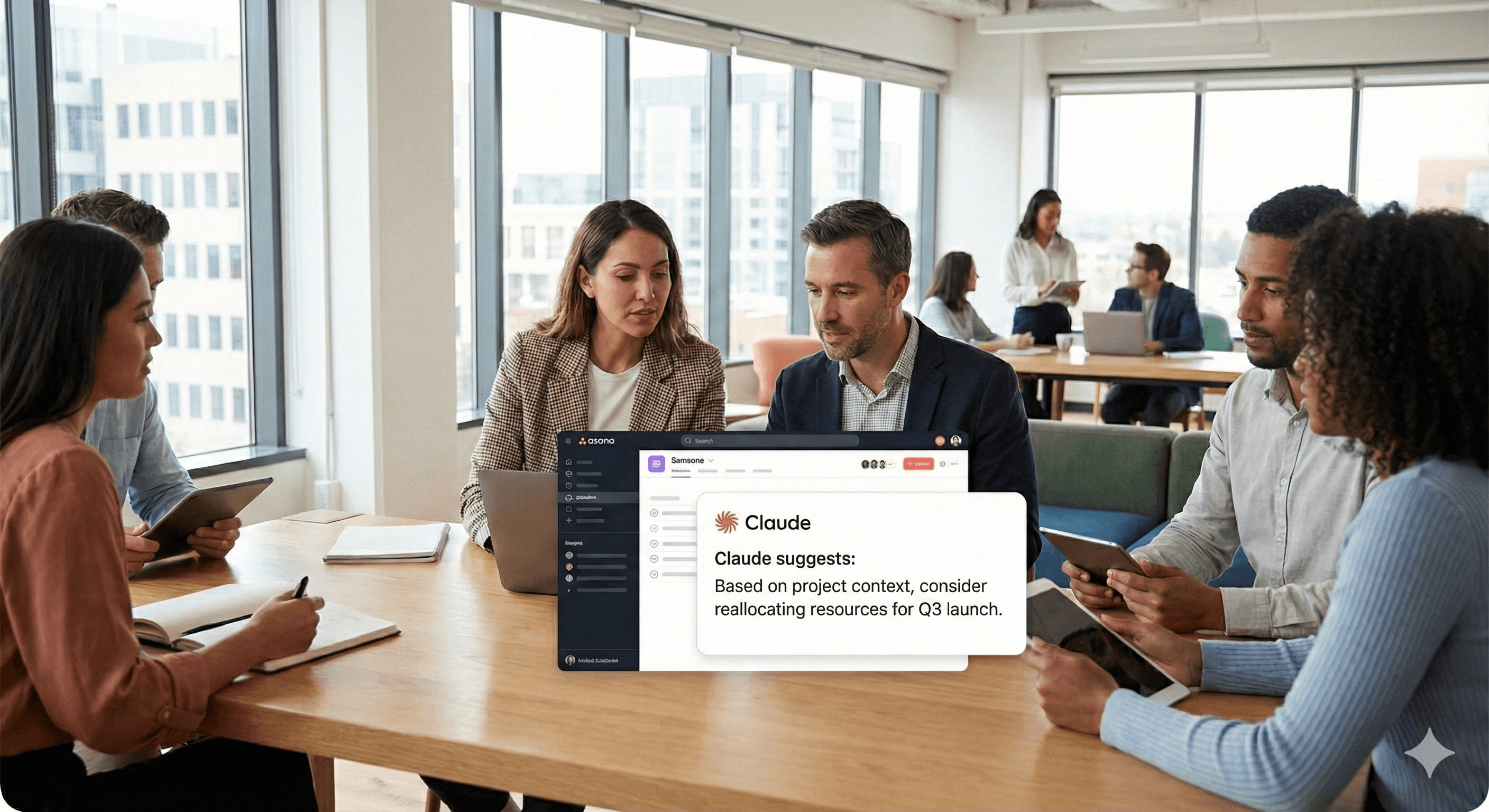
Asana has launched an interactive Claude app and made a compelling argument: LLMs without enterprise context are “context-starved.” Asana believes that the Work Graph—a dynamic map of who’s doing what, by when, and why—provides that context, ensuring external models (Anthropic today; OpenAI/Google tomorrow) can effectively contribute to meaningful work.
In an interview with VentureBeat, Asana’s CPO clearly states: raw model power is less crucial than business context, and Asana aims to serve as the front-end for any vendor’s agents, rather than being a model vendor itself.
What’s been launched (and why it’s important)
Claude integrated into your Asana flow: Connect via OAuth, then create projects, tasks, and complete structures through conversation; ask status questions and get answers grounded in your projects. Human approval is required before Claude implements changes.
Available now: Asana’s guide confirms setup through Claude’s app directory; once connected, mention Asana in chat to move ideas into action.
Model-agnostic strategy: Asana is also enhancing ChatGPT and Gemini connectors and aligning with MCP and agent-to-agent standards—safeguarding against vendor lock-in.
Broader perspective: Anthropic’s new interactive apps (Asana, Slack, Figma, etc.) make Claude a true work interface instead of merely another tab.
Why it’s important: This marks the transition from “chatting about work” to “transforming the work”—but only if the AI is anchored in your organization’s goals, approvals, and relationships (such as the Work Graph).
The operating model: making AI useful, safe, and measurable
Anchor in the Work Graph (or equivalent)
Ensure agents view projects, owners, dependencies, and objectives—not just text. This reduces fictional outcomes and drives relevant actions.Human involvement by design
Maintain mandatory approvals for edits/creations; follow Asana’s pattern: review, confirm, then execute. (It minimizes organizational risk while trust develops.)Diverse models over lock-in
Regard Claude, ChatGPT, and Gemini as interchangeable reasoning engines behind one orchestration layer. Asana’s roadmap explicitly supports this approach.Specific agent roles, not general chat
Utilize AI Teammates/agent patterns aligned with goals and workflows (risk identification, dependency checks, follow-up orchestration). This is where Work Graph context excels.Governance & audit
OAuth-scoped access, permissible-respecting actions, admin visibility, and change logs. Announce “What this agent can and cannot do.”
A rollout strategy (start now)
Phase 1 — Connect & limit (2–3 weeks)
Enable the Asana app in Claude; limit access by workspace/project.
Identify approved actions (create tasks, draft plans) vs. read-only.
Establish an approvals gateway for any write action.
Phase 2 — Design agentic workflows (3–6 weeks)
Develop slash-commands/conversational prompts for:
“Draft project plan from this PRD” → review → approve → publish to Asana.
“What’s delayed on Launch X?” → status, risks, owners, and recommended mitigations.
Test AI Teammate-style routines that monitor dependencies and suggest follow-ups.
Phase 3 — Measure & expand (ongoing)
Monitor cycle time to project creation, % tasks created via AI (with human approval), dependency resolution time, and user satisfaction.
Incorporate connectors to Slack (updates), Figma (review links), Miro (workshops) within Claude’s interactive apps for smoother context switches.
Risks & mitigation strategies
Over-automation anxiety: Maintain mandatory human sign-off; publish an agent capabilities matrix.
Data scope creep: Enforce least-privilege with OAuth and role-based access; track usage through admin panels.
Vendor instability: Adopt Asana’s model-agnostic perspective and standards like MCP to stay adaptable.
Where Generation Digital fits (what we do vs don’t)
We do: Orchestration software, policy/prompt governance, approval gateways, metrics dashboards, enablement programs, and integrations (Asana, Slack, Notion, Miro, Glean).
We don’t: Construct foundational models or replace your PM stack—we ensure your multi-model, human-in-loop setup is fully functional.
FAQs
How does Asana’s Claude integration function?
Authenticate via OAuth, then utilize Claude to create/modify projects and obtain status—with explicit human approval before changes are implemented.
Why is “context-starved AI” an issue?
Models can write, but they lack knowledge of your goals, owners, or approvals. The Work Graph provides that organizational context, ensuring actions are relevant.
Are we locked into Anthropic?
No. Asana is model-agnostic and is enhancing connectors for ChatGPT and Gemini, as well as industry standards like MCP.
What guardrails are implemented?
User permissions are respected; admins have visibility; and human-in-loop approval is mandatory before Claude writes to Asana.
What’s the quickest way to pilot?
Select a high-impact workflow (e.g., “new project from PRD”), launch with approvals enabled, track time-to-project and satisfaction, then increase the scope.
Next Steps
Ready to enrich your AI with context?
We’ll implement Asana + Claude with guardrails, approvals, and metrics—keeping you adaptable across models.
→ Book a discovery session with Generation Digital to pilot within weeks, not months.
Receive weekly AI news and advice straight to your inbox
By subscribing, you agree to allow Generation Digital to store and process your information according to our privacy policy. You can review the full policy at gend.co/privacy.



Generation
Digital

Canadian Office
33 Queen St,
Toronto
M5H 2N2
Canada
Canadian Office
1 University Ave,
Toronto,
ON M5J 1T1,
Canada
NAMER Office
77 Sands St,
Brooklyn,
NY 11201,
USA
Head Office
Charlemont St, Saint Kevin's, Dublin,
D02 VN88,
Ireland
Middle East Office
6994 Alsharq 3890,
An Narjis,
Riyadh 13343,
Saudi Arabia







Business Number: 256 9431 77 | Copyright 2026 | Terms and Conditions | Privacy Policy