Avoid the Meeting Overload: Move Coordination to Asana AI, Not Your Calendar

Avoid the Meeting Overload: Move Coordination to Asana AI, Not Your Calendar

Asana
Nov 27, 2025

A man is sitting at a desk in a modern office, using dual monitors displaying code and a collaborative platform, illustrating the use of Glean Code Search and Writing Tools.

Not sure what to do next with AI?
Assess readiness, risk, and priorities in under an hour.

Not sure what to do next with AI?
Assess readiness, risk, and priorities in under an hour.

➔ Schedule a Consultation

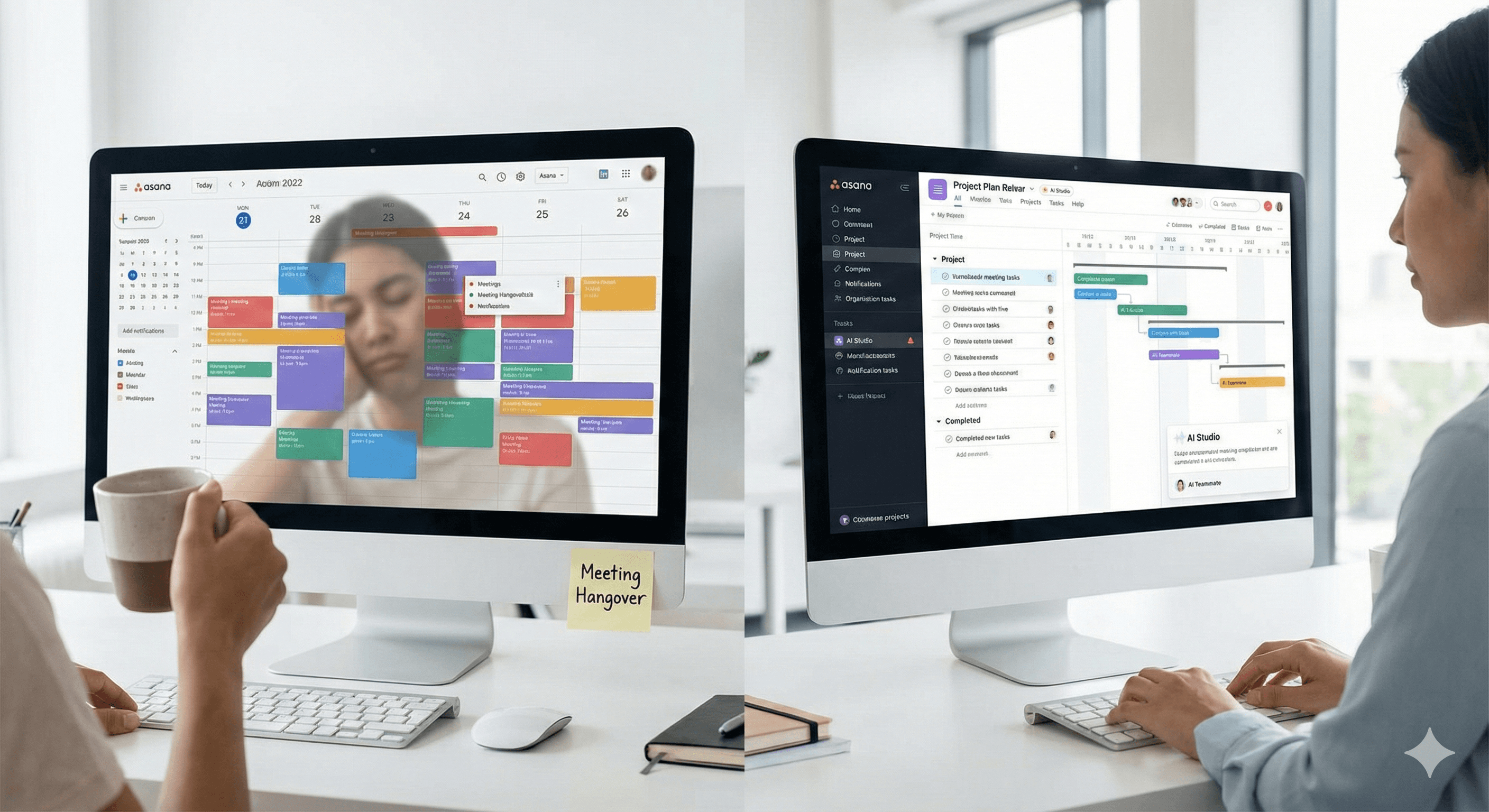
Your calendar shouldn’t be your way of working. When every update, dependency, and approval requires a live call, days become a jumble of semi-productive sessions that sap energy and still don’t propel work forward. That’s the meeting hangover: unclear alignment, slow decisions, and the nagging feeling that real work happens after hours.

The issue isn’t your team—it’s trying to organize complex tasks without a system of record. Handling coordination as a sequence of events forces everyone to sync in real time, even when tasks would be better managed asynchronously. The solution is to integrate coordination into the workflow itself so status, hand-offs, and decisions progress without calling the whole team together.

Move coordination from the calendar into Asana AI

This is where Asana AI transforms the process. Two pillars now handle the coordination within Asana. AI Studio is a no-code builder for AI-driven workflows that manage intake, enrich briefs, create tasks, and keep dependencies updated—right where the work resides. AI Teammates are governed, collaborative agents that run rules, draft updates, and highlight risks under enterprise controls, while humans maintain control of outcomes. Together, they replace a surprising number of status meetings with consistent, auditable progress.

When coordination is managed in Asana, meetings focus on what they do best: discussion and decision-making. Status becomes a stream you can review, not a room you must enter. Leaders receive summarized updates and risk highlights from AI, contributors receive clear ownership and deadlines, and no one has to make slide decks just to “share where we are”. Asana’s latest releases emphasize this with pre-built AI workflows and templates that standardize approvals, reviews, and stakeholder updates—enabling teams to stop reinventing the wheel every quarter.

Proof that clarity drives engagement

If you need proof, look to the NCAA. By transitioning from dispersed tools to a single system in Asana, they developed repeatable workflows and quadrupled content consumption—proving that when work is unified and visible, audiences engage and teams save time from endless explanations. That same foundation grants teams fewer meetings: shared context, trusted automation, and one place to find the truth.

Day-to-day: what it truly feels like

Intake no longer starts with a meeting; requests come via forms and are enhanced by AI, ensuring the right details are there from the beginning. Dependencies and due dates auto-adjust when upstream tasks shift, replacing “quick check-ins” with clear prompts within the workflow. Weekly updates summarize themselves, with AI Teammates generating accurate notes from live project data. The remaining meeting is shorter, more focused, and centered on decisions—because coordination has already happened.

The cultural benefits are genuine. Teams report fewer status calls, more dedicated work blocks, and clearer ownership because context, updates, and history are captured where the work actually happens. Even beyond Asana, the shift away from cluttered calendars is well documented; what Asana adds is a governed, scalable method to execute that change with AI that respects enterprise controls.

What changes when meetings are no longer your coordination method

You regain time—hours each week recouped from updates software can organize. You achieve alignment—goals, accountability, and status visible in one place, not buried in emails. And you enjoy better outcomes—like the NCAA’s 4× increase—because people focus more on doing the work and less on narrating it.

Asana AI ends the “meeting hangover” by integrating coordination into the workflow. With AI Studio to create no-code, AI-driven processes and AI Teammates to manage governed updates and hand-offs, teams replace status meetings with automated progress and informed decision-making—proven by results like the NCAA’s increase in content consumption.

Next steps

Ready to end the meeting hangover and let work progress independently? Book an Asana Workflow Consultation. We’ll analyze your current meeting schedule, replace one status routine with an AI Studio flow, pilot AI Teammates for updates and risk identification, and measure the time you gain back.

FAQs

Will AI start scheduling more meetings for us?
The goal is the opposite. Asana AI automates status, hand-offs, and summaries so meetings are reserved for discussion and decision-making. AI Studio and AI Teammates work with human checkpoints.

How do we start without disrupting everything?
Start by mapping one recurring status call and reconstructing it as an AI Studio workflow (intake → updates → approvals). Pilot with one team, then scale using templates.

Is this enterprise-grade and secure?
Yes. AI Teammates inherit Asana’s enterprise controls (SSO/SCIM, role-based access, audit trails). You control the visibility and actions of the agents, and every action is transparent.

Your calendar shouldn’t be your way of working. When every update, dependency, and approval requires a live call, days become a jumble of semi-productive sessions that sap energy and still don’t propel work forward. That’s the meeting hangover: unclear alignment, slow decisions, and the nagging feeling that real work happens after hours.

The issue isn’t your team—it’s trying to organize complex tasks without a system of record. Handling coordination as a sequence of events forces everyone to sync in real time, even when tasks would be better managed asynchronously. The solution is to integrate coordination into the workflow itself so status, hand-offs, and decisions progress without calling the whole team together.

Move coordination from the calendar into Asana AI

This is where Asana AI transforms the process. Two pillars now handle the coordination within Asana. AI Studio is a no-code builder for AI-driven workflows that manage intake, enrich briefs, create tasks, and keep dependencies updated—right where the work resides. AI Teammates are governed, collaborative agents that run rules, draft updates, and highlight risks under enterprise controls, while humans maintain control of outcomes. Together, they replace a surprising number of status meetings with consistent, auditable progress.

When coordination is managed in Asana, meetings focus on what they do best: discussion and decision-making. Status becomes a stream you can review, not a room you must enter. Leaders receive summarized updates and risk highlights from AI, contributors receive clear ownership and deadlines, and no one has to make slide decks just to “share where we are”. Asana’s latest releases emphasize this with pre-built AI workflows and templates that standardize approvals, reviews, and stakeholder updates—enabling teams to stop reinventing the wheel every quarter.

Proof that clarity drives engagement

If you need proof, look to the NCAA. By transitioning from dispersed tools to a single system in Asana, they developed repeatable workflows and quadrupled content consumption—proving that when work is unified and visible, audiences engage and teams save time from endless explanations. That same foundation grants teams fewer meetings: shared context, trusted automation, and one place to find the truth.

Day-to-day: what it truly feels like

Intake no longer starts with a meeting; requests come via forms and are enhanced by AI, ensuring the right details are there from the beginning. Dependencies and due dates auto-adjust when upstream tasks shift, replacing “quick check-ins” with clear prompts within the workflow. Weekly updates summarize themselves, with AI Teammates generating accurate notes from live project data. The remaining meeting is shorter, more focused, and centered on decisions—because coordination has already happened.

The cultural benefits are genuine. Teams report fewer status calls, more dedicated work blocks, and clearer ownership because context, updates, and history are captured where the work actually happens. Even beyond Asana, the shift away from cluttered calendars is well documented; what Asana adds is a governed, scalable method to execute that change with AI that respects enterprise controls.

What changes when meetings are no longer your coordination method

You regain time—hours each week recouped from updates software can organize. You achieve alignment—goals, accountability, and status visible in one place, not buried in emails. And you enjoy better outcomes—like the NCAA’s 4× increase—because people focus more on doing the work and less on narrating it.

Asana AI ends the “meeting hangover” by integrating coordination into the workflow. With AI Studio to create no-code, AI-driven processes and AI Teammates to manage governed updates and hand-offs, teams replace status meetings with automated progress and informed decision-making—proven by results like the NCAA’s increase in content consumption.

Next steps

Ready to end the meeting hangover and let work progress independently? Book an Asana Workflow Consultation. We’ll analyze your current meeting schedule, replace one status routine with an AI Studio flow, pilot AI Teammates for updates and risk identification, and measure the time you gain back.

FAQs

Will AI start scheduling more meetings for us?
The goal is the opposite. Asana AI automates status, hand-offs, and summaries so meetings are reserved for discussion and decision-making. AI Studio and AI Teammates work with human checkpoints.

How do we start without disrupting everything?
Start by mapping one recurring status call and reconstructing it as an AI Studio workflow (intake → updates → approvals). Pilot with one team, then scale using templates.

Is this enterprise-grade and secure?
Yes. AI Teammates inherit Asana’s enterprise controls (SSO/SCIM, role-based access, audit trails). You control the visibility and actions of the agents, and every action is transparent.

Receive practical advice directly in your inbox

By subscribing, you agree to allow Generation Digital to store and process your information according to our privacy policy. You can review the full policy at gend.co/privacy.


Are you ready to get the support your organization needs to successfully leverage AI?

Miro Solutions Partner
Asana Platinum Solutions Partner
Notion Platinum Solutions Partner
Glean Certified Partner

Ready to get the support your organization needs to successfully use AI?

Miro Solutions Partner
Asana Platinum Solutions Partner
Notion Platinum Solutions Partner
Glean Certified Partner

Generation
Digital

Canadian Office
33 Queen St,
Toronto
M5H 2N2
Canada

Canadian Office
1 University Ave,
Toronto,
ON M5J 1T1,
Canada

NAMER Office
77 Sands St,
Brooklyn,
NY 11201,
USA

Head Office
Charlemont St, Saint Kevin's, Dublin,
D02 VN88,
Ireland

Middle East Office
6994 Alsharq 3890,
An Narjis,
Riyadh 13343,
Saudi Arabia

UK Fast Growth Index UBS Logo
Financial Times FT 1000 Logo
Febe Growth 100 Logo (Background Removed)

Business Number: 256 9431 77 | Copyright 2026 | Terms and Conditions | Privacy Policy

Generation
Digital

Canadian Office
33 Queen St,
Toronto
M5H 2N2
Canada

Canadian Office
1 University Ave,
Toronto,
ON M5J 1T1,
Canada

NAMER Office
77 Sands St,
Brooklyn,
NY 11201,
USA

Head Office
Charlemont St, Saint Kevin's, Dublin,
D02 VN88,
Ireland

Middle East Office
6994 Alsharq 3890,
An Narjis,
Riyadh 13343,
Saudi Arabia

UK Fast Growth Index UBS Logo
Financial Times FT 1000 Logo
Febe Growth 100 Logo (Background Removed)


Business No: 256 9431 77
Terms and Conditions
Privacy Policy
© 2026




