Miro for Strategic Planning with AI: From Setting Goals to Execution

Miro for Strategic Planning with AI: From Setting Goals to Execution
Miro

Dec 10, 2025

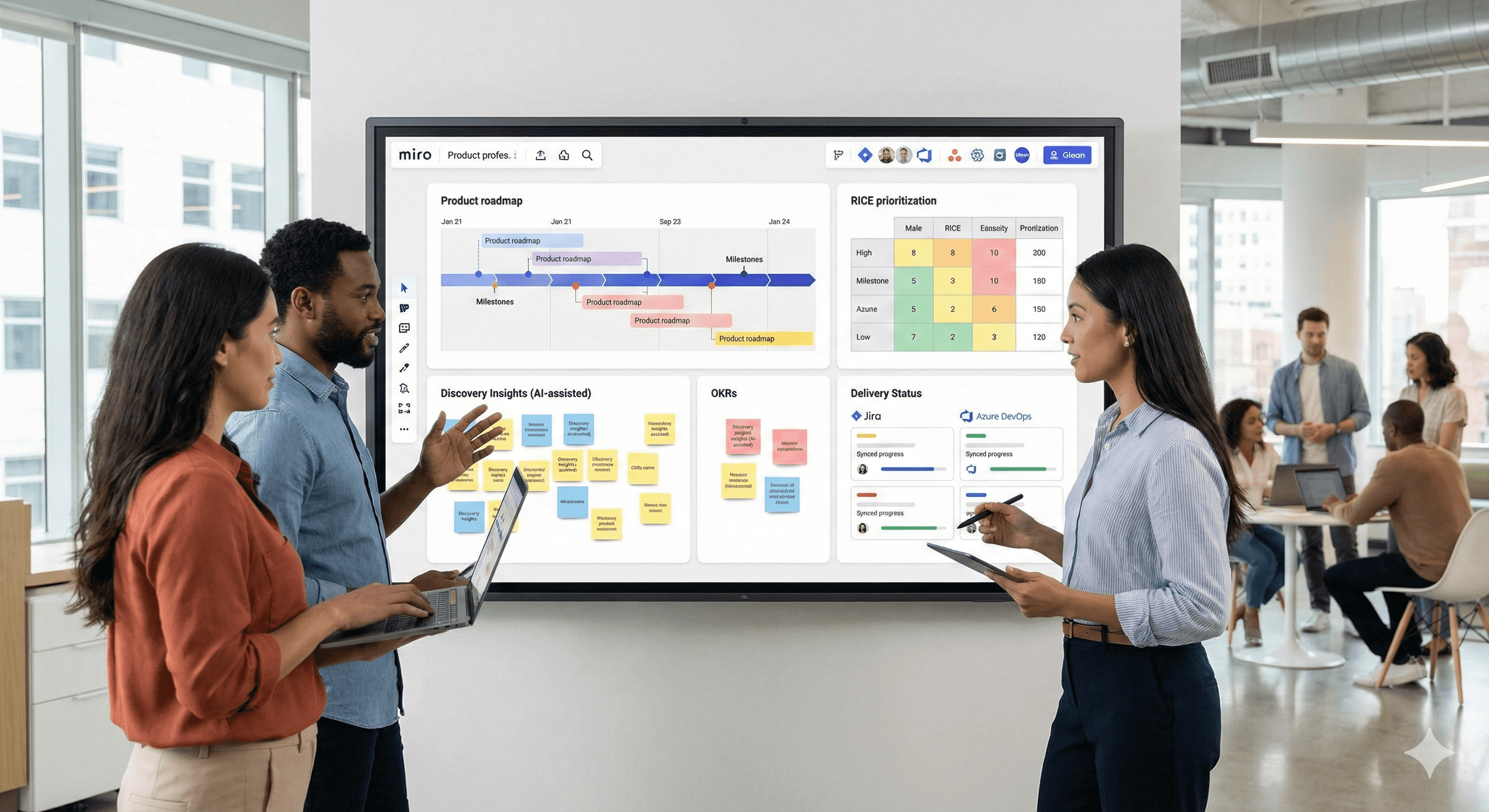
Three people are gathered around a digital whiteboard in a modern office, discussing strategy and planning while reviewing a product roadmap on Miro. They are using sticky notes and charts to visualize their ideas, fostering a collaborative environment perfect for a Canadian business setting.

Not sure what to do next with AI?
Assess readiness, risk, and priorities in under an hour.

Not sure what to do next with AI?
Assess readiness, risk, and priorities in under an hour.

➔ Schedule a Consultation

Discover how product leaders can transform strategy into execution as a continuous, intelligent flow with Miro—combining AI-assisted insights, prioritization, timelines/roadmaps, and live synchronization with your delivery tools.

Why this matters in 2026

Plans falter when discovery, roadmaps, and delivery reside in separate tools. Miro centralizes planning—workshops, prioritization, dependencies—and connects them to execution with Cards/Planner for Jira and Azure DevOps, plus Miro AI for clustering notes and summarizing insights. The result: faster alignment, fewer handoffs.

Key points

  • Seamless integration of strategy and execution. Plan in Miro; sync issues both ways with Jira Cards and Azure Cards/Planner, ensuring updates in Miro reflect in the systems of record (and vice versa).

  • Enhanced collaboration and facilitation. Conduct engaging sessions with Voting, Attention management (“Follow” / “Bring everyone to me”), Smart Meetings templates and Talktrack for asynchronous walkthroughs.

  • Improved outcomes with a structured workflow. Move from OKRs → discovery synthesis → RICE → timeline/roadmap on one canvas using Tables and Timeline, then track dependencies across teams.

How it works

Miro offers a complete strategy & planning toolkit: facilitator controls, planning templates (OKR, roadmap, PI planning), integrations with task trackers, and AI to speed up synthesis. You can run the planning event, prioritize, and track progress—all in Miro.

AI highlights for planning

  • Cluster & summarize research: Select stickies → Miro AI → Cluster (by keyword/sentiment) → Summarize to rapidly create themes.

  • Create with AI: Generate content and structured artifacts directly on the canvas (Docs, Tables, Prototypes) using your board context.

  • Sticky capture: Photograph physical notes and convert them to editable stickies for distributed teams.

  • AI prototyping (for concept alignment): Turn text or screenshots into clickable prototypes to validate flows before building.

A practical blueprint

  1. Set the North Star and OKRs
    Open the OKR Planning/OKR templates to co-create objectives and key results; use Smart Meetings to guide the workshop. Maintain ownership and progress in a Table on the board.

  2. Synthesize discovery with Miro AI
    Paste interview notes or survey signals as stickies, then Cluster by keyword/sentiment and Summarize into themes. Link evidence to each theme for auditability.

  3. Prioritize with RICE (in context)
    Use the RICE template (built on Tables) so rationales sit next to scores and research.

  4. Build the delivery plan
    Drop initiatives into Timeline for quarters/months and/or the Roadmap view to connect work to strategic themes.

  5. Connect strategy to execution

  • Jira Cards / Planner for Jira: Import/create issues, update statuses, and sync both ways. Use the Dependencies app during planning to visualize cross-team blockers.

  • Azure DevOps: Use Azure Cards and Planner for Azure; drag items across iterations to update Azure in real time. Map dependencies across teams.

  1. Facilitate decisively
    Conduct Voting, keep participants together with Attention management, and record an asynchronous Talktrack so stakeholders can review decisions without another meeting.

  2. Share, govern, and iterate
    Present plans via Interactive Presentation Mode; log decisions and PRDs in Notion; orchestrate tasks in Asana; make research/findings instantly discoverable with Glean; maintain your Miro service hub at Miro.


Deep-dive examples

  • Quarterly planning in one canvas: OKRs → AI-assisted synthesis → RICE → Timeline → push epics/issues to Jira/Azure; use Dependencies to surface cross-team risk.

  • Exec review without a meeting: Record a Talktrack over your planning frames; stakeholders watch on the board and provide inline comments.

  • Scaled planning (PI/Big Room): Conduct the event in Miro with Planner + Dependencies; decisions sync to Azure/Jira instantly.

FAQs

Q1: How does Miro help in strategy execution?

A: Miro unites planning and delivery: conduct sessions, prioritize in Tables, timeline your roadmap, and sync with Jira/Azure so board changes and issue updates align. help.miro.com

Q2: Can Miro improve team collaboration?

A: Yes—use Voting, Attention management, Smart Meetings, and Talktrack to keep decisions moving and engage stakeholders both live and asynchronously. help.miro.com

Q3: What AI features matter most here?

A: Miro AI clusters/summarizes stickies, captures physical notes, and can generate content and prototypes from prompts—accelerating synthesis and alignment. help.miro.com

Q4: Will Miro connect with our wider tool stack?

A: Yes—Miro offers 250+ apps and integrations (incl. Jira, Azure DevOps, Asana, Slack, Teams, and more) to keep plans connected. Miro

Summary

Miro enables product leaders to manage a continuous planning loop: set OKRs, synthesize evidence with AI, prioritize transparently, plan on timelines/roadmaps, map dependencies, and sync to delivery tools—then share updates asynchronously. Looking for a guided rollout for 2026? Generation Digital can craft your Miro boards, governance, and integrations—paired with Asana, Notion, and Glean—so strategy and execution move as one.

Discover how product leaders can transform strategy into execution as a continuous, intelligent flow with Miro—combining AI-assisted insights, prioritization, timelines/roadmaps, and live synchronization with your delivery tools.

Why this matters in 2026

Plans falter when discovery, roadmaps, and delivery reside in separate tools. Miro centralizes planning—workshops, prioritization, dependencies—and connects them to execution with Cards/Planner for Jira and Azure DevOps, plus Miro AI for clustering notes and summarizing insights. The result: faster alignment, fewer handoffs.

Key points

  • Seamless integration of strategy and execution. Plan in Miro; sync issues both ways with Jira Cards and Azure Cards/Planner, ensuring updates in Miro reflect in the systems of record (and vice versa).

  • Enhanced collaboration and facilitation. Conduct engaging sessions with Voting, Attention management (“Follow” / “Bring everyone to me”), Smart Meetings templates and Talktrack for asynchronous walkthroughs.

  • Improved outcomes with a structured workflow. Move from OKRs → discovery synthesis → RICE → timeline/roadmap on one canvas using Tables and Timeline, then track dependencies across teams.

How it works

Miro offers a complete strategy & planning toolkit: facilitator controls, planning templates (OKR, roadmap, PI planning), integrations with task trackers, and AI to speed up synthesis. You can run the planning event, prioritize, and track progress—all in Miro.

AI highlights for planning

  • Cluster & summarize research: Select stickies → Miro AI → Cluster (by keyword/sentiment) → Summarize to rapidly create themes.

  • Create with AI: Generate content and structured artifacts directly on the canvas (Docs, Tables, Prototypes) using your board context.

  • Sticky capture: Photograph physical notes and convert them to editable stickies for distributed teams.

  • AI prototyping (for concept alignment): Turn text or screenshots into clickable prototypes to validate flows before building.

A practical blueprint

  1. Set the North Star and OKRs
    Open the OKR Planning/OKR templates to co-create objectives and key results; use Smart Meetings to guide the workshop. Maintain ownership and progress in a Table on the board.

  2. Synthesize discovery with Miro AI
    Paste interview notes or survey signals as stickies, then Cluster by keyword/sentiment and Summarize into themes. Link evidence to each theme for auditability.

  3. Prioritize with RICE (in context)
    Use the RICE template (built on Tables) so rationales sit next to scores and research.

  4. Build the delivery plan
    Drop initiatives into Timeline for quarters/months and/or the Roadmap view to connect work to strategic themes.

  5. Connect strategy to execution

  • Jira Cards / Planner for Jira: Import/create issues, update statuses, and sync both ways. Use the Dependencies app during planning to visualize cross-team blockers.

  • Azure DevOps: Use Azure Cards and Planner for Azure; drag items across iterations to update Azure in real time. Map dependencies across teams.

  1. Facilitate decisively
    Conduct Voting, keep participants together with Attention management, and record an asynchronous Talktrack so stakeholders can review decisions without another meeting.

  2. Share, govern, and iterate
    Present plans via Interactive Presentation Mode; log decisions and PRDs in Notion; orchestrate tasks in Asana; make research/findings instantly discoverable with Glean; maintain your Miro service hub at Miro.


Deep-dive examples

  • Quarterly planning in one canvas: OKRs → AI-assisted synthesis → RICE → Timeline → push epics/issues to Jira/Azure; use Dependencies to surface cross-team risk.

  • Exec review without a meeting: Record a Talktrack over your planning frames; stakeholders watch on the board and provide inline comments.

  • Scaled planning (PI/Big Room): Conduct the event in Miro with Planner + Dependencies; decisions sync to Azure/Jira instantly.

FAQs

Q1: How does Miro help in strategy execution?

A: Miro unites planning and delivery: conduct sessions, prioritize in Tables, timeline your roadmap, and sync with Jira/Azure so board changes and issue updates align. help.miro.com

Q2: Can Miro improve team collaboration?

A: Yes—use Voting, Attention management, Smart Meetings, and Talktrack to keep decisions moving and engage stakeholders both live and asynchronously. help.miro.com

Q3: What AI features matter most here?

A: Miro AI clusters/summarizes stickies, captures physical notes, and can generate content and prototypes from prompts—accelerating synthesis and alignment. help.miro.com

Q4: Will Miro connect with our wider tool stack?

A: Yes—Miro offers 250+ apps and integrations (incl. Jira, Azure DevOps, Asana, Slack, Teams, and more) to keep plans connected. Miro

Summary

Miro enables product leaders to manage a continuous planning loop: set OKRs, synthesize evidence with AI, prioritize transparently, plan on timelines/roadmaps, map dependencies, and sync to delivery tools—then share updates asynchronously. Looking for a guided rollout for 2026? Generation Digital can craft your Miro boards, governance, and integrations—paired with Asana, Notion, and Glean—so strategy and execution move as one.

Receive practical advice directly in your inbox

By subscribing, you agree to allow Generation Digital to store and process your information according to our privacy policy. You can review the full policy at gend.co/privacy.


Are you ready to get the support your organization needs to successfully leverage AI?

Miro Solutions Partner
Asana Platinum Solutions Partner
Notion Platinum Solutions Partner
Glean Certified Partner

Ready to get the support your organization needs to successfully use AI?

Miro Solutions Partner
Asana Platinum Solutions Partner
Notion Platinum Solutions Partner
Glean Certified Partner

Generation
Digital

Canadian Office
33 Queen St,
Toronto
M5H 2N2
Canada

Canadian Office
1 University Ave,
Toronto,
ON M5J 1T1,
Canada

NAMER Office
77 Sands St,
Brooklyn,
NY 11201,
USA

Head Office
Charlemont St, Saint Kevin's, Dublin,
D02 VN88,
Ireland

Middle East Office
6994 Alsharq 3890,
An Narjis,
Riyadh 13343,
Saudi Arabia

UK Fast Growth Index UBS Logo
Financial Times FT 1000 Logo
Febe Growth 100 Logo (Background Removed)

Business Number: 256 9431 77 | Copyright 2026 | Terms and Conditions | Privacy Policy

Generation
Digital

Canadian Office
33 Queen St,
Toronto
M5H 2N2
Canada

Canadian Office
1 University Ave,
Toronto,
ON M5J 1T1,
Canada

NAMER Office
77 Sands St,
Brooklyn,
NY 11201,
USA

Head Office
Charlemont St, Saint Kevin's, Dublin,
D02 VN88,
Ireland

Middle East Office
6994 Alsharq 3890,
An Narjis,
Riyadh 13343,
Saudi Arabia

UK Fast Growth Index UBS Logo
Financial Times FT 1000 Logo
Febe Growth 100 Logo (Background Removed)


Business No: 256 9431 77
Terms and Conditions
Privacy Policy
© 2026





