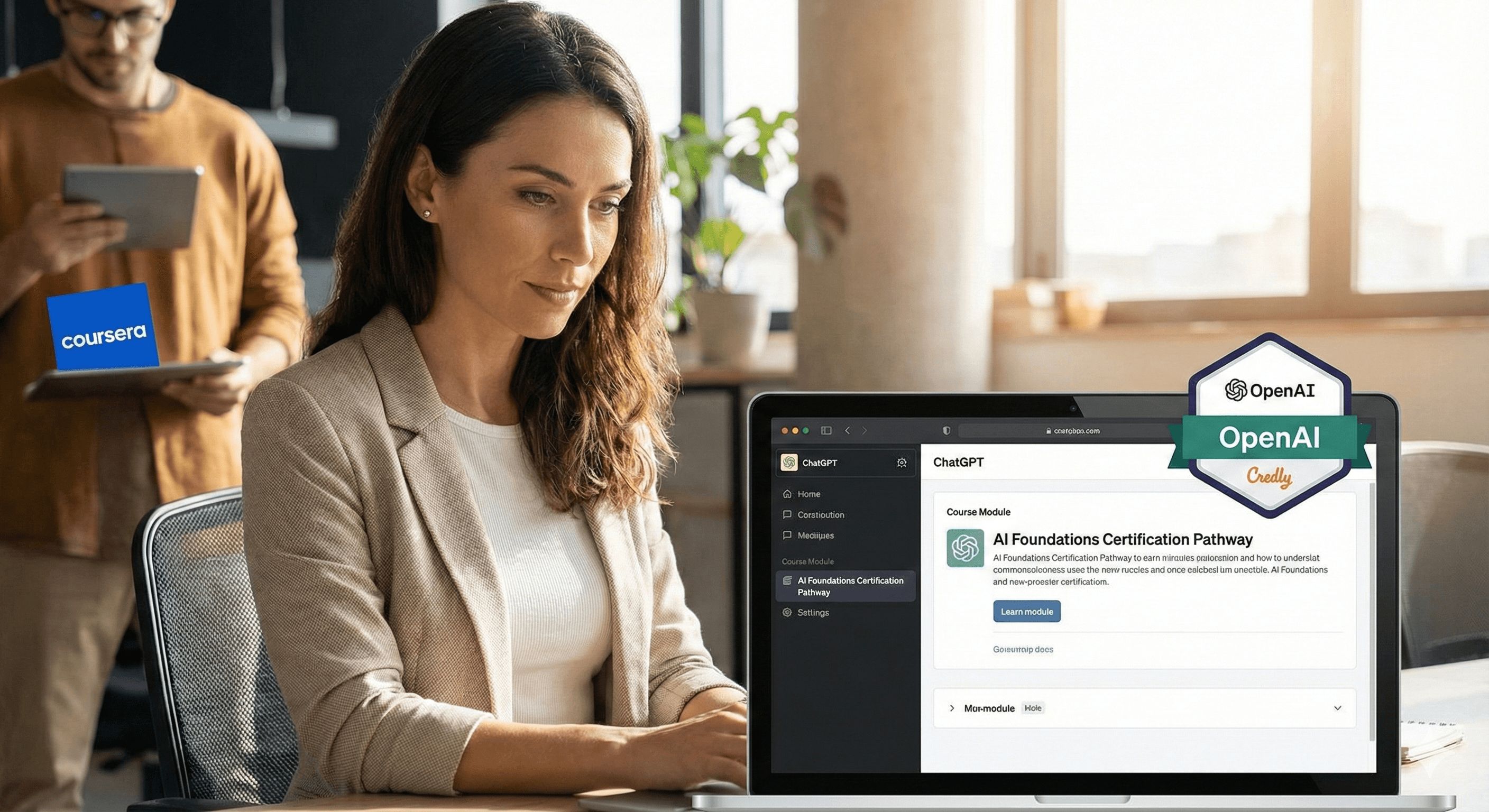
OpenAI has introduced its first certification pathway, starting with AI Foundations (delivered inside ChatGPT for pilot partners) and ChatGPT Foundations for Teachers (available on Coursera). Learners practice real tasks directly in ChatGPT and earn credentials backed by partners including ETS and Credly by Pearson.
Why this matters in 2026
Enterprises now expect “AI-literate” teams. OpenAI’s model brings the learning environment, practice, and feedback loop into ChatGPT, then issues portable evidence of skills via external credential partners — a faster route from training to verified capability. Early pilots span large employers, universities and US state partners.
What’s new — the programme at a glance
AI Foundations (in ChatGPT): A hands-on course embedded in ChatGPT where learners complete tasks, receive feedback, and earn a course certificate en route to OpenAI Certification. Pilot partners include Walmart, John Deere, BCG, Accenture, Hearst and public-sector programmes (e.g., Delaware).
ChatGPT Foundations for Teachers (Coursera): A parallel track tailored to educators, live on Coursera.
Standards & portability: OpenAI is working with ETS and Credly to ensure psychometric rigour and transferable proof of learning.
Roadmap: Pilots run through late 2025/early 2026; broader access expands after partner feedback. Academy materials indicate certifications will scale from late-2025 into 2026.
How it works
Learn inside ChatGPT: AI Foundations presents scenarios (e.g., drafting workflows, citing sources, using tools). ChatGPT acts as tutor and practice space in one.
Get credentialed: Completing AI Foundations yields a certificate; additional coursework plus a hands-on project stacks toward a fuller OpenAI Certification. Credentials are issued via partners for employer-recognised portability.
For educators: The Coursera course provides structured modules and classroom-ready tasks; OpenAI and Coursera highlight confidence-building for teachers adopting AI.
For students & campuses: OpenAI is piloting with Arizona State University and the California State University system to create entry-to-work pathways.
What you’ll actually learn
Turn messy notes into action plans and project tasks (ideal with Asana for intake/ownership).
Produce research with citations and draft decision docs (documented neatly in Notion).
Create visuals and process maps to explain ideas (Miro).
Retrieve the right organisational knowledge when paired with enterprise search (Glean). (Pattern recommendation; not part of OpenAI’s courseware itself.)
FAQs
Who is it for?
Beginners and working professionals who need practical, verifiable AI skills; educator-specific content is available on Coursera. OpenAI+1
What do the courses cover?
Core AI skills applied to real tasks — planning, summarising with citations, drafting workflows, and reflective feedback — all inside ChatGPT, plus a teacher-oriented curriculum. OpenAI+1
When can I get certified?
AI Foundations is in pilot now; OpenAI indicates certifications will expand from late-2025 into 2026 after partner feedback and psychometric review. OpenAI Academy+1
Are these recognised by employers?
OpenAI is working with ETS and Credly to ensure rigour and portability; early pilots involve large employers and public-sector partners to align skills with job needs. OpenAI
Want help putting this into practice? Generation Digital supports organisations in the UK, US and Canada with AI training for teams.
Put this into practice
Rolling out Claude or AI across your organisation?
Generation Digital is a certified partner in Anthropic’s Claude Partner Network. Talk to one of our Claude specialists about rollout, training and adoption.
Get weekly AI news and advice delivered to your inbox
By subscribing you consent to Generation Digital storing and processing your details in line with our privacy policy. You can read the full policy at gend.co/privacy.


