OpenAI invests in Merge Labs to advance brain–computer interfaces
OpenAI
Uncertain about how to get started with AI?Evaluate your readiness, potential risks, and key priorities in less than an hour.
➔ Download Our Free AI Preparedness Pack
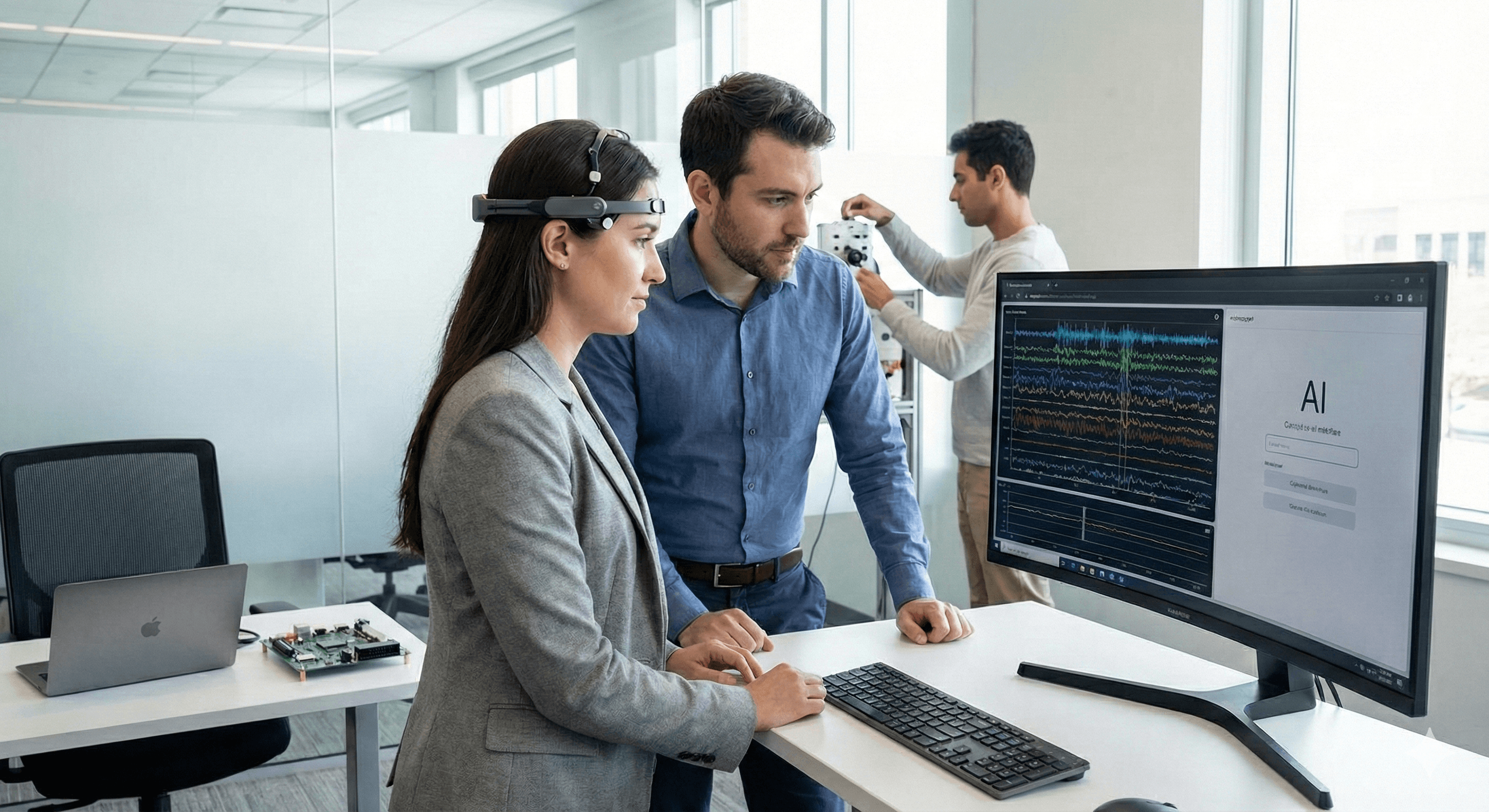
OpenAI has invested in Merge Labs, a neurotech startup developing brain–computer interfaces that bridge biological and artificial intelligence. The collaboration aims to create human-centred, non-invasive interfaces so people can interact with AI more directly—enhancing ability, agency and future applications across assistive tech and human–AI collaboration.
At a glance
What’s new: OpenAI has participated in Merge Labs’ seed round to accelerate brain–computer interface (BCI) research and development.
Who’s Merge: A neurotechnology startup aiming to bridge biological and artificial intelligence with non-invasive approaches and AI models.
Why it matters: Aims to create natural, human-centred interfaces for interacting with AI—beyond keyboards, touch and voice.
Stage: Early-stage; research-first with applications expected across assistive tech, learning/communication, and human–AI collaboration.
The story
OpenAI says progress in interfaces unlocks progress in computing—and that BCIs are the next frontier. By backing Merge Labs, OpenAI positions itself closer to hardware and biosensing breakthroughs that could enable people to express intent more directly to AI systems. Merge frames its mission as “maximising human ability” by combining biology, devices and AI in accessible form factors. While timelines are not detailed, the company emphasises non-invasive or minimally invasive modalities and expects near-term work on robust data acquisition, interpretation models and safety.
What’s new
Seed investment & collaboration: OpenAI contributes capital and AI expertise; Merge focuses on sensing and modulation of brain activity and pairing that data with foundation models tuned for neural signals.
Non-invasive focus: Early signals point to ultrasound-based or other deep-reaching, non-implant modalities rather than surgical electrodes.
Human-centred design: Target form factors people will actually wear/use; privacy, consent and safety are core design constraints.
Why this matters
Better human–AI I/O: Interfaces that read intent and provide feedback could make AI more useful, accessible and controllable.
Assistive potential: Long-term, BCIs may improve communication for people with motor or speech impairments, and aid neurorehabilitation.
Competitive landscape: Activity in neurotech is accelerating (non-invasive and implant approaches). OpenAI’s move signals intent to help shape standards and models for neural data.
Governance stakes: Data sensitivity is high; expect rigorous privacy, safety and ethics frameworks as part of productisation.
What to watch
Research milestones: papers/prototypes on signal quality, decoding accuracy, closed-loop control, and safety.
Partnerships: hospitals, universities, and device partners for trials and validation.
Policy & standards: guidance on neural data handling, consent, and medical/consumer compliance.
FAQ
What is the primary goal of the investment?
To advance non-invasive BCIs and the AI models that interpret neural signals, enabling more natural interaction with AI.
How could this benefit human experience?
By improving how we communicate intent to machines—potentially increasing ability, agency and accessibility in everyday tools and assistive technologies.
Who are the key players?
OpenAI as strategic investor/collaborator; Merge Labs as the neurotech startup focusing on the interface layer.
Is this a medical device effort?
Too early to say. Expect research and prototypes first; any clinical applications would follow appropriate regulatory pathways.
Receive weekly AI news and advice straight to your inbox
By subscribing, you agree to allow Generation Digital to store and process your information according to our privacy policy. You can review the full policy at gend.co/privacy.



Generation
Digital

Canadian Office
33 Queen St,
Toronto
M5H 2N2
Canada
Canadian Office
1 University Ave,
Toronto,
ON M5J 1T1,
Canada
NAMER Office
77 Sands St,
Brooklyn,
NY 11201,
USA
Head Office
Charlemont St, Saint Kevin's, Dublin,
D02 VN88,
Ireland
Middle East Office
6994 Alsharq 3890,
An Narjis,
Riyadh 13343,
Saudi Arabia







Business Number: 256 9431 77 | Copyright 2026 | Terms and Conditions | Privacy Policy