Pentagon Reviews Anthropic Deal: AI Safeguards Clash
Anthropic
Uncertain about how to get started with AI?Evaluate your readiness, potential risks, and key priorities in less than an hour.
➔ Download Our Free AI Preparedness Pack
Below is an SEO/GEO-optimised rewrite (British English, “Warm Intelligence” tone) based on reporting that the US Department of Defense is reviewing its relationship with Anthropic over AI usage terms, including requests for broader “all lawful purposes” use and Anthropic’s stated hard limits.
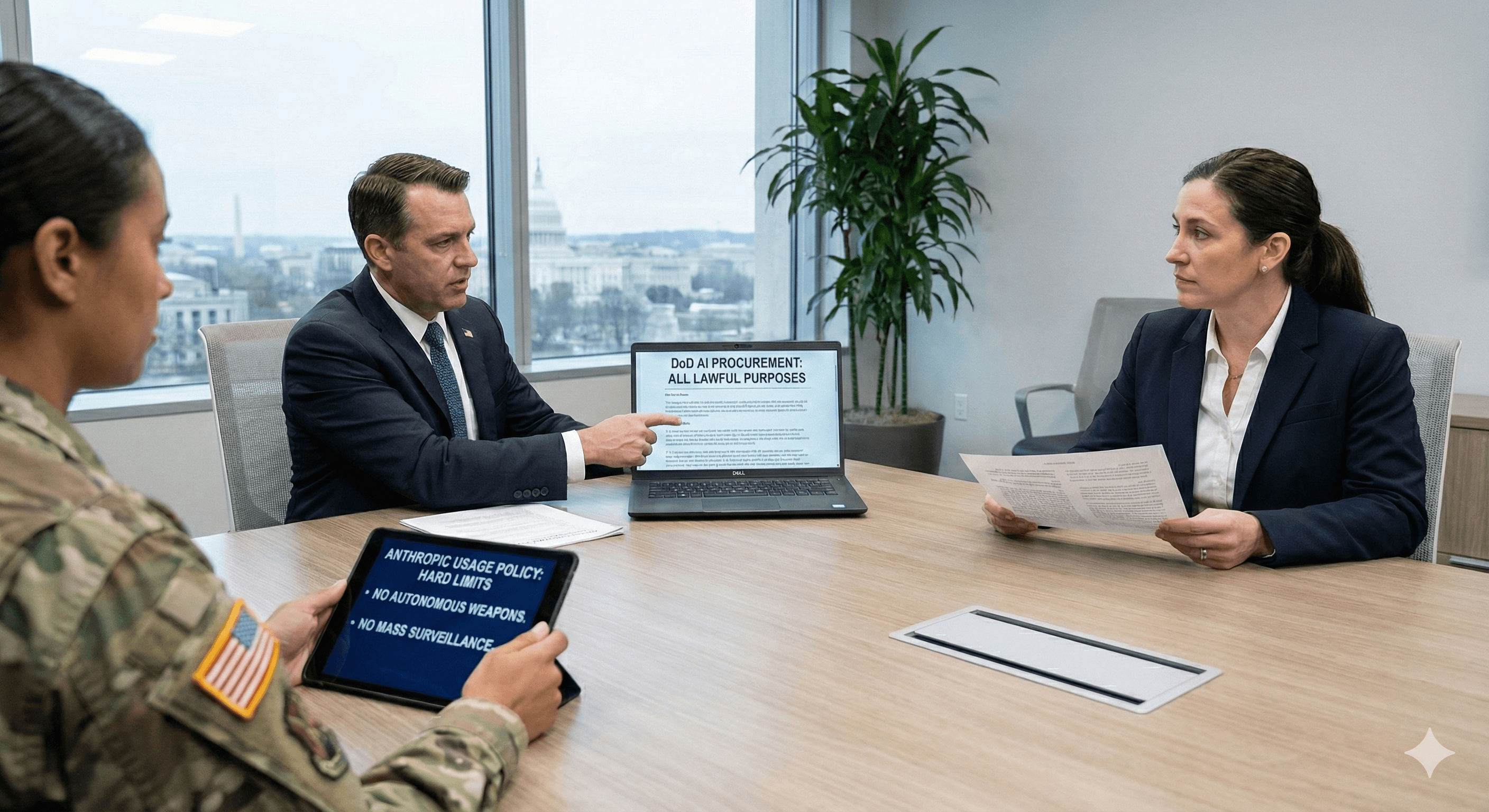
The Pentagon is reportedly reviewing its relationship with AI company Anthropic after disagreements over how Claude can be used in military contexts. Officials want broader “all lawful purposes” usage, while Anthropic has stated hard limits around fully autonomous weapons and mass domestic surveillance. The outcome could shape how AI safeguards are treated in government procurement.
A reported dispute between the US Department of Defense and Anthropic is becoming a test case for a question many organisations now face: who controls how a powerful AI system may be used once it’s embedded in critical workflows?
Multiple outlets report that the Pentagon is reviewing its relationship with Anthropic, the maker of Claude, following tensions over usage terms and safeguards. The Pentagon is said to be pushing AI providers to allow use of their models for “all lawful purposes”, while Anthropic has been described as resisting that approach and maintaining hard limits, including around fully autonomous weapons and mass domestic surveillance.
What’s happening
According to reporting based on Axios, the Pentagon has been in negotiations with Anthropic over how Claude can be used within defence environments. The sticking point is the scope of permitted use: the Pentagon wants broad latitude, while Anthropic’s policies emphasise restrictions and safeguards for high‑risk applications.
Some reports say the Pentagon has threatened to end a contract worth around $200 million if the dispute can’t be resolved.
Why this matters beyond defence
Even if you don’t work anywhere near government, this story matters because it’s a live example of a wider shift:
Procurement is becoming governance. Contracts increasingly include usage clauses, safety obligations, and audit expectations.
Policy meets product reality. AI providers may have safety policies that don’t neatly align with every customer’s operational demands.
Regulated sectors are watching. Healthcare, finance, education and critical infrastructure buyers often need the same clarity: “What’s allowed, what’s prohibited, and who is accountable?”
The core tension: “all lawful purposes” vs hard limits
In TechCrunch’s summary of the Axios reporting, the Pentagon is pushing AI companies to allow use of their technology for “all lawful purposes”, while Anthropic is pushing back. Anthropic’s position (as reported) focuses on a specific set of usage policy questions, including hard limits around fully autonomous weapons and mass domestic surveillance.
From a governance perspective, this is the main takeaway: lawfulness is not the same as safety. Many organisations now want terms that define not just legality, but acceptable risk.
What could happen next
Reporting suggests several potential outcomes:
A negotiated compromise that clarifies permitted use, adds oversight, or introduces carve‑outs for certain high‑risk applications.
A commercial separation, where the Pentagon reduces or ends its use of Anthropic tools.
A precedent for the industry, signalling to other AI vendors what government buyers may require—and what vendors may refuse.
Some coverage also references the possibility of the Pentagon labelling Anthropic a “supply chain risk”, which—if pursued—could have wider knock‑on effects for contractors and partners. (Because this is typically a severe designation, it’s best treated as a “watch item” until confirmed in official documentation.)
What organisations can learn from this
If you’re adopting AI in high‑stakes environments, three practical steps help reduce surprises:
Translate usage policy into operational rules
Don’t assume “we bought the tool” equals “we can use it any way we like”. Map vendor terms to real workflows.Create a high‑risk use register
Define which use cases require extra approvals (e.g., surveillance, profiling, autonomous decisioning, weapons-adjacent work).Build governance into procurement
Add contract language for auditability, incident response, model updates, and policy changes—so compliance doesn’t depend on memory or goodwill.
Summary
The reported Pentagon review of its relationship with Anthropic is less about one vendor and one contract, and more about how AI will be governed once it sits inside sensitive systems. Whether the dispute ends in compromise or separation, it’s a signal that usage terms and safety constraints are now central to enterprise—and government—AI adoption.
Next steps (Generation Digital): If your team needs help turning AI policies into practical guardrails (and procurement language) that still allow innovation, we can help design a governance framework that fits real workflows.
FAQs
Q1: Why is the Pentagon reviewing its relationship with Anthropic?
Reporting indicates disagreements over how Anthropic’s Claude model may be used in defence contexts, including the scope of permitted usage and safeguards.
Q2: What is the key issue in the reported dispute?
Coverage describes tension between broader “all lawful purposes” usage requested by the Pentagon and Anthropic’s stated hard limits around fully autonomous weapons and mass domestic surveillance.
Q3: What does “supply chain risk” mean in this context?
In general terms, it refers to a designation that could restrict how contractors and partners work with a supplier. (Treat specific outcomes as unconfirmed unless officially published.)
Q4: What should organisations take from this story?
It highlights that AI adoption increasingly depends on clear usage terms, governance, and accountability—not just model performance.
Receive weekly AI news and advice straight to your inbox
By subscribing, you agree to allow Generation Digital to store and process your information according to our privacy policy. You can review the full policy at gend.co/privacy.



Generation
Digital

Canadian Office
33 Queen St,
Toronto
M5H 2N2
Canada
Canadian Office
1 University Ave,
Toronto,
ON M5J 1T1,
Canada
NAMER Office
77 Sands St,
Brooklyn,
NY 11201,
USA
Head Office
Charlemont St, Saint Kevin's, Dublin,
D02 VN88,
Ireland
Middle East Office
6994 Alsharq 3890,
An Narjis,
Riyadh 13343,
Saudi Arabia







Business Number: 256 9431 77 | Copyright 2026 | Terms and Conditions | Privacy Policy