Perplexity Computer for Enterprise: 20‑Model AI Orchestration

Perplexity Computer for Enterprise: 20‑Model AI Orchestration

Confusion

Mar 12, 2026

A professional office setting with two people collaborating on a large computer monitor displaying various AI orchestration models, surrounded by laptops, notebooks, and coffee cups, illustrating the concept of enterprise technology integration.

Uncertain about how to get started with AI?Evaluate your readiness, potential risks, and key priorities in less than an hour.

Uncertain about how to get started with AI?Evaluate your readiness, potential risks, and key priorities in less than an hour.

➔ Download Our Free AI Preparedness Pack

Perplexity Computer for Enterprise is an enterprise-grade AI agent system that runs multi-step workflows by routing tasks across roughly 20 advanced models and connecting to hundreds of business apps. It’s designed to help teams research, analyse, create, code and ship work faster—while keeping governance, access control, and auditability in place.

Enterprise Computer: Orchestrate Projects with 20 Models

Most AI tools stop at answers. Enterprises need systems that can complete work across multiple steps—without turning governance into an afterthought.

Perplexity Computer for Enterprise is built for that reality. It’s a multi-model, multi-tool agent that can take a goal, break it down into tasks, and route each task to the best model or sub-agent—then push results into the applications your teams already use.

What is Perplexity Computer for Enterprise?

Computer for Enterprise is an agentic workflow system built on Perplexity’s enterprise platform. The headline capability is orchestration:

  • It routes tasks across ~20 specialised models (rather than relying on a single model for everything).

  • It can run multi-step projects across research, analysis, creation, design, coding, and delivery.

  • It connects into your work ecosystem through hundreds of application connectors and collaboration surfaces (including Slack).

The practical outcome is a single system that can move from “find the facts” to “produce the artefact” to “ship it to the right place”—with enterprise controls layered on top.

Why multi-model orchestration matters

One model can be excellent at reasoning, another at fast summarisation, another at code quality, and another at creative assets. Orchestration turns that diversity into a reliable workflow.

Instead of asking teams to choose the “perfect” model up front, Computer can:

  • match subtasks to strengths (research vs coding vs design)

  • keep work flowing across steps

  • reduce tool-switching and copy/paste operations

For enterprise leaders, this is an important shift: you’re buying a workflow layer, not just a chatbot.

How it works?
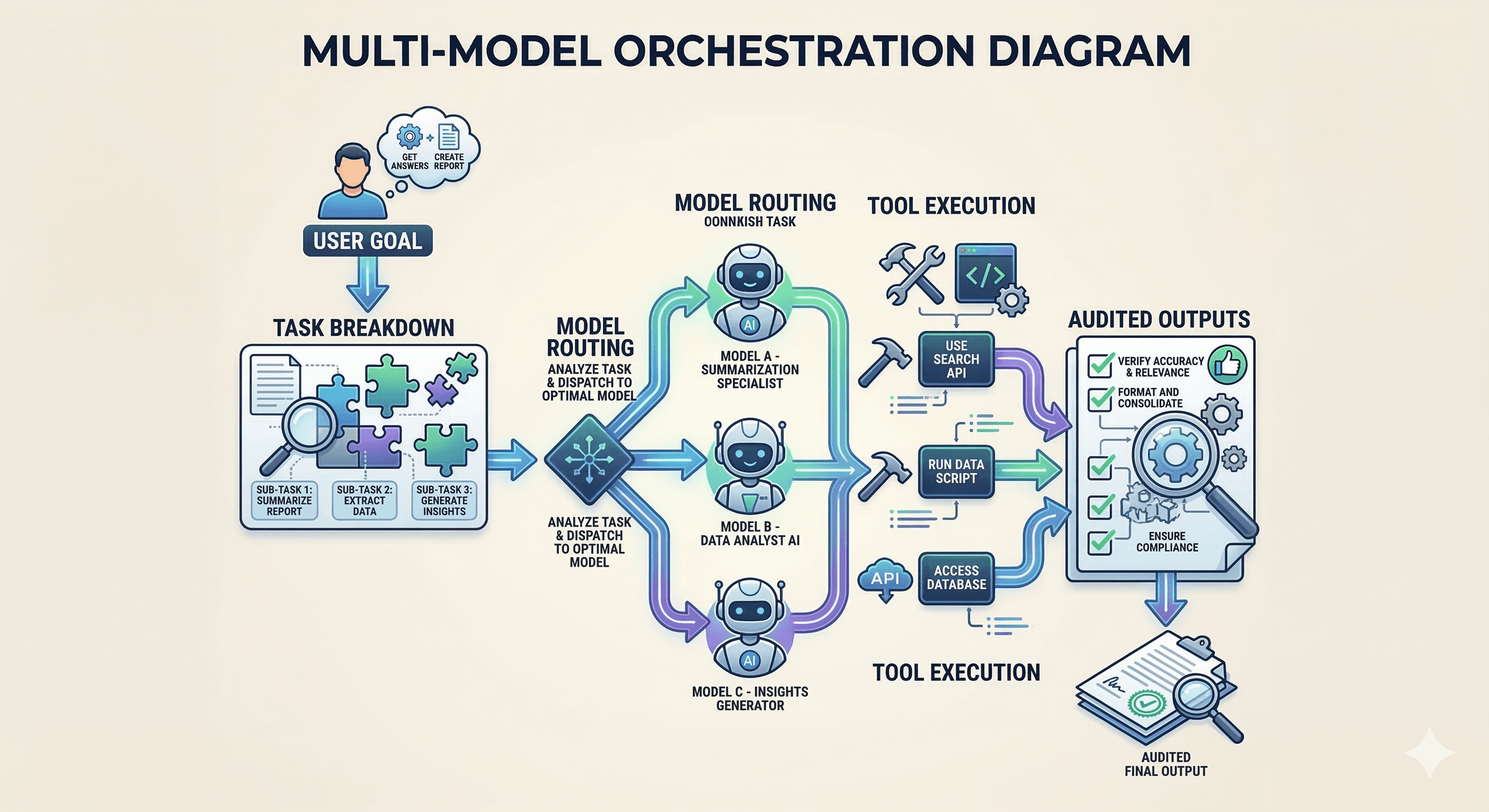
Computer is easiest to understand as a pipeline:

  1. You give it a goal (e.g., “Prepare a board-ready competitive briefing and create a launch plan”).

  2. It breaks the goal into tasks (research, analysis, drafting, visuals, review notes, output packaging).

  3. It routes each task to the most appropriate model/sub-agent.

  4. It uses connectors to pull inputs (documents, tickets, data) and push outputs (docs, slides, tickets, messages).

  5. It supports controls: governance, access boundaries, and supervision so actions happen safely.

Where Computer fits in a business stack

Computer is most valuable when it sits alongside systems you already run:

  • Knowledge & content: Notion, Confluence, Google Drive, SharePoint

  • Work management: Asana, Jira, ServiceNow

  • Collaboration: Slack, Microsoft Teams

  • Data: BI tools, internal dashboards, structured exports

The differentiator is that it doesn’t just read these sources—it can help you do the next step: create, update, escalate, and deliver.

Practical examples: multi-step projects it can run

Below are realistic “thin-slice” workflows that show what orchestration looks like.

1) Competitive briefing → exec pack

  • Pull latest competitor moves and citations

  • Compare positioning and pricing

  • Draft an exec summary + risk/opportunity list

  • Generate a slide-ready structure and key visuals

  • Deliver to a shared workspace and notify stakeholders

2) Product launch coordination

  • Create a launch plan (milestones, dependencies)

  • Produce first-draft assets (FAQs, release notes, enablement)

  • Create tasks in Asana/Jira with owners and dates

  • Track progress and generate weekly updates

3) Security and IT operations support

  • Summarise incidents from tickets + timelines

  • Identify missing evidence and suggested next checks

  • Draft comms and post-incident actions

  • Log work back into your ITSM tool

Enterprise governance: what to check before deployment

Agents become risky when they can act broadly. For enterprise use, focus on five control areas.

1) Identity and access control

  • SSO + MFA

  • role-based access to tools and connectors

  • separation of duties for sensitive operations

2) Data boundaries

  • least-privilege connector scopes

  • clearly defined “allowed” repositories and folders

  • policy on regulated data (PII, health, finance)

3) Human-in-the-loop checkpoints

Use approvals for:

  • sending external comms

  • making changes in production systems

  • publishing or filing official documents

4) Auditability and monitoring

You need:

  • logs you can search

  • alerting for unusual behaviour

  • revocation and “kill switch” processes

5) Cost controls

Multi-model orchestration can add spend if unmanaged. Look for:

  • spending caps

  • usage reporting by team/workflow

  • controls for premium model selection

A rollout plan that avoids “pilot purgatory”

Step 1: Pick one workflow with measurable outcomes

Examples: weekly exec briefings, launch packs, ticket summarisation, proposal drafting.

Step 2: Define success metrics

Time saved, reduced rework, fewer handoffs, faster cycle time, lower cost per deliverable.

Step 3: Lock down connectors and permissions

Start with minimal scopes. Expand only after review.

Step 4: Instrument and review

  • access reviews

  • quality checks

  • security review of tool permissions

Step 5: Scale to adjacent workflows

Once one workflow is stable, expand across teams.

Summary

Perplexity Computer for Enterprise is best understood as a governed workflow engine: it routes work across ~20 models and connects into your app ecosystem to run multi-step projects end-to-end.

For enterprise teams, the opportunity is clear: fewer handoffs, less tool-switching, and faster delivery—provided you implement strong identity, connector scopes, approvals, and auditability.

Next steps (with Generation Digital)

If you’re evaluating Computer for Enterprise, Generation Digital can help you:

  • identify the highest-ROI workflows to automate first

  • design connector scopes and governance (least privilege + approvals)

  • build evaluation harnesses to measure quality and ROI

  • run a secure pilot and scale into production adoption

FAQs

Q1: How does Computer for Enterprise enhance productivity?

It automates multi-step work by breaking projects into tasks and routing those tasks across specialised models and tools, reducing manual handoffs and rework.

Q2: What types of projects benefit most?

Projects with repeatable steps and many handoffs—research-to-deck briefs, launch planning, operational reporting, IT ticket workflows, and knowledge synthesis.

Q3: Is it easy to integrate with existing infrastructure?

It’s designed to connect to common enterprise applications via connectors and collaboration surfaces. The real work is governance: scoping access and approvals correctly.

Q4: Can it be customised for specific business needs?

Yes. The most effective customisation is workflow design: defining which tasks the agent runs, what tools it can use, and where human approvals are required.

Q5: What support is available for implementation?

Most enterprise deployments pair platform configuration with enablement: workflow design, governance setup, training, and measurement of business outcomes.

Perplexity Computer for Enterprise is an enterprise-grade AI agent system that runs multi-step workflows by routing tasks across roughly 20 advanced models and connecting to hundreds of business apps. It’s designed to help teams research, analyse, create, code and ship work faster—while keeping governance, access control, and auditability in place.

Enterprise Computer: Orchestrate Projects with 20 Models

Most AI tools stop at answers. Enterprises need systems that can complete work across multiple steps—without turning governance into an afterthought.

Perplexity Computer for Enterprise is built for that reality. It’s a multi-model, multi-tool agent that can take a goal, break it down into tasks, and route each task to the best model or sub-agent—then push results into the applications your teams already use.

What is Perplexity Computer for Enterprise?

Computer for Enterprise is an agentic workflow system built on Perplexity’s enterprise platform. The headline capability is orchestration:

  • It routes tasks across ~20 specialised models (rather than relying on a single model for everything).

  • It can run multi-step projects across research, analysis, creation, design, coding, and delivery.

  • It connects into your work ecosystem through hundreds of application connectors and collaboration surfaces (including Slack).

The practical outcome is a single system that can move from “find the facts” to “produce the artefact” to “ship it to the right place”—with enterprise controls layered on top.

Why multi-model orchestration matters

One model can be excellent at reasoning, another at fast summarisation, another at code quality, and another at creative assets. Orchestration turns that diversity into a reliable workflow.

Instead of asking teams to choose the “perfect” model up front, Computer can:

  • match subtasks to strengths (research vs coding vs design)

  • keep work flowing across steps

  • reduce tool-switching and copy/paste operations

For enterprise leaders, this is an important shift: you’re buying a workflow layer, not just a chatbot.

How it works?

Computer is easiest to understand as a pipeline:

  1. You give it a goal (e.g., “Prepare a board-ready competitive briefing and create a launch plan”).

  2. It breaks the goal into tasks (research, analysis, drafting, visuals, review notes, output packaging).

  3. It routes each task to the most appropriate model/sub-agent.

  4. It uses connectors to pull inputs (documents, tickets, data) and push outputs (docs, slides, tickets, messages).

  5. It supports controls: governance, access boundaries, and supervision so actions happen safely.

Where Computer fits in a business stack

Computer is most valuable when it sits alongside systems you already run:

  • Knowledge & content: Notion, Confluence, Google Drive, SharePoint

  • Work management: Asana, Jira, ServiceNow

  • Collaboration: Slack, Microsoft Teams

  • Data: BI tools, internal dashboards, structured exports

The differentiator is that it doesn’t just read these sources—it can help you do the next step: create, update, escalate, and deliver.

Practical examples: multi-step projects it can run

Below are realistic “thin-slice” workflows that show what orchestration looks like.

1) Competitive briefing → exec pack

  • Pull latest competitor moves and citations

  • Compare positioning and pricing

  • Draft an exec summary + risk/opportunity list

  • Generate a slide-ready structure and key visuals

  • Deliver to a shared workspace and notify stakeholders

2) Product launch coordination

  • Create a launch plan (milestones, dependencies)

  • Produce first-draft assets (FAQs, release notes, enablement)

  • Create tasks in Asana/Jira with owners and dates

  • Track progress and generate weekly updates

3) Security and IT operations support

  • Summarise incidents from tickets + timelines

  • Identify missing evidence and suggested next checks

  • Draft comms and post-incident actions

  • Log work back into your ITSM tool

Enterprise governance: what to check before deployment

Agents become risky when they can act broadly. For enterprise use, focus on five control areas.

1) Identity and access control

  • SSO + MFA

  • role-based access to tools and connectors

  • separation of duties for sensitive operations

2) Data boundaries

  • least-privilege connector scopes

  • clearly defined “allowed” repositories and folders

  • policy on regulated data (PII, health, finance)

3) Human-in-the-loop checkpoints

Use approvals for:

  • sending external comms

  • making changes in production systems

  • publishing or filing official documents

4) Auditability and monitoring

You need:

  • logs you can search

  • alerting for unusual behaviour

  • revocation and “kill switch” processes

5) Cost controls

Multi-model orchestration can add spend if unmanaged. Look for:

  • spending caps

  • usage reporting by team/workflow

  • controls for premium model selection

A rollout plan that avoids “pilot purgatory”

Step 1: Pick one workflow with measurable outcomes

Examples: weekly exec briefings, launch packs, ticket summarisation, proposal drafting.

Step 2: Define success metrics

Time saved, reduced rework, fewer handoffs, faster cycle time, lower cost per deliverable.

Step 3: Lock down connectors and permissions

Start with minimal scopes. Expand only after review.

Step 4: Instrument and review

  • access reviews

  • quality checks

  • security review of tool permissions

Step 5: Scale to adjacent workflows

Once one workflow is stable, expand across teams.

Summary

Perplexity Computer for Enterprise is best understood as a governed workflow engine: it routes work across ~20 models and connects into your app ecosystem to run multi-step projects end-to-end.

For enterprise teams, the opportunity is clear: fewer handoffs, less tool-switching, and faster delivery—provided you implement strong identity, connector scopes, approvals, and auditability.

Next steps (with Generation Digital)

If you’re evaluating Computer for Enterprise, Generation Digital can help you:

  • identify the highest-ROI workflows to automate first

  • design connector scopes and governance (least privilege + approvals)

  • build evaluation harnesses to measure quality and ROI

  • run a secure pilot and scale into production adoption

FAQs

Q1: How does Computer for Enterprise enhance productivity?

It automates multi-step work by breaking projects into tasks and routing those tasks across specialised models and tools, reducing manual handoffs and rework.

Q2: What types of projects benefit most?

Projects with repeatable steps and many handoffs—research-to-deck briefs, launch planning, operational reporting, IT ticket workflows, and knowledge synthesis.

Q3: Is it easy to integrate with existing infrastructure?

It’s designed to connect to common enterprise applications via connectors and collaboration surfaces. The real work is governance: scoping access and approvals correctly.

Q4: Can it be customised for specific business needs?

Yes. The most effective customisation is workflow design: defining which tasks the agent runs, what tools it can use, and where human approvals are required.

Q5: What support is available for implementation?

Most enterprise deployments pair platform configuration with enablement: workflow design, governance setup, training, and measurement of business outcomes.

Receive weekly AI news and advice straight to your inbox

By subscribing, you agree to allow Generation Digital to store and process your information according to our privacy policy. You can review the full policy at gend.co/privacy.


Generation
Digital

Canadian Office
33 Queen St,
Toronto
M5H 2N2
Canada

Canadian Office
1 University Ave,
Toronto,
ON M5J 1T1,
Canada

NAMER Office
77 Sands St,
Brooklyn,
NY 11201,
USA

Head Office
Charlemont St, Saint Kevin's, Dublin,
D02 VN88,
Ireland

Middle East Office
6994 Alsharq 3890,
An Narjis,
Riyadh 13343,
Saudi Arabia

UK Fast Growth Index UBS Logo
Financial Times FT 1000 Logo
Febe Growth 100 Logo (Background Removed)

Business Number: 256 9431 77 | Copyright 2026 | Terms and Conditions | Privacy Policy

Generation
Digital

Canadian Office
33 Queen St,
Toronto
M5H 2N2
Canada

Canadian Office
1 University Ave,
Toronto,
ON M5J 1T1,
Canada

NAMER Office
77 Sands St,
Brooklyn,
NY 11201,
USA

Head Office
Charlemont St, Saint Kevin's, Dublin,
D02 VN88,
Ireland

Middle East Office
6994 Alsharq 3890,
An Narjis,
Riyadh 13343,
Saudi Arabia

UK Fast Growth Index UBS Logo
Financial Times FT 1000 Logo
Febe Growth 100 Logo (Background Removed)


Business No: 256 9431 77
Terms and Conditions
Privacy Policy
© 2026




