GPT-5 for Work: Benchmarks, Use Cases and Evaluation (2026)

GPT-5 for Work: Benchmarks, Use Cases and Evaluation (2026)

ChatGPT

OpenAI

24 févr. 2026

A diverse group of professionals engage in a collaborative meeting at a modern office, with laptops displaying data and graphs related to GPT-5 benchmarks and evaluations, highlighting its use cases in business contexts.

Pas sûr de quoi faire ensuite avec l'IA?
Évaluez la préparation, les risques et les priorités en moins d'une heure.

Pas sûr de quoi faire ensuite avec l'IA?
Évaluez la préparation, les risques et les priorités en moins d'une heure.

➔ Téléchargez notre kit de préparation à l'IA gratuit

GPT-5 for work is a single flagship model designed to balance reasoning and responsiveness across everyday business tasks. OpenAI positions it as smarter across maths, real-world coding, and multimodal understanding, with fewer factual errors and more efficient outputs. For teams, the practical value shows up in faster planning, analysis, research, and multi-step workflows.

AI isn’t useful because it can write a paragraph. It becomes useful when teams can trust it with the kind of work that normally takes hours: planning, analysis, research, troubleshooting, and turning messy inputs into a decision.

OpenAI’s “Inside GPT-5 for Work” summary makes a clear claim: GPT-5 is a step change for enterprise use—designed to feel like “one powerful model for every task”, with fewer hallucinations and better results when grounded in your company context.

This post translates the PDF into a practical guide for business teams.

What’s new in GPT-5

OpenAI highlights six changes that matter for work:

  1. One powerful model for every task (no model selection or setup)

  2. Smarter performance across the board in maths, coding, and multimodal tasks

  3. Significantly fewer hallucinations (fewer factual errors)

  4. Faster, more efficient answers (fewer output tokens)

  5. Higher-quality responses using your company knowledge and apps

  6. A more natural, helpful tone that feels like working with a colleague

The most important shift isn’t the benchmark scores—it’s the combination of reliability + speed + grounding. That’s what lets teams move beyond “draft this email” into “help me make a decision”.

The benchmark headlines (and what they actually mean)

OpenAI includes headline performance figures to illustrate breadth:

  • AIME 2025 (with tools): 99.6% (math)

  • SWE-Bench: 74.9% (real-world coding)

  • MMMU: 84.2% (multimodal understanding)

It also claims GPT-5 is ~45% less likely to contain a factual error than GPT-4o, and produces 50–80% fewer output tokens compared to o3 across capabilities.

If you’re buying for business outcomes, treat these as signals—not guarantees. The real test is how well GPT-5 performs on your workflows, your documents, your terminology, and your risk profile.
Impact: where teams see value first

The PDF groups value into three outcomes:

1) Save time

Offload tasks that take up hours so teams can focus on higher-impact work.

2) Move faster

Go from idea to execution in minutes, unblocking teams across functions.

3) Grow smarter

Support launches, client work and analysis without sacrificing quality.

It also includes example quotes from leaders in retail, finance, and consulting that emphasise speed, context-aware answers, and the feeling of working with a capable assistant.

What GPT-5 looks like in practice (by team)

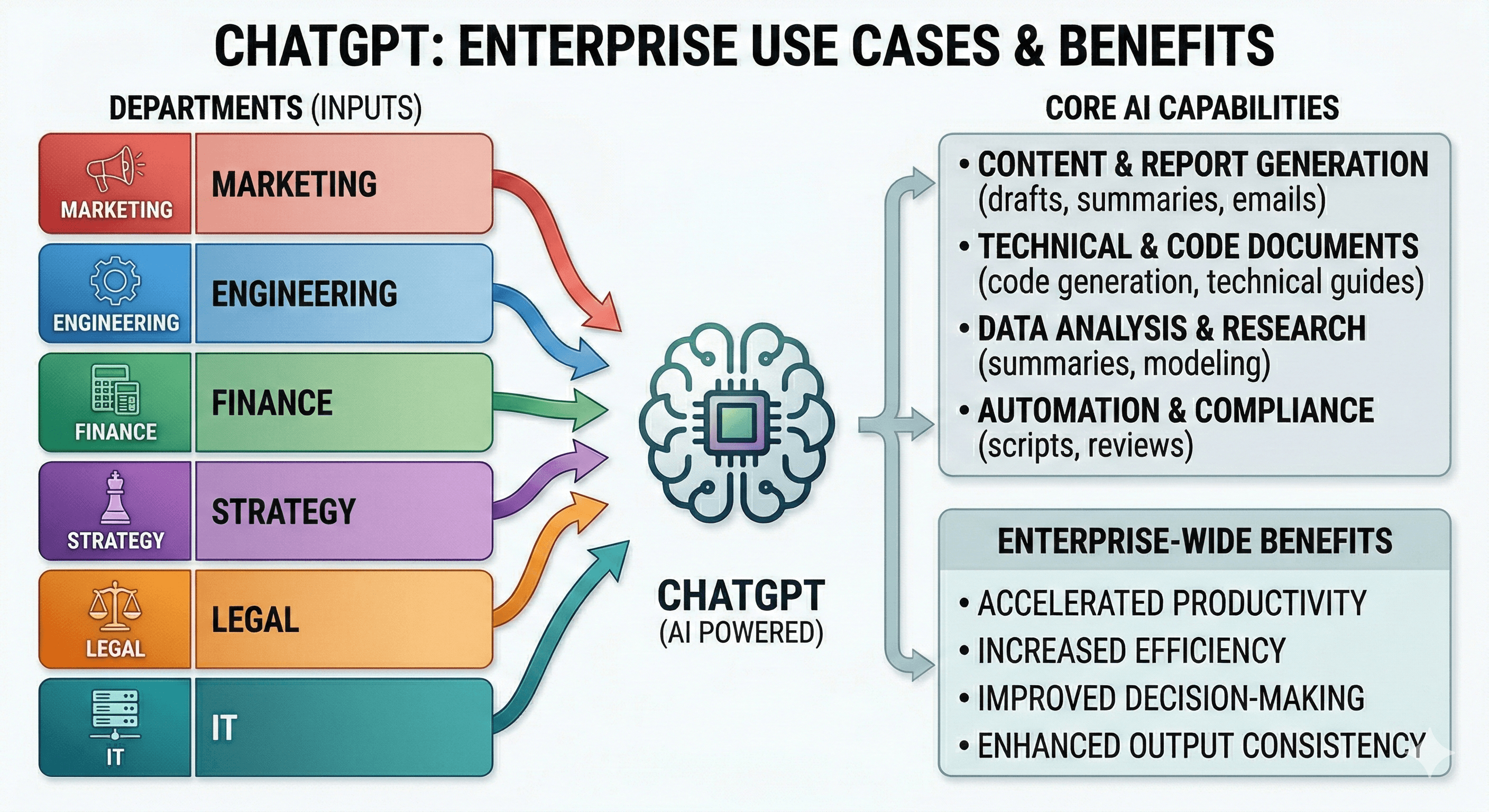
The most helpful part of the PDF is a simple table that maps teams to problems and outputs. Here’s the distilled version:

Team

Common problem

What GPT-5 helps do

Typical output

Marketing

Board-ready launch plan

Analyse market + draft plan, messaging, sales content

GTM brief + talking points

Engineering

Live incident dashboard

Build dashboard from plain-English prompt

Live app with real-time data

Finance

Model impact of rate change

Run simulations + recommend levers

1-slide summary + model

Strategy

Respond to new entrant

Research, benchmark, draft response

Leadership deck + sales assets

Legal

Policy updates from regulation

Review and compare laws to spot commonalities

Updates to compliance controls

IT

Faster issue resolution

Diagnose logs + suggest fixes

Troubleshooting plan

This is the pattern to follow: start with work that is frequent, document-heavy, and bottlenecked by specialist time.

Enterprise-ready from day one (what IT and security will ask)

OpenAI positions GPT-5 in ChatGPT for business as enterprise-ready with:

  • Security & privacy by design: “your data stays yours”, and business data is not used for training by default

  • Encryption: AES-256 at rest and TLS 1.2+ in transit

  • Governance: SAML SSO, SCIM provisioning, role-based access, and real-time usage analytics

  • Compliance: references include GDPR, CCPA, CSA STAR, SOC 2 Type 2, plus data residency in seven global regions

For buyers, this matters because it’s the foundation for scaling AI beyond individual experimentation.

How to evaluate GPT-5 for your business (a simple checklist)

The PDF suggests four evaluation lenses. They’re a solid way to structure a pilot.

1) Subject-matter expertise

Test GPT-5 across functions: draft legal text, produce market analysis, debug code—then compare quality, completeness, and time saved against human benchmarks.

2) Reliable and fast responses

Give fact-based and multi-step tasks. Check accuracy, citation quality, and how it handles clarifications. Measure response time across low/medium/high complexity prompts.

3) Advanced reasoning built in

Give a complex, ambiguous problem that requires multi-step reasoning with minimal guidance. Assess solution quality and whether follow-up questions are genuinely useful.

4) Understands your company context

Upload internal files or connect company apps (e.g., Drive, SharePoint, GitHub). Evaluate whether answers reflect the latest content and internal terminology.

A practical rollout plan (so adoption sticks)

If you want GPT-5 benefits without chaos:

  1. Choose 3 workflows with obvious ROI (incident response, weekly reporting, launch plans, policy updates).

  2. Define guardrails: what can be uploaded, what outputs need review, how to handle sensitive data.

  3. Create prompt templates for each workflow, including required outputs (summary, risks, next actions).

  4. Pilot with measurement: time saved, quality improvements, fewer errors, fewer meetings.

  5. Scale via champions: publish examples, share prompts, and build a “what good looks like” library.

Next steps

GPT-5 is most valuable when you treat it like a capability—not a novelty.

Start with one team, one workflow, and one measurable outcome. Once you’ve proven value and set guardrails, you can expand into multi-step workflows and agentic automation.

FAQs

Is GPT-5 “one model for everything”?
OpenAI positions GPT-5 as a single flagship model that can cover many tasks without needing users to choose models or set up specialised configurations.

Does GPT-5 reduce hallucinations?
The PDF claims GPT-5 is approximately 45% less likely to contain a factual error than GPT-4o.

What does “uses your company context” mean?
It means GPT-5 can use information from your internal files or connected apps to produce more relevant answers and follow your organisation’s terminology and guidelines.

What’s the best first use case?
Start with frequent, document-heavy workflows where humans spend hours doing repeatable work: launch planning, incident response, weekly reporting, policy reviews, and internal Q&A.

How do we evaluate it safely?
Run a pilot with a small set of workflows, require human review for high-risk outputs, and track accuracy, speed, and quality against a baseline.


Image/diagram prompts

  1. “GPT-5 for work: what’s new” as a six-point infographic.

  2. “Department use case map”: marketing/engineering/finance/strategy/legal/IT → outputs.

  3. “GPT-5 evaluation checklist”: expertise, reliability, reasoning, company context.

GPT-5 for work is a single flagship model designed to balance reasoning and responsiveness across everyday business tasks. OpenAI positions it as smarter across maths, real-world coding, and multimodal understanding, with fewer factual errors and more efficient outputs. For teams, the practical value shows up in faster planning, analysis, research, and multi-step workflows.

AI isn’t useful because it can write a paragraph. It becomes useful when teams can trust it with the kind of work that normally takes hours: planning, analysis, research, troubleshooting, and turning messy inputs into a decision.

OpenAI’s “Inside GPT-5 for Work” summary makes a clear claim: GPT-5 is a step change for enterprise use—designed to feel like “one powerful model for every task”, with fewer hallucinations and better results when grounded in your company context.

This post translates the PDF into a practical guide for business teams.

What’s new in GPT-5

OpenAI highlights six changes that matter for work:

  1. One powerful model for every task (no model selection or setup)

  2. Smarter performance across the board in maths, coding, and multimodal tasks

  3. Significantly fewer hallucinations (fewer factual errors)

  4. Faster, more efficient answers (fewer output tokens)

  5. Higher-quality responses using your company knowledge and apps

  6. A more natural, helpful tone that feels like working with a colleague

The most important shift isn’t the benchmark scores—it’s the combination of reliability + speed + grounding. That’s what lets teams move beyond “draft this email” into “help me make a decision”.

The benchmark headlines (and what they actually mean)

OpenAI includes headline performance figures to illustrate breadth:

  • AIME 2025 (with tools): 99.6% (math)

  • SWE-Bench: 74.9% (real-world coding)

  • MMMU: 84.2% (multimodal understanding)

It also claims GPT-5 is ~45% less likely to contain a factual error than GPT-4o, and produces 50–80% fewer output tokens compared to o3 across capabilities.

If you’re buying for business outcomes, treat these as signals—not guarantees. The real test is how well GPT-5 performs on your workflows, your documents, your terminology, and your risk profile.

Impact: where teams see value first

The PDF groups value into three outcomes:

1) Save time

Offload tasks that take up hours so teams can focus on higher-impact work.

2) Move faster

Go from idea to execution in minutes, unblocking teams across functions.

3) Grow smarter

Support launches, client work and analysis without sacrificing quality.

It also includes example quotes from leaders in retail, finance, and consulting that emphasise speed, context-aware answers, and the feeling of working with a capable assistant.

What GPT-5 looks like in practice (by team)

The most helpful part of the PDF is a simple table that maps teams to problems and outputs. Here’s the distilled version:

Team

Common problem

What GPT-5 helps do

Typical output

Marketing

Board-ready launch plan

Analyse market + draft plan, messaging, sales content

GTM brief + talking points

Engineering

Live incident dashboard

Build dashboard from plain-English prompt

Live app with real-time data

Finance

Model impact of rate change

Run simulations + recommend levers

1-slide summary + model

Strategy

Respond to new entrant

Research, benchmark, draft response

Leadership deck + sales assets

Legal

Policy updates from regulation

Review and compare laws to spot commonalities

Updates to compliance controls

IT

Faster issue resolution

Diagnose logs + suggest fixes

Troubleshooting plan

This is the pattern to follow: start with work that is frequent, document-heavy, and bottlenecked by specialist time.

Enterprise-ready from day one (what IT and security will ask)

OpenAI positions GPT-5 in ChatGPT for business as enterprise-ready with:

  • Security & privacy by design: “your data stays yours”, and business data is not used for training by default

  • Encryption: AES-256 at rest and TLS 1.2+ in transit

  • Governance: SAML SSO, SCIM provisioning, role-based access, and real-time usage analytics

  • Compliance: references include GDPR, CCPA, CSA STAR, SOC 2 Type 2, plus data residency in seven global regions

For buyers, this matters because it’s the foundation for scaling AI beyond individual experimentation.

How to evaluate GPT-5 for your business (a simple checklist)

The PDF suggests four evaluation lenses. They’re a solid way to structure a pilot.

1) Subject-matter expertise

Test GPT-5 across functions: draft legal text, produce market analysis, debug code—then compare quality, completeness, and time saved against human benchmarks.

2) Reliable and fast responses

Give fact-based and multi-step tasks. Check accuracy, citation quality, and how it handles clarifications. Measure response time across low/medium/high complexity prompts.

3) Advanced reasoning built in

Give a complex, ambiguous problem that requires multi-step reasoning with minimal guidance. Assess solution quality and whether follow-up questions are genuinely useful.

4) Understands your company context

Upload internal files or connect company apps (e.g., Drive, SharePoint, GitHub). Evaluate whether answers reflect the latest content and internal terminology.

A practical rollout plan (so adoption sticks)

If you want GPT-5 benefits without chaos:

  1. Choose 3 workflows with obvious ROI (incident response, weekly reporting, launch plans, policy updates).

  2. Define guardrails: what can be uploaded, what outputs need review, how to handle sensitive data.

  3. Create prompt templates for each workflow, including required outputs (summary, risks, next actions).

  4. Pilot with measurement: time saved, quality improvements, fewer errors, fewer meetings.

  5. Scale via champions: publish examples, share prompts, and build a “what good looks like” library.

Next steps

GPT-5 is most valuable when you treat it like a capability—not a novelty.

Start with one team, one workflow, and one measurable outcome. Once you’ve proven value and set guardrails, you can expand into multi-step workflows and agentic automation.

FAQs

Is GPT-5 “one model for everything”?
OpenAI positions GPT-5 as a single flagship model that can cover many tasks without needing users to choose models or set up specialised configurations.

Does GPT-5 reduce hallucinations?
The PDF claims GPT-5 is approximately 45% less likely to contain a factual error than GPT-4o.

What does “uses your company context” mean?
It means GPT-5 can use information from your internal files or connected apps to produce more relevant answers and follow your organisation’s terminology and guidelines.

What’s the best first use case?
Start with frequent, document-heavy workflows where humans spend hours doing repeatable work: launch planning, incident response, weekly reporting, policy reviews, and internal Q&A.

How do we evaluate it safely?
Run a pilot with a small set of workflows, require human review for high-risk outputs, and track accuracy, speed, and quality against a baseline.


Image/diagram prompts

  1. “GPT-5 for work: what’s new” as a six-point infographic.

  2. “Department use case map”: marketing/engineering/finance/strategy/legal/IT → outputs.

  3. “GPT-5 evaluation checklist”: expertise, reliability, reasoning, company context.

Recevez chaque semaine des nouvelles et des conseils sur l'IA directement dans votre boîte de réception

En vous abonnant, vous consentez à ce que Génération Numérique stocke et traite vos informations conformément à notre politique de confidentialité. Vous pouvez lire la politique complète sur gend.co/privacy.


Ateliers et webinaires à venir

A diverse group of professionals collaborating around a table in a bright, modern office setting.

Clarté opérationnelle à grande échelle - Asana

Webinaire Virtuel
Mercredi 25 février 2026
En ligne

A diverse group of professionals collaborating around a table in a bright, modern office setting.

Collaborez avec des coéquipiers IA - Asana

Atelier en personne
Jeudi 26 février 2026
London, UK

A diverse group of professionals collaborating around a table in a bright, modern office setting.

De l'idée au prototype - L'IA dans Miro

Webinaire virtuel
Mercredi 18 février 2026
En ligne

Génération
Numérique

Bureau du Royaume-Uni

Génération Numérique Ltée
33 rue Queen,
Londres
EC4R 1AP
Royaume-Uni

Bureau au Canada

Génération Numérique Amériques Inc
181 rue Bay, Suite 1800
Toronto, ON, M5J 2T9
Canada

Bureau aux États-Unis

Generation Digital Americas Inc
77 Sands St,
Brooklyn, NY 11201,
États-Unis

Bureau de l'UE

Génération de logiciels numériques
Bâtiment Elgee
Dundalk
A91 X2R3
Irlande

Bureau du Moyen-Orient

6994 Alsharq 3890,
An Narjis,
Riyad 13343,
Arabie Saoudite

UK Fast Growth Index UBS Logo
Financial Times FT 1000 Logo
Febe Growth 100 Logo (Background Removed)

Numéro d'entreprise : 256 9431 77 | Droits d'auteur 2026 | Conditions générales | Politique de confidentialité

Génération
Numérique

Bureau du Royaume-Uni

Génération Numérique Ltée
33 rue Queen,
Londres
EC4R 1AP
Royaume-Uni

Bureau au Canada

Génération Numérique Amériques Inc
181 rue Bay, Suite 1800
Toronto, ON, M5J 2T9
Canada

Bureau aux États-Unis

Generation Digital Americas Inc
77 Sands St,
Brooklyn, NY 11201,
États-Unis

Bureau de l'UE

Génération de logiciels numériques
Bâtiment Elgee
Dundalk
A91 X2R3
Irlande

Bureau du Moyen-Orient

6994 Alsharq 3890,
An Narjis,
Riyad 13343,
Arabie Saoudite

UK Fast Growth Index UBS Logo
Financial Times FT 1000 Logo
Febe Growth 100 Logo (Background Removed)


Numéro d'entreprise : 256 9431 77
Conditions générales
Politique de confidentialité
Droit d'auteur 2026





