GPT‑5 et Ginkgo : Réduction de 40 % des coûts CFPS avec l'IA autonome
OpenAI
Pas sûr de quoi faire ensuite avec l'IA?Évaluez la préparation, les risques et les priorités en moins d'une heure.
➔ Téléchargez notre kit de préparation à l'IA gratuit
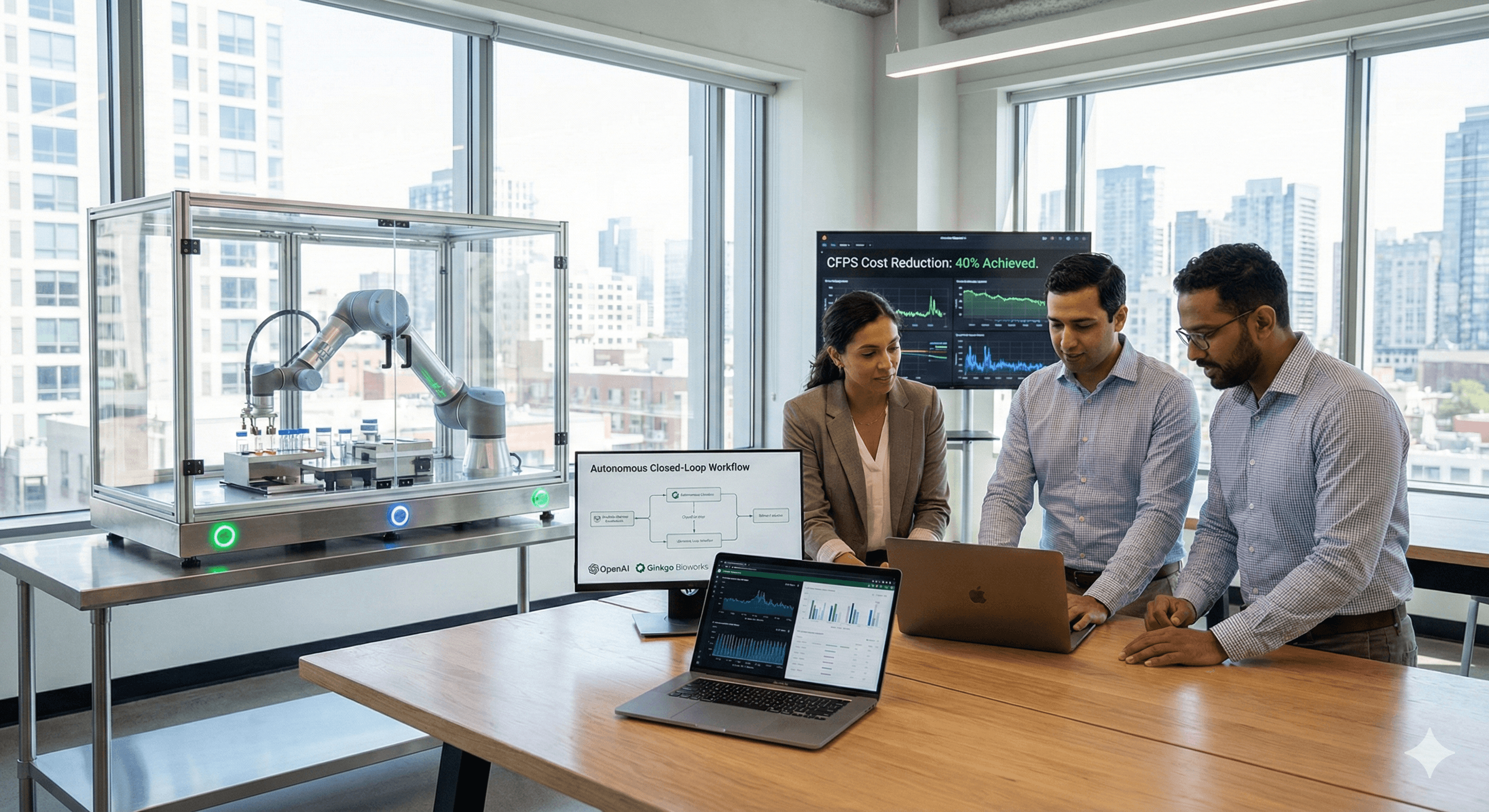
OpenAI et Ginkgo Bioworks ont utilisé GPT‑5 pour exécuter des expériences autonomes en boucle fermée qui ont réduit les coûts des composants de réaction de la synthèse de protéines sans cellule (SPCS) de 40%. En concevant, exécutant, analysant et affinant les expériences de manière répétée via un flux de travail de laboratoire en nuage, le système a amélioré l'efficacité des coûts avec une intervention humaine minimale.
La synthèse de protéines sans cellule (SPCS) est un moyen puissant de produire des protéines sans dépendre des cellules vivantes — mais son optimisation peut être coûteuse et complexe. C’est pourquoi la récente collaboration entre OpenAI et Ginkgo Bioworks mérite votre attention.
Dans un environnement en boucle fermée dirigée par GPT‑5, l'équipe rapporte une réduction de 40% des coûts des composants de réaction SPCS par rapport à une référence de pointe — obtenue grâce à une expérimentation autonome à grande échelle.
Pourquoi cela est important maintenant
Les équipes en biotechnologie et sciences de la vie font souvent face à un goulot d'étranglement similaire : elles peuvent générer des hypothèses rapidement, mais l'expérimentation est lente et coûteuse. Les laboratoires autonomes en boucle fermée sont conçus pour changer cela en reliant trois éléments :
Un système de raisonnement qui propose des expériences
Une couche d'automatisation de laboratoire qui les exécute
Une boucle de rétroaction qui transforme les résultats en la prochaine (meilleure) série d'expériences
Si vous pouvez faire cela de manière fiable, vous pouvez compresser des semaines d'itération en jours – et éliminer beaucoup de tâtonnements manuels.
Quoi de neuf : expérimentation en boucle fermée avec GPT‑5 + un laboratoire en nuage
Ce travail intègre GPT‑5 dans le flux de travail expérimental en tant que « couche cognitive » qui :
Conçoit des expériences (sélection des conditions, des compositions et de la stratégie d'exploration)
Interprète les résultats (identifiant ce qui a changé et pourquoi cela a fonctionné)
Affiner le plan (proposant le prochain cycle d'expériences)
L'infrastructure de laboratoire en nuage de Ginkgo fournit la couche d'exécution physique — exécutant les plaques expérimentales, collectant les mesures et renvoyant les données pour la prochaine itération.
Le résultat principal (et ce que cela signifie)
Le résultat rapporté est une réduction de 40% des coûts des composants de réaction SPCS, obtenue en découvrant des compositions de réaction améliorées mieux adaptées aux conditions de laboratoire autonomes.
Pour les équipes d'entreprises, l'enseignement pratique est moins à propos d'une seule recette de protéine et davantage sur le modèle :
Définir une référence claire
Exécuter des itérations rapides et automatisées
Optimiser selon un objectif mesurable (ici : le coût)
Laisser le système apprendre à partir de données réelles en boucle
Exemples pratiques
Exemple 1 : Essais d'optimisation automatisés
Une équipe définit une sortie cible (rendement, stabilité, coût ou pureté). Le modèle propose des conditions, le laboratoire les exécute, et le cycle suivant est guidé par les résultats.
Exemple 2 : Ajustements d'efficacité en temps réel
Au fur et à mesure que les résultats reviennent, le système modifie sa stratégie d'exploration — se concentrant sur des régions prometteuses de l'espace des paramètres ou testant la robustesse sous différentes conditions de laboratoire.
Ce que cela ne veut pas dire (guide important)
Ce n'est pas « l'IA remplace les scientifiques ». Dans la pratique, le travail autonome en boucle fermée nécessite toujours :
Des objectifs et des contraintes bien définis
Une supervision humaine pour la sécurité, la qualité et l'interprétation
Un bon design expérimental et une validation
Une gouvernance sur ce que le système peut exécuter et quand
Que faire si vous voulez explorer l'expérimentation autonome
Si vous envisagez cette approche, commencez par un problème restreint :
Choisissez une tâche d'optimisation à coût élevé ou à forte friction
Établir un référentiel et des métriques de succès
Construisez un petit projet pilote en boucle fermée avec des garde-fous clairs
Mesurez l'impact (coût, temps pour obtenir un résultat, reproductibilité)
Ne passez à l'échelle que lorsque vous pouvez auditer les décisions et les résultats
Résumé & prochaines étapes
Une réduction de 40% des coûts des composants de réaction SPCS est une démonstration convaincante de ce que l'IA agentique + l'automatisation + les boucles de rétroaction peuvent accomplir dans les sciences physiques. La plus grande histoire est le modèle opérationnel : optimisation reproductible et basée sur les données à grande échelle.
Prochaine étape : Si vous souhaitez de l'aide pour définir un projet pilote en boucle fermée, pour construire une gouvernance, ou pour identifier le bon flux de travail d'automatisation + IA, contactez Generation Digital.
FAQ
Q1 : Qu'est-ce que la synthèse de protéines sans cellule ?
La synthèse de protéines sans cellule (SPCS) est une méthode de production de protéines en dehors des cellules vivantes, utilisant un mélange de réaction biochimique. Elle est largement utilisée dans la recherche et les flux de travail industriels où la rapidité et la contrôlabilité sont importantes.
Q2 : Comment GPT‑5 contribue-t-il à la réduction des coûts ?
GPT‑5 peut proposer et affiner les conceptions expérimentales en cycles, en apprenant à partir des résultats et en concentrant les tests sur les conditions les plus prometteuses. Dans un environnement en boucle fermée, cela réduit l'expérimentation manuelle et accélère l'optimisation.
Q3 : Quel rôle joue Ginkgo Bioworks ?
Ginkgo fournit le laboratoire en nuage et l'infrastructure d'automatisation qui exécute les expériences à grande échelle, capture les mesures et renvoie les données pour permettre au système d'itérer.
Q4 : Le chiffre de 40% concerne-t-il le coût total ou les réactifs ?
L'amélioration principale rapportée est une réduction de 40% des coûts des composants de réaction dans des conditions de référence. Le travail rapporte également une amélioration plus importante dans certaines métriques de coût des réactifs.
Recevez chaque semaine des nouvelles et des conseils sur l'IA directement dans votre boîte de réception
En vous abonnant, vous consentez à ce que Génération Numérique stocke et traite vos informations conformément à notre politique de confidentialité. Vous pouvez lire la politique complète sur gend.co/privacy.



Génération
Numérique

Bureau du Royaume-Uni
Génération Numérique Ltée
33 rue Queen,
Londres
EC4R 1AP
Royaume-Uni
Bureau au Canada
Génération Numérique Amériques Inc
181 rue Bay, Suite 1800
Toronto, ON, M5J 2T9
Canada
Bureau aux États-Unis
Generation Digital Americas Inc
77 Sands St,
Brooklyn, NY 11201,
États-Unis
Bureau de l'UE
Génération de logiciels numériques
Bâtiment Elgee
Dundalk
A91 X2R3
Irlande
Bureau du Moyen-Orient
6994 Alsharq 3890,
An Narjis,
Riyad 13343,
Arabie Saoudite






Numéro d'entreprise : 256 9431 77 | Droits d'auteur 2026 | Conditions générales | Politique de confidentialité