Notion vs Monday.com: Connected AI Workspace Comparison (2026)

Notion vs Monday.com: Connected AI Workspace Comparison (2026)

Notion

24 févr. 2026

In a modern office space, two professionals sit across from each other at desks with multiple computer monitors displaying task management software, collaborating and discussing over documents.

Pas sûr de quoi faire ensuite avec l'IA?
Évaluez la préparation, les risques et les priorités en moins d'une heure.

Pas sûr de quoi faire ensuite avec l'IA?
Évaluez la préparation, les risques et les priorités en moins d'une heure.

➔ Téléchargez notre kit de préparation à l'IA gratuit

Notion and Monday.com both support project delivery, but they’re built for different outcomes. Monday.com is a project-focused tool that often needs separate apps for documentation, wikis, and advanced AI. Notion is a connected AI workspace that unifies knowledge, projects, and collaboration—with enterprise search and agents built into the same platform.

Monday.com is a strong visual project management tool. If your needs begin and end with board-based delivery, it can do the job.

But many teams don’t just manage projects—they manage knowledge, decisions, documentation, onboarding, and an increasing number of AI-enabled workflows.

That’s where the comparison gets interesting.

The core argument is simple: Monday.com often creates fragmentation because organisations add other tools for documentation, wikis, and AI capabilities—while Notion brings it together as a unified AI-powered workspace.

This post breaks down what that means in practice and how to evaluate both tools like a buyer, not a brochure.
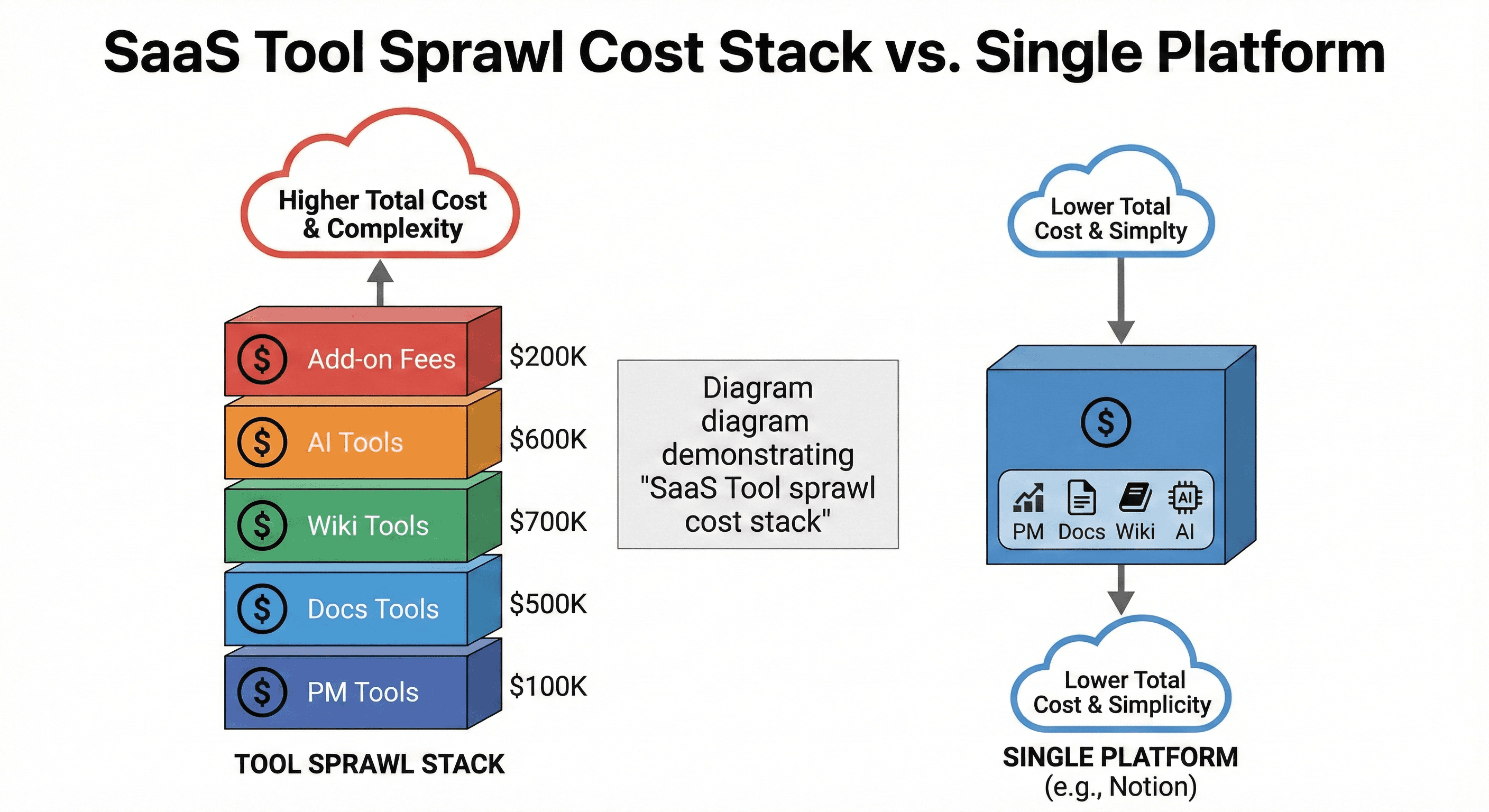
The real decision: project tool or connected workspace?

A useful way to frame the choice is scope.

  • Monday.com is positioned as a project-focused tool that can require separate solutions for documentation, knowledge management, and AI.

  • Notion is positioned as a connected workspace that unifies company knowledge, team projects, and collaboration—with AI integrated throughout.

If you’re already paying for multiple apps to make project work “complete”, the total cost and complexity quickly become the real problem.

Side-by-side: where each platform tends to win

AI capabilities

There's a big difference here with Notion’s AI layer (enterprise search across apps, AI agents, automated meeting notes, and research mode) with Monday.com’s “basic workflow automation” and limited AI features that often require additional tools.

Documentation and knowledge

Notion is described as strong on rich docs, wikis, and databases that are integrated with project management and searchable by AI. Monday.com is described as weaker for documentation, typically requiring separate tools such as Confluence or Google Docs.

Customisation and flexibility

Notion is positioned around “infinite building blocks” that adapt to different team workflows. Monday.com is positioned as visually strong for PM, but more rigid outside project management use cases.

Tool consolidation and cost

Notion claims customers can save up to 83% tool cost per employee by consolidating multiple tools into Notion, whereas Monday.com often results in additional tool purchases for documentation, AI, and knowledge management. A practical comparison table

What matters to you

Notion

Monday.com

Work model

Connected workspace (knowledge + projects + collaboration)

Project-focused tool

Docs & wikis

Built in, integrated with projects and AI-searchable

Typically needs separate docs/wiki tools

AI depth

Enterprise search across apps, agents, meeting notes, research mode

Basic automation + limited AI features

Knowledge management

Central knowledge hub with AI-powered search across connected apps

Limited beyond project documentation

Flexibility

Building blocks adapt across teams

Strong PM visuals, but more rigid outside PM

Consolidation

Replace PM + docs + wiki + AI tools in one platform

Likely to add tools for full coverage

What “connected AI workspace” looks like day to day

When a workspace is connected, you stop doing “status by spreadsheet” and “knowledge by Slack”. Instead:

  • Project plans link directly to the docs and decisions that explain why they exist.

  • Meeting notes turn into action items without copy/paste.

  • AI can answer questions and draft outputs with context from your workspace, not just from a single project board.

Notion’s playbook frames this as enabling AI to work effectively because it has access to connected knowledge and enterprise search across apps, rather than isolated project data.

What to ask in a buying conversation

If you’re evaluating Notion vs Monday.com, ask questions that reveal whether you’re really choosing a project tool—or designing a work system.

  1. Where does documentation live today? If it’s separate from project delivery, you’re already in fragmentation.

  2. How do people find the latest answer? If search is limited to project data, teams will keep creating duplicates.

  3. What does AI need to do in 12 months? If it’s just drafting, most tools can help. If it’s agents, enterprise search, and workflow automation with context, you’ll want AI embedded where work lives.

  4. What’s the real cost? Include the extra apps you need for wikis, docs, and AI—plus the adoption cost of maintaining multiple systems.

Customer examples from the source

The playbook includes examples of organisations that replaced Monday.com alongside other tools:

  • Planful consolidated multiple tools (including Monday.com) into Notion, reporting reduced onboarding time, faster documentation creation, and over 90% employee adoption.

  • Lyka consolidated Monday.com and Confluence into Notion, saving over $75k annually and improving cross-functional collaboration.

  • Viva replaced Monday.com and other tools with Notion to improve onboarding, collaboration, and client workflows.

(As always: validate against your own baseline, scope, and rollout approach.)

Migration notes: how to move from Monday.com without breaking delivery

If you’re considering a move, the fastest wins tend to come from a phased approach:

  1. Start with knowledge: build a wiki / playbook structure and migrate the docs people rely on most.

  2. Pick one workflow: replicate one delivery workflow end-to-end (projects → meetings → decisions → updates).

  3. Standardise templates: project briefs, meeting notes, decision logs, weekly updates.

  4. Then migrate boards: move project tracking once teams trust the new “source of truth”.

The playbook also notes a Monday.com importer available in beta, plus professional services to support migration.

Next steps

If Monday.com is working for project boards but the rest of the work is scattered, the question isn’t “which PM tool is better?” It’s:

Do we want a project tool, or a connected AI workspace?

A sensible next step is to map your current stack (PM + docs + wiki + AI), identify overlap, and pilot one team’s workflow in a connected workspace model.

FAQs

Is Monday.com a competitor to Notion?
They overlap in project delivery, but Notion is positioned as a connected workspace that also includes documentation, knowledge management, and AI capabilities—areas where Monday.com often needs additional tools.

What’s the biggest difference between Notion and Monday.com?
Scope. Monday.com is primarily project-focused. Notion is designed to unify knowledge, projects and collaboration in one platform with AI integrated across workflows.

Does Notion replace Confluence and Google Docs?
Notion’s documentation and wiki capabilities as strong enough that teams don’t need separate tools, and Monday.com commonly requires separate documentation apps.

What AI features does Notion include?
Enterprise search across apps, AI agents, automated meeting notes, and research mode as core capabilities.

What’s the most common migration approach?
Start with knowledge and templates first, pilot a single workflow, then migrate project tracking once the new structure is working.

Notion and Monday.com both support project delivery, but they’re built for different outcomes. Monday.com is a project-focused tool that often needs separate apps for documentation, wikis, and advanced AI. Notion is a connected AI workspace that unifies knowledge, projects, and collaboration—with enterprise search and agents built into the same platform.

Monday.com is a strong visual project management tool. If your needs begin and end with board-based delivery, it can do the job.

But many teams don’t just manage projects—they manage knowledge, decisions, documentation, onboarding, and an increasing number of AI-enabled workflows.

That’s where the comparison gets interesting.

The core argument is simple: Monday.com often creates fragmentation because organisations add other tools for documentation, wikis, and AI capabilities—while Notion brings it together as a unified AI-powered workspace.

This post breaks down what that means in practice and how to evaluate both tools like a buyer, not a brochure.

The real decision: project tool or connected workspace?

A useful way to frame the choice is scope.

  • Monday.com is positioned as a project-focused tool that can require separate solutions for documentation, knowledge management, and AI.

  • Notion is positioned as a connected workspace that unifies company knowledge, team projects, and collaboration—with AI integrated throughout.

If you’re already paying for multiple apps to make project work “complete”, the total cost and complexity quickly become the real problem.

Side-by-side: where each platform tends to win

AI capabilities

There's a big difference here with Notion’s AI layer (enterprise search across apps, AI agents, automated meeting notes, and research mode) with Monday.com’s “basic workflow automation” and limited AI features that often require additional tools.

Documentation and knowledge

Notion is described as strong on rich docs, wikis, and databases that are integrated with project management and searchable by AI. Monday.com is described as weaker for documentation, typically requiring separate tools such as Confluence or Google Docs.

Customisation and flexibility

Notion is positioned around “infinite building blocks” that adapt to different team workflows. Monday.com is positioned as visually strong for PM, but more rigid outside project management use cases.

Tool consolidation and cost

Notion claims customers can save up to 83% tool cost per employee by consolidating multiple tools into Notion, whereas Monday.com often results in additional tool purchases for documentation, AI, and knowledge management. A practical comparison table

What matters to you

Notion

Monday.com

Work model

Connected workspace (knowledge + projects + collaboration)

Project-focused tool

Docs & wikis

Built in, integrated with projects and AI-searchable

Typically needs separate docs/wiki tools

AI depth

Enterprise search across apps, agents, meeting notes, research mode

Basic automation + limited AI features

Knowledge management

Central knowledge hub with AI-powered search across connected apps

Limited beyond project documentation

Flexibility

Building blocks adapt across teams

Strong PM visuals, but more rigid outside PM

Consolidation

Replace PM + docs + wiki + AI tools in one platform

Likely to add tools for full coverage

What “connected AI workspace” looks like day to day

When a workspace is connected, you stop doing “status by spreadsheet” and “knowledge by Slack”. Instead:

  • Project plans link directly to the docs and decisions that explain why they exist.

  • Meeting notes turn into action items without copy/paste.

  • AI can answer questions and draft outputs with context from your workspace, not just from a single project board.

Notion’s playbook frames this as enabling AI to work effectively because it has access to connected knowledge and enterprise search across apps, rather than isolated project data.

What to ask in a buying conversation

If you’re evaluating Notion vs Monday.com, ask questions that reveal whether you’re really choosing a project tool—or designing a work system.

  1. Where does documentation live today? If it’s separate from project delivery, you’re already in fragmentation.

  2. How do people find the latest answer? If search is limited to project data, teams will keep creating duplicates.

  3. What does AI need to do in 12 months? If it’s just drafting, most tools can help. If it’s agents, enterprise search, and workflow automation with context, you’ll want AI embedded where work lives.

  4. What’s the real cost? Include the extra apps you need for wikis, docs, and AI—plus the adoption cost of maintaining multiple systems.

Customer examples from the source

The playbook includes examples of organisations that replaced Monday.com alongside other tools:

  • Planful consolidated multiple tools (including Monday.com) into Notion, reporting reduced onboarding time, faster documentation creation, and over 90% employee adoption.

  • Lyka consolidated Monday.com and Confluence into Notion, saving over $75k annually and improving cross-functional collaboration.

  • Viva replaced Monday.com and other tools with Notion to improve onboarding, collaboration, and client workflows.

(As always: validate against your own baseline, scope, and rollout approach.)

Migration notes: how to move from Monday.com without breaking delivery

If you’re considering a move, the fastest wins tend to come from a phased approach:

  1. Start with knowledge: build a wiki / playbook structure and migrate the docs people rely on most.

  2. Pick one workflow: replicate one delivery workflow end-to-end (projects → meetings → decisions → updates).

  3. Standardise templates: project briefs, meeting notes, decision logs, weekly updates.

  4. Then migrate boards: move project tracking once teams trust the new “source of truth”.

The playbook also notes a Monday.com importer available in beta, plus professional services to support migration.

Next steps

If Monday.com is working for project boards but the rest of the work is scattered, the question isn’t “which PM tool is better?” It’s:

Do we want a project tool, or a connected AI workspace?

A sensible next step is to map your current stack (PM + docs + wiki + AI), identify overlap, and pilot one team’s workflow in a connected workspace model.

FAQs

Is Monday.com a competitor to Notion?
They overlap in project delivery, but Notion is positioned as a connected workspace that also includes documentation, knowledge management, and AI capabilities—areas where Monday.com often needs additional tools.

What’s the biggest difference between Notion and Monday.com?
Scope. Monday.com is primarily project-focused. Notion is designed to unify knowledge, projects and collaboration in one platform with AI integrated across workflows.

Does Notion replace Confluence and Google Docs?
Notion’s documentation and wiki capabilities as strong enough that teams don’t need separate tools, and Monday.com commonly requires separate documentation apps.

What AI features does Notion include?
Enterprise search across apps, AI agents, automated meeting notes, and research mode as core capabilities.

What’s the most common migration approach?
Start with knowledge and templates first, pilot a single workflow, then migrate project tracking once the new structure is working.

Recevez chaque semaine des nouvelles et des conseils sur l'IA directement dans votre boîte de réception

En vous abonnant, vous consentez à ce que Génération Numérique stocke et traite vos informations conformément à notre politique de confidentialité. Vous pouvez lire la politique complète sur gend.co/privacy.


Ateliers et webinaires à venir

A diverse group of professionals collaborating around a table in a bright, modern office setting.

Clarté opérationnelle à grande échelle - Asana

Webinaire Virtuel
Mercredi 25 février 2026
En ligne

A diverse group of professionals collaborating around a table in a bright, modern office setting.

Collaborez avec des coéquipiers IA - Asana

Atelier en personne
Jeudi 26 février 2026
London, UK

A diverse group of professionals collaborating around a table in a bright, modern office setting.

De l'idée au prototype - L'IA dans Miro

Webinaire virtuel
Mercredi 18 février 2026
En ligne

Génération
Numérique

Bureau du Royaume-Uni

Génération Numérique Ltée
33 rue Queen,
Londres
EC4R 1AP
Royaume-Uni

Bureau au Canada

Génération Numérique Amériques Inc
181 rue Bay, Suite 1800
Toronto, ON, M5J 2T9
Canada

Bureau aux États-Unis

Generation Digital Americas Inc
77 Sands St,
Brooklyn, NY 11201,
États-Unis

Bureau de l'UE

Génération de logiciels numériques
Bâtiment Elgee
Dundalk
A91 X2R3
Irlande

Bureau du Moyen-Orient

6994 Alsharq 3890,
An Narjis,
Riyad 13343,
Arabie Saoudite

UK Fast Growth Index UBS Logo
Financial Times FT 1000 Logo
Febe Growth 100 Logo (Background Removed)

Numéro d'entreprise : 256 9431 77 | Droits d'auteur 2026 | Conditions générales | Politique de confidentialité

Génération
Numérique

Bureau du Royaume-Uni

Génération Numérique Ltée
33 rue Queen,
Londres
EC4R 1AP
Royaume-Uni

Bureau au Canada

Génération Numérique Amériques Inc
181 rue Bay, Suite 1800
Toronto, ON, M5J 2T9
Canada

Bureau aux États-Unis

Generation Digital Americas Inc
77 Sands St,
Brooklyn, NY 11201,
États-Unis

Bureau de l'UE

Génération de logiciels numériques
Bâtiment Elgee
Dundalk
A91 X2R3
Irlande

Bureau du Moyen-Orient

6994 Alsharq 3890,
An Narjis,
Riyad 13343,
Arabie Saoudite

UK Fast Growth Index UBS Logo
Financial Times FT 1000 Logo
Febe Growth 100 Logo (Background Removed)


Numéro d'entreprise : 256 9431 77
Conditions générales
Politique de confidentialité
Droit d'auteur 2026





