Perplexity Agent API: Managed Runtime for AI Workflows
Pérplexité

Pas sûr de quoi faire ensuite avec l'IA?Évaluez la préparation, les risques et les priorités en moins d'une heure.
➔ Téléchargez notre kit de préparation à l'IA gratuit
Perplexity’s Agent API is a managed runtime for building agentic workflows. It combines real-time web search with configurable tool execution and multi-model access across providers, so developers can orchestrate multi-step tasks without stitching together separate search, routing, and tooling layers. It also supports reasoning controls and token budgets for more predictable behaviour.
Most agent builds fail for boring reasons: separate API keys, a home-grown orchestration layer, a brittle search pipeline, and a growing set of tools that are hard to govern. The result is expensive to maintain and difficult to scale.
Perplexity’s Agent API is positioned as a managed runtime to simplify that stack. It’s designed for teams building agentic workflows that need integrated web search, tool execution, and the ability to orchestrate across multiple model providers through one interface.
What is the Perplexity Agent API?
The Agent API is a multi-provider, interoperable API specification for building LLM applications. It provides:
Integrated real-time web search inside the same request flow
Tool configuration and execution (built-in tools plus your own custom tools)
Multi-model support across providers (so you can route by cost, speed, or capability)
Reasoning controls and token budgets to help keep behaviour predictable
In practical terms: you send a request, enable the tools you want, and the runtime supports a more end-to-end, agentic execution pattern.
What’s new / why it matters now
“Agentic” is no longer just chat. Organisations want systems that can:
research in real time
fetch and synthesise sources
call internal services
produce structured outputs
run reliably in production
The Agent API wraps those patterns into a managed experience so you can focus on the workflow, not the plumbing.
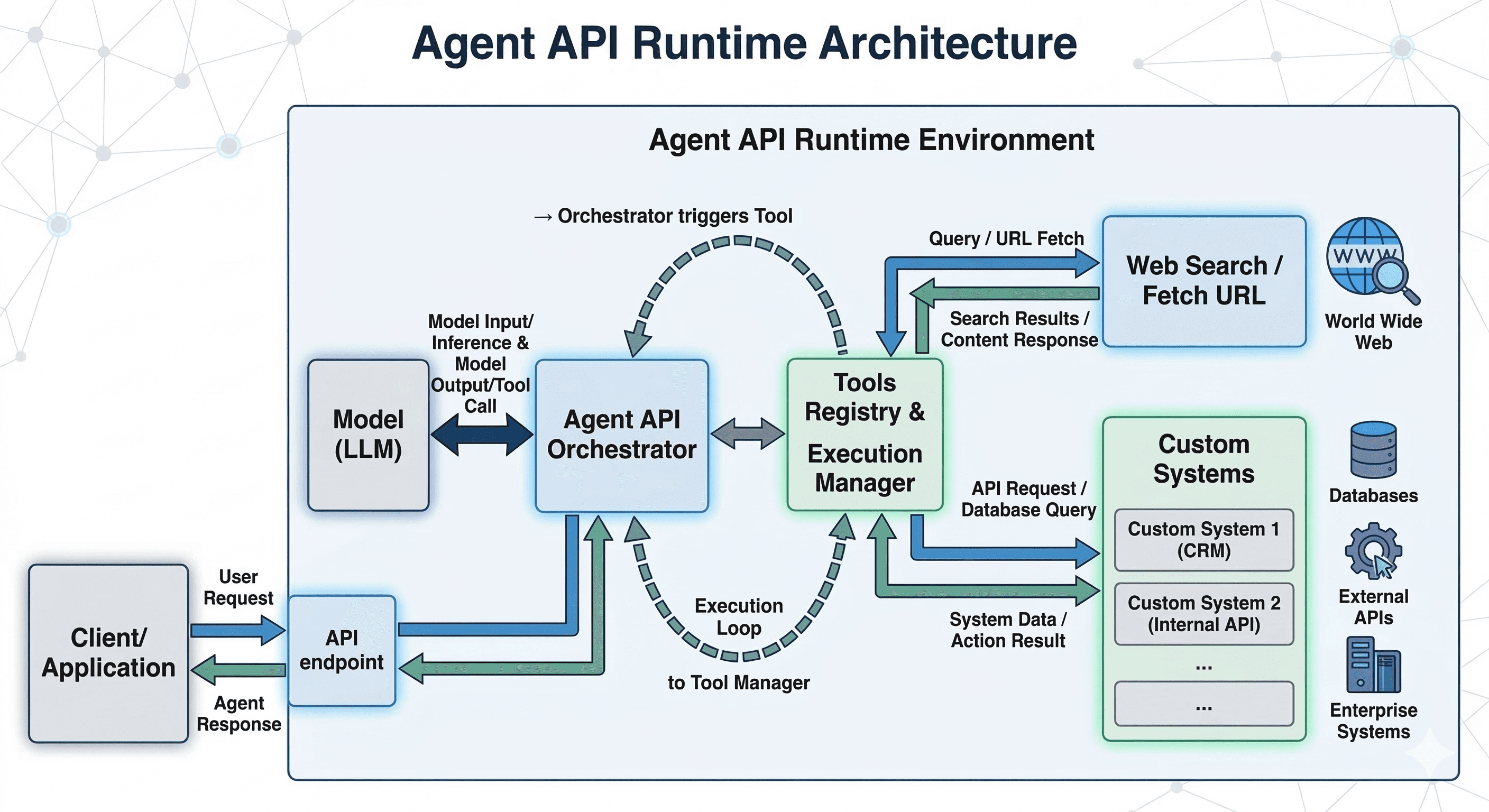
How it works (high-level)
At a high level, you:
Choose a model (and optionally implement routing logic)
Provide instructions and the required context
Enable tools in a
toolsarrayLet the model decide when to use tools based on your instructions
Perplexity documents built-in tools such as:
web_searchfor real-time web retrievalfetch_urlfor pulling content from a specific URL
You can also define custom tools to connect to databases, internal APIs, business logic, or workflow systems.
Practical workflows you can build
Here are common “first wins” that make the runtime feel tangible.
1) Research + drafting workflows (Marketing, Product, Comms)
Search the web for recent updates
Fetch key sources
Generate a brief, landing page, or executive summary with citations and links
2) Support triage and response automation (Customer Success)
Search internal KB and relevant public docs
Fetch policy pages or release notes
Draft responses, escalation summaries, and next actions
3) Sales enablement (Revenue teams)
Pull competitor information and market changes
Create account briefs and objection-handling sheets
Generate a meeting prep pack with sources and talking points
4) Knowledge ops (IT + Ops)
Standardise and tag incoming requests
Route to the right owner
Summarise status and produce weekly roll-ups
A sensible enterprise rollout pattern
If you’re deploying an agent runtime in a real organisation, you’ll want a deployment pattern that security and engineering can both support.
Start with one workflow that has clear value and bounded risk.
Define tool boundaries (what tools exist, who can call them, and which actions require human approval).
Instrument and log (inputs, outputs, tool calls, failures) so you can debug and audit.
Scale by templates: turn the successful workflow into a reusable recipe.
Pricing and admin considerations
Perplexity documents token-based pricing for the Agent API, including access to third-party models, and provides usage tiers and rate limits through its admin console.
For teams rolling this out, treat pricing and rate limits as part of your architecture: they influence caching, batching, and where you place “heavy reasoning” vs “light classification”.
Where Generation Digital can help
Generation Digital helps organisations build governed AI workflows that don’t collapse in production.
We can support:
agent workflow design (from prompt → tools → evaluation)
safe tooling patterns (approvals, role boundaries, auditability)
search + knowledge strategy to reduce hallucination risk
operational rollout (templates, playbooks, enablement)
Summary
Perplexity’s Agent API is a managed runtime that combines integrated search, tool execution, and multi-model access in one workflow layer. For teams building agentic systems, that can reduce plumbing, speed up iteration, and make it easier to standardise what “good” looks like.
Next steps: If you’re planning an agent pilot (or scaling one), talk to Generation Digital about turning it into a repeatable, governed workflow: https://www.gend.co/contact
FAQs
1) What is the primary function of the Perplexity Agent API?
It provides a managed runtime for building agentic workflows, integrating real-time web search, tool configuration/execution, and multi-model access through a unified interface.
2) How does the Agent API improve workflow efficiency?
By bundling retrieval, tooling, and orchestration, you spend less time stitching together services and more time shipping workflows that can research, act, and generate outputs in one flow.
3) Can the API be integrated with existing systems?
Yes. You can integrate it into existing services and expose your internal capabilities as custom tools (APIs, databases, workflow actions).
4) What tools are available out of the box?
Perplexity documents built-in tools such as web_search and fetch_url, and supports custom tools you define.
5) How do we make this safe to deploy?
Start with one bounded workflow, restrict tool access, add approvals for high-impact actions, and ensure you have logging and monitoring before expanding.
Recevez chaque semaine des nouvelles et des conseils sur l'IA directement dans votre boîte de réception
En vous abonnant, vous consentez à ce que Génération Numérique stocke et traite vos informations conformément à notre politique de confidentialité. Vous pouvez lire la politique complète sur gend.co/privacy.



Génération
Numérique

Bureau du Royaume-Uni
Génération Numérique Ltée
33 rue Queen,
Londres
EC4R 1AP
Royaume-Uni
Bureau au Canada
Génération Numérique Amériques Inc
181 rue Bay, Suite 1800
Toronto, ON, M5J 2T9
Canada
Bureau aux États-Unis
Generation Digital Americas Inc
77 Sands St,
Brooklyn, NY 11201,
États-Unis
Bureau de l'UE
Génération de logiciels numériques
Bâtiment Elgee
Dundalk
A91 X2R3
Irlande
Bureau du Moyen-Orient
6994 Alsharq 3890,
An Narjis,
Riyad 13343,
Arabie Saoudite







Numéro d'entreprise : 256 9431 77 | Droits d'auteur 2026 | Conditions générales | Politique de confidentialité