CES 2026: ¿El Fin de la IA como Herramienta? Qué Hacer Ahora
Inteligencia Artificial
¿No sabes por dónde empezar con la IA?Evalúa preparación, riesgos y prioridades en menos de una hora.
➔ Descarga nuestro paquete gratuito de preparación para IA
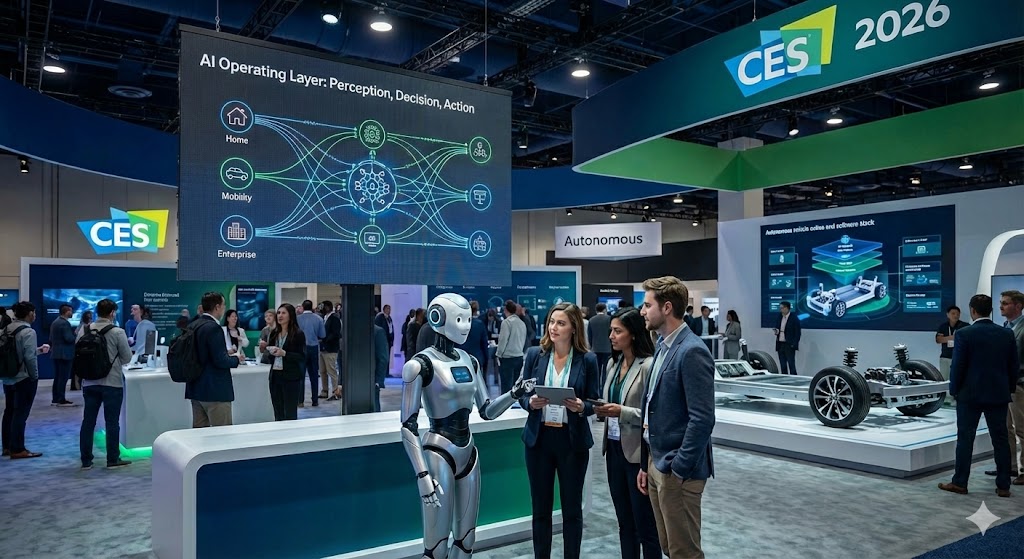
CES 2026 confirma un cambio que muchos equipos han sentido durante un año: la IA ha dejado de ser una "herramienta" y se ha convertido en una capa operativa para productos, espacios y servicios. Es visible en los robots humanoides y de compañía en la exposición, el cambio de lanzamientos brillantes de vehículos eléctricos hacia la autonomía y el software, y los paneles de entretenimiento que abordan la producción impulsada por IA.
Para los líderes, esto es importante porque su ventaja no provendrá de agregar un chatbot o una función puntual. Provendrá de diseñar sistemas: cómo los modelos, datos, sensado, seguridad y experiencia del usuario se interconectan con el tiempo.
De “app que abres” a “capa en la que vives”
En ciclos anteriores, la IA vivía en interfaces discretas: escribías un mensaje; respondía. En 2026, la IA cada vez más percibe, decide y actúa dentro del contexto: los robots co-navegan hogares, los vehículos integran la IA en sus sistemas de conducción, y las cadenas de contenido mezclan la IA con supervisión humana. La historia en CES no es la novedad de la IA—es la integración.
Hogar & cuidado: Los robots de compañía y los bots sociales destacan la presencia y la interacción, no solo la automatización. Reconocen a las personas, conversan y ayudan con las rutinas—primeros pasos hacia la asistencia ambiental.
Movilidad: Los fabricantes de automóviles destacan las plataformas de autonomía y las hojas de ruta de asistencia al conductor más que los vehículos eléctricos de portada, señalando la inversión en pilas de software de IA sobre el espectáculo del hardware.
Medios & entretenimiento: Los paneles y demostraciones exploran la creación, personalización y distribución asistidas por IA—templadas por derechos, atribución y consideraciones de fuerza laboral.
Por qué los “sistemas de IA” superan a las “funciones de IA”
“IA como herramienta” se enfoca en características. “IA como capa” se enfoca en arquitectura. El pensamiento de sistemas gana porque se compone:
Efectos de red de datos: Cuanto más aprenda su sistema de flujos de datos seguros y regulados, mejores serán las experiencias.
Orquestación: La coordinación de percepción, planificación y acción en todos los dispositivos supera a habilidades aisladas.
Ciclo de vida: Los modelos derivan; las regulaciones evolucionan. Los equipos que diseñan para monitoreo, evaluación y actualizaciones envían más rápido y seguro.
Qué priorizar en 2026
1. Defina los trabajos para agentes autónomos o semi-autónomos
Comience con tareas delimitadas y de alto valor (por ejemplo, gestionar una fila de soporte, preparar una propuesta de venta, realizar controles de inventario) y especifique entradas, niveles de autoridad, límites y reglas de transferencia. Apunte a mejoras medibles en tiempo de ciclo y calidad, no solo novedad.
2. Construya un gráfico de contexto en tiempo real
Unifique señales de aplicaciones, dispositivos y sensores (donde sea apropiado y legal) en una capa de contexto que respete la privacidad. Esto permite a los agentes percibir el estado (“quién, qué, dónde, cuándo”) y actuar responsablemente. Es el tejido conectivo de la IA ambiental.
3. Operationalice la seguridad y gobernanza
Trate la seguridad como el tiempo de actividad: defina casos de mal uso, realice pruebas de equipo rojo y cree un camino de gestión de cambios de IA (actualizaciones de modelos, cambios de mensaje, cambios de política). Agregue explicabilidad, consentimiento y registros de auditoría desde el principio—especialmente donde está en juego personas, vehículos o derechos de contenido. Las discusiones de entretenimiento y movilidad en CES subrayan lo central que es esto.
4. Invierta en flujos de trabajo con humanos en el circuito
Equilibre la autonomía con la supervisión. En la robótica y los medios, la revisión humana competente sigue siendo vital para casos límite, voz de marca y gestión de derechos. Las sesiones de CES resaltan que la IA debe complementar a los creadores y operadores, no reemplazarlos.
5. Elija plataformas para longevidad, no por moda
Si 2025 se trataba de “probar muchas herramientas”, 2026 se trata de estandarizarse en pilas interoperables que sobrevivan a múltiples ciclos de modelos y hardware. Pregunte a los proveedores sobre disciplina de evaluación, cambio de modelos, portabilidad de datos y certificaciones de seguridad. Los cambios automotrices de este año son una advertencia: las hojas de ruta de software perduran más que las modas de hardware.
Señales de CES 2026 que puede actuar sobre
La robótica está cruzando el umbral de la novedad a la utilidad. Los robots de compañía y humanoides todavía son incipientes, pero demuestran cómo la IA habitará nuestros espacios como presencia continua, no como aplicaciones. Comience a probar agentes en flujos de trabajo físicos (inventario, inspecciones, conserjería) donde el riesgo se pueda acotar.
Las exhibiciones automotrices priorizan pilas de IA sobre nuevos VE. Incluso marcas famosas por autos conceptuales se centraron en software de autonomía, asociaciones e infraestructura de datos. Si está en cualquier dominio regulado y crítico para la seguridad, alinee su hoja de ruta de IA con cumplimiento por diseño y telemetría segura para la vigilancia.
Los líderes de entretenimiento están alineando creatividad y controles. Desde el desarrollo asistido por IA de historias hasta el contenido adaptativo, la industria está construyendo canalizaciones conscientes de derechos y centradas en el creador. Los equipos de marketing y producto deberían reflejar esto: mensajes estándar, conjuntos de datos aprobados, límites de marca.
Un marco simple: De herramienta → capa
Mapea el trayecto: ¿Dónde puede la IA continua y ambiental reducir fricciones (configuración, búsqueda, transferencias, personalización)?
Instrumentar contexto: ¿Qué eventos y estados debe “sensar” el sistema para actuar responsablemente?
Asignar niveles de capacidad: ¿Qué se puede automatizar ahora vs. supervisar vs. manejar manualmente?
Diseñar límites: Seguridad, privacidad, equidad y caminos de escalación.
Medir e iterar: Definir métricas estrella polar (tiempo de resolución, satisfacción, tasas de defectos) y un ritmo semanal de evaluación.
Qué significa esto para los equipos
Producto: Cambie las hojas de ruta de “lanzamientos de características” a madurez de capacidades (percepción, razonamiento, acción, recuperación).
Datos: Construya canalizaciones gobernadas y conjuntos de evaluación que reflejen la complejidad del mundo real, no solo caminos felices.
Ingeniería: Elija plataformas con observabilidad, pruebas de seguridad A/B y cambiabilidad de modelos.
Legal & Riesgo: Pre-aprobar patrones de consentimiento, derechos de contenido, y respuesta a incidentes para resultados de IA.
Personas & Cambio: Entrene para colaboración con agentes: iniciando, supervisando y auditando salidas de IA en herramientas cotidianas.
Conclusión
El CES 2026 no dice “la IA ganó.” Dice la integración ganó. Los líderes de 2026-27 serán aquellos que diseñen sistemas coherentes a través de productos, datos y gobernanza, para que los usuarios experimenten la inteligencia no como una herramienta que abren, sino como una capacidad que simplemente está ahí.
Preguntas frecuentes
P1: ¿Qué significa realmente “fin de la IA como herramienta”?
La IA está pasando de ser aplicaciones autónomas a una capa incrustada y siempre activa en dispositivos, vehículos y flujos de trabajo de medios, priorizando el diseño del sistema sobre las funciones individuales. The Verge
P2: ¿Cuáles son las señales más claras del CES 2026 de este cambio?
Robots de compañía/humanoides, keynotes automotrices enfocados en la autonomía, y canalizaciones de IA enfocadas en el creador en el entretenimiento—cada uno mostrando la IA como capacidad integrada. The Verge
P3: ¿Por dónde deben comenzar las empresas?
Defina tareas dignas de agentes, unifique señales de contexto, operationalice la seguridad, mantenga supervisión humana y estandarice en plataformas duraderas con sólida evaluación.
P4: ¿Cómo gestionamos el riesgo?
Incorpore gobernanza: controles de consentimiento y datos, gestión de derechos, equipos rojos, respuesta a incidentes y registros de modelos/cambios—especialmente en dominios críticos para la seguridad o derechos sensibles. AP News
Recibe noticias y consejos sobre IA cada semana en tu bandeja de entrada
Al suscribirte, das tu consentimiento para que Generation Digital almacene y procese tus datos de acuerdo con nuestra política de privacidad. Puedes leer la política completa en gend.co/privacy.



Generación
Digital

Oficina en Reino Unido
Generation Digital Ltd
33 Queen St,
Londres
EC4R 1AP
Reino Unido
Oficina en Canadá
Generation Digital Americas Inc
181 Bay St., Suite 1800
Toronto, ON, M5J 2T9
Canadá
Oficina en EE. UU.
Generation Digital Américas Inc
77 Sands St,
Brooklyn, NY 11201,
Estados Unidos
Oficina de la UE
Software Generación Digital
Edificio Elgee
Dundalk
A91 X2R3
Irlanda
Oficina en Medio Oriente
6994 Alsharq 3890,
An Narjis,
Riad 13343,
Arabia Saudita







Número de la empresa: 256 9431 77 | Derechos de autor 2026 | Términos y Condiciones | Política de Privacidad