GABRIEL Toolkit: Scale Qualitative Research with GPT

GABRIEL Toolkit: Scale Qualitative Research with GPT

OpenAI

13 feb 2026

A woman is working at a desk in an office, focused on a computer screen displaying a document review interface, showcasing the use of the GABRIEL Toolkit to scale qualitative research with GPT.

¿No sabes por dónde empezar con la IA?
Evalúa preparación, riesgos y prioridades en menos de una hora.

¿No sabes por dónde empezar con la IA?
Evalúa preparación, riesgos y prioridades en menos de una hora.

➔ Descarga nuestro paquete gratuito de preparación para IA

GABRIEL is an open-source toolkit from OpenAI that uses GPT to convert unstructured qualitative material — like text and images — into quantitative measurements. It helps social scientists define what they want to measure, apply consistent labelling at scale, and analyse large datasets faster than manual coding alone.

Qualitative data is rich — interviews, open-ended survey responses, policy documents, images — but it’s also slow to analyse when you’re coding by hand. That bottleneck makes it hard to run studies at the scale modern research questions demand.

GABRIEL is OpenAI’s new open-source toolkit built to close that gap. It uses GPT to help researchers turn unstructured inputs into quantitative measurements that can be analysed statistically, without losing the interpretability that social science requires.

What GABRIEL is (and what it isn’t)

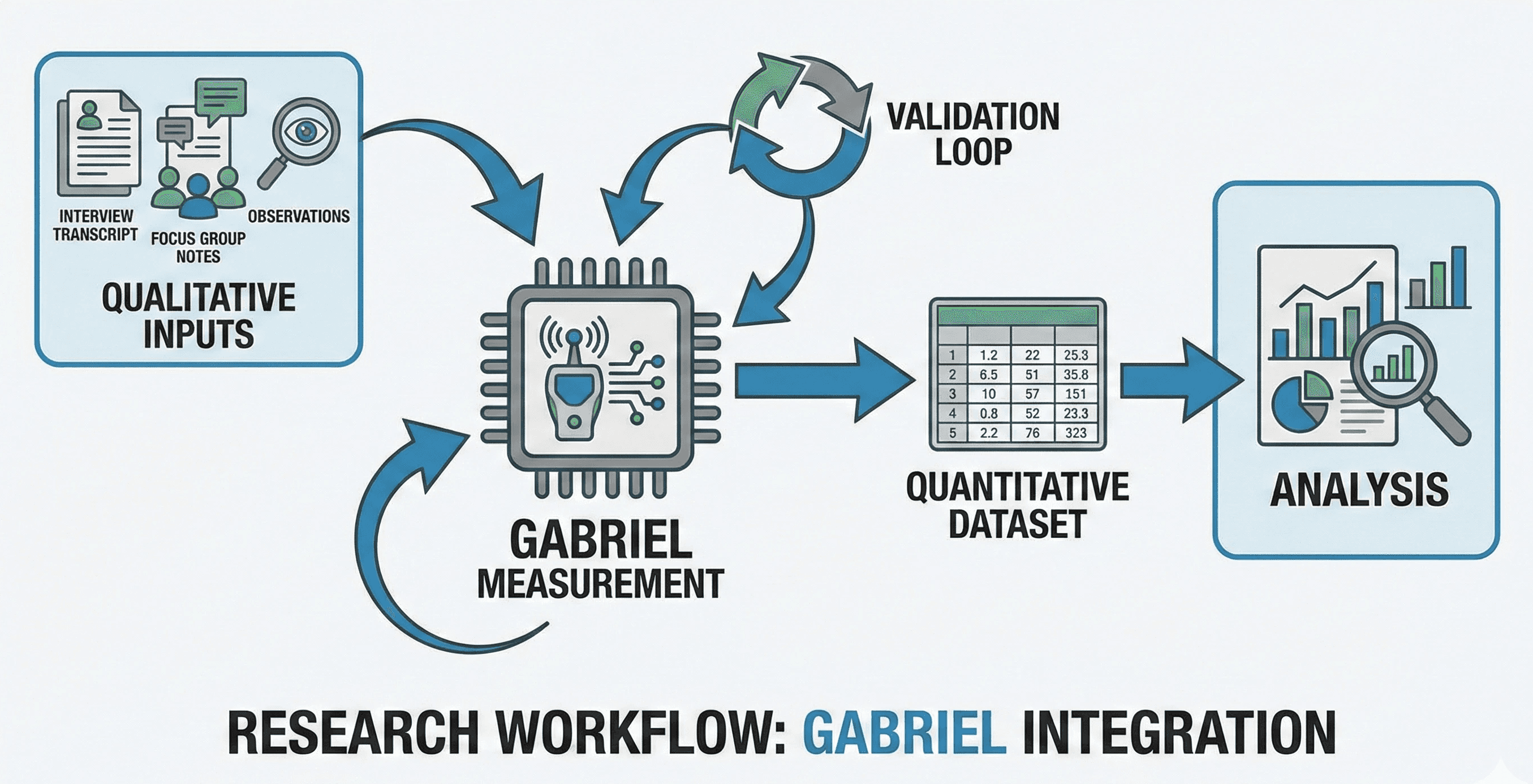
GABRIEL is best thought of as a measurement workflow: you define the attribute you want to quantify (for example, sentiment, policy stance, or “pro‑innovation” framing), then apply that measurement consistently across large volumes of data.

It’s not a magic “auto-truth” button. The value comes from making your coding more scalable and more auditable: you can test prompts, compare results against human labels, and iterate until the measurement behaves the way your study design requires.
What data can it handle?

OpenAI’s announcement focuses on text and images, and the GitHub repository description also notes audio as a supported modality.

That matters because many research datasets aren’t just spreadsheets — they’re mixed-media collections that are hard to quantify without an army of research assistants.

How it works in practice

A practical way to use GABRIEL is to treat it as a structured bridge between qualitative interpretation and quantitative analysis:

  1. Define the construct you want to measure (what “counts” and what doesn’t).

  2. Design a rubric and prompt that captures that construct consistently.

  3. Validate on a small sample (compare against expert labels; check edge cases; refine).

  4. Scale to the full dataset once your measurement is stable.

This approach keeps the research logic in the foreground, while letting the toolkit handle the repeatability and volume that makes manual analysis drag on for months.

Practical examples social scientists can start with

GABRIEL is particularly useful when you need to apply the same judgement many times, such as:

  • Coding themes or stances across thousands of policy documents

  • Turning open-ended survey responses into consistent categories

  • Measuring attributes in mixed datasets (text + images) for comparative studies

Summary

If your research workflow is bottlenecked by manual coding, GABRIEL offers a structured way to scale measurement across qualitative data — while keeping validation and interpretability in view. As an open-source toolkit, it’s accessible to researchers who want to build repeatable, testable measurement pipelines using GPT.

Next steps: Generation Digital can help you assess where GABRIEL fits in your methodology, design evaluation steps, and integrate the workflow into your existing tooling.

FAQs

Q1: How does GABRIEL improve research scalability?
By turning qualitative inputs into repeatable quantitative measurements, it reduces the amount of manual coding required and makes it feasible to analyse much larger datasets.

Q2: What types of data can GABRIEL handle?
OpenAI describes support for text and images, and the repository also mentions audio.

Q3: Is GABRIEL accessible to all researchers?
Yes. It’s released as open-source under the Apache 2.0 licence, so researchers can use and adapt it within the licence terms.

Q4: Does using GABRIEL remove the need for human validation?
No — the accompanying “GPT as a measurement tool” framing emphasises designing the measurement carefully and validating it, especially on a labelled subset, before scaling.

GABRIEL is an open-source toolkit from OpenAI that uses GPT to convert unstructured qualitative material — like text and images — into quantitative measurements. It helps social scientists define what they want to measure, apply consistent labelling at scale, and analyse large datasets faster than manual coding alone.

Qualitative data is rich — interviews, open-ended survey responses, policy documents, images — but it’s also slow to analyse when you’re coding by hand. That bottleneck makes it hard to run studies at the scale modern research questions demand.

GABRIEL is OpenAI’s new open-source toolkit built to close that gap. It uses GPT to help researchers turn unstructured inputs into quantitative measurements that can be analysed statistically, without losing the interpretability that social science requires.

What GABRIEL is (and what it isn’t)

GABRIEL is best thought of as a measurement workflow: you define the attribute you want to quantify (for example, sentiment, policy stance, or “pro‑innovation” framing), then apply that measurement consistently across large volumes of data.

It’s not a magic “auto-truth” button. The value comes from making your coding more scalable and more auditable: you can test prompts, compare results against human labels, and iterate until the measurement behaves the way your study design requires.

What data can it handle?

OpenAI’s announcement focuses on text and images, and the GitHub repository description also notes audio as a supported modality.

That matters because many research datasets aren’t just spreadsheets — they’re mixed-media collections that are hard to quantify without an army of research assistants.

How it works in practice

A practical way to use GABRIEL is to treat it as a structured bridge between qualitative interpretation and quantitative analysis:

  1. Define the construct you want to measure (what “counts” and what doesn’t).

  2. Design a rubric and prompt that captures that construct consistently.

  3. Validate on a small sample (compare against expert labels; check edge cases; refine).

  4. Scale to the full dataset once your measurement is stable.

This approach keeps the research logic in the foreground, while letting the toolkit handle the repeatability and volume that makes manual analysis drag on for months.

Practical examples social scientists can start with

GABRIEL is particularly useful when you need to apply the same judgement many times, such as:

  • Coding themes or stances across thousands of policy documents

  • Turning open-ended survey responses into consistent categories

  • Measuring attributes in mixed datasets (text + images) for comparative studies

Summary

If your research workflow is bottlenecked by manual coding, GABRIEL offers a structured way to scale measurement across qualitative data — while keeping validation and interpretability in view. As an open-source toolkit, it’s accessible to researchers who want to build repeatable, testable measurement pipelines using GPT.

Next steps: Generation Digital can help you assess where GABRIEL fits in your methodology, design evaluation steps, and integrate the workflow into your existing tooling.

FAQs

Q1: How does GABRIEL improve research scalability?
By turning qualitative inputs into repeatable quantitative measurements, it reduces the amount of manual coding required and makes it feasible to analyse much larger datasets.

Q2: What types of data can GABRIEL handle?
OpenAI describes support for text and images, and the repository also mentions audio.

Q3: Is GABRIEL accessible to all researchers?
Yes. It’s released as open-source under the Apache 2.0 licence, so researchers can use and adapt it within the licence terms.

Q4: Does using GABRIEL remove the need for human validation?
No — the accompanying “GPT as a measurement tool” framing emphasises designing the measurement carefully and validating it, especially on a labelled subset, before scaling.

Recibe noticias y consejos sobre IA cada semana en tu bandeja de entrada

Al suscribirte, das tu consentimiento para que Generation Digital almacene y procese tus datos de acuerdo con nuestra política de privacidad. Puedes leer la política completa en gend.co/privacy.


Próximos talleres y seminarios web

A diverse group of professionals collaborating around a table in a bright, modern office setting.

Claridad Operacional a Gran Escala - Asana

Webinar Virtual
Miércoles 25 de febrero de 2026
En línea

A diverse group of professionals collaborating around a table in a bright, modern office setting.

Trabaja con compañeros de equipo de IA - Asana

Taller Presencial
Jueves 26 de febrero de 2026
Londres, Reino Unido

A diverse group of professionals collaborating around a table in a bright, modern office setting.

De Idea a Prototipo: IA en Miro

Seminario Web Virtual
Miércoles 18 de febrero de 2026
En línea

Generación
Digital

Oficina en Reino Unido

Generation Digital Ltd
33 Queen St,
Londres
EC4R 1AP
Reino Unido

Oficina en Canadá

Generation Digital Americas Inc
181 Bay St., Suite 1800
Toronto, ON, M5J 2T9
Canadá

Oficina en EE. UU.

Generation Digital Américas Inc
77 Sands St,
Brooklyn, NY 11201,
Estados Unidos

Oficina de la UE

Software Generación Digital
Edificio Elgee
Dundalk
A91 X2R3
Irlanda

Oficina en Medio Oriente

6994 Alsharq 3890,
An Narjis,
Riad 13343,
Arabia Saudita

UK Fast Growth Index UBS Logo
Financial Times FT 1000 Logo
Febe Growth 100 Logo (Background Removed)

Número de la empresa: 256 9431 77 | Derechos de autor 2026 | Términos y Condiciones | Política de Privacidad

Generación
Digital

Oficina en Reino Unido

Generation Digital Ltd
33 Queen St,
Londres
EC4R 1AP
Reino Unido

Oficina en Canadá

Generation Digital Americas Inc
181 Bay St., Suite 1800
Toronto, ON, M5J 2T9
Canadá

Oficina en EE. UU.

Generation Digital Américas Inc
77 Sands St,
Brooklyn, NY 11201,
Estados Unidos

Oficina de la UE

Software Generación Digital
Edificio Elgee
Dundalk
A91 X2R3
Irlanda

Oficina en Medio Oriente

6994 Alsharq 3890,
An Narjis,
Riad 13343,
Arabia Saudita

UK Fast Growth Index UBS Logo
Financial Times FT 1000 Logo
Febe Growth 100 Logo (Background Removed)


Número de Empresa: 256 9431 77
Términos y Condiciones
Política de Privacidad
Derechos de Autor 2026





