Discover AI Marketing: 25 Expert Prompts for Success in 2026

Discover AI Marketing: 25 Expert Prompts for Success in 2026

Gather

Conceptual

Featured List
Dec 9, 2025

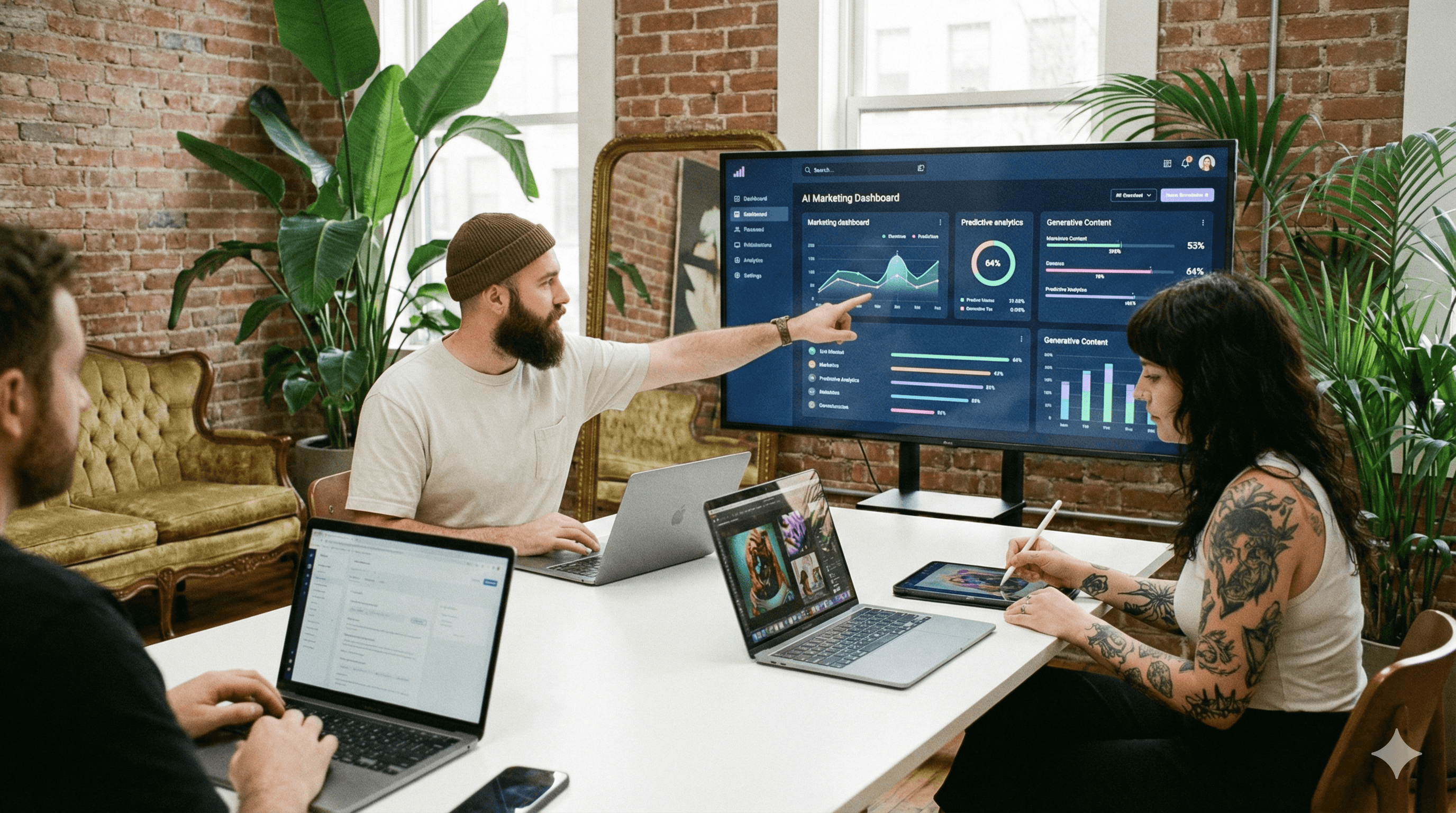
A team of professionals works together in a modern office, interacting with a data-rich digital marketing dashboard displayed on a large screen and using laptops, showcasing the integration of marketing AI prompts in business strategy.

Not sure what to do next with AI?
Assess readiness, risk, and priorities in under an hour.

Not sure what to do next with AI?
Assess readiness, risk, and priorities in under an hour.

➔ Schedule a Consultation

Looking for 25 AI marketing prompts for 2026? Use our ready-made prompts to plan your campaigns, create engaging content, personalize customer experiences, and optimize spending. Each prompt includes context fields, governance advice, and success metrics, empowering your team to adopt AI with confidence and responsibility across strategy, content, ads, email, and analytics.

The Importance of Marketing AI in 2026

In 2025, generative and agentic AI shifted from experimental to impactful applications. Teams now leverage AI for campaign planning, generating creative ad variants, predicting demand, and orchestrating omnichannel customer journeys. Meanwhile, privacy reforms and the phasing out of third-party cookies are making first-party data and transparent AI practices essential. The prompts below enable you to produce higher-quality work at a faster pace while maintaining brand safety and compliance.

How to Effectively Use These Prompts

  1. Copy and paste into your preferred AI assistant (ChatGPT, Gemini, Copilot, etc.).

  2. Add your context: industry, audience, tone, objectives, KPIs, brand terms, compliance notes.

  3. Iterate: run 2–3 variations, A/B test outputs, and maintain a prompt library in Notion or Glean.

  4. Review: human-in-the-loop editing for truth, tone, and legal approvals.

25 Expert AI Marketing Prompts for 2026

Tip: Wherever you see [brackets], replace with your specifics.

Strategy & Planning

  1. Quarterly Marketing Plan
    “Act as a CMO for a Canada-based [industry] brand. Develop a quarterly plan covering ICPs, channels, budget distribution, and 3 main objectives. Include risks, mitigation strategies, and an executive summary. Optimize for [goal/KPI].”

  2. Go-To-Market Messaging Map
    “Using the [product] positioning and [customer interviews], create a messaging matrix segmented by pain points, value, proof, and CTA. Output a table ready for presentation.”

  3. Budget Reallocation
    “Based on last quarter’s results (CPL, ROAS, CAC:LTV) and a $[budget], propose a reallocation by channel with justifications and confidence levels. Include a 10% testing budget.”

Audience, Research & Data

  1. Voice of Customer Synthesizer
    “Summarize themes from these 30 reviews/interviews. Extract the top 10 pain points, desired outcomes, precise phrases, and objections. Provide messaging angles and a list of what not to say.”

  2. Segmentation Draft
    “Propose practical segments using first-party data fields [fields]. For each segment: problem to solve, value proposition, hooks, and claims to avoid.”

  3. Jobs-to-Be-Done
    “Create 3 JTBD statements for buyers of [product]. Include triggers and concerns. Suggest content to guide them from challenges to desired outcomes.”

Content & SEO

  1. SEO Content Brief
    “Create an SEO brief for ‘[keyword]’ (Canada). Include intent, outline, FAQs, internal link targets, and schema. Focus on featured snippets and People Also Ask sections.”

  2. Thought Leadership Outline
    “Draft a 1,200-word POV on [industry shift] tailored for a Canadian audience. Reference reputable data points with links and propose 3 original frameworks.”

  3. E-E-A-T Enhancer
    “Edit this article for expertise and trust: add author bio, cite primary sources, specify dates, and include a limitations section and update policy.”

Creative & Brand

  1. Tone Transposer
    “Rewrite this copy in our brand voice: [voice traits]. Keep the original meaning. Provide a before/after table and a checklist to maintain tone consistently.”

  2. Concepting Sprint
    “Generate 10 campaign ideas for [launch]. For each: headline, tagline, key visual prompt, social hooks, and proof points.”

  3. Asset Variant Generator
    “Produce 6 copy variants for a 15-second vertical video on [offer]. Include compliance disclaimers suitable for Canada and alternative text suggestions.”

Paid Media & Retail Media

  1. ROAS Optimizer
    “Given this data feed and these constraints (bid caps, brand exclusions), propose audience, creative, and placement tests to increase ROAS from [x] to [y] within 4 weeks.”


  2. Retail Media Playbook
    “Design a test plan for [Amazon/retailer], including a search versus display budget allocation, keyword clusters, product page enhancements, and cross-sell bundles.”


  3. Creative Fit-Check
    “Audit these 5 video ads against platform best practices for [YouTube/TikTok/Meta/LinkedIn]. Provide a pass/fail assessment with necessary revisions and new hooks for the first 3 seconds.”

Email, Lifecycle & Personalisation

  1. Lifecycle Map
    “Create an event-based lifecycle for [product] using first-party data. Define triggers, personalization fields, suppression logic, and success metrics.”


  2. Subject Line Studio
    “Generate 12 subject lines and preheaders for [campaign] using curiosity, benefit, and urgency frameworks. Return a table predicting open-rate categories.”


  3. Offer Personalizer
    “Using segments [A/B/C], create personalized offers and CTAs. Include fairness checks and an override option if users opt out of personalization.”

Social, Community & PR

  1. Social Content System
    “Plan a 30-day schedule for LinkedIn and Instagram: topics, hooks, carousels, and user-generated content prompts related to [theme]. Include repost guidelines and moderation rules.”


  2. Influencer Shortlist
    “Compile a shortlist of 15 Canadian creators who match [niche]. Evaluate on audience authenticity, brand fit, and past performance. Provide outreach messages.”


  3. Crisis Response Draft
    “Create a tiered response plan for [issue]. Include 3 prepared statements, spokesperson briefs, Q&As, and escalation procedures aligned with Canadian privacy laws and company policy.”

Analytics, Testing & Governance

  1. Experiment Planner
    “Outline an A/B testing roadmap for [funnel stage]. Include hypotheses, sample size estimates, minimal detectable effects, and decision rules. Produce a calendar.”


  2. Attribution Sanity Check
    “Explain model differences (last-click, data-driven, MMM). Suggest a practical approach given our $[budget] and data maturity. Identify pitfalls and outline a 90-day action plan.”


  3. AI Usage Policy
    “Draft a marketing AI usage policy addressing data handling, disclosure, approval steps, and risks. Include a one-page training checklist for the team.”


  4. Risk & Bias Review
    “Evaluate this personalized journey for bias/consent risks and suggest mitigations. Provide a DPIA-friendly summary and a simple customer explanation.”

Practical Workflows

A. First-Party Data Personalization

  • Inputs: CRM fields (consented), product feed, web events.

  • Flow: segment → prompt 18 → creative variants → QA → send → A/B testing learnings.

  • Guardrails: explicit consent, easy opt-out options, fairness checks.

  • Success: increased CTR, conversion rates, and customer lifetime value by segment.

B. Content Operations with Human-in-the-Loop

  • Inputs: keyword map, expert notes, brand voice.

  • Flow: prompt 7 → draft → subject matter expert review → prompt 9 for E-E-A-T → publish.

  • Guardrails: cite primary sources, use date stamps, follow an update schedule.

  • Success: featured snippet wins, organic traffic growth, and increased assisted conversions.

C. Paid Media Incrementality

  • Inputs: channel performance, audience overlaps.

  • Flow: prompt 13 → 2x2 creative/messaging test → negative keyword cleaning → MMM validation.

  • Guardrails: frequency caps, brand safety lists.

  • Success: improved ROAS, lower CAC, verified incremental benefits.

What's New for 2026

  • Agentic Workflows: multi-step tasks like media planning, QA, and reporting managed by AI with human approvals.

  • Privacy-Centric Targeting: reliance on first-party data and contextual signals instead of third-party cookies; plan migrations and customer communications.

  • Retail Media Surge: increased budget allocation to retail networks; creative and product display page optimization become essential.

  • Trust by Design: incorporate clearer AI disclosures, explainability, and data protection into processes.

Key Benefits

  • Faster Creativity: structured ideation across multiple channels in minutes.

  • More Precise Strategy: data-informed plans with measurable tests.

  • Enhanced Personalization: responsibly use first-party data to increase relevance and conversion rates.


FAQs

How can AI improve marketing strategy?
By converting data into decisions—from segmentation to budget allocation—and quickly generating creative options for testing. Keeping humans in the loop ensures approvals and brand uniqueness.

What are practical AI use cases in marketing?
Content briefs, multivariate creative testing, lifecycle automation, media optimization, product page improvements, and synthesizing customer research.

How do we personalize without third-party cookies?
Leverage consented first-party data, contextual signals, and platform privacy solutions. Communicate value, offer easy control options, and test responsibly.

How do we ensure AI outputs are accurate?
Provide high-quality inputs, request sources, establish non-negotiables (claims, tone, compliance), and require expert reviews before publication.

Next Steps

AI can significantly enhance your team’s creativity and speed - when combined with strong governance. Use these prompts to systematize ideation, personalization, and optimization, then focus on measurement that matters.

Ready to implement AI? Contact Generation Digital for playbooks, training, and integrations tailored across your systems.

Looking for 25 AI marketing prompts for 2026? Use our ready-made prompts to plan your campaigns, create engaging content, personalize customer experiences, and optimize spending. Each prompt includes context fields, governance advice, and success metrics, empowering your team to adopt AI with confidence and responsibility across strategy, content, ads, email, and analytics.

The Importance of Marketing AI in 2026

In 2025, generative and agentic AI shifted from experimental to impactful applications. Teams now leverage AI for campaign planning, generating creative ad variants, predicting demand, and orchestrating omnichannel customer journeys. Meanwhile, privacy reforms and the phasing out of third-party cookies are making first-party data and transparent AI practices essential. The prompts below enable you to produce higher-quality work at a faster pace while maintaining brand safety and compliance.

How to Effectively Use These Prompts

  1. Copy and paste into your preferred AI assistant (ChatGPT, Gemini, Copilot, etc.).

  2. Add your context: industry, audience, tone, objectives, KPIs, brand terms, compliance notes.

  3. Iterate: run 2–3 variations, A/B test outputs, and maintain a prompt library in Notion or Glean.

  4. Review: human-in-the-loop editing for truth, tone, and legal approvals.

25 Expert AI Marketing Prompts for 2026

Tip: Wherever you see [brackets], replace with your specifics.

Strategy & Planning

  1. Quarterly Marketing Plan
    “Act as a CMO for a Canada-based [industry] brand. Develop a quarterly plan covering ICPs, channels, budget distribution, and 3 main objectives. Include risks, mitigation strategies, and an executive summary. Optimize for [goal/KPI].”

  2. Go-To-Market Messaging Map
    “Using the [product] positioning and [customer interviews], create a messaging matrix segmented by pain points, value, proof, and CTA. Output a table ready for presentation.”

  3. Budget Reallocation
    “Based on last quarter’s results (CPL, ROAS, CAC:LTV) and a $[budget], propose a reallocation by channel with justifications and confidence levels. Include a 10% testing budget.”

Audience, Research & Data

  1. Voice of Customer Synthesizer
    “Summarize themes from these 30 reviews/interviews. Extract the top 10 pain points, desired outcomes, precise phrases, and objections. Provide messaging angles and a list of what not to say.”

  2. Segmentation Draft
    “Propose practical segments using first-party data fields [fields]. For each segment: problem to solve, value proposition, hooks, and claims to avoid.”

  3. Jobs-to-Be-Done
    “Create 3 JTBD statements for buyers of [product]. Include triggers and concerns. Suggest content to guide them from challenges to desired outcomes.”

Content & SEO

  1. SEO Content Brief
    “Create an SEO brief for ‘[keyword]’ (Canada). Include intent, outline, FAQs, internal link targets, and schema. Focus on featured snippets and People Also Ask sections.”

  2. Thought Leadership Outline
    “Draft a 1,200-word POV on [industry shift] tailored for a Canadian audience. Reference reputable data points with links and propose 3 original frameworks.”

  3. E-E-A-T Enhancer
    “Edit this article for expertise and trust: add author bio, cite primary sources, specify dates, and include a limitations section and update policy.”

Creative & Brand

  1. Tone Transposer
    “Rewrite this copy in our brand voice: [voice traits]. Keep the original meaning. Provide a before/after table and a checklist to maintain tone consistently.”

  2. Concepting Sprint
    “Generate 10 campaign ideas for [launch]. For each: headline, tagline, key visual prompt, social hooks, and proof points.”

  3. Asset Variant Generator
    “Produce 6 copy variants for a 15-second vertical video on [offer]. Include compliance disclaimers suitable for Canada and alternative text suggestions.”

Paid Media & Retail Media

  1. ROAS Optimizer
    “Given this data feed and these constraints (bid caps, brand exclusions), propose audience, creative, and placement tests to increase ROAS from [x] to [y] within 4 weeks.”


  2. Retail Media Playbook
    “Design a test plan for [Amazon/retailer], including a search versus display budget allocation, keyword clusters, product page enhancements, and cross-sell bundles.”


  3. Creative Fit-Check
    “Audit these 5 video ads against platform best practices for [YouTube/TikTok/Meta/LinkedIn]. Provide a pass/fail assessment with necessary revisions and new hooks for the first 3 seconds.”

Email, Lifecycle & Personalisation

  1. Lifecycle Map
    “Create an event-based lifecycle for [product] using first-party data. Define triggers, personalization fields, suppression logic, and success metrics.”


  2. Subject Line Studio
    “Generate 12 subject lines and preheaders for [campaign] using curiosity, benefit, and urgency frameworks. Return a table predicting open-rate categories.”


  3. Offer Personalizer
    “Using segments [A/B/C], create personalized offers and CTAs. Include fairness checks and an override option if users opt out of personalization.”

Social, Community & PR

  1. Social Content System
    “Plan a 30-day schedule for LinkedIn and Instagram: topics, hooks, carousels, and user-generated content prompts related to [theme]. Include repost guidelines and moderation rules.”


  2. Influencer Shortlist
    “Compile a shortlist of 15 Canadian creators who match [niche]. Evaluate on audience authenticity, brand fit, and past performance. Provide outreach messages.”


  3. Crisis Response Draft
    “Create a tiered response plan for [issue]. Include 3 prepared statements, spokesperson briefs, Q&As, and escalation procedures aligned with Canadian privacy laws and company policy.”

Analytics, Testing & Governance

  1. Experiment Planner
    “Outline an A/B testing roadmap for [funnel stage]. Include hypotheses, sample size estimates, minimal detectable effects, and decision rules. Produce a calendar.”


  2. Attribution Sanity Check
    “Explain model differences (last-click, data-driven, MMM). Suggest a practical approach given our $[budget] and data maturity. Identify pitfalls and outline a 90-day action plan.”


  3. AI Usage Policy
    “Draft a marketing AI usage policy addressing data handling, disclosure, approval steps, and risks. Include a one-page training checklist for the team.”


  4. Risk & Bias Review
    “Evaluate this personalized journey for bias/consent risks and suggest mitigations. Provide a DPIA-friendly summary and a simple customer explanation.”

Practical Workflows

A. First-Party Data Personalization

  • Inputs: CRM fields (consented), product feed, web events.

  • Flow: segment → prompt 18 → creative variants → QA → send → A/B testing learnings.

  • Guardrails: explicit consent, easy opt-out options, fairness checks.

  • Success: increased CTR, conversion rates, and customer lifetime value by segment.

B. Content Operations with Human-in-the-Loop

  • Inputs: keyword map, expert notes, brand voice.

  • Flow: prompt 7 → draft → subject matter expert review → prompt 9 for E-E-A-T → publish.

  • Guardrails: cite primary sources, use date stamps, follow an update schedule.

  • Success: featured snippet wins, organic traffic growth, and increased assisted conversions.

C. Paid Media Incrementality

  • Inputs: channel performance, audience overlaps.

  • Flow: prompt 13 → 2x2 creative/messaging test → negative keyword cleaning → MMM validation.

  • Guardrails: frequency caps, brand safety lists.

  • Success: improved ROAS, lower CAC, verified incremental benefits.

What's New for 2026

  • Agentic Workflows: multi-step tasks like media planning, QA, and reporting managed by AI with human approvals.

  • Privacy-Centric Targeting: reliance on first-party data and contextual signals instead of third-party cookies; plan migrations and customer communications.

  • Retail Media Surge: increased budget allocation to retail networks; creative and product display page optimization become essential.

  • Trust by Design: incorporate clearer AI disclosures, explainability, and data protection into processes.

Key Benefits

  • Faster Creativity: structured ideation across multiple channels in minutes.

  • More Precise Strategy: data-informed plans with measurable tests.

  • Enhanced Personalization: responsibly use first-party data to increase relevance and conversion rates.


FAQs

How can AI improve marketing strategy?
By converting data into decisions—from segmentation to budget allocation—and quickly generating creative options for testing. Keeping humans in the loop ensures approvals and brand uniqueness.

What are practical AI use cases in marketing?
Content briefs, multivariate creative testing, lifecycle automation, media optimization, product page improvements, and synthesizing customer research.

How do we personalize without third-party cookies?
Leverage consented first-party data, contextual signals, and platform privacy solutions. Communicate value, offer easy control options, and test responsibly.

How do we ensure AI outputs are accurate?
Provide high-quality inputs, request sources, establish non-negotiables (claims, tone, compliance), and require expert reviews before publication.

Next Steps

AI can significantly enhance your team’s creativity and speed - when combined with strong governance. Use these prompts to systematize ideation, personalization, and optimization, then focus on measurement that matters.

Ready to implement AI? Contact Generation Digital for playbooks, training, and integrations tailored across your systems.

Receive practical advice directly in your inbox

By subscribing, you agree to allow Generation Digital to store and process your information according to our privacy policy. You can review the full policy at gend.co/privacy.


Are you ready to get the support your organization needs to successfully leverage AI?

Miro Solutions Partner
Asana Platinum Solutions Partner
Notion Platinum Solutions Partner
Glean Certified Partner

Ready to get the support your organization needs to successfully use AI?

Miro Solutions Partner
Asana Platinum Solutions Partner
Notion Platinum Solutions Partner
Glean Certified Partner

Generation
Digital

Canadian Office
33 Queen St,
Toronto
M5H 2N2
Canada

Canadian Office
1 University Ave,
Toronto,
ON M5J 1T1,
Canada

NAMER Office
77 Sands St,
Brooklyn,
NY 11201,
USA

Head Office
Charlemont St, Saint Kevin's, Dublin,
D02 VN88,
Ireland

Middle East Office
6994 Alsharq 3890,
An Narjis,
Riyadh 13343,
Saudi Arabia

UK Fast Growth Index UBS Logo
Financial Times FT 1000 Logo
Febe Growth 100 Logo (Background Removed)

Business Number: 256 9431 77 | Copyright 2026 | Terms and Conditions | Privacy Policy

Generation
Digital

Canadian Office
33 Queen St,
Toronto
M5H 2N2
Canada

Canadian Office
1 University Ave,
Toronto,
ON M5J 1T1,
Canada

NAMER Office
77 Sands St,
Brooklyn,
NY 11201,
USA

Head Office
Charlemont St, Saint Kevin's, Dublin,
D02 VN88,
Ireland

Middle East Office
6994 Alsharq 3890,
An Narjis,
Riyadh 13343,
Saudi Arabia

UK Fast Growth Index UBS Logo
Financial Times FT 1000 Logo
Febe Growth 100 Logo (Background Removed)


Business No: 256 9431 77
Terms and Conditions
Privacy Policy
© 2026





