AI Expansion: Simplify Tool Overload with Miro AI

AI Expansion: Simplify Tool Overload with Miro AI

Miro
Dec 3, 2025

A man is sitting at a desk in a modern office, using dual monitors displaying code and a collaborative platform, illustrating the use of Glean Code Search and Writing Tools.

Not sure what to do next with AI?
Assess readiness, risk, and priorities in under an hour.

Not sure what to do next with AI?
Assess readiness, risk, and priorities in under an hour.

➔ Schedule a Consultation

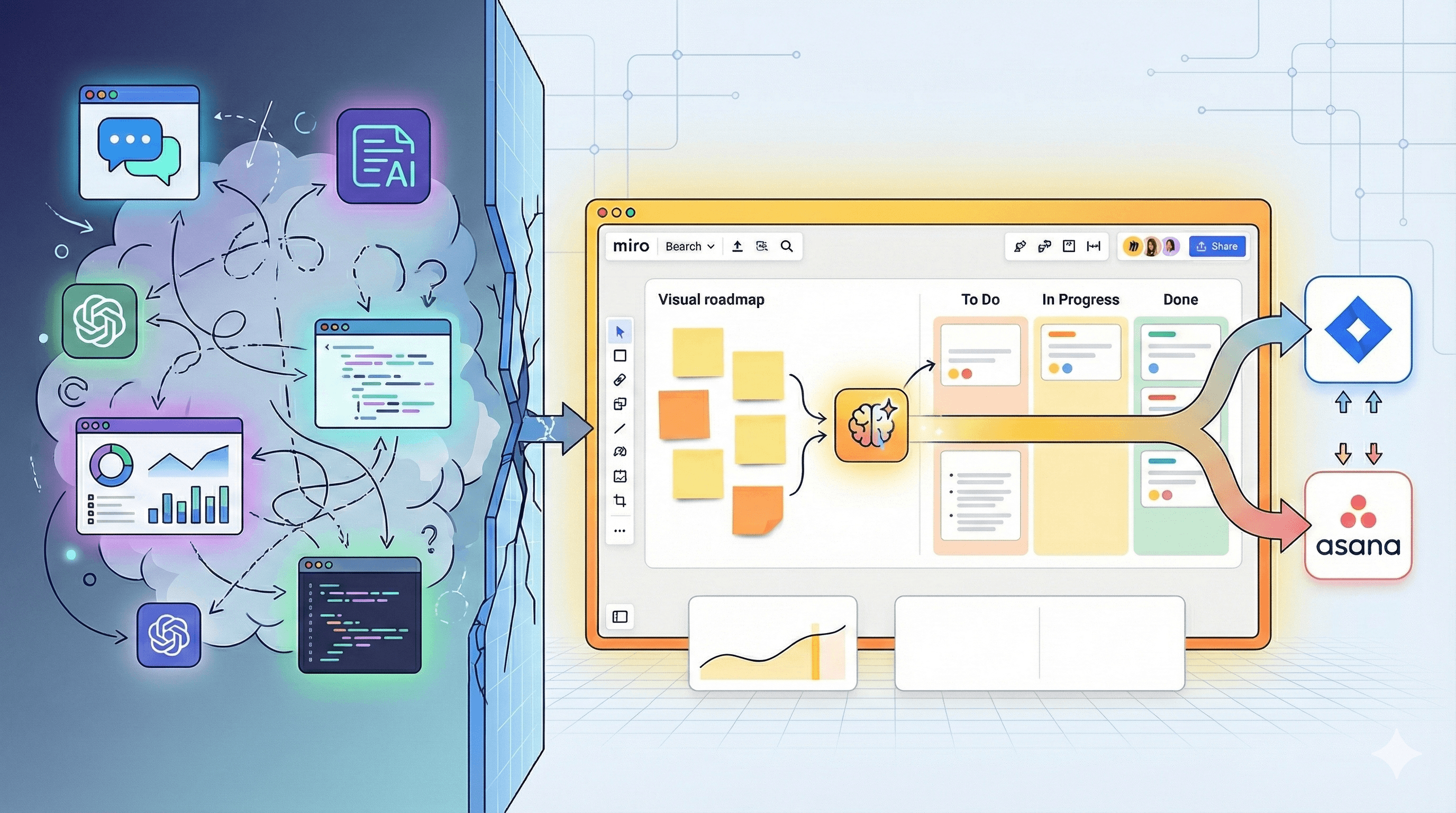
AI sprawl is what happens when too many disconnected AI tools spread haphazardly through your tech systems. This leads to switching between tasks, repeated data, and lapses in oversight, making it hard to see a return on investment. The solution? Consolidation: integrate AI where your work gets done, linking planning with execution via two-way integrations.

AI Sprawl: The Hidden Cost of Your Digital Transformation

You’re investing in AI to boost productivity, but the payoff feels lacking. The problem often lies with AI sprawl: an increasing collection of disjointed AI apps cluttering your existing tools. Executives note the friction caused by toggling between primary work apps and separate AI tools, which disrupts workflow — the exact opposite of AI's promise. When AI is segregated from your workflow, you inevitably automate confusion instead of achieving clarity.

Why AI sprawl occurs (and why it’s escalating)

Many organizations have adopted AI on an ad hoc basis — a chatbot here, a summarizer there — without addressing app sprawl first. Each new tool introduces another layer of complexity, more logins, and additional data silos. Employees bounce between planning tools, execution tools, and standalone AI helpers. This complicates governance and security, while knowledge becomes fragmented across systems. The upshot? You spend more time managing your toolset than forwarding your work.

The consolidation blueprint: AI at the point of work

Top-performing companies are stabilizing their foundations before AI adds to the complexity. The key principle is: bring AI to where the work is, not the other way around.

Meet Miro — the innovation workspace built to tackle tool overload by integrating AI onto a visual platform. In a unified space, teams can transition from brainstorming to organized execution while maintaining a link between planning and output. Miro doesn’t force teams into rigid workflows; instead, it adapts to the actual working styles of cross-functional teams.

From ideas to outcomes: Miro’s tools for order and efficiency

AI-enhanced templates and boards. Forget starting from scratch. Use smart templates and AI on the platform to convert ideas, notes, and early concepts into structured strategies, briefs, and roadmaps. The platform provides context for AI, ensuring outcomes match your team’s terminology and frameworks.

Kanban for visual project planning. Quickly build Kanban boards, designate tasks and deadlines, and visualize workflow. Use cards to detail tasks and link to other systems. Visual progress indicators allow everyone to instantly gauge status.

Two-way sync with delivery tools. Keep planning in Miro connected with actual execution in your primary systems. Sync Kanban cards with Jira and — now in beta — Asana to ensure updates are mutual. Designers, project managers, and engineers work from an identical, up-to-date state, eliminating redundant updates.

AI that comprehends context. Because Miro’s AI operates where your tasks unfold, it can convert sticky notes into tables, diagrams into documents, and draft content without needing to switch contexts. You save time on exporting, reformatting, and explaining contexts to separate tools — and spend that time delivering results.

Proof that consolidation yields benefits

Clients report clear benefits when they bring planning and collaboration into Miro:

  • Alignment: 80% say Miro enhances cross-team alignment, clarifying shared objectives and decisions.

  • Speed: Teams report a ~19% cut in time required to finish projects following consolidation, thanks to fewer transitions and less redundancy.

  • Productivity: Users experience notable productivity boosts when AI and teamwork converge on one platform.

These outcomes collectively become self-reinforcing: stronger alignment boosts quality, faster feedback speeds up delivery, and reduced app clutter cuts costs and risk.

What this looks like in practice

  1. Plan visually, then sync. Facilitate brainstorming and planning in Miro (workshops, story mapping, PI planning). Transform results into a Kanban board and sync the board’s tasks with Jira or Asana.

  2. Maintain a single source of truth. Let engineering continue work in Jira while product/design iterate in Miro. Two-way sync ensures both perspectives are based on reality.

  3. Automate routine tasks. Use AI to create initial task drafts, convert note clusters into epics, condense feedback, or translate content for stakeholders.

  4. Assess impact. Measure cycle time and lead time before and after consolidation. Share progress with executives using concise dashboards on the platform.

Effective governance, less hassle

Consolidation enhances security measures. With fewer overlapping apps, IT can standardize authentication, permissions, and data storage. Miro’s enterprise features, auditable functions, and partner ecosystem help secure integrations while curtailing shadow IT and unmonitored data flows.

Action: Evaluate your stack today

Strategic consolidation is key to AI success. Our team assists IT leaders in viewing app rationalization as a strategic move, not merely a cost-saving measure. Begin by assessing your current tools and pinpointing consolidation chances that align with your business aims and delivery approach.

Contact Generation Digital to discuss how we can establish an enterprise-level foundation with Miro — embedding AI where work actually occurs and revolutionizing workflow execution.

FAQ

What is AI sprawl? The unchecked expansion of disparate AI tools within a fragmented system, causing context-switching, data silos, and governance issues.

Why does AI sprawl reduce ROI? Because AI is removed from the workflow. Fragmentation brings friction, redundancy, and extra work, meaning gains don't turn into results.

How does Miro help? It combines planning and teamwork on one platform, embeds AI into the context, and connects to Jira/Asana with two-way syncing for orderly execution.

Is two-way sync available for Jira and Asana? Jira two-way sync is available; Asana's is in beta but evolving. Both ensure planning and execution stay in sync.

What results can we expect? Organizations frequently achieve higher alignment and quicker project completions post-Miro consolidation, alongside better governance.

AI sprawl is what happens when too many disconnected AI tools spread haphazardly through your tech systems. This leads to switching between tasks, repeated data, and lapses in oversight, making it hard to see a return on investment. The solution? Consolidation: integrate AI where your work gets done, linking planning with execution via two-way integrations.

AI Sprawl: The Hidden Cost of Your Digital Transformation

You’re investing in AI to boost productivity, but the payoff feels lacking. The problem often lies with AI sprawl: an increasing collection of disjointed AI apps cluttering your existing tools. Executives note the friction caused by toggling between primary work apps and separate AI tools, which disrupts workflow — the exact opposite of AI's promise. When AI is segregated from your workflow, you inevitably automate confusion instead of achieving clarity.

Why AI sprawl occurs (and why it’s escalating)

Many organizations have adopted AI on an ad hoc basis — a chatbot here, a summarizer there — without addressing app sprawl first. Each new tool introduces another layer of complexity, more logins, and additional data silos. Employees bounce between planning tools, execution tools, and standalone AI helpers. This complicates governance and security, while knowledge becomes fragmented across systems. The upshot? You spend more time managing your toolset than forwarding your work.

The consolidation blueprint: AI at the point of work

Top-performing companies are stabilizing their foundations before AI adds to the complexity. The key principle is: bring AI to where the work is, not the other way around.

Meet Miro — the innovation workspace built to tackle tool overload by integrating AI onto a visual platform. In a unified space, teams can transition from brainstorming to organized execution while maintaining a link between planning and output. Miro doesn’t force teams into rigid workflows; instead, it adapts to the actual working styles of cross-functional teams.

From ideas to outcomes: Miro’s tools for order and efficiency

AI-enhanced templates and boards. Forget starting from scratch. Use smart templates and AI on the platform to convert ideas, notes, and early concepts into structured strategies, briefs, and roadmaps. The platform provides context for AI, ensuring outcomes match your team’s terminology and frameworks.

Kanban for visual project planning. Quickly build Kanban boards, designate tasks and deadlines, and visualize workflow. Use cards to detail tasks and link to other systems. Visual progress indicators allow everyone to instantly gauge status.

Two-way sync with delivery tools. Keep planning in Miro connected with actual execution in your primary systems. Sync Kanban cards with Jira and — now in beta — Asana to ensure updates are mutual. Designers, project managers, and engineers work from an identical, up-to-date state, eliminating redundant updates.

AI that comprehends context. Because Miro’s AI operates where your tasks unfold, it can convert sticky notes into tables, diagrams into documents, and draft content without needing to switch contexts. You save time on exporting, reformatting, and explaining contexts to separate tools — and spend that time delivering results.

Proof that consolidation yields benefits

Clients report clear benefits when they bring planning and collaboration into Miro:

  • Alignment: 80% say Miro enhances cross-team alignment, clarifying shared objectives and decisions.

  • Speed: Teams report a ~19% cut in time required to finish projects following consolidation, thanks to fewer transitions and less redundancy.

  • Productivity: Users experience notable productivity boosts when AI and teamwork converge on one platform.

These outcomes collectively become self-reinforcing: stronger alignment boosts quality, faster feedback speeds up delivery, and reduced app clutter cuts costs and risk.

What this looks like in practice

  1. Plan visually, then sync. Facilitate brainstorming and planning in Miro (workshops, story mapping, PI planning). Transform results into a Kanban board and sync the board’s tasks with Jira or Asana.

  2. Maintain a single source of truth. Let engineering continue work in Jira while product/design iterate in Miro. Two-way sync ensures both perspectives are based on reality.

  3. Automate routine tasks. Use AI to create initial task drafts, convert note clusters into epics, condense feedback, or translate content for stakeholders.

  4. Assess impact. Measure cycle time and lead time before and after consolidation. Share progress with executives using concise dashboards on the platform.

Effective governance, less hassle

Consolidation enhances security measures. With fewer overlapping apps, IT can standardize authentication, permissions, and data storage. Miro’s enterprise features, auditable functions, and partner ecosystem help secure integrations while curtailing shadow IT and unmonitored data flows.

Action: Evaluate your stack today

Strategic consolidation is key to AI success. Our team assists IT leaders in viewing app rationalization as a strategic move, not merely a cost-saving measure. Begin by assessing your current tools and pinpointing consolidation chances that align with your business aims and delivery approach.

Contact Generation Digital to discuss how we can establish an enterprise-level foundation with Miro — embedding AI where work actually occurs and revolutionizing workflow execution.

FAQ

What is AI sprawl? The unchecked expansion of disparate AI tools within a fragmented system, causing context-switching, data silos, and governance issues.

Why does AI sprawl reduce ROI? Because AI is removed from the workflow. Fragmentation brings friction, redundancy, and extra work, meaning gains don't turn into results.

How does Miro help? It combines planning and teamwork on one platform, embeds AI into the context, and connects to Jira/Asana with two-way syncing for orderly execution.

Is two-way sync available for Jira and Asana? Jira two-way sync is available; Asana's is in beta but evolving. Both ensure planning and execution stay in sync.

What results can we expect? Organizations frequently achieve higher alignment and quicker project completions post-Miro consolidation, alongside better governance.

Receive practical advice directly in your inbox

By subscribing, you agree to allow Generation Digital to store and process your information according to our privacy policy. You can review the full policy at gend.co/privacy.


Are you ready to get the support your organization needs to successfully leverage AI?

Miro Solutions Partner
Asana Platinum Solutions Partner
Notion Platinum Solutions Partner
Glean Certified Partner

Ready to get the support your organization needs to successfully use AI?

Miro Solutions Partner
Asana Platinum Solutions Partner
Notion Platinum Solutions Partner
Glean Certified Partner

Generation
Digital

Canadian Office
33 Queen St,
Toronto
M5H 2N2
Canada

Canadian Office
1 University Ave,
Toronto,
ON M5J 1T1,
Canada

NAMER Office
77 Sands St,
Brooklyn,
NY 11201,
USA

Head Office
Charlemont St, Saint Kevin's, Dublin,
D02 VN88,
Ireland

Middle East Office
6994 Alsharq 3890,
An Narjis,
Riyadh 13343,
Saudi Arabia

UK Fast Growth Index UBS Logo
Financial Times FT 1000 Logo
Febe Growth 100 Logo (Background Removed)

Business Number: 256 9431 77 | Copyright 2026 | Terms and Conditions | Privacy Policy

Generation
Digital

Canadian Office
33 Queen St,
Toronto
M5H 2N2
Canada

Canadian Office
1 University Ave,
Toronto,
ON M5J 1T1,
Canada

NAMER Office
77 Sands St,
Brooklyn,
NY 11201,
USA

Head Office
Charlemont St, Saint Kevin's, Dublin,
D02 VN88,
Ireland

Middle East Office
6994 Alsharq 3890,
An Narjis,
Riyadh 13343,
Saudi Arabia

UK Fast Growth Index UBS Logo
Financial Times FT 1000 Logo
Febe Growth 100 Logo (Background Removed)


Business No: 256 9431 77
Terms and Conditions
Privacy Policy
© 2026





