Enhance Accessibility Testing with Asana’s Innovative Approaches

Enhance Accessibility Testing with Asana’s Innovative Approaches

Asana
Dec 6, 2025

Uncertain about how to get started with AI?
Evaluate your readiness, potential risks, and key priorities in less than an hour.

Uncertain about how to get started with AI?
Evaluate your readiness, potential risks, and key priorities in less than an hour.

➔ Download Our Free AI Preparedness Pack

Asana reduced the duration of accessibility bug cycles from weeks to hours by organizing checks, automating prioritization, and directing issues straight to the appropriate teams, who generally resolve them within days. This approach combines straightforward automation with precise triage and verification, allowing clear, easy-to-fix issues to emerge early and be resolved faster.

Why this matters now

Accessibility issues often linger because they’re identified late, lack clear ownership, or don’t have actionable context. Asana revamped its testing workflow to ensure obvious, high-impact fixes appear quickly, reach the appropriate team, and are resolved swiftly—changing resolution time from weeks to hours in many instances.

What’s new in Asana’s approach

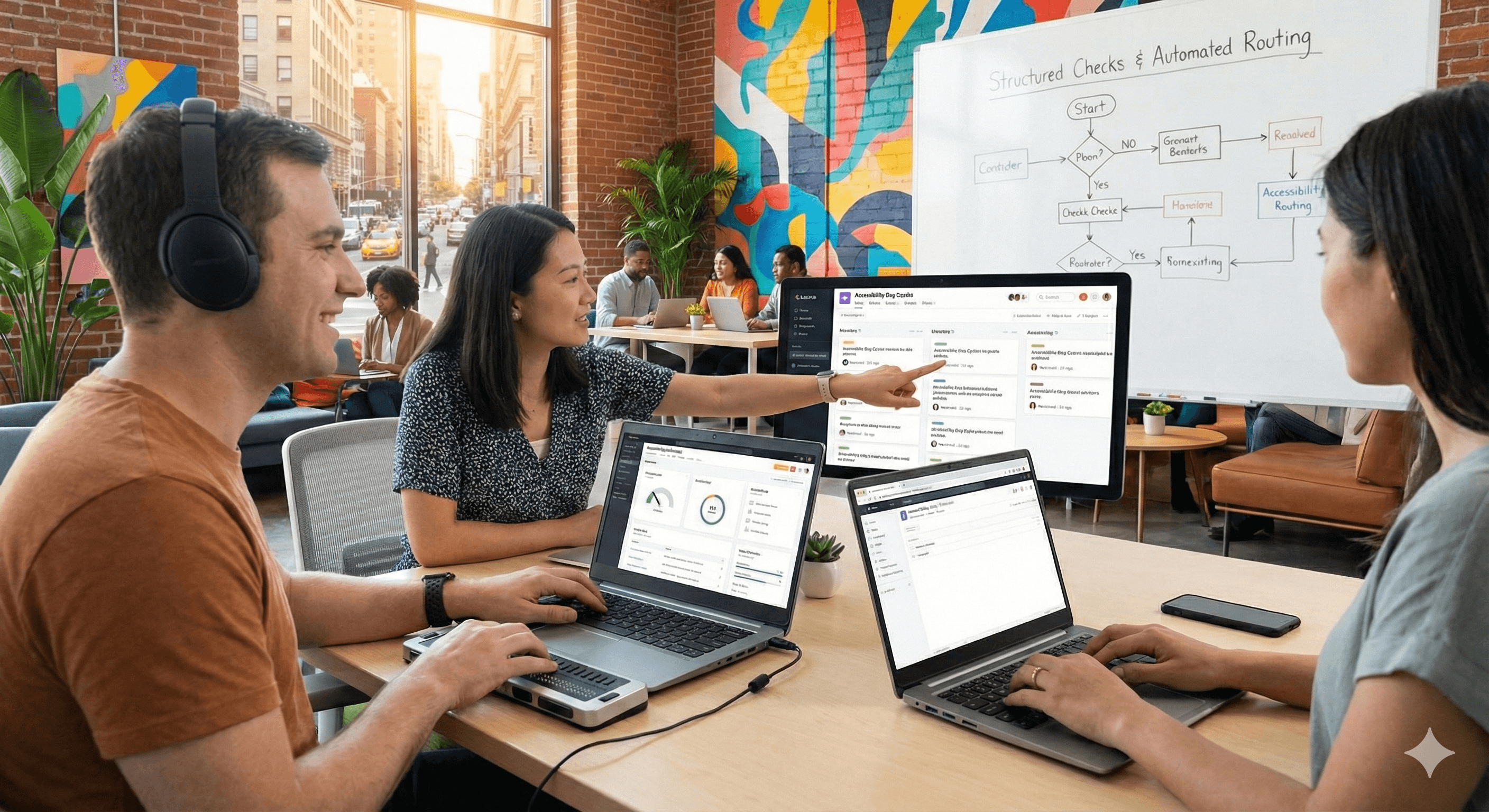
  • Organized checks → actionable tasks. Accessibility checks are mapped to task templates and custom fields, making findings specific, reproducible, and immediately assignable.

  • Automatic urgency + strategic routing. New processes prioritize findings and direct them to the correct product team, providing clear next steps and SLAs; most are resolved within days.

  • Program, not a project. This builds on Asana’s ongoing investment: a dedicated accessibility team, enhanced design system guidance, and integrated practices across design and engineering.

Key benefits

  • Faster resolution time. Clear, easy-to-fix issues are resolved swiftly due to better triage and ownership.

  • Higher signal, less noise. Structured reports minimize back-and-forth communication and assist teams in addressing the most impactful items first.

  • Cultural shift. Engineers receive feedback earlier and consider accessibility throughout the lifecycle, not just at the end.

Practical steps to replicate in your organization

  1. Create a standard checklist. Base it on WCAG success criteria pertinent to your product. Convert each check into a task template with fields for context (URL/screen, AT used, steps, expected vs. actual outcomes).

  2. Automate the entry process. Add simple automated checks to CI to catch apparent regressions; funnel results into your tracker, labeled for severity, component, and assistive tech. (Asana stresses the importance of pairing automation with clear human review for nuance.)

  3. Triage with SLAs. Set severity definitions and service levels (e.g., critical: 48 hours). Automatically route items to the teams responsible based on component/area.

  4. Clarify ownership. Use templates that pre-assign the owner, reviewer, and due date; include reproduction steps and screenshots/recordings for immediate fixes.

  5. Verify and learn. Add a verification sub-task and a brief post-fix note (root cause, prevention). Review weekly to refine patterns and update your design system guidance.

Next Steps

Want this playbook customized to your stack? Contact Generation Digital for an accessibility testing workflow you can implement within Asana from day one.

FAQs

Q1: How does Asana's new method improve testing?
It organizes checks, automates prioritization, and routes issues to the right team—so clear issues are identified earlier and fixed more quickly, transitioning often from weeks to hours with normal resolution in days. Asana

Q2: What are the advantages of faster accessibility testing?
Users get improvements sooner, teams reduce rework, and accessibility becomes a standard practice across design and engineering, rather than a last-minute challenge. Asana

Q3: Can these methods be applied elsewhere?
Yes. The principles—standardized checklists, CI checks, triage with SLAs, clear ownership, and a verification loop—are adaptable to any product team. Asana’s public commitment demonstrates how to integrate these practices at scale. Asana

Asana reduced the duration of accessibility bug cycles from weeks to hours by organizing checks, automating prioritization, and directing issues straight to the appropriate teams, who generally resolve them within days. This approach combines straightforward automation with precise triage and verification, allowing clear, easy-to-fix issues to emerge early and be resolved faster.

Why this matters now

Accessibility issues often linger because they’re identified late, lack clear ownership, or don’t have actionable context. Asana revamped its testing workflow to ensure obvious, high-impact fixes appear quickly, reach the appropriate team, and are resolved swiftly—changing resolution time from weeks to hours in many instances.

What’s new in Asana’s approach

  • Organized checks → actionable tasks. Accessibility checks are mapped to task templates and custom fields, making findings specific, reproducible, and immediately assignable.

  • Automatic urgency + strategic routing. New processes prioritize findings and direct them to the correct product team, providing clear next steps and SLAs; most are resolved within days.

  • Program, not a project. This builds on Asana’s ongoing investment: a dedicated accessibility team, enhanced design system guidance, and integrated practices across design and engineering.

Key benefits

  • Faster resolution time. Clear, easy-to-fix issues are resolved swiftly due to better triage and ownership.

  • Higher signal, less noise. Structured reports minimize back-and-forth communication and assist teams in addressing the most impactful items first.

  • Cultural shift. Engineers receive feedback earlier and consider accessibility throughout the lifecycle, not just at the end.

Practical steps to replicate in your organization

  1. Create a standard checklist. Base it on WCAG success criteria pertinent to your product. Convert each check into a task template with fields for context (URL/screen, AT used, steps, expected vs. actual outcomes).

  2. Automate the entry process. Add simple automated checks to CI to catch apparent regressions; funnel results into your tracker, labeled for severity, component, and assistive tech. (Asana stresses the importance of pairing automation with clear human review for nuance.)

  3. Triage with SLAs. Set severity definitions and service levels (e.g., critical: 48 hours). Automatically route items to the teams responsible based on component/area.

  4. Clarify ownership. Use templates that pre-assign the owner, reviewer, and due date; include reproduction steps and screenshots/recordings for immediate fixes.

  5. Verify and learn. Add a verification sub-task and a brief post-fix note (root cause, prevention). Review weekly to refine patterns and update your design system guidance.

Next Steps

Want this playbook customized to your stack? Contact Generation Digital for an accessibility testing workflow you can implement within Asana from day one.

FAQs

Q1: How does Asana's new method improve testing?
It organizes checks, automates prioritization, and routes issues to the right team—so clear issues are identified earlier and fixed more quickly, transitioning often from weeks to hours with normal resolution in days. Asana

Q2: What are the advantages of faster accessibility testing?
Users get improvements sooner, teams reduce rework, and accessibility becomes a standard practice across design and engineering, rather than a last-minute challenge. Asana

Q3: Can these methods be applied elsewhere?
Yes. The principles—standardized checklists, CI checks, triage with SLAs, clear ownership, and a verification loop—are adaptable to any product team. Asana’s public commitment demonstrates how to integrate these practices at scale. Asana

Receive weekly AI news and advice straight to your inbox

By subscribing, you agree to allow Generation Digital to store and process your information according to our privacy policy. You can review the full policy at gend.co/privacy.


Upcoming Workshops and Webinars

A diverse group of professionals collaborating around a table in a bright, modern office setting.

Streamlined Operations for Canadian Businesses - Asana

Virtual Webinar
Wednesday, February 25, 2026
Online

A diverse group of professionals collaborating around a table in a bright, modern office setting.

Collaborate with AI Team Members - Asana

In-Person Workshop
Thursday, February 26, 2026
Toronto, Canada

A diverse group of professionals collaborating around a table in a bright, modern office setting.

From Concept to Prototype - AI in Miro

Online Webinar
Wednesday, February 18, 2026
Online

Generation
Digital

Canadian Office
33 Queen St,
Toronto
M5H 2N2
Canada

Canadian Office
1 University Ave,
Toronto,
ON M5J 1T1,
Canada

NAMER Office
77 Sands St,
Brooklyn,
NY 11201,
USA

Head Office
Charlemont St, Saint Kevin's, Dublin,
D02 VN88,
Ireland

Middle East Office
6994 Alsharq 3890,
An Narjis,
Riyadh 13343,
Saudi Arabia

UK Fast Growth Index UBS Logo
Financial Times FT 1000 Logo
Febe Growth 100 Logo (Background Removed)

Business Number: 256 9431 77 | Copyright 2026 | Terms and Conditions | Privacy Policy

Generation
Digital

Canadian Office
33 Queen St,
Toronto
M5H 2N2
Canada

Canadian Office
1 University Ave,
Toronto,
ON M5J 1T1,
Canada

NAMER Office
77 Sands St,
Brooklyn,
NY 11201,
USA

Head Office
Charlemont St, Saint Kevin's, Dublin,
D02 VN88,
Ireland

Middle East Office
6994 Alsharq 3890,
An Narjis,
Riyadh 13343,
Saudi Arabia

UK Fast Growth Index UBS Logo
Financial Times FT 1000 Logo
Febe Growth 100 Logo (Background Removed)


Business No: 256 9431 77
Terms and Conditions
Privacy Policy
© 2026





