Top AI Collaboration Tools for Businesses (2026)

Top AI Collaboration Tools for Businesses (2026)

Gather

Conceptual

Asana

Miro
Dec 16, 2025

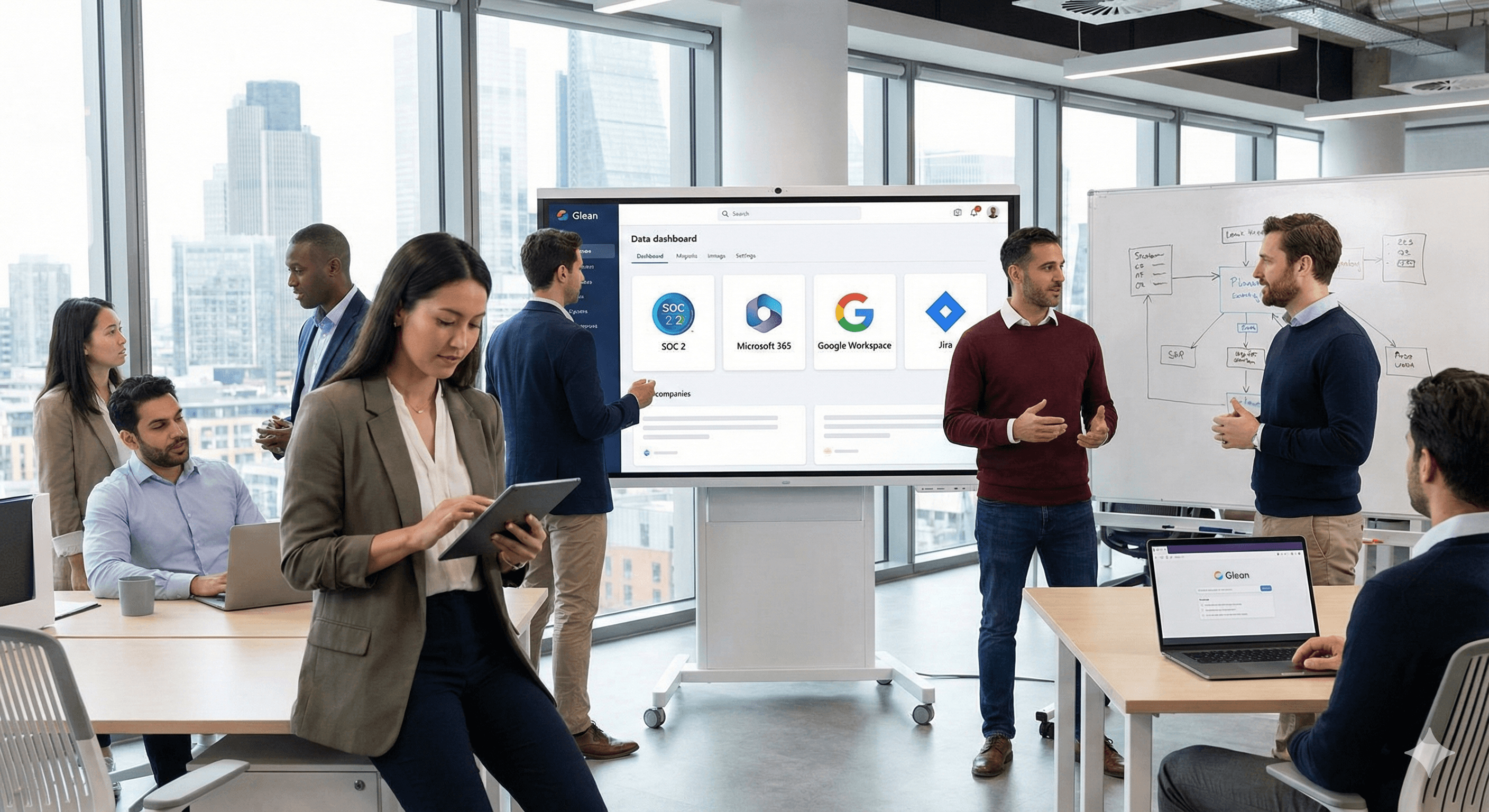
A team of professionals gathers for a collaborative meeting in a modern office, featuring a large screen showcasing a dashboard called "Glean AI," with various tech logos such as Microsoft and Google visible. This setting promotes teamwork and innovation in a high-rise urban environment, reflecting Canadian business values.

Not sure what to do next with AI?
Assess readiness, risk, and priorities in under an hour.

Not sure what to do next with AI?
Assess readiness, risk, and priorities in under an hour.

➔ Schedule a Consultation

Why this matters now

Enterprise AI adoption is gaining momentum into 2026, but success depends on tools that are secure, well-integrated, and easy for people to use every day. Leaders are shifting from small-scale tests to comprehensive platforms and require confidence in security, governance, integrations, and agent plans.

Key points / benefits

  • Boost productivity with AI tools that bring knowledge to the surface, summarize content, and automate regular tasks.

  • Evaluate software security and integration depth to safeguard data and minimize obstacles.

  • Increase user adoption with clear enablement, governance, and role-specific training.

What “AI collaboration software” means in 2026

The platforms today go beyond mere chatting. They index enterprise knowledge with awareness of permissions, base responses on your data with references, and—by 2026—increasingly orchestrate complex tasks through policy-aware agents. Validate any “agentic” claims against tangible, measurable use cases.

Evaluation criteria CIOs should use

1) Security, privacy, and compliance (non-negotiable)

Choose platforms built on zero trust and the principle of least privilege. Demand encryption in transit/at rest, tenant isolation, and recognized certifications (e.g., SOC 2 Type II, ISO 27001). Confirm relevant GDPR/HIPAA coverage. Ensure RBAC, permission-aware retrieval, audit logging, and options for data residency.

Checklist

  • Independent certifications (SOC 2 Type II, ISO 27001)

  • Role-based access controls with audit trails

  • Permission-aware search and fundamental integration

  • Data residency and clear DPA/sub-processor listings

2) Breadth and depth of integrations

Your AI layer should connect to where work already occurs: Microsoft 365, Google Workspace, Slack/Teams, Jira, Confluence, GitHub, ServiceNow, Salesforce, and more. Rich, permission-respecting connectors provide accurate answers and reduce unauthorized IT usage. Request a published catalog of connectors and governance controls.

Checklist

  • Native connectors to core software suites, communications, development, CRM/ITSM

  • Source-level permission mapping

  • Administrative controls for connector governance

3) Governance and explainability

Insist on transparency: source citations, traceable reasoning, and central policy management. Every response or action should be grounded in your data, with links back to the originals. Administrators should oversee models, prompts, retention, and approval processes from a single interface.

4) Agent readiness without the hype

When considering agents, prioritize policy-aware coordination, human-in-the-loop approvals, and access that is restricted to the necessity. Start with focused, auditable tasks (such as ticket triage, meeting actions, and scheduling) and expand only when performance indicators prove beneficial.

5) Adoption, change management, and measurability

Adoption is a significant factor. Choose vendors offering role-specific enablement, prompt/playbook libraries, and administration analytics for usage and impact tracking.

Checklist

  • Role-based onboarding and training programs

  • Built-in analytics (such as queries answered, time saved)

  • Champions network; evolving prompt libraries

A closer look at Glean for enterprise AI collaboration

Glean positions itself as a Work AI platform that connects to enterprise data and offers search, an assistant, and a framework for secure agent orchestration. It emphasizes enterprise-grade security (e.g., SOC 2/ISO 27001), permission-aware retrieval, and a growing array of connectors and agents—aligning well with CIO evaluation criteria for 2026.

Where Glean can help

  • Secure knowledge access: Permission-aware search and responses across Microsoft 365, Google Workspace, Slack/Teams, Jira, Salesforce, and more.

  • Work AI assistant: Summarize, draft, and retrieve with clear source citations.

  • Agents and orchestration: Develop policy-limited automations with approvals and observability.

Practical steps or examples

  1. Assess integration with existing systems
    Identify high-value scenarios (like support resolution, sprint planning, policy Q&A, RFP responses) and the applications where data resides. Prioritize based on impact and risk.

  2. Review security features and compliance
    Request documentation on certifications, architecture, data handling, RBAC, audit logging, and model governance. Involve Security, Legal, and Data Protection teams early in the process.

  3. Encourage user adoption through training
    Design a role-based enablement strategy with prompts, playbooks, and clearly defined boundaries. Set up a champions network and measure time saved, decision speed, and operation effectiveness.

Summary

The right AI collaboration platform in 2026 should be secure, permission-aware, deeply integrated, and ready for adoption. Glean is a strong candidate for enterprises focusing on governance and measurable outcomes. For a structured selection process and a hands-on pilot, reach out to Generation Digital.

Ready to compare platforms and develop a secure pilot?

FAQs

Q1: What should enterprises consider when selecting AI collaboration software?
In 2026, prioritize security (SOC 2/ISO 27001), permission-aware retrieval, RBAC, and proven integrations with your core technology stack. Evaluate vendor governance, auditability, and data residency.

Q2: How can AI-driven tools enhance productivity?
They deliver faster answers, summarize content, automate routine tasks, and—when orchestrated safely—coordinate tasks across multiple apps via agents. Measure the time saved and decision speed during trial phases.

Q3: Why is security crucial in AI collaboration tools?
Security ensures that sensitive enterprise data is safeguarded against breaches and unauthorized access. Certifications, zero-trust architecture, and RBAC enable productivity without compromising control.

Related links

Why this matters now

Enterprise AI adoption is gaining momentum into 2026, but success depends on tools that are secure, well-integrated, and easy for people to use every day. Leaders are shifting from small-scale tests to comprehensive platforms and require confidence in security, governance, integrations, and agent plans.

Key points / benefits

  • Boost productivity with AI tools that bring knowledge to the surface, summarize content, and automate regular tasks.

  • Evaluate software security and integration depth to safeguard data and minimize obstacles.

  • Increase user adoption with clear enablement, governance, and role-specific training.

What “AI collaboration software” means in 2026

The platforms today go beyond mere chatting. They index enterprise knowledge with awareness of permissions, base responses on your data with references, and—by 2026—increasingly orchestrate complex tasks through policy-aware agents. Validate any “agentic” claims against tangible, measurable use cases.

Evaluation criteria CIOs should use

1) Security, privacy, and compliance (non-negotiable)

Choose platforms built on zero trust and the principle of least privilege. Demand encryption in transit/at rest, tenant isolation, and recognized certifications (e.g., SOC 2 Type II, ISO 27001). Confirm relevant GDPR/HIPAA coverage. Ensure RBAC, permission-aware retrieval, audit logging, and options for data residency.

Checklist

  • Independent certifications (SOC 2 Type II, ISO 27001)

  • Role-based access controls with audit trails

  • Permission-aware search and fundamental integration

  • Data residency and clear DPA/sub-processor listings

2) Breadth and depth of integrations

Your AI layer should connect to where work already occurs: Microsoft 365, Google Workspace, Slack/Teams, Jira, Confluence, GitHub, ServiceNow, Salesforce, and more. Rich, permission-respecting connectors provide accurate answers and reduce unauthorized IT usage. Request a published catalog of connectors and governance controls.

Checklist

  • Native connectors to core software suites, communications, development, CRM/ITSM

  • Source-level permission mapping

  • Administrative controls for connector governance

3) Governance and explainability

Insist on transparency: source citations, traceable reasoning, and central policy management. Every response or action should be grounded in your data, with links back to the originals. Administrators should oversee models, prompts, retention, and approval processes from a single interface.

4) Agent readiness without the hype

When considering agents, prioritize policy-aware coordination, human-in-the-loop approvals, and access that is restricted to the necessity. Start with focused, auditable tasks (such as ticket triage, meeting actions, and scheduling) and expand only when performance indicators prove beneficial.

5) Adoption, change management, and measurability

Adoption is a significant factor. Choose vendors offering role-specific enablement, prompt/playbook libraries, and administration analytics for usage and impact tracking.

Checklist

  • Role-based onboarding and training programs

  • Built-in analytics (such as queries answered, time saved)

  • Champions network; evolving prompt libraries

A closer look at Glean for enterprise AI collaboration

Glean positions itself as a Work AI platform that connects to enterprise data and offers search, an assistant, and a framework for secure agent orchestration. It emphasizes enterprise-grade security (e.g., SOC 2/ISO 27001), permission-aware retrieval, and a growing array of connectors and agents—aligning well with CIO evaluation criteria for 2026.

Where Glean can help

  • Secure knowledge access: Permission-aware search and responses across Microsoft 365, Google Workspace, Slack/Teams, Jira, Salesforce, and more.

  • Work AI assistant: Summarize, draft, and retrieve with clear source citations.

  • Agents and orchestration: Develop policy-limited automations with approvals and observability.

Practical steps or examples

  1. Assess integration with existing systems
    Identify high-value scenarios (like support resolution, sprint planning, policy Q&A, RFP responses) and the applications where data resides. Prioritize based on impact and risk.

  2. Review security features and compliance
    Request documentation on certifications, architecture, data handling, RBAC, audit logging, and model governance. Involve Security, Legal, and Data Protection teams early in the process.

  3. Encourage user adoption through training
    Design a role-based enablement strategy with prompts, playbooks, and clearly defined boundaries. Set up a champions network and measure time saved, decision speed, and operation effectiveness.

Summary

The right AI collaboration platform in 2026 should be secure, permission-aware, deeply integrated, and ready for adoption. Glean is a strong candidate for enterprises focusing on governance and measurable outcomes. For a structured selection process and a hands-on pilot, reach out to Generation Digital.

Ready to compare platforms and develop a secure pilot?

FAQs

Q1: What should enterprises consider when selecting AI collaboration software?
In 2026, prioritize security (SOC 2/ISO 27001), permission-aware retrieval, RBAC, and proven integrations with your core technology stack. Evaluate vendor governance, auditability, and data residency.

Q2: How can AI-driven tools enhance productivity?
They deliver faster answers, summarize content, automate routine tasks, and—when orchestrated safely—coordinate tasks across multiple apps via agents. Measure the time saved and decision speed during trial phases.

Q3: Why is security crucial in AI collaboration tools?
Security ensures that sensitive enterprise data is safeguarded against breaches and unauthorized access. Certifications, zero-trust architecture, and RBAC enable productivity without compromising control.

Related links

Receive practical advice directly in your inbox

By subscribing, you agree to allow Generation Digital to store and process your information according to our privacy policy. You can review the full policy at gend.co/privacy.


Are you ready to get the support your organization needs to successfully leverage AI?

Miro Solutions Partner
Asana Platinum Solutions Partner
Notion Platinum Solutions Partner
Glean Certified Partner

Ready to get the support your organization needs to successfully use AI?

Miro Solutions Partner
Asana Platinum Solutions Partner
Notion Platinum Solutions Partner
Glean Certified Partner

Generation
Digital

Canadian Office
33 Queen St,
Toronto
M5H 2N2
Canada

Canadian Office
1 University Ave,
Toronto,
ON M5J 1T1,
Canada

NAMER Office
77 Sands St,
Brooklyn,
NY 11201,
USA

Head Office
Charlemont St, Saint Kevin's, Dublin,
D02 VN88,
Ireland

Middle East Office
6994 Alsharq 3890,
An Narjis,
Riyadh 13343,
Saudi Arabia

UK Fast Growth Index UBS Logo
Financial Times FT 1000 Logo
Febe Growth 100 Logo (Background Removed)

Business Number: 256 9431 77 | Copyright 2026 | Terms and Conditions | Privacy Policy

Generation
Digital

Canadian Office
33 Queen St,
Toronto
M5H 2N2
Canada

Canadian Office
1 University Ave,
Toronto,
ON M5J 1T1,
Canada

NAMER Office
77 Sands St,
Brooklyn,
NY 11201,
USA

Head Office
Charlemont St, Saint Kevin's, Dublin,
D02 VN88,
Ireland

Middle East Office
6994 Alsharq 3890,
An Narjis,
Riyadh 13343,
Saudi Arabia

UK Fast Growth Index UBS Logo
Financial Times FT 1000 Logo
Febe Growth 100 Logo (Background Removed)


Business No: 256 9431 77
Terms and Conditions
Privacy Policy
© 2026





