FrontierScience benchmark: AI scientific reasoning, explained

FrontierScience benchmark: AI scientific reasoning, explained

OpenAI

Dec 16, 2025

A group of four colleagues is engaged in a meeting in a modern office, with a woman presenting colorful Miro bar charts on a large screen, as three others seated with laptops and a coffee cup listen attentively.

What is FrontierScience?

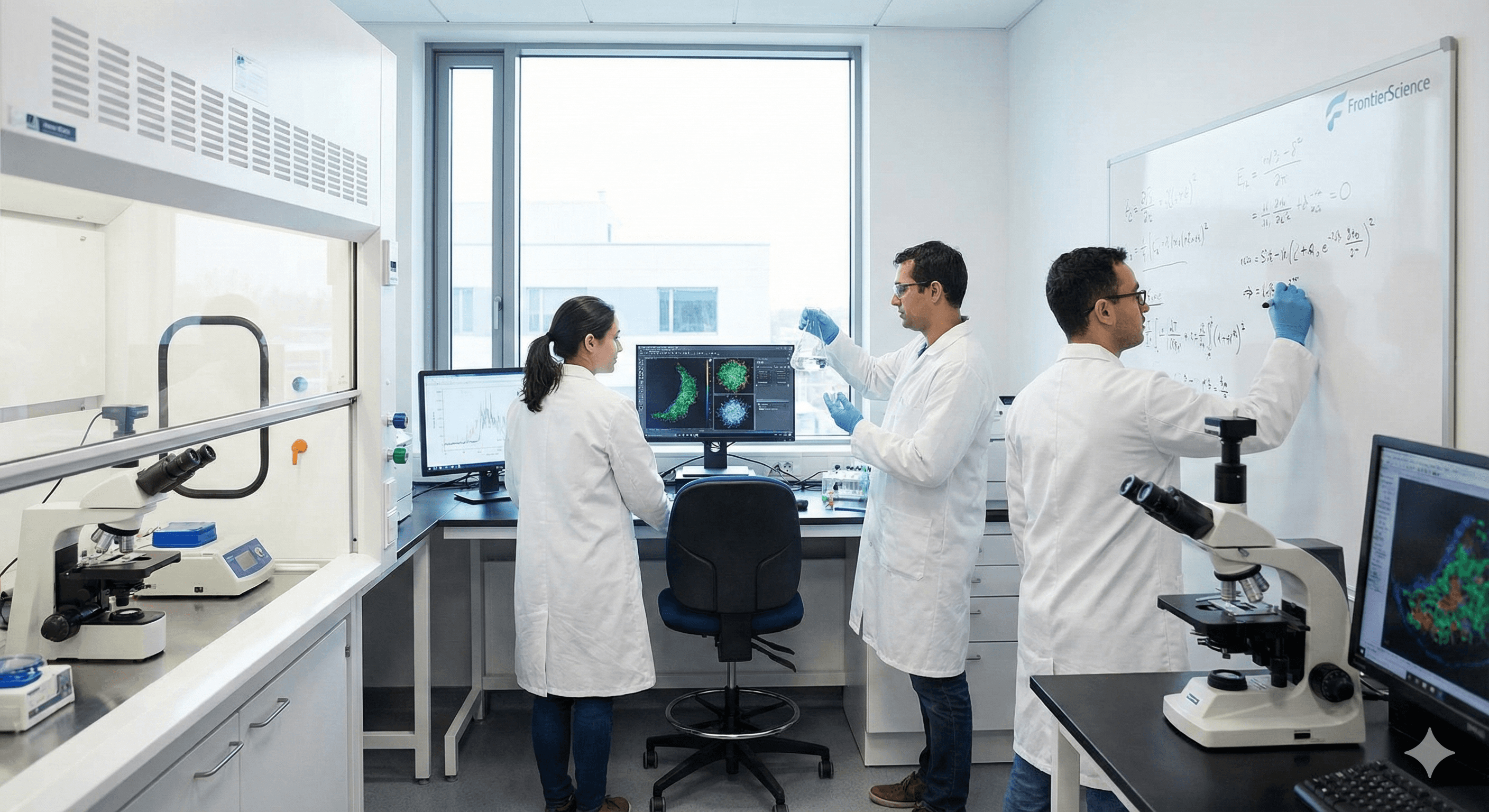
FrontierScience is a new benchmark designed to test whether modern AI models can reason like scientists—not just recall facts. Unlike saturated multiple-choice datasets, it focuses on difficult, original problems written and verified by domain experts across physics, chemistry, and biology. OpenAI

Two complementary tracks

  • Olympiad track: 100 short-answer tasks at international-medallist difficulty, enabling precise grading (numeric, expression, or fuzzy match).

  • Research track: 60 open-ended subtasks crafted by PhD-level scientists, graded with a 10-point rubric to capture reasoning quality, methodology, and scientific judgement.

Together, these tracks assess both constrained problem-solving and the messier reasoning used in real research workflows.

Why does it matter now?

As labs and institutions pilot AI for literature review, hypothesis shaping, and even early wet-lab optimisation, the field needs harder, more meaningful evaluations. FrontierScience provides a defensible way to compare models before they’re trusted in research pipelines. Recent reporting on AI-assisted lab work underscores the urgency of robust measurement.

How FrontierScience is built

FrontierScience spans 700+ textual questions (with a gold set of 160 released to the community). Each task passes through creation, peer review, resolution, and revision to ensure it is factual, gradable, objective, and difficult. Expert authors include Olympiad medallists, coaches, and PhD-level researchers across specialised subfields.

Grading approach as per OpenAI

  • Olympiad: exact/fuzzy short-answer scoring for high-precision accuracy.

  • Research: rubric-based scoring across multiple objective items (up to 10 points) to evaluate reasoning depth, methodology, and scientific soundness.

What early results show

OpenAI reports that GPT-5.2 currently leads competing frontier models on both tracks—77% on Olympiad and 25% on Research—highlighting strong progress on structured reasoning and significant headroom on open-ended, real-research tasks. Independent coverage echoes the theme: great at tough problems, but genuine research remains challenging.

Practical uses for R&D teams

  • Model selection: Use FrontierScience scores to shortlist models for pilot projects in your domain.

  • Risk management: Prefer tasks aligned with demonstrated strengths (e.g., structured subproblems) while keeping human oversight for experimental design and interpretation.

  • Benchmark-driven KPIs: Track gains in solution accuracy, time-to-insight, and literature synthesis quality as your models improve.

Limitations to consider

FrontierScience doesn’t represent all of science: it’s text-based, focuses on expert-written problems, and can’t substitute for real experimental validation. Treat scores as directional signals—use them alongside domain-specific evaluations and rigorous safety reviews.

Getting started (quick steps)

  1. Define your use cases: literature triage, proof checking, or problem-set exploration.

  2. Select candidate models based on FrontierScience and internal constraints (cost, latency, safety).

  3. Run a pilot on non-sensitive problems; apply human-in-the-loop review.

  4. Measure outcomes: accuracy vs. baselines, researcher time saved, and quality of reasoning artefacts.

  5. Scale cautiously into higher-stakes workflows with governance and auditability.

UK context: pair model evaluation with national guidance and independent testing signals (e.g., AISI trend reporting) when planning deployments in regulated environments. AI Security Institute

Summary

FrontierScience raises the standard for measuring scientific reasoning in AI. It’s challenging, expert-built, and informative for teams deciding where models can help today—and where human expertise remains essential. Speak to Generation Digital to design a benchmark-driven pilot for your research programme.

Next Steps: Get a FrontierScience-informed AI research pilot scoped for your team—policy-aligned, measurable, and safe.

FAQ

Q1: What is FrontierScience?
A benchmark from OpenAI measuring expert-level scientific reasoning with Olympiad and Research tracks across physics, chemistry, and biology. OpenAI

Q2: Which fields does it cover?
Physics, chemistry, and biology; tasks are authored and verified by domain experts. OpenAI

Q3: How does it benefit researchers?
It provides a structured, expert-grade way to compare models and identify where AI can accelerate parts of the research workflow—while keeping human judgement in the loop. OpenAI

What is FrontierScience?

FrontierScience is a new benchmark designed to test whether modern AI models can reason like scientists—not just recall facts. Unlike saturated multiple-choice datasets, it focuses on difficult, original problems written and verified by domain experts across physics, chemistry, and biology. OpenAI

Two complementary tracks

  • Olympiad track: 100 short-answer tasks at international-medallist difficulty, enabling precise grading (numeric, expression, or fuzzy match).

  • Research track: 60 open-ended subtasks crafted by PhD-level scientists, graded with a 10-point rubric to capture reasoning quality, methodology, and scientific judgement.

Together, these tracks assess both constrained problem-solving and the messier reasoning used in real research workflows.

Why does it matter now?

As labs and institutions pilot AI for literature review, hypothesis shaping, and even early wet-lab optimisation, the field needs harder, more meaningful evaluations. FrontierScience provides a defensible way to compare models before they’re trusted in research pipelines. Recent reporting on AI-assisted lab work underscores the urgency of robust measurement.

How FrontierScience is built

FrontierScience spans 700+ textual questions (with a gold set of 160 released to the community). Each task passes through creation, peer review, resolution, and revision to ensure it is factual, gradable, objective, and difficult. Expert authors include Olympiad medallists, coaches, and PhD-level researchers across specialised subfields.

Grading approach as per OpenAI

  • Olympiad: exact/fuzzy short-answer scoring for high-precision accuracy.

  • Research: rubric-based scoring across multiple objective items (up to 10 points) to evaluate reasoning depth, methodology, and scientific soundness.

What early results show

OpenAI reports that GPT-5.2 currently leads competing frontier models on both tracks—77% on Olympiad and 25% on Research—highlighting strong progress on structured reasoning and significant headroom on open-ended, real-research tasks. Independent coverage echoes the theme: great at tough problems, but genuine research remains challenging.

Practical uses for R&D teams

  • Model selection: Use FrontierScience scores to shortlist models for pilot projects in your domain.

  • Risk management: Prefer tasks aligned with demonstrated strengths (e.g., structured subproblems) while keeping human oversight for experimental design and interpretation.

  • Benchmark-driven KPIs: Track gains in solution accuracy, time-to-insight, and literature synthesis quality as your models improve.

Limitations to consider

FrontierScience doesn’t represent all of science: it’s text-based, focuses on expert-written problems, and can’t substitute for real experimental validation. Treat scores as directional signals—use them alongside domain-specific evaluations and rigorous safety reviews.

Getting started (quick steps)

  1. Define your use cases: literature triage, proof checking, or problem-set exploration.

  2. Select candidate models based on FrontierScience and internal constraints (cost, latency, safety).

  3. Run a pilot on non-sensitive problems; apply human-in-the-loop review.

  4. Measure outcomes: accuracy vs. baselines, researcher time saved, and quality of reasoning artefacts.

  5. Scale cautiously into higher-stakes workflows with governance and auditability.

UK context: pair model evaluation with national guidance and independent testing signals (e.g., AISI trend reporting) when planning deployments in regulated environments. AI Security Institute

Summary

FrontierScience raises the standard for measuring scientific reasoning in AI. It’s challenging, expert-built, and informative for teams deciding where models can help today—and where human expertise remains essential. Speak to Generation Digital to design a benchmark-driven pilot for your research programme.

Next Steps: Get a FrontierScience-informed AI research pilot scoped for your team—policy-aligned, measurable, and safe.

FAQ

Q1: What is FrontierScience?
A benchmark from OpenAI measuring expert-level scientific reasoning with Olympiad and Research tracks across physics, chemistry, and biology. OpenAI

Q2: Which fields does it cover?
Physics, chemistry, and biology; tasks are authored and verified by domain experts. OpenAI

Q3: How does it benefit researchers?
It provides a structured, expert-grade way to compare models and identify where AI can accelerate parts of the research workflow—while keeping human judgement in the loop. OpenAI

Receive practical advice directly in your inbox

By subscribing, you agree to allow Generation Digital to store and process your information according to our privacy policy. You can review the full policy at gend.co/privacy.


Are you ready to get the support your organization needs to successfully leverage AI?

Miro Solutions Partner
Asana Platinum Solutions Partner
Notion Platinum Solutions Partner
Glean Certified Partner

Ready to get the support your organization needs to successfully use AI?

Miro Solutions Partner
Asana Platinum Solutions Partner
Notion Platinum Solutions Partner
Glean Certified Partner

Generation
Digital

Canadian Office
33 Queen St,
Toronto
M5H 2N2
Canada

Canadian Office
1 University Ave,
Toronto,
ON M5J 1T1,
Canada

NAMER Office
77 Sands St,
Brooklyn,
NY 11201,
USA

Head Office
Charlemont St, Saint Kevin's, Dublin,
D02 VN88,
Ireland

Middle East Office
6994 Alsharq 3890,
An Narjis,
Riyadh 13343,
Saudi Arabia

UK Fast Growth Index UBS Logo
Financial Times FT 1000 Logo
Febe Growth 100 Logo (Background Removed)

Business Number: 256 9431 77 | Copyright 2026 | Terms and Conditions | Privacy Policy

Generation
Digital

Canadian Office
33 Queen St,
Toronto
M5H 2N2
Canada

Canadian Office
1 University Ave,
Toronto,
ON M5J 1T1,
Canada

NAMER Office
77 Sands St,
Brooklyn,
NY 11201,
USA

Head Office
Charlemont St, Saint Kevin's, Dublin,
D02 VN88,
Ireland

Middle East Office
6994 Alsharq 3890,
An Narjis,
Riyadh 13343,
Saudi Arabia

UK Fast Growth Index UBS Logo
Financial Times FT 1000 Logo
Febe Growth 100 Logo (Background Removed)


Business No: 256 9431 77
Terms and Conditions
Privacy Policy
© 2026