GPT-5.2-Codex: Agentic coding & cybersecurity explained

GPT-5.2-Codex: Agentic coding & cybersecurity explained

OpenAI

Dec 17, 2025

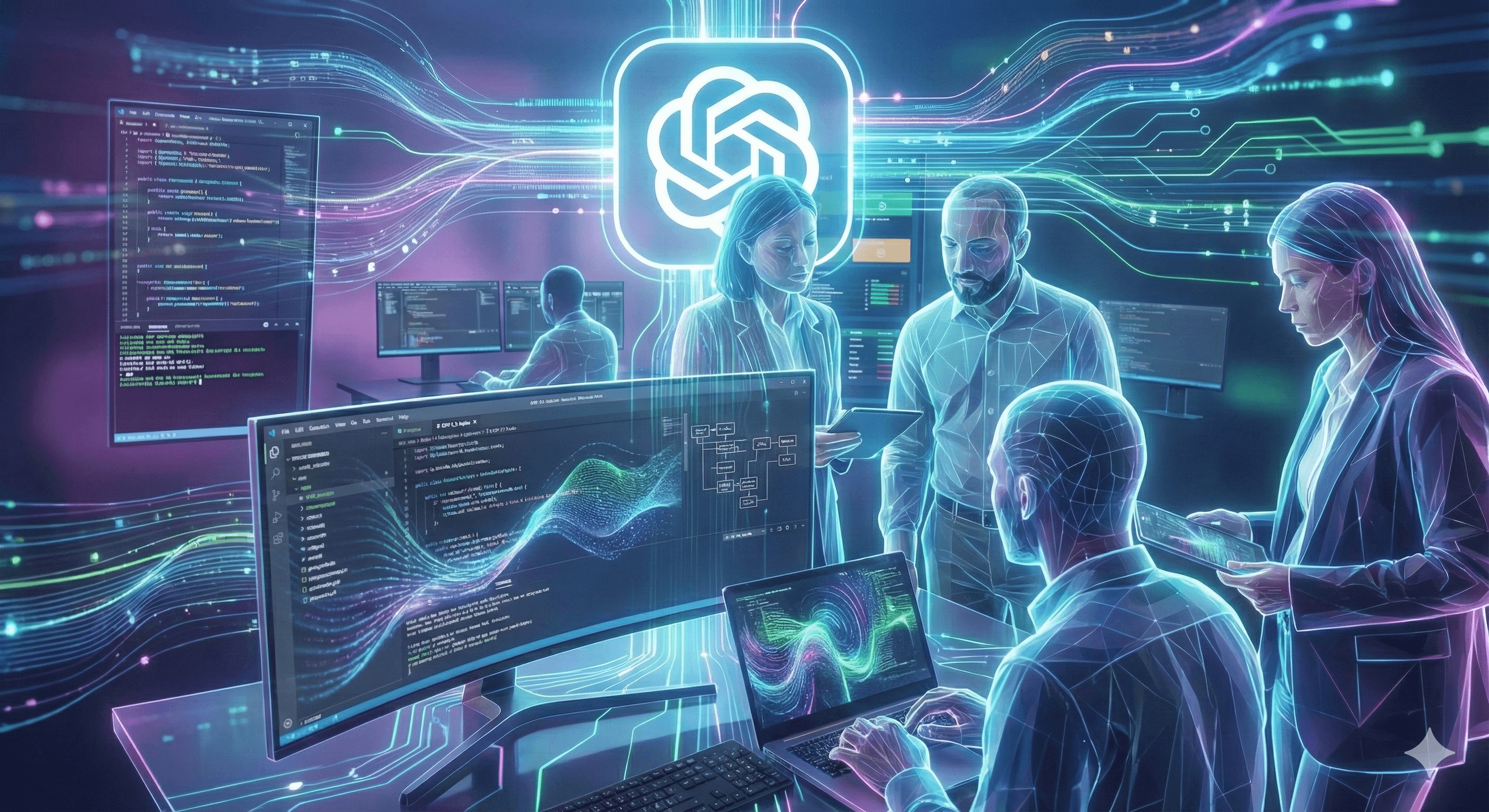
A group of four colleagues is engaged in a meeting in a modern office, with a woman presenting colorful Miro bar charts on a large screen, as three others seated with laptops and a coffee cup listen attentively.

Discover GPT-5.2-Codex: why it matters now

OpenAI has released GPT-5.2-Codex, its most advanced agentic coding model to date, built to tackle real-world software engineering and strengthen defensive cybersecurity. If you’re leading an engineering or security team, this is the first Codex version explicitly tuned for long-horizon work in large codebases—and it arrives with clearer guardrails and deployment guidance.

What’s new in GPT-5.2-Codex

Long-horizon reliability with context compaction. Codex can maintain state over extended sessions, improving continuity across large refactors, code migrations, and feature builds.
Better on Windows. Expect more effective and reliable agentic coding in native Windows environments, building on GPT-5.1-Codex-Max.
Security-aware behaviour. OpenAI added specialised training and product-level safeguards (e.g., sandboxing, configurable network access) to reduce risky actions during agentic tasks.
Benchmark signals. The broader GPT-5.2 family posts SOTA results on coding and reasoning benchmarks (e.g., SWE-Bench Pro, GPQA), underscoring improvements that Codex builds on for engineering workflows.

Capability vs. responsibility

OpenAI evaluated GPT-5.2-Codex under its Preparedness Framework. It is “very capable” in cybersecurity but does not reach “High” capability; OpenAI is planning deployments as if future models may cross that threshold, and has added additional safeguards accordingly. For enterprises, that translates into clearer boundaries for defensive use.

How GPT-5.2-Codex works in practice

At its core, GPT-5.2-Codex is tuned for agentic coding—using tools, terminals, and context to iteratively progress a task. In practice, that means it can:

  • Navigate large repos, maintain context, and propose multi-file changes.

  • Draft and validate refactors/migrations, including tests and documentation updates.

  • Operate more reliably in Windows environments, including terminal workflows.

  • Surface security weaknesses during code review and recommend mitigations as part of the coding loop.

Example workflow (end-to-end)

  1. Define the objective: “Migrate auth service from library A to B; preserve SSO; improve logging; add tests.”

  2. Grant scoped access: Use sandboxed agent access with restricted secrets and configurable network egress.

  3. Repository analysis: Codex maps dependencies, detects impact zones, and proposes a migration plan.

  4. Plan & check: It outlines steps, risks, and rollback; you approve.

  5. Apply changes: Codex refactors affected modules, updates configs/CI, and generates tests.

  6. Security pass: It flags potential vulnerabilities introduced by the change and recommends fixes.

  7. Review & merge: Human-in-the-loop approvals; Codex prepares PR description and change log.

Integration and rollout

Where you can use it today: OpenAI is releasing GPT-5.2-Codex across Codex surfaces in ChatGPT for paid users, with broader API access coming. If you’re standardising on ChatGPT Enterprise or leveraging Codex CLI/IDE integrations, you can pilot immediately.

Tooling fit: GPT-5.2-Codex is designed to slot into existing engineering workflows—terminals, IDEs, code review systems, CI/CD—and to cooperate with policy controls rather than bypass them. For UK organisations with strict change management, the sandboxing and network controls are especially relevant.

Security posture and limits

  • Not “High” on cybersecurity under OpenAI’s framework, but trending upwards—so deploy with principle-of-least-privilege, audit trails, and gated access.

  • Defensive focus: Codex supports vulnerability identification and remediation suggestions; it is not a licence to run live exploitation. Keep sensitive credentials out of the agent’s runtime unless strictly necessary.

  • Human oversight: Maintain code-review gates and security approvals. Treat agentic actions like those of a contractor in your repo: logged, limited, reversible.

Who should consider GPT-5.2-Codex

  • Scale-ups needing to accelerate roadmap items (migrations/refactors) without sacrificing quality.

  • Enterprises modernising legacy estates on Windows with stricter governance.

  • Security teams embedding proactive code health checks and policy compliance in the dev loop.

Getting started (quick steps)

  1. Enable ChatGPT paid with Codex surfaces for your pilot cohort.

  2. Define guardrails: repositories in scope, sandbox policies, network permissions, and rollback plans.

  3. Start with low-risk refactors and test creation to validate the loop.

  4. Track lead-time, change failure rate, and review throughput as KPIs.

  5. Expand to migrations and cross-service improvements once controls are proven.

Summary

GPT-5.2-Codex moves agentic coding closer to day-to-day production work while clarifying security boundaries. For engineering leaders, it’s a pragmatic leap—more continuity on long tasks, better Windows reliability, and a safer baseline for defensive use. If you’re ready to pilot, we can help scope and deploy.

Next Steps: Talk to Generation Digital about a secure GPT-5.2-Codex pilot, enterprise policy alignment, and developer enablement.

FAQ

Q1: How does GPT-5.2-Codex improve coding efficiency?
It keeps context over longer sessions, proposes multi-file changes, and operates more reliably in Windows, reducing rework on refactors and migrations. OpenAI

Q2: Can it be integrated with current systems?
Yes. It’s designed for real-world engineering environments—terminals, IDEs, CI/CD—and is rolling out across Codex surfaces for paid ChatGPT users, with API access to follow. OpenAI

Q3: What makes it a cybersecurity asset?
OpenAI added specialised safety training plus sandboxing and network controls. It supports defensive tasks like vulnerability identification, though it is not rated “High” on cybersecurity capability. OpenAI

Discover GPT-5.2-Codex: why it matters now

OpenAI has released GPT-5.2-Codex, its most advanced agentic coding model to date, built to tackle real-world software engineering and strengthen defensive cybersecurity. If you’re leading an engineering or security team, this is the first Codex version explicitly tuned for long-horizon work in large codebases—and it arrives with clearer guardrails and deployment guidance.

What’s new in GPT-5.2-Codex

Long-horizon reliability with context compaction. Codex can maintain state over extended sessions, improving continuity across large refactors, code migrations, and feature builds.
Better on Windows. Expect more effective and reliable agentic coding in native Windows environments, building on GPT-5.1-Codex-Max.
Security-aware behaviour. OpenAI added specialised training and product-level safeguards (e.g., sandboxing, configurable network access) to reduce risky actions during agentic tasks.
Benchmark signals. The broader GPT-5.2 family posts SOTA results on coding and reasoning benchmarks (e.g., SWE-Bench Pro, GPQA), underscoring improvements that Codex builds on for engineering workflows.

Capability vs. responsibility

OpenAI evaluated GPT-5.2-Codex under its Preparedness Framework. It is “very capable” in cybersecurity but does not reach “High” capability; OpenAI is planning deployments as if future models may cross that threshold, and has added additional safeguards accordingly. For enterprises, that translates into clearer boundaries for defensive use.

How GPT-5.2-Codex works in practice

At its core, GPT-5.2-Codex is tuned for agentic coding—using tools, terminals, and context to iteratively progress a task. In practice, that means it can:

  • Navigate large repos, maintain context, and propose multi-file changes.

  • Draft and validate refactors/migrations, including tests and documentation updates.

  • Operate more reliably in Windows environments, including terminal workflows.

  • Surface security weaknesses during code review and recommend mitigations as part of the coding loop.

Example workflow (end-to-end)

  1. Define the objective: “Migrate auth service from library A to B; preserve SSO; improve logging; add tests.”

  2. Grant scoped access: Use sandboxed agent access with restricted secrets and configurable network egress.

  3. Repository analysis: Codex maps dependencies, detects impact zones, and proposes a migration plan.

  4. Plan & check: It outlines steps, risks, and rollback; you approve.

  5. Apply changes: Codex refactors affected modules, updates configs/CI, and generates tests.

  6. Security pass: It flags potential vulnerabilities introduced by the change and recommends fixes.

  7. Review & merge: Human-in-the-loop approvals; Codex prepares PR description and change log.

Integration and rollout

Where you can use it today: OpenAI is releasing GPT-5.2-Codex across Codex surfaces in ChatGPT for paid users, with broader API access coming. If you’re standardising on ChatGPT Enterprise or leveraging Codex CLI/IDE integrations, you can pilot immediately.

Tooling fit: GPT-5.2-Codex is designed to slot into existing engineering workflows—terminals, IDEs, code review systems, CI/CD—and to cooperate with policy controls rather than bypass them. For UK organisations with strict change management, the sandboxing and network controls are especially relevant.

Security posture and limits

  • Not “High” on cybersecurity under OpenAI’s framework, but trending upwards—so deploy with principle-of-least-privilege, audit trails, and gated access.

  • Defensive focus: Codex supports vulnerability identification and remediation suggestions; it is not a licence to run live exploitation. Keep sensitive credentials out of the agent’s runtime unless strictly necessary.

  • Human oversight: Maintain code-review gates and security approvals. Treat agentic actions like those of a contractor in your repo: logged, limited, reversible.

Who should consider GPT-5.2-Codex

  • Scale-ups needing to accelerate roadmap items (migrations/refactors) without sacrificing quality.

  • Enterprises modernising legacy estates on Windows with stricter governance.

  • Security teams embedding proactive code health checks and policy compliance in the dev loop.

Getting started (quick steps)

  1. Enable ChatGPT paid with Codex surfaces for your pilot cohort.

  2. Define guardrails: repositories in scope, sandbox policies, network permissions, and rollback plans.

  3. Start with low-risk refactors and test creation to validate the loop.

  4. Track lead-time, change failure rate, and review throughput as KPIs.

  5. Expand to migrations and cross-service improvements once controls are proven.

Summary

GPT-5.2-Codex moves agentic coding closer to day-to-day production work while clarifying security boundaries. For engineering leaders, it’s a pragmatic leap—more continuity on long tasks, better Windows reliability, and a safer baseline for defensive use. If you’re ready to pilot, we can help scope and deploy.

Next Steps: Talk to Generation Digital about a secure GPT-5.2-Codex pilot, enterprise policy alignment, and developer enablement.

FAQ

Q1: How does GPT-5.2-Codex improve coding efficiency?
It keeps context over longer sessions, proposes multi-file changes, and operates more reliably in Windows, reducing rework on refactors and migrations. OpenAI

Q2: Can it be integrated with current systems?
Yes. It’s designed for real-world engineering environments—terminals, IDEs, CI/CD—and is rolling out across Codex surfaces for paid ChatGPT users, with API access to follow. OpenAI

Q3: What makes it a cybersecurity asset?
OpenAI added specialised safety training plus sandboxing and network controls. It supports defensive tasks like vulnerability identification, though it is not rated “High” on cybersecurity capability. OpenAI

Receive practical advice directly in your inbox

By subscribing, you agree to allow Generation Digital to store and process your information according to our privacy policy. You can review the full policy at gend.co/privacy.


Are you ready to get the support your organization needs to successfully leverage AI?

Miro Solutions Partner
Asana Platinum Solutions Partner
Notion Platinum Solutions Partner
Glean Certified Partner

Ready to get the support your organization needs to successfully use AI?

Miro Solutions Partner
Asana Platinum Solutions Partner
Notion Platinum Solutions Partner
Glean Certified Partner

Generation
Digital

Canadian Office
33 Queen St,
Toronto
M5H 2N2
Canada

Canadian Office
1 University Ave,
Toronto,
ON M5J 1T1,
Canada

NAMER Office
77 Sands St,
Brooklyn,
NY 11201,
USA

Head Office
Charlemont St, Saint Kevin's, Dublin,
D02 VN88,
Ireland

Middle East Office
6994 Alsharq 3890,
An Narjis,
Riyadh 13343,
Saudi Arabia

UK Fast Growth Index UBS Logo
Financial Times FT 1000 Logo
Febe Growth 100 Logo (Background Removed)

Business Number: 256 9431 77 | Copyright 2026 | Terms and Conditions | Privacy Policy

Generation
Digital

Canadian Office
33 Queen St,
Toronto
M5H 2N2
Canada

Canadian Office
1 University Ave,
Toronto,
ON M5J 1T1,
Canada

NAMER Office
77 Sands St,
Brooklyn,
NY 11201,
USA

Head Office
Charlemont St, Saint Kevin's, Dublin,
D02 VN88,
Ireland

Middle East Office
6994 Alsharq 3890,
An Narjis,
Riyadh 13343,
Saudi Arabia

UK Fast Growth Index UBS Logo
Financial Times FT 1000 Logo
Febe Growth 100 Logo (Background Removed)


Business No: 256 9431 77
Terms and Conditions
Privacy Policy
© 2026