GenAI in Automotive Operations: Cut Cost, Move Faster
Artificial Intelligence
OpenAI
Uncertain about how to get started with AI?Evaluate your readiness, potential risks, and key priorities in less than an hour.
➔ Download Our Free AI Preparedness Pack
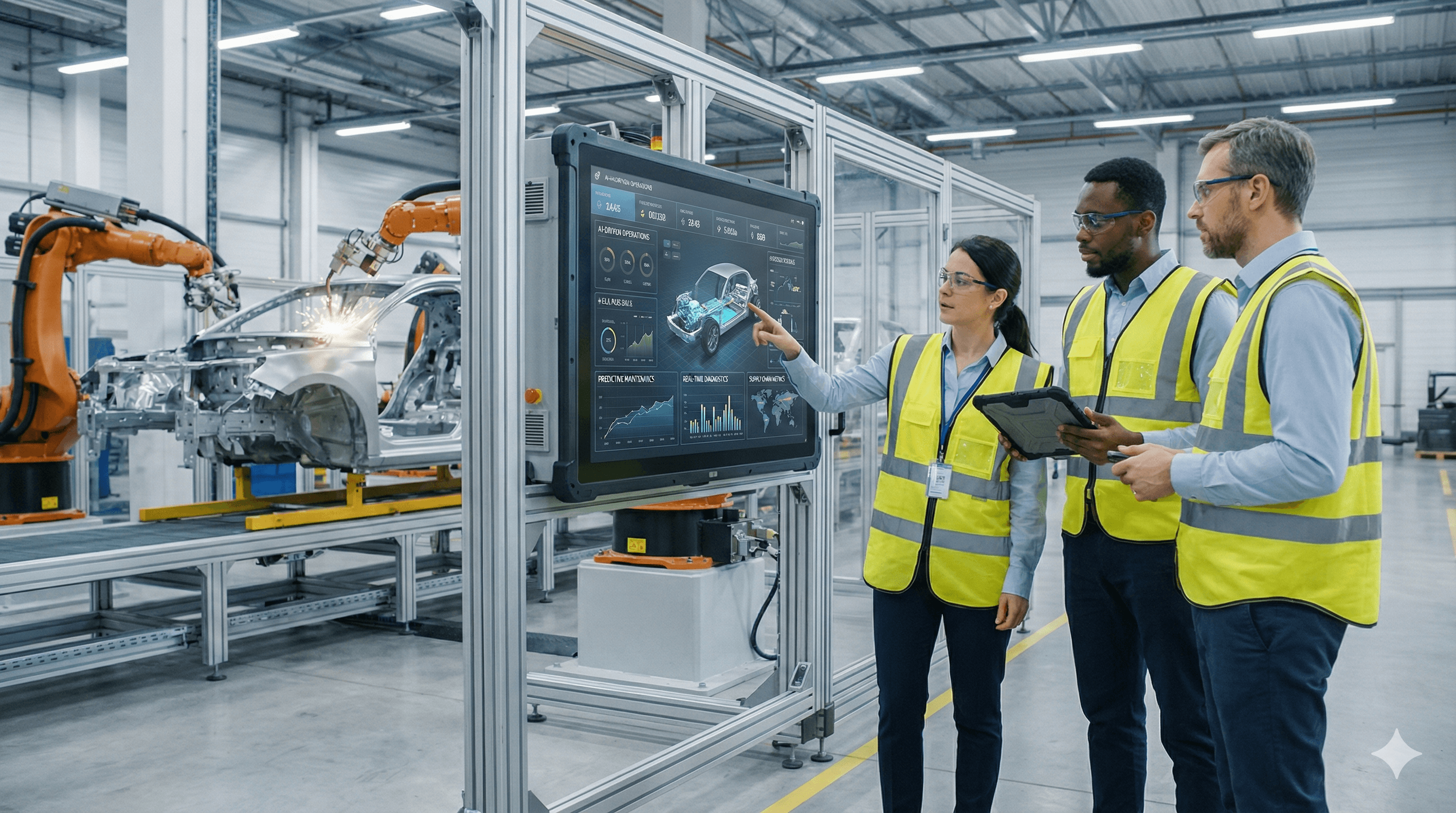
Generative AI is transforming automotive operations by automating routine work, speeding decisions with real-time insights, and hardening supply chains. Automakers report lower costs, faster execution, and improved resilience when GenAI sits inside core workflows such as procurement, maintenance, quality, engineering, and logistics—not as a siloed tool.
Automakers are moving beyond pilots and wiring GenAI into day-to-day operations. The prize is clear: lower cost to serve, shorter cycle times, and greater resilience across volatile supply chains. Leaders put GenAI inside existing systems—MES, PLM, ERP, and supplier portals—so it augments human decisions rather than adding another dashboard.
Why it matters now
Cost and speed at scale. Consultancies report double-digit savings when GenAI streamlines procurement and routine back-office tasks—freeing engineers and operators to focus on higher-value work.
From pilot to production. High performers standardise practices (human-in-the-loop, data quality, operating model) to move beyond proofs of concept and capture value at scale.
Live factory examples. BMW’s “Factory Genius” uses generative AI to support equipment maintenance and efficiency—evidence that GenAI can work on real lines, not just slides.
How it works
GenAI connects to enterprise data and shop-floor signals to summarise, predict, and automate. In practice, it:
Automates routine tasks (supplier queries, document drafting, warranty triage).
Provides real-time insights by translating noisy sensor and logistics data into recommended actions.
Orchestrates agents that execute steps—e.g., creating work orders, adjusting reorder points, or scheduling inspections—under human supervision.
Where GenAI drives impact
1) Procurement & sourcing
GenAI drafts RFQs, compares bids against should-cost models, flags risk language, and reconciles invoices. BCG finds AI can streamline manual steps by up to 30% and reduce overall costs by roughly 15%–45% in targeted categories.
2) Manufacturing & maintenance
Shop-floor copilots summarise alarms, propose root causes, and schedule condition-based work. OEMs report improved availability when predictive algorithms guide maintenance; BMW’s deployment highlights tangible efficiency gains.
3) Quality & warranty
Models spot anomaly patterns across images, text, and test data, accelerating containment and reducing escapes. (Pair GenAI with established computer-vision stacks for inspection; use GenAI to summarise findings and generate CAPAs.)
4) Engineering & software
In SDV programmes, GenAI speeds code, test generation, and documentation, helping R&D coordinate across domains and suppliers.
5) Supply chain & logistics
GenAI predicts demand shifts, revises safety stocks, drafts shipment recovery plans, and negotiates carrier changes—improving resilience during shortages or port disruptions.
Practical steps (start this quarter)
Pick two value-backed use cases. One in procurement (e.g., PO reconciliation assistant) and one in plant ops (e.g., maintenance copilot). Define owners, KPIs (cycle time, stockouts, MTBF), and guardrails.
Integrate, don’t bolt-on. Connect GenAI to ERP/MES/PLM so actions write back—no swivel-chair copying.
Design for human-in-the-loop. Establish when outputs need validation; high performers formalise this to scale safely.
Harden data & controls. Mask sensitive data, isolate prompts, log decisions, and implement role-based access for agents.
Measure and iterate. Track realised savings and throughput; retire use cases that don’t clear the hurdle rate within a quarter.
Proof points you can cite
BCG on operational outcomes: cut costs, accelerate execution, and build resilience—at scale.
BCG on procurement: up to 30% manual work reduction; 15%–45% cost reduction in selected areas.
BMW on factory deployment: generative AI assistant supporting maintenance and efficiency.
McKinsey on scaling practices: governance and human validation distinguish high performers.
Risks & how to manage them
Hallucinations → Require source grounding and human approval for safety-critical steps.
IP/data leakage → Apply data minimisation and supplier “no-train” commitments where necessary.
Pilot purgatory → Fund use cases against P&L metrics; publish a quarterly GenAI scorecard.
FAQs
Q1: How does GenAI cut costs in automotive operations?
By automating manual steps (e.g., sourcing, reconciliation) and accelerating decisions in maintenance and logistics; BCG cites 15%–45% cost reductions in targeted procurement areas.
Q2: What role does GenAI play in resilience?
It detects risk early (supplier, logistics, equipment), recommends actions, and can trigger workflows that adjust inventory or maintenance to keep output stable.
Q3: Can GenAI improve supply chain management?
Yes—by forecasting demand, rationalising safety stocks, and drafting recovery plans, then writing changes back to ERP or planning tools for execution.
Receive weekly AI news and advice straight to your inbox
By subscribing, you agree to allow Generation Digital to store and process your information according to our privacy policy. You can review the full policy at gend.co/privacy.



Generation
Digital

Canadian Office
33 Queen St,
Toronto
M5H 2N2
Canada
Canadian Office
1 University Ave,
Toronto,
ON M5J 1T1,
Canada
NAMER Office
77 Sands St,
Brooklyn,
NY 11201,
USA
Head Office
Charlemont St, Saint Kevin's, Dublin,
D02 VN88,
Ireland
Middle East Office
6994 Alsharq 3890,
An Narjis,
Riyadh 13343,
Saudi Arabia






Business Number: 256 9431 77 | Copyright 2026 | Terms and Conditions | Privacy Policy