GPT‑5 & Ginkgo: 40% Lower CFPS Costs with Autonomous AI

GPT‑5 & Ginkgo: 40% Lower CFPS Costs with Autonomous AI

OpenAI
Feb 5, 2026

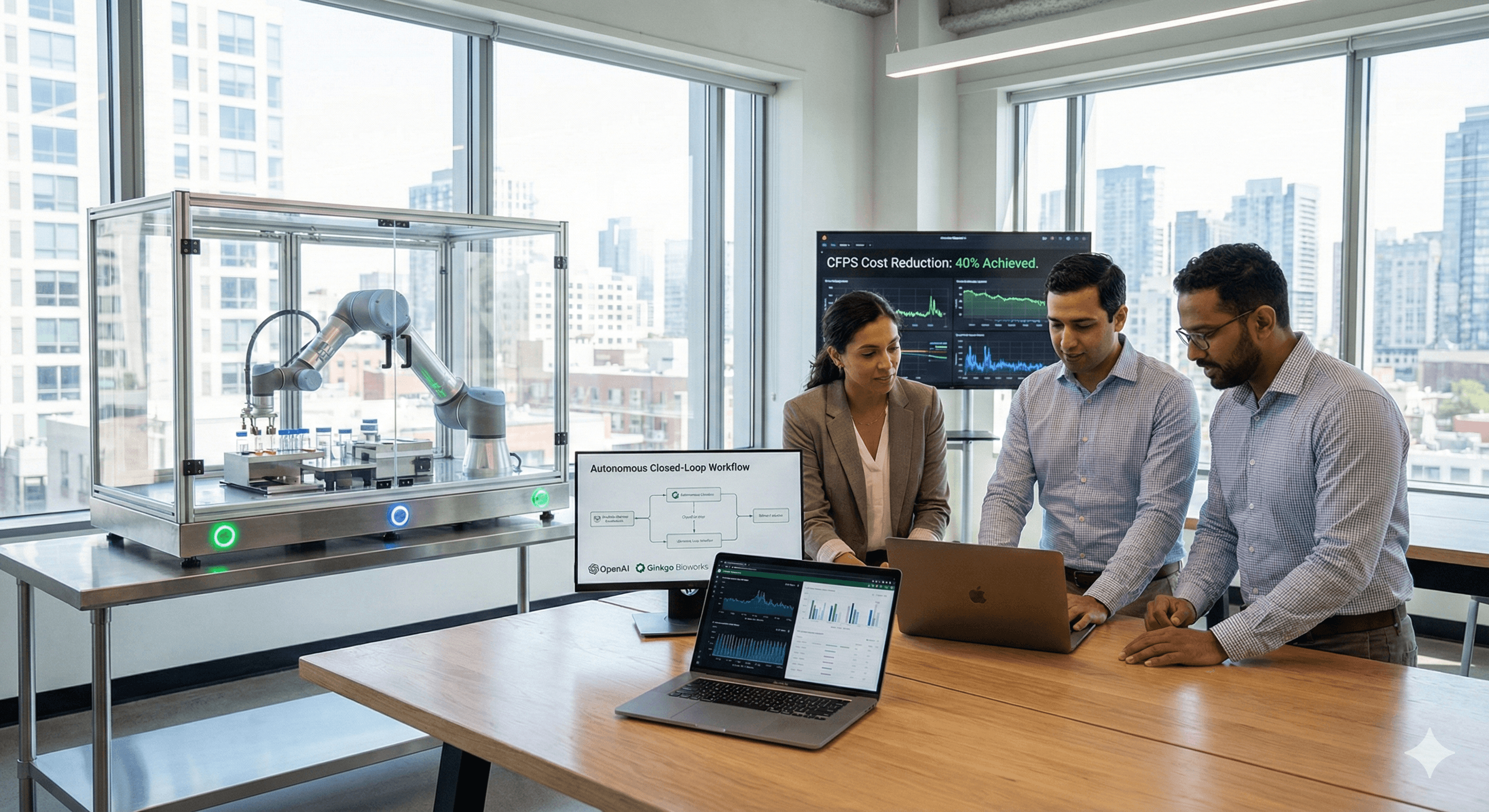
A team of professionals collaborates in a modern office featuring advanced technology, including a robotic arm and laptops displaying graphs and charts, with a city skyline visible through large windows, illustrating innovative AI solutions and cost efficiency.

Not sure what to do next with AI?
Assess readiness, risk, and priorities in under an hour.

Not sure what to do next with AI?
Assess readiness, risk, and priorities in under an hour.

➔ Schedule a Consultation

OpenAI and Ginkgo Bioworks used GPT‑5 to run closed‑loop autonomous experiments that reduced cell‑free protein synthesis (CFPS) reaction component costs by 40%. By repeatedly designing, executing, analysing, and refining experiments through a cloud laboratory workflow, the system improved cost efficiency with minimal human intervention.

Cell‑free protein synthesis (CFPS) is a powerful way to produce proteins without relying on living cells — but it can be expensive and fiddly to optimise. That’s why the recent OpenAI–Ginkgo Bioworks collaboration is worth paying attention to.

In a GPT‑5–driven closed‑loop setup, the team reports a 40% reduction in CFPS reaction component costs against a state‑of‑the‑art benchmark — achieved through autonomous experimentation at meaningful scale.

Why this matters now

Biotech and life sciences teams often face a similar bottleneck: they can generate hypotheses quickly, but experimentation is slow and costly. Closed‑loop autonomous labs are designed to change that by connecting three things:

  • A reasoning system that proposes experiments

  • A lab automation layer that executes them

  • A feedback loop that turns results into the next (better) set of experiments

If you can do that reliably, you can compress weeks of iteration into days — and remove a lot of manual trial-and-error.

What’s new: closed‑loop experimentation with GPT‑5 + a cloud lab

This work brings GPT‑5 into the experimental workflow as the “cognitive layer” that:

  1. Designs experiments (selecting conditions, compositions, and exploration strategy)

  2. Interprets results (identifying what changed and why it worked)

  3. Refines the plan (proposing the next round of experiments)

Ginkgo’s cloud lab infrastructure provides the physical execution layer — running the experimental plates, collecting measurements, and returning data for the next iteration.

The headline result (and what it means)

The reported outcome is a 40% reduction in CFPS reaction component costs, achieved by discovering improved reaction compositions that are better suited to autonomous lab conditions.

For enterprise teams, the practical takeaway is less about one protein recipe and more about the pattern:

  • Define a clear benchmark

  • Run rapid, automated iteration

  • Optimise against a measurable objective (here: cost)

  • Let the system learn from real data in loops

Practical examples

Example 1: Automated optimisation trials
A team defines a target output (yield, stability, cost, or purity). The model proposes conditions, the lab runs them, and the next cycle is guided by the results.

Example 2: Real‑time efficiency adjustments
As results come back, the system changes its exploration strategy — narrowing in on promising regions of the parameter space or testing robustness under different lab conditions.

What this doesn’t mean (important guardrail)

This isn’t “AI replaces scientists”. In practice, autonomous closed‑loop work still requires:

  • Well‑defined goals and constraints

  • Human oversight for safety, quality, and interpretation

  • Proper experimental design and validation

  • Governance around what the system can run and when

What to do if you want to explore autonomous experimentation

If you’re considering this approach, start with a constrained problem:

  1. Choose a high‑cost or high‑friction optimisation task

  2. Establish a benchmark and success metrics

  3. Build a small closed‑loop pilot with clear guardrails

  4. Measure impact (cost, time-to-result, reproducibility)

  5. Scale only once you can audit decisions and outcomes

Summary & next steps

A 40% reduction in CFPS reaction component costs is a compelling demonstration of what agentic AI + automation + feedback loops can deliver in the physical sciences. The bigger story is the operating model: repeatable, data‑driven optimisation at scale.

Next step: If you want help scoping a closed‑loop pilot, building governance, or identifying the right automation + AI workflow, speak to Generation Digital.

FAQs

Q1: What is cell‑free protein synthesis?

Cell‑free protein synthesis (CFPS) is a method for producing proteins outside living cells, using a biochemical reaction mix. It’s widely used in research and industrial workflows when speed and controllability matter.

Q2: How does GPT‑5 contribute to cost reduction?

GPT‑5 can propose and refine experiment designs in cycles, learning from results and focusing tests on the most promising conditions. In a closed‑loop setup, this reduces manual trial-and-error and speeds optimisation.

Q3: What role does Ginkgo Bioworks play?

Ginkgo provides the cloud laboratory and automation infrastructure that executes experiments at scale, captures measurements, and returns data so the system can iterate.

Q4: Is the 40% figure about total cost or reagents?

The reported headline improvement is a 40% reduction in reaction component costs under the benchmark conditions. The work also reports a larger improvement in certain reagent cost metrics.

OpenAI and Ginkgo Bioworks used GPT‑5 to run closed‑loop autonomous experiments that reduced cell‑free protein synthesis (CFPS) reaction component costs by 40%. By repeatedly designing, executing, analysing, and refining experiments through a cloud laboratory workflow, the system improved cost efficiency with minimal human intervention.

Cell‑free protein synthesis (CFPS) is a powerful way to produce proteins without relying on living cells — but it can be expensive and fiddly to optimise. That’s why the recent OpenAI–Ginkgo Bioworks collaboration is worth paying attention to.

In a GPT‑5–driven closed‑loop setup, the team reports a 40% reduction in CFPS reaction component costs against a state‑of‑the‑art benchmark — achieved through autonomous experimentation at meaningful scale.

Why this matters now

Biotech and life sciences teams often face a similar bottleneck: they can generate hypotheses quickly, but experimentation is slow and costly. Closed‑loop autonomous labs are designed to change that by connecting three things:

  • A reasoning system that proposes experiments

  • A lab automation layer that executes them

  • A feedback loop that turns results into the next (better) set of experiments

If you can do that reliably, you can compress weeks of iteration into days — and remove a lot of manual trial-and-error.

What’s new: closed‑loop experimentation with GPT‑5 + a cloud lab

This work brings GPT‑5 into the experimental workflow as the “cognitive layer” that:

  1. Designs experiments (selecting conditions, compositions, and exploration strategy)

  2. Interprets results (identifying what changed and why it worked)

  3. Refines the plan (proposing the next round of experiments)

Ginkgo’s cloud lab infrastructure provides the physical execution layer — running the experimental plates, collecting measurements, and returning data for the next iteration.

The headline result (and what it means)

The reported outcome is a 40% reduction in CFPS reaction component costs, achieved by discovering improved reaction compositions that are better suited to autonomous lab conditions.

For enterprise teams, the practical takeaway is less about one protein recipe and more about the pattern:

  • Define a clear benchmark

  • Run rapid, automated iteration

  • Optimise against a measurable objective (here: cost)

  • Let the system learn from real data in loops

Practical examples

Example 1: Automated optimisation trials
A team defines a target output (yield, stability, cost, or purity). The model proposes conditions, the lab runs them, and the next cycle is guided by the results.

Example 2: Real‑time efficiency adjustments
As results come back, the system changes its exploration strategy — narrowing in on promising regions of the parameter space or testing robustness under different lab conditions.

What this doesn’t mean (important guardrail)

This isn’t “AI replaces scientists”. In practice, autonomous closed‑loop work still requires:

  • Well‑defined goals and constraints

  • Human oversight for safety, quality, and interpretation

  • Proper experimental design and validation

  • Governance around what the system can run and when

What to do if you want to explore autonomous experimentation

If you’re considering this approach, start with a constrained problem:

  1. Choose a high‑cost or high‑friction optimisation task

  2. Establish a benchmark and success metrics

  3. Build a small closed‑loop pilot with clear guardrails

  4. Measure impact (cost, time-to-result, reproducibility)

  5. Scale only once you can audit decisions and outcomes

Summary & next steps

A 40% reduction in CFPS reaction component costs is a compelling demonstration of what agentic AI + automation + feedback loops can deliver in the physical sciences. The bigger story is the operating model: repeatable, data‑driven optimisation at scale.

Next step: If you want help scoping a closed‑loop pilot, building governance, or identifying the right automation + AI workflow, speak to Generation Digital.

FAQs

Q1: What is cell‑free protein synthesis?

Cell‑free protein synthesis (CFPS) is a method for producing proteins outside living cells, using a biochemical reaction mix. It’s widely used in research and industrial workflows when speed and controllability matter.

Q2: How does GPT‑5 contribute to cost reduction?

GPT‑5 can propose and refine experiment designs in cycles, learning from results and focusing tests on the most promising conditions. In a closed‑loop setup, this reduces manual trial-and-error and speeds optimisation.

Q3: What role does Ginkgo Bioworks play?

Ginkgo provides the cloud laboratory and automation infrastructure that executes experiments at scale, captures measurements, and returns data so the system can iterate.

Q4: Is the 40% figure about total cost or reagents?

The reported headline improvement is a 40% reduction in reaction component costs under the benchmark conditions. The work also reports a larger improvement in certain reagent cost metrics.

Receive practical advice directly in your inbox

By subscribing, you agree to allow Generation Digital to store and process your information according to our privacy policy. You can review the full policy at gend.co/privacy.


AI Integration Resources & How-To Guides for Canadian Businesses

A diverse group of professionals collaborating around a table in a bright, modern office setting.

Maximizing the Benefits of Miro AI for Canadian Businesses

In-Person Workshop
November 5, 2025
Toronto, Canada

A diverse group of professionals collaborating around a table in a bright, modern office setting.

Work With AI Teammates - Asana

In-Person Workshop
Thurs 26th February 2026
London, UK

A diverse group of professionals collaborating around a table in a bright, modern office setting.

From Idea to Prototype - AI in Miro

Virtual Webinar
Weds 18th February 2026
Online

Generation
Digital

Canadian Office
33 Queen St,
Toronto
M5H 2N2
Canada

Canadian Office
1 University Ave,
Toronto,
ON M5J 1T1,
Canada

NAMER Office
77 Sands St,
Brooklyn,
NY 11201,
USA

Head Office
Charlemont St, Saint Kevin's, Dublin,
D02 VN88,
Ireland

Middle East Office
6994 Alsharq 3890,
An Narjis,
Riyadh 13343,
Saudi Arabia

UK Fast Growth Index UBS Logo
Financial Times FT 1000 Logo
Febe Growth 100 Logo (Background Removed)

Business Number: 256 9431 77 | Copyright 2026 | Terms and Conditions | Privacy Policy

Generation
Digital

Canadian Office
33 Queen St,
Toronto
M5H 2N2
Canada

Canadian Office
1 University Ave,
Toronto,
ON M5J 1T1,
Canada

NAMER Office
77 Sands St,
Brooklyn,
NY 11201,
USA

Head Office
Charlemont St, Saint Kevin's, Dublin,
D02 VN88,
Ireland

Middle East Office
6994 Alsharq 3890,
An Narjis,
Riyadh 13343,
Saudi Arabia

UK Fast Growth Index UBS Logo
Financial Times FT 1000 Logo
Febe Growth 100 Logo (Background Removed)


Business No: 256 9431 77
Terms and Conditions
Privacy Policy
© 2026




