Scale AI in Manufacturing: COO Playbook for Performance (2026)

Scale AI in Manufacturing: COO Playbook for Performance (2026)

AI

Dec 15, 2025

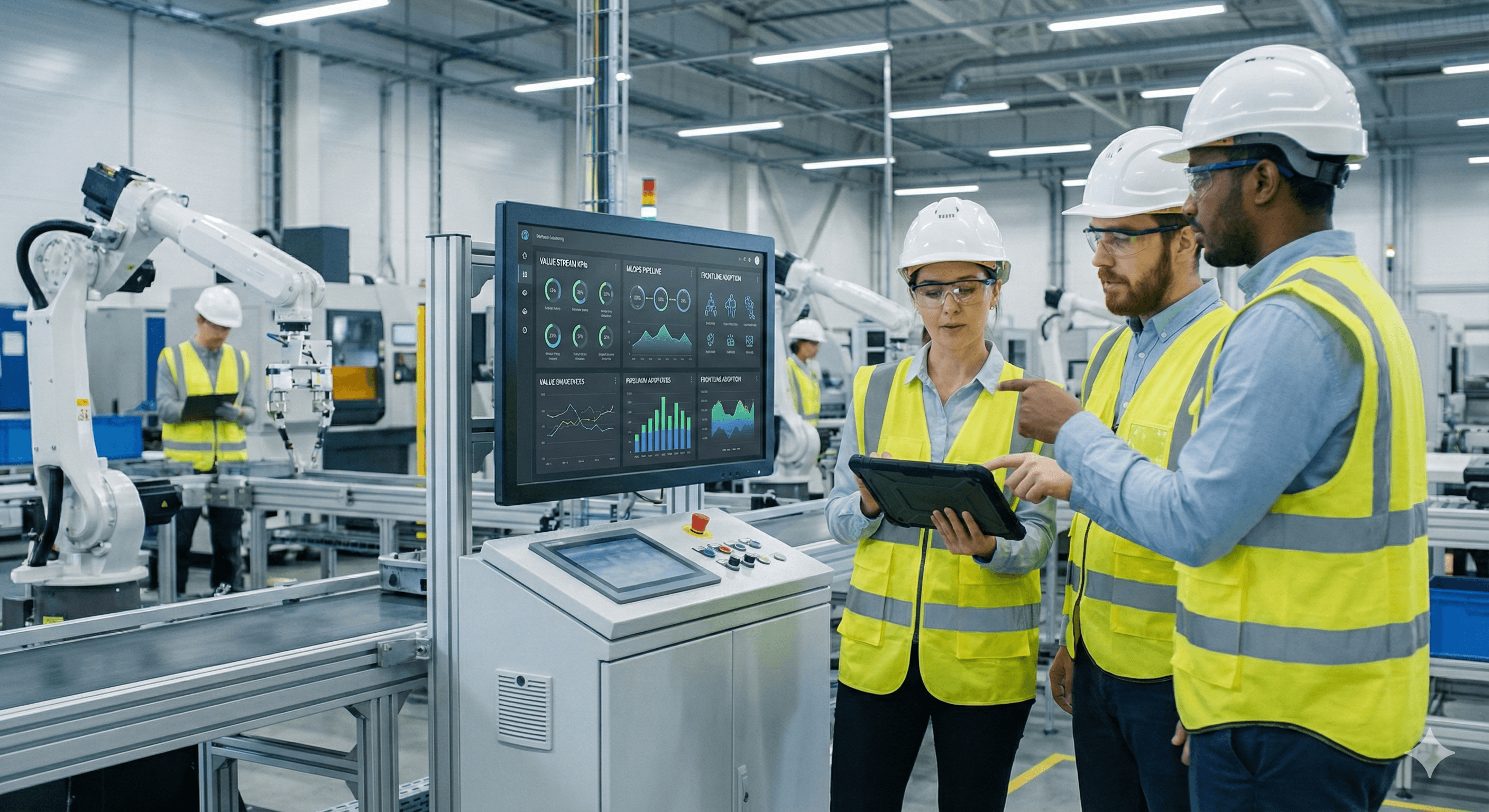
In a modern factory setting, three engineers wearing safety helmets and vests discuss data displayed on a tablet and monitor, with a robotic arm operating in the background, highlighting the integration of AI in manufacturing processes.

The COO thesis: value comes from the enablers, not the demo

The COO100 Survey is unequivocal: manufacturing leaders are funding AI at scale, yet many are underinvesting in the foundations required for durable impact—precisely why pilots stall and savings evaporate after year one. Treat AI like a production process: capability, control, cadence.

What changes in 2026

Two realities converge. First, boards expect plant-level productivity and quality gains to show up in the P&L, not just in slideware. Second, the firms that do report returns look different in their operating model and enablers—data pipelines tied to the line, hardened MLOps, frontline adoption rituals, and governance that funds by value stream, not tool.

To scale AI in manufacturing, COOs must over-index on enablers: data/OT connectivity, MLOps, cross-functional operating models, and frontline adoption. The McKinsey COO100 survey finds high AI budgets but underinvestment in these foundations—explaining why pilots rarely become plant-wide performance. Make the enablers the programme.

From pilots to performance: five COO choices

1) Fund by value stream, not use case.
Stop scattering budgets across isolated “wins.” Finance a target value stream (e.g., packaging OEE or FPY) and bind all models, data work, and change activities to those KPIs. Leaders that scale AI organise around strategy, talent, operating model, tech, data, and adoption—and measure at that level.

2) Industrialise the data layer at the line.
Make the boring work non-negotiable: sensor quality, historian access, semantic models for equipment, and governed feature stores. If data aren’t production-grade, neither are the models. (This is the most common underinvestment the survey flags.)

3) Treat models like assets: MLOps for OT.
Standardise deployment to edge and cloud, implement drift monitoring, rollback, and change control that your plant managers trust. Tie model releases to maintenance windows like any other asset change. High performers do this as routine.

4) Put adoption on the Gemba.
Shift improvement rituals (stand-ups, tiered meetings) to use AI insights by default—quality alerts, predicted downtime, energy anomalies—so operators pull the tools, not endure them. Adoption is a management system, not a comms plan.

5) Govern for scale, not permission.
Create an AI control tower that owns the backlog, squashes duplication, and retires models that don’t earn their keep. Fund experiments, but graduate only those with verified impact on throughput, yield, cost-to-serve, and safety.

What good looks like on the factory floor

  • OEE, FPY, and MTBF move together, not in isolation—because models are embedded in maintenance, quality, and planning workflows, not just dashboards.

  • Cycle of learning every two weeks: new data, retrain, redeploy, verify; models are treated like equipment—maintained, audited, and replaced when obsolete.

  • Enterprise-wide reuse: one playbook for vision QA or energy optimisation, replicated to similar lines/plants with 80% common components.

(UK note: adoption is accelerating; the UK now leads Europe on smart-manufacturing AI penetration—evidence the ecosystem is ready if enablers are in place.)

FAQs

Q1: What is the primary benefit of AI in manufacturing?
When scaled through the enablers, AI lifts yield, throughput and energy efficiency simultaneously—showing up in OEE, FPY and cost per unit, not just in pilot anecdotes. McKinsey & Company

Q2: Why do companies underinvest in enablers?
Because use-cases are visible and fundable, while data plumbing, MLOps and change management feel like overhead. The COO100 warns this is exactly what kills durability. McKinsey & Company

Q3: How can COOs ensure successful scaling?
Run AI like a production programme: value-stream funding, hardened data/OT, disciplined MLOps, and adoption rituals on the shop floor. Govern with a single backlog and retire what doesn’t deliver. McKinsey & Company

Software Options

  • Asana for value-stream OKRs and cross-plant release trains.

  • Miro for mapping line-level data and failure modes.

  • Notion for standard work, playbooks, and model runbooks.

  • Glean for permissioned access to engineering knowledge.

Next Steps?

Ready to turn pilots into performance? Generation Digital helps COOs stand up the AI enablers—data to Gemba—and build the operating model that scales across plants.

The COO thesis: value comes from the enablers, not the demo

The COO100 Survey is unequivocal: manufacturing leaders are funding AI at scale, yet many are underinvesting in the foundations required for durable impact—precisely why pilots stall and savings evaporate after year one. Treat AI like a production process: capability, control, cadence.

What changes in 2026

Two realities converge. First, boards expect plant-level productivity and quality gains to show up in the P&L, not just in slideware. Second, the firms that do report returns look different in their operating model and enablers—data pipelines tied to the line, hardened MLOps, frontline adoption rituals, and governance that funds by value stream, not tool.

To scale AI in manufacturing, COOs must over-index on enablers: data/OT connectivity, MLOps, cross-functional operating models, and frontline adoption. The McKinsey COO100 survey finds high AI budgets but underinvestment in these foundations—explaining why pilots rarely become plant-wide performance. Make the enablers the programme.

From pilots to performance: five COO choices

1) Fund by value stream, not use case.
Stop scattering budgets across isolated “wins.” Finance a target value stream (e.g., packaging OEE or FPY) and bind all models, data work, and change activities to those KPIs. Leaders that scale AI organise around strategy, talent, operating model, tech, data, and adoption—and measure at that level.

2) Industrialise the data layer at the line.
Make the boring work non-negotiable: sensor quality, historian access, semantic models for equipment, and governed feature stores. If data aren’t production-grade, neither are the models. (This is the most common underinvestment the survey flags.)

3) Treat models like assets: MLOps for OT.
Standardise deployment to edge and cloud, implement drift monitoring, rollback, and change control that your plant managers trust. Tie model releases to maintenance windows like any other asset change. High performers do this as routine.

4) Put adoption on the Gemba.
Shift improvement rituals (stand-ups, tiered meetings) to use AI insights by default—quality alerts, predicted downtime, energy anomalies—so operators pull the tools, not endure them. Adoption is a management system, not a comms plan.

5) Govern for scale, not permission.
Create an AI control tower that owns the backlog, squashes duplication, and retires models that don’t earn their keep. Fund experiments, but graduate only those with verified impact on throughput, yield, cost-to-serve, and safety.

What good looks like on the factory floor

  • OEE, FPY, and MTBF move together, not in isolation—because models are embedded in maintenance, quality, and planning workflows, not just dashboards.

  • Cycle of learning every two weeks: new data, retrain, redeploy, verify; models are treated like equipment—maintained, audited, and replaced when obsolete.

  • Enterprise-wide reuse: one playbook for vision QA or energy optimisation, replicated to similar lines/plants with 80% common components.

(UK note: adoption is accelerating; the UK now leads Europe on smart-manufacturing AI penetration—evidence the ecosystem is ready if enablers are in place.)

FAQs

Q1: What is the primary benefit of AI in manufacturing?
When scaled through the enablers, AI lifts yield, throughput and energy efficiency simultaneously—showing up in OEE, FPY and cost per unit, not just in pilot anecdotes. McKinsey & Company

Q2: Why do companies underinvest in enablers?
Because use-cases are visible and fundable, while data plumbing, MLOps and change management feel like overhead. The COO100 warns this is exactly what kills durability. McKinsey & Company

Q3: How can COOs ensure successful scaling?
Run AI like a production programme: value-stream funding, hardened data/OT, disciplined MLOps, and adoption rituals on the shop floor. Govern with a single backlog and retire what doesn’t deliver. McKinsey & Company

Software Options

  • Asana for value-stream OKRs and cross-plant release trains.

  • Miro for mapping line-level data and failure modes.

  • Notion for standard work, playbooks, and model runbooks.

  • Glean for permissioned access to engineering knowledge.

Next Steps?

Ready to turn pilots into performance? Generation Digital helps COOs stand up the AI enablers—data to Gemba—and build the operating model that scales across plants.

Get practical advice delivered to your inbox

By subscribing you consent to Generation Digital storing and processing your details in line with our privacy policy. You can read the full policy at gend.co/privacy.

Ready to get the support your organization needs to successfully use AI?

Miro Solutions Partner
Asana Platinum Solutions Partner
Notion Platinum Solutions Partner
Glean Certified Partner

Ready to get the support your organization needs to successfully use AI?

Miro Solutions Partner
Asana Platinum Solutions Partner
Notion Platinum Solutions Partner
Glean Certified Partner

Generation
Digital

Canadian Office
33 Queen St,
Toronto
M5H 2N2
Canada

Canadian Office
1 University Ave,
Toronto,
ON M5J 1T1,
Canada

NAMER Office
77 Sands St,
Brooklyn,
NY 11201,
USA

Head Office
Charlemont St, Saint Kevin's, Dublin,
D02 VN88,
Ireland

Middle East Office
6994 Alsharq 3890,
An Narjis,
Riyadh 13343,
Saudi Arabia
UK Fast Growth Index UBS Logo
Financial Times FT 1000 Logo
Febe Growth 100 Logo (Background Removed)

Business Number: 256 9431 77 | Copyright 2026 | Terms and Conditions | Privacy Policy

Generation
Digital

Canadian Office
33 Queen St,
Toronto
M5H 2N2
Canada

Canadian Office
1 University Ave,
Toronto,
ON M5J 1T1,
Canada

NAMER Office
77 Sands St,
Brooklyn,
NY 11201,
USA

Head Office
Charlemont St, Saint Kevin's, Dublin,
D02 VN88,
Ireland

Middle East Office
6994 Alsharq 3890,
An Narjis,
Riyadh 13343,
Saudi Arabia

UK Fast Growth Index UBS Logo
Financial Times FT 1000 Logo
Febe Growth 100 Logo (Background Removed)


Business No: 256 9431 77
Terms and Conditions
Privacy Policy
© 2026