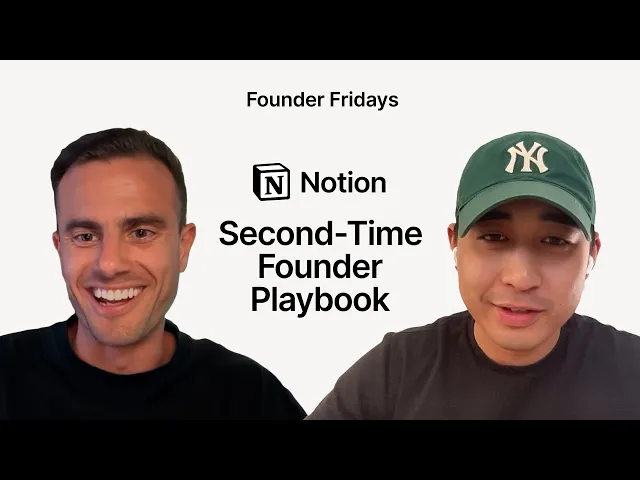
Second-Time Founders: Lessons from Frank Greeff (Kinso)

Second-Time Founders: Lessons from Frank Greeff (Kinso)

Conceptual

Jan 23, 2026

Two people are engaged in a discussion at a table in a modern, open office space with large windows and several colleagues working in the background.

Not sure what to do next with AI?
Assess readiness, risk, and priorities in under an hour.

Not sure what to do next with AI?
Assess readiness, risk, and priorities in under an hour.

➔ Schedule a Consultation

After a $180m exit with Realbase, Kinso co-founder Frank Greeff shows how second-time founders move faster: reuse playbooks, hire earlier for gaps, ship small but often, and apply stricter capital discipline. With a deeper network and clearer focus, they prioritise sustainable growth over vanity metrics.

Why this matters now

Frank and his brother Jacques sold Realbase to Domain Group (2022) and later left to build Kinso, an AI messaging and workflow app. Their “build again” journey gives rare, first-hand guidance on what changes the second time: standards, speed, and the quality of decisions.

Three advantages second-time founders can lean on

1) Execution over ideas

Frank repeatedly emphasises that outcomes come from relentless execution, not pristine ideas—refining in public via short, testable releases. Use weekly demo cadence and kill work that doesn’t move the metric.

Do this next

  • Set a ship-something-weekly rule (even internally).

  • Track “time-to-first-signal” and cut experiments that miss two consecutive targets.

2) Hiring the right gaps, earlier

With clearer self-awareness the second time, you hire for your weaknesses (e.g., ops, data, brand) and avoid over-indexing on generalists. Frank highlights bringing in senior technical leadership early to attract top talent.

Do this next

  • Map founder strengths vs. business needs; open roles for the bottom-three gaps now.

  • Give leaders problem-shaped charters (not role-shaped job descriptions).

3) Capital discipline and sustainable pace

Post-exit perspective tightens spend and focuses on durable compounding—choosing sustainable growth over blitz scaling. Document “why now” for every programme and cap burn per hypothesis.

Do this next

  • Require a one-page investment memo (goal, metric, spend, kill-criteria) before any new initiative.

  • Review run-rate monthly; sunset low-leverage activities quickly.

What’s new or how it works (Kinso context)

Kinso is built as an “AI executive assistant” for messages, calendars and email—born from the founders’ own pain with fragmented communication while scaling prior ventures. It’s a clean example of using lived founder constraints to shape product scope and sequencing.

Practical steps (apply Frank’s playbook)

  1. Reflect with receipts
    Write a two-page post-mortem of your first venture: three decisions you’d repeat; three you wouldn’t; the patterns behind both. Socialise with mentors for blind-spot checks. (Frank shares lessons publicly across podcasts and posts.)

  2. Network to unlock speed
    Use your second-time network for senior hires, distribution and vendor rates. Pre-book a six-week pipeline of candidate and partner conversations before launch. (Frank leverages a visible founder platform and content.)

  3. Founder calendars as product strategy
    Audit your own week; remove recurring tasks that software could do. Prioritise features that return time to founders/operators—as Kinso’s focus illustrates.

  4. Guardrails from day one
    Bake governance (SSO, audit logs, data boundaries) into early releases so you can sell to mid-market/enterprise sooner—another second-time efficiency.

FAQs

Q1: How do second-time founders differ from first-timers?
They ship faster with tighter scopes, hire earlier for gaps, and apply stronger capital and time discipline—benefits of scar tissue and networks built in the first venture.

Q2: What is the single biggest advantage?
A compounding network: faster access to talent, distribution and advice—plus credibility with partners and press. (See coverage and community around Frank’s post-exit journey.)

Q3: How can second-time founders ensure success?
Stay adaptable, run short learning cycles, and keep sustainability front-and-centre. Formalise kill-criteria and review them monthly to avoid zombie projects.

Next Steps

Want a second-time founder operating system—ship cadence, hiring scorecards, and investment memos—in your team? Contact Generation Digital for a 30-day rollout.

After a $180m exit with Realbase, Kinso co-founder Frank Greeff shows how second-time founders move faster: reuse playbooks, hire earlier for gaps, ship small but often, and apply stricter capital discipline. With a deeper network and clearer focus, they prioritise sustainable growth over vanity metrics.

Why this matters now

Frank and his brother Jacques sold Realbase to Domain Group (2022) and later left to build Kinso, an AI messaging and workflow app. Their “build again” journey gives rare, first-hand guidance on what changes the second time: standards, speed, and the quality of decisions.

Three advantages second-time founders can lean on

1) Execution over ideas

Frank repeatedly emphasises that outcomes come from relentless execution, not pristine ideas—refining in public via short, testable releases. Use weekly demo cadence and kill work that doesn’t move the metric.

Do this next

  • Set a ship-something-weekly rule (even internally).

  • Track “time-to-first-signal” and cut experiments that miss two consecutive targets.

2) Hiring the right gaps, earlier

With clearer self-awareness the second time, you hire for your weaknesses (e.g., ops, data, brand) and avoid over-indexing on generalists. Frank highlights bringing in senior technical leadership early to attract top talent.

Do this next

  • Map founder strengths vs. business needs; open roles for the bottom-three gaps now.

  • Give leaders problem-shaped charters (not role-shaped job descriptions).

3) Capital discipline and sustainable pace

Post-exit perspective tightens spend and focuses on durable compounding—choosing sustainable growth over blitz scaling. Document “why now” for every programme and cap burn per hypothesis.

Do this next

  • Require a one-page investment memo (goal, metric, spend, kill-criteria) before any new initiative.

  • Review run-rate monthly; sunset low-leverage activities quickly.

What’s new or how it works (Kinso context)

Kinso is built as an “AI executive assistant” for messages, calendars and email—born from the founders’ own pain with fragmented communication while scaling prior ventures. It’s a clean example of using lived founder constraints to shape product scope and sequencing.

Practical steps (apply Frank’s playbook)

  1. Reflect with receipts
    Write a two-page post-mortem of your first venture: three decisions you’d repeat; three you wouldn’t; the patterns behind both. Socialise with mentors for blind-spot checks. (Frank shares lessons publicly across podcasts and posts.)

  2. Network to unlock speed
    Use your second-time network for senior hires, distribution and vendor rates. Pre-book a six-week pipeline of candidate and partner conversations before launch. (Frank leverages a visible founder platform and content.)

  3. Founder calendars as product strategy
    Audit your own week; remove recurring tasks that software could do. Prioritise features that return time to founders/operators—as Kinso’s focus illustrates.

  4. Guardrails from day one
    Bake governance (SSO, audit logs, data boundaries) into early releases so you can sell to mid-market/enterprise sooner—another second-time efficiency.

FAQs

Q1: How do second-time founders differ from first-timers?
They ship faster with tighter scopes, hire earlier for gaps, and apply stronger capital and time discipline—benefits of scar tissue and networks built in the first venture.

Q2: What is the single biggest advantage?
A compounding network: faster access to talent, distribution and advice—plus credibility with partners and press. (See coverage and community around Frank’s post-exit journey.)

Q3: How can second-time founders ensure success?
Stay adaptable, run short learning cycles, and keep sustainability front-and-centre. Formalise kill-criteria and review them monthly to avoid zombie projects.

Next Steps

Want a second-time founder operating system—ship cadence, hiring scorecards, and investment memos—in your team? Contact Generation Digital for a 30-day rollout.

Receive practical advice directly in your inbox

By subscribing, you agree to allow Generation Digital to store and process your information according to our privacy policy. You can review the full policy at gend.co/privacy.


Are you ready to get the support your organization needs to successfully leverage AI?

Miro Solutions Partner
Asana Platinum Solutions Partner
Notion Platinum Solutions Partner
Glean Certified Partner

Ready to get the support your organization needs to successfully use AI?

Miro Solutions Partner
Asana Platinum Solutions Partner
Notion Platinum Solutions Partner
Glean Certified Partner

Generation
Digital

Canadian Office
33 Queen St,
Toronto
M5H 2N2
Canada

Canadian Office
1 University Ave,
Toronto,
ON M5J 1T1,
Canada

NAMER Office
77 Sands St,
Brooklyn,
NY 11201,
USA

Head Office
Charlemont St, Saint Kevin's, Dublin,
D02 VN88,
Ireland

Middle East Office
6994 Alsharq 3890,
An Narjis,
Riyadh 13343,
Saudi Arabia

UK Fast Growth Index UBS Logo
Financial Times FT 1000 Logo
Febe Growth 100 Logo (Background Removed)

Business Number: 256 9431 77 | Copyright 2026 | Terms and Conditions | Privacy Policy

Generation
Digital

Canadian Office
33 Queen St,
Toronto
M5H 2N2
Canada

Canadian Office
1 University Ave,
Toronto,
ON M5J 1T1,
Canada

NAMER Office
77 Sands St,
Brooklyn,
NY 11201,
USA

Head Office
Charlemont St, Saint Kevin's, Dublin,
D02 VN88,
Ireland

Middle East Office
6994 Alsharq 3890,
An Narjis,
Riyadh 13343,
Saudi Arabia

UK Fast Growth Index UBS Logo
Financial Times FT 1000 Logo
Febe Growth 100 Logo (Background Removed)


Business No: 256 9431 77
Terms and Conditions
Privacy Policy
© 2026





